Tuesday, October 17, 2017

First Frost

How it Used to Look Mid-October

First frost. Three a.m. this morning, I stepped out barefoot, walked across the lot free of neighbors who might ogle at my folly, and touched ice outdoors for the first time since early in the year. Car tops stitched with tiny frozen patterns. I sat on a curb facing northeast and the sky overhead invited me in as it hasn't in a long time. Simple and spontaneous as looking up and getting admitted free of charge. Inside on the couch, I had been reading Gray's Sporting Journal, a bulwark of sanity against a world that forgets where it is, and forgets that the most basic requirement for living here, besides water and breath, is capturing food and sheltering oneself in the pursuit.

Someone has to do it. Most of us think farmers.

But here's a twist. Gray's is devoted to the word as much as it is to the sport. The name of the magazine doesn't leave out the word journal. Anyone can believe farmers are enough for everyone's dietary need, but only fools believe language should be limited to reflect such systematization as agriculture. Word--for human beings--is as important as food. And funny thing, isn't it, that romancing farm life might lose something--no, not always, necessarily...think of Wendel Berry, perhaps--to sentimentality, compared to reflections of the wild.

Don't mistake romance as escape writing, if you follow what I mean. I think some of the best is gritty with arduously labored detail coming from strenuous first-hand experience. Realism and romance unite in writing difficult to read, requiring time and absorption. Difficult outdoor experience demands the same.


After posting last night, I went into edit function and added what, at first, I felt would be most important to the text, which, when first composing, I completely forgot: green foliage. I subsequently riffed on climate change, but here's more.

I've felt disgusted at right-wing denial of global warming, for years. I thought this a denial of science. Now I think the right, or the denial-laden of any ideological disease, are not religious enough. We used to hear so much huff and puff about The Bible. Now I consider that if the same sort as believe in "God's word" also believe (suddenly we don't hear much of the likes) Global Warming is a false idea, then they don't know how to read The Bible, perhaps.

What was God always doing to the Jews, when they went astray? Biting them in the ass, so to speak, and in response, at least in some of the stories, if I recall rightly, the Jews firmed up. Who wouldn't when getting chomped on at the rear?

Now supposedly, Jesus made redemption universal, so the wrathful antics of a jealous God are done and over with. This might imply sweet nectar from the front side of the human form, but it is a most naïve belief, unless it's understood that this redemption is an ongoing and historical process. Anyone who has worked a tough job in any economy of the past 2000 years knows damn well that The Kingdom of God did not supplant the human condition upon Jesus's crucifixion. The symbolic event of the life of Jesus Christ--and I do not deny its importance, on the contrary--is potential, not actuality. And on that point of Christ's importance, a simple consideration might do. Think of his life. If you don't know about it, you can Google information, if you want to. Anyone of that repressive society (at least more so than ours is repressive) of Christ's time, and who would have lived as Jesus lived for three years before he gut busted, anyone who would have done that would have been a monumental genius.

That said. What about God. Does "He" still compensate in the negative for our excesses. Read the Lessons of History. (The title adorns more than one book.) History never gets over itself. Always pride comes before a fall. Our scientific and technological achievement is the greatest pride mankind has ever known.

As I put it last night. Kudos to all who have done it and still do. Pride is the crowning virtue. Most Christians might not agree this is true, but my opinion differs. Pride and power. And power implies responsibility. So now that it is payback time, we must pick up the mess. Make something that works differently, just as the Scientific Revolution 400 years ago was a proposal to work and produce differently.

Monday, October 16, 2017

October River Smallmouths


Behr's Bait on U.S. 22, Lebanon. Note on the door: "Out getting bait."

So we rode eastward to The Sporting Life. Closed Mondays. On the way to Sportsman's Rendevous in Flemington, Mike told me this place is going out of business....but he had phoned them a week ago and got an answer. We found the store open with virtually nothing left on shelves and in racks or anywhere else. We took two dozen shiners, just about all they had left, and I bought some lures I might need this coming spring and summer, the lures at 50% off. 

"Sorry you're going out of business," I told the man who I think is the owner.

"Just how it goes," he said. He was cheerful in the way a retiree who's lived well might let the past go.

"You were always our old reliable when Behr's was closed," I said. 

And some of those runs from Behr's way out to Flemington involved an extra 45 minutes at the least tagged onto a trip to Round Valley Reservoir, which is right around the corner from Behr's, but 20 minutes from Flemington, far to the west of Bedminster, also.

I hate to think of what might happen with The Sportsman's Rendevous gone, but at least The Sporting Life--a new store--should usually back for up Behr's. In any event, today, I would hope, is unique, except the fact is: climate change is only ramping up towards a very uncertain future. The landscape looked like South Carolina appeared on November 6th just three years ago. True, it is only October 16th, but never before in New Jersey has an October 16th appeared so green. As Cushetunk Mountains appeared on the approach to Behr's, I felt that sort of awe mixed with horror; an inchoate suspicion colored my response as if we might be in for more than a simple adjustment to warmer temperatures. Those mountains are green. Some of the trees are an off green, but far and away, they are green, no orange and red at all, and very little, only slight, yellow. 

After we left the Flemington store with the bucket half full of water and bait, I hooked a right, instead of a left, and wound up way off course for Neshanic...thinking instead of Round Valley. But we got to our spot after driving forever, and passing Stanton General Store where Mike used to buy breakfast as a cable installer. 

"That place has the best blueberry muffins. We used to get them fresh out of the oven, cut in half and buttered."

Valuable to know, whether or not I'll ever be in the vicinity of this place in the morning. And, if so, have time to stop. In itself, the character of Highlands culture and society is interesting to learn about, because it's the backyard of any Central Jersey citizen with enough gumption to explore and patronize what's there. Or in other words, what can make for a life. And whatever our future as a society, I believe we can manage to maintain forms of the good life; we will, that is, if we survive as a civilization, and I certainly see no reason not to believe we will. The issue is simple in the following way: what did we do, beginning with the Scientific Revolution 400 years ago and subsequent technology? We discovered much of nature's order, to challenge nature's dominance over us. OK. Very well, kudos to success all around, but now nature will challenge us in turn. Rise to it. It's just a classic situation of hubris resulting in a firm bite on the ass. As human beings, we can get over the likes. We have intelligence and will, which, for example, a deer brought down by a wolf and chewed on the posterior (to begin with) doesn't have to save itself. For the time being, as we rapidly sink into the witch's cauldron of the Anthropocene, businesses like Stanton General Store are available to anyone on a pretty low budget. Don't I know that. County roads, state highways, U.S. highways, towns, have establishments of unique individual character interrelating as a sort of spread-out collage of possibilities. I'm not saying blueberry muffins are much to live for, but all told, when you think about opportunities in the Big Picture frame, little things do matter. There's no picture without details.

I promised Mike on Messenger we would catch fish. I promised him more than that, but I'll get to that point in moment. I caught a 13-inch or better smallmouth on the first cast, Mike losing another on his first cast. Then the hole--it gets about 10 feet deep--sort of gave us the glass eye. Here the river's running pretty high, since apparently Spruce Run Reservoir is delivering water, and the river is running somewhat off color; this state of affairs tends to put the bass off bait and lures, in my experience. We used those shiners weighted by split shots to get them down, but no matter what we cast, action just wasn't going to amount to a fervid day in memory years from now.

I went downstream some 25 yards, got snagged, snapped off, retied and re-baited. I went back down, this time warming like a fanned coal to a wide, slow eddy in casting range. The split shot must have just touched down when the bass took the bait. I felt the loping pull, swung back like a batter to a ball, and said, "Woah." Mike must have heard me by the reception of an ear reaching a moment's perfection, I asked for his audience, but having turned to watch, he might have pictured a comedy. Moments before my big hookup, I had chided myself for forgetting my chest wader belt, but I never thought--did I--that maybe I was forgetting something else. No doubt about it, this bass I had on was somewhere around three to four pounds. If not larger. It's a big bass and still in there! And during the two seconds it lugged on the line, I became aware the drag was too tight. It's going to run. Of course it would. As I began to reach for the drag knob, it began that run, snapping my six-pound test monofilament almost immediately. I always know better than to fish with a drag set too tight.

I told Mike we would catch some serious fish. He knows how much I chastised myself.

Mike caught a smallmouth. I wanted to wade way down to a special spot I know about near the long stretch's tailout, and so I departed. By the time I got there, fishing as I waded, the shiner was almost dead, but I curved a beautiful sling of a cast, owing to the heavy split shot, slicing surface by that weight right on my target, spotting at least a dime with this exchange, who knows, maybe better.

I don't know how deep it is there. I've tried counting the sink, but never with any precision to report back, not to you or to my own mind. I was up to my waist and a good 20 yards from underneath the overhanging tree. I imagine it's five feet. Maybe it's six. Big bass like to hang there in summer.

The split shot clicked stone, I hopped it and the bait, paused, and then I felt the pick up, allowing the fish--that fish making sure that shiner was dead--some slack. And then I tightened the line and set the hook. I soon lipped a nice bass of about two pounds. One of those rare humpbacked smallmouths that weigh more per inch than the usual fish of sleek form. Fifteen or sixteen of those inches from nose to tail.

We ran out of time after an hour total, packed it in to my Honda, and drove a short distance to a stocked destination, not that trout can't swim upstream to where we fished in the first place, but surely more trout exist near where they got released on Monday. First cast, I lost a largemouth on a shiner, and further attempts--using large and smaller split shots, and also no weight at all--yielded no interest until my last cast, when I caught a small smallmouth. Before that final take of the day, Mike hooked a nice trout on a salmon egg, but although he had his drag set loose, the leader snapped in the middle. Two-pound test.

Maybe the line was nicked. Always more happens out there that I don't know, than what I do know. But sometimes it seems easier to forget what I know, than to take my mind off what I can't fully fathom.


Tuesday, October 10, 2017

Consideration

I revised and finished an article for New Jersey Federated Sportsmen's Clubs News very early Monday morning. This organization I deeply respect, not for conservatism per se, but for the grounded quality I find in relation to both fact and story material. The editor, Oliver Shapiro, is first rate. When he's improved sentences of mine, I've endured without complaint. He knows the publication through and through, and so he commits the right tweaks to keep its communication finely tuned to the readership. His vigilance never flags.

I sent him the article, on lake trout, by email at about the usual time. With very few--if any--exceptions, always after midnight the second Monday of the month. Then I went downstairs to settle into reading an issue of Fly Fisherman. I read a few sentences when something clicked, so I came back upstairs to write this piece for Litton's Lines I work on now with the intention of keeping it in Drafts. Something important had triggered in my mind, but I will post about my trout fishing later on Monday first.

Here we go.

I could have contacted fisheries biologist Sean Crouse of New Jersey Fish and Wildlife for the News article on lake trout. Could have asked him about why lake trout seem to come in close at Round Valley during the severest cold, even though--by late December--that reservoir is plenty cold, and lakers like 50-degree water anyway. (Even with average late December weather, that water surely isn't much warmer than when under weather extremely cold.) Is there something I'm missing, I could ask. And of course, his authority on the page would help, right?

As a Round Valley Trout Association member, I met Mr. Crouse in March. He was enthusiastic about a question I submitted to him before the meeting, but as the presentation began after we spoke and throughout, I felt uneasy. The relationship between authority and club didn't seem right, even though many members asked further questions after he finished speaking. This wasn't an issue of silence among the public, but the uneven balance of attitude between state and public I observe is normal, as such events have unfolded since the day the Constitution was ratified, but certainly not the only normal way for public and a state official to interact. For me personally, and I would italicize "personally," if that didn't give undue emphasis, considering that my real concern here is impersonal, but nevertheless, for me personally, I felt as if putting the official on a pedestal would ultimately disrespect us both. And as a matter of fact, I asked whether or not barred sunfish are present in the reservoir, in such a direct manner that Mr. Crouse felt compelled to (impulsively, humanly) utter the Latin name for the species, a moment which could have been awkward, but because of it's timing and quick attentive regard for me, when our eyes met with an electrified flash of mutual recognition, it felt uncannily perfect. I did not know and do not remember that Latin name, but at age 9, I was obsessed with zoology, and my mother had the intention of my learning Latin that year (1970) for the purpose of my pursuing science. I did not learn Latin, and though I did feel a little overwhelmed at this prospect that never came about, I thought about it a lot, and took interest in a "Latin" course during 7th grade I felt was too slow and too much by rote to follow. It was just some adjunct of some other "period."

I emailed Mr. Crouse almost immediately after the meeting. He had sent me a pdf of the presentation, and I asked if I could use a particular photo from it for my blog. No answer came. So I confronted him on this by forwarding the email message, telling him it's no loss to me if I can't use the photo, but if I can use it, that's a simple plus. Could I. He replied and told me he had to seek approval. I could have shot back and told him not to trouble himself, but I guess I was stymied. He wrote in that same email that he would get back to me.

That's what the state is for the most part, in my humble opinion. Trouble.

Since Mr. Crouse never got back to me about that photo, if I were to email for information to stack up the import of my article on lakers, I might expect no reply, but I could phone him. One of my readers often does, and they talk fishing at length. I suspect this wouldn't be so easy for me. That's an irony. If you were to get in my shoes and feel what went between Sean and I, when I asked about the sunfish, you could understand. Other guys for whom the state seems normal as an authority have no problem speaking to him informally on the phone.

There's another consideration. Not that I should presume of an authority not knowing something and claiming that he does, when I have no such evidence, but simply to acknowledge my preemptive refusal to ask, when the state of affairs is as I have outlined. You guys and gals read my posts. So you know that when I don't know something, I'm not afraid to say so. Why should authority be any different? Aren't we each human beings who don't know everything? We certainly know very, very little; no matter how great the genius any of us possesses--very little, compared to what is. So it's never contrary to the (true) pride of any representative of any organization--I certainly presume--to admit of not knowing.

I don't know what other factors might be involved in why lake trout prefer to come in close to shore during periods of severe cold. I don't even know if this proposition is true. In the article I only say I have some evidence it is true. But I don't need a state official's authority to beef up the text. Especially since the particular official I have in mind has already gone against his own word in relation to me.

The greatest--in my opinion--philosopher of all time, Aristotle, wrote very simple words: "To know is not enough." But what can this mean? Many things. And for one, the sand flies back in the face of any man who "needs" to know in order to presumably keep face, when he does not know, but feels and behaves as if he should. This is not to say such a man might not advance to knowing better, and this is not to say this might not be a good thing. Only to say that it's perfectly OK if he does not know, right now, and he shouldn't feel awkward about that; he shouldn't have to look over his shoulder to an agency that might make demands unwarranted by the facts of life. It's not to demand humility of officials who rightly should take proud stances, but simply to discriminate between an authentic willingness of an official to engage and keep a true dialogue, and, on the other hand, an evasion. This latter state of affairs is one of cowering and flight from responsibility. It's completely beside the point, if Mr. Crouse's time is limited. So is mine. But as I say, I  will respond to everyone who comments on this blog. I actually do so, unless it's spam. I felt at the Round Valley Trout Association discussion as if the state "didn't have enough time" for us, so to speak, when RVTA is the prime voice of stakeholders in the fishery. The discussion did not probe indepth, in my opinion, particularly on the issue of whether or not stocking herring is a good idea after the structural work on the reservoir is completed and water levels rise. That's something members wanted to do. Me included. Anyone can judge--by common sense--that untold tons of vegetation growing in along shorelines, with the water level drastically lowered, will produce some fertility, which these herring might live on for awhile, and yet the issue was given short shrift as Crouse moved the discussion along. Surely he knew this was a prime concern of ours.

That attitude I mentioned. I find in the public, everywhere, awe before authority. But individuals forget that they have authority of their own, which should come first.

 http://littonsfishinglines.blogspot.com/2017/03/round-valley-reservoir-rvta-trout.html

Monday, October 9, 2017

Get Away Outing to Pohandusing Brook

Near Belvidere


I promised some Americana and captured just a little of that on camera. Leaving Bedminter in steady rain, stopping at Shannon's Fly Shop in Califon on the way over to State Highway 31 while perusing an issue of The Drake, I came to infer valuable info on how to go about a certain essay. Hope for this sort of thing is more precious in itself than practical, but I never forget appearing in Salmon and Steelhead Journal as a 2016 finalist for the Brookwood Press Writing Award. Yours truly may make it yet, and if not, well, a life well-lived never depends on outside recognition.

Getting to Pohandusing Brook proved more time consuming than I had prepared for. My mapping--I don't use GPS--was frivolous and yet sufficient. I found some access near CR 519, but here the stream seemed too little, so I went through Belvidere and found a promising stretch.

I parked near industrial fencing and a No Trespassing sign, but outside that fence....well. (Actually, nothing forbids anyone.) You don't go to strange new places, emphasis on strange for this snippet of thought, unless you have a little of the explorer in you. The sort of explorer who can deal with strangers, if they decide to confront him. As I got my stuff together--I fully enjoyed tying on leader, tippet, and a little worm imitation--I imagined my brother David doing this (he's bragged about "guiding" me on the Farmington River in CT)--and that was a no brainer. Nothing against him, but he never would get near this place. I had already entertained the company of a State Police officer, having pulled over on a wide shoulder to review my maps. I never saw the flashing lights until he smiled and turned back to his unit. I had simply looked up--my window down in the heat--and in a confidently pleasant and matter-of-fact way, greeted him.

Despite the forecast I noted last night, I had felt rain would be no problem, and it was no problem at all, until the very end of my outing, which I'll soon relate. I ambled through brush and into little Pohandusing Brook, soon dabbling my fly near a little undercut, way too shallow I observed once I got close. The water didn't feel very chilly, my never having put on my chest waders, and I even wondered if it were at or above 68 degrees, the temperature that divides fishing for trout or leaving them be, if you value clean release. The weather was so muggy and warm I took off my rain jacket to leave it behind for the time being, figuring I'd wade and hike upstream with Sadie the Black Labrador for at least half a mile. I never got more than about an eighth of a mile before I saw the stream runs though a backyard, a nice bridge over the water connecting the property.

So much for my dream of getting well and good into a little stream. In the meantime, I had found a nice pool and caught a couple of dace. On closer examination, I found it's about two-and-a-half feet deep, certainly enough water to hold brown trout, especially with the nice undercut into thick tree roots. I saw no browns. And so I was thinking. Surely no one fishes the Pohandusing Brook. But the state has designated it a wild trout steam with reproducing brown trout, and I don't doubt but a tiny bit they're in there. After my blowout at this nice hole I photographed, I was fully bent on looking for more, and who knows, elsewhere in this state I'm surely to do so.

I felt very satisfied. Creeks and I go way, way back. I would enjoy exploring dozens in New Jersey, had I the time. It was time to leave and I had sunk deep enough into experience that it didn't feel ridiculous, and I imagined that after I judged Buckhorn Creek useless, I might have time to try Peapack Brook near home for a few minutes before heavy dusk.

I got to where I had parked my car, and noticed the fence gate was now open, a truck with headlights on facing in my direction, a driver inside. I leisurely packed up, only very slightly nervous and staying that way, refusing to feel awkward. I guess the guy stared with the sort of stony eyes we all know about, that mindless indecision of the captive of our modern demise of ideology, the sort of zombie Dagny in Ayn Rand's novel Atlas Shrugged shot dead, but before I got in view of this situation, I was thinking in a celebratory way about how all of us share this planet, regardless of us parceling it out on mathematical terms that amount to money and private ownership. But more than this. I'm not against private ownership and fancy myself a believer in laizze faire capitalism, but there has to be some way to overcome the mindless (bad!) aspect of greed for benevolence towards one another based on such facts as the air we breathe, water we drink and wade, and soil we stand on.

By everything I deduced, I trespassed against no one today. I drove off having already forgotten the open gate and truck. Best part of the day was fishing the Pohandusing.

I did find Buckhorn and some access, where I quickly judged the creek too little. I hung a right, found some water that looked kind of interesting; no access here. So I found a pullover, looked at my map, but as I drove off, noticed my gas was dangerously low, so I never took the trouble to find the right turn I needed, bent on getting to Philipsburg and eventually Peapack Brook, but when I got to State Highway 57, I turned left, looking at little creeks as I passed by and coming upon a larger bridge, as I hoped to see. This turned out to be the familiar Pohatcong, but I saw--after stopping and getting out to look--only fishless water, me not willing to wade and look with sun very low. I found gas, turned right on Rt. 31 at Washington while listening to the Grateful Dead. I've meant to listen to Bach's Concertos for One and Two Harpsicords (I habitually hear classical), but today I heard Crosby, Stills, and Nash, the Dead, and the Outlaws.

There were moments approaching an experience I well know referred to in "Box of Rain," on the Dead's American Beauty album. I listened to this album alone among Dead tracks today. Any of you over 35 who read this blog might relate to this sort of evaluation of life as something not just airy fairy, but psychologically factual. A dream we dreamed one afternoon long ago.

It's not Deja Vu. Much better than that.

I hung a left and saw stretches of the Musconetcong River--to be stocked tomorrow. I have never before seen these before I got to Changewater. That road took me to Point Mountain, when I knew I had borne northeast, instead of southeast, so it took me longer to get to Peapack. But I had cut new territory. I did get to Peapack Brook before heavy dusk, but the water ran high, off color (visibility about a foot), and full of leaves and twigs. I knew this meant a skunker, but I tried thoroughly the hole where Jorge caught a wild brown on a salmon egg in April. The effort helped bond me with my two-weight fly rod.

Not much of a day in terms of fishing, but there's never a time away that doesn't incentivize me for more to come. I thought I should have waded upstream the Pohatcong while I was there. (All the time and gas it takes to return!) But I wouldn't have had much time. I got to thinking about trying the Peapack again.

Above all, I got away from the grist mill of the almighty buck. That might seem an ironic thing for a believer in laizze faire capitalism to say, and I guess it is ironic, but then again, I think the dollar--ultimately--is the only way it's possible to get away from the grind. Can you imagine any other, besides going vagrant? Anyone who would choose that course of action, anyhow, would find his or herself in quite a grind for sure. If the world is too much with you--as I felt it's too much with me as I parked at home not very long ago--that feeling at least implies the possibility of earning one's way free and clear of a daily drudge. But this eventuality means, of course, it's paid for. I certainly never want to be the sort of guy who expects others to pay my way.
Residential scene near where I fished the Pohandusing

 I caught two striped dace at....

Best spot I fished


 The residence with bridge over the Pohandusing


Sunlight broke through, touching mountains south and east of Belvidere

South of Belvidere. (Belvidere means "beautiful place," perhaps a sort of vain romanticism you might expect as simplified by limelight, but real beauty does exist hereabouts in both ragged edges and soft-toned mists out and away from hyper-real images designed to titillate, obsess, and empty your wallet.)


Bizarre Weather

Nothing bizarre about this little tornado.

Not once in my life--until tonight--have I called weather this. All my life, I've paid keen attention to weather. Blizzard, hurricane, tornado, 96 degrees early in April, all this and much more I've appreciated first hand, no instance of weather whatsoever have I stooped to name bizarre. I have too much respect for and understanding of this planet.

But this October is really abnormal. It's not actually climbed above 90 this October, not this year, only in late September and for at least two days then, other days near that figure, but days on end have reached the 80's or near this range--71 degrees out right now near midnight--and 70's, including mid-70's, are forecast all the way through the 22nd!

Mid and late August was the weirdest of summer weather, also worth mention. It felt like October. In other words, the weather is acting like a badly led government, not a natural system.

So. What about my plans for Hopatcong? Well, Landolfi didn't phone me. We have an understanding of the likes--or he should by now, too. Especially since he's the one who doesn't get back to me. He must have read the forecast before I read it. So the point is completely moot, other than to say we're not going and that's the simplest way of his saying so. I've called him a kite in a tornado and I've featured a photo of him falling on ice. He knows I get on his case. But no else gets him out fishing as I do, and no one else offers appreciations for this as he does, either. Which I don't simply take, but listen to and remember for hopes of life getting better. Honestly, he can really use some fishing, instead of baiting the hornets tearing around his brain at a million miles per hour. The implication such a statement bears for potential talent is ultimately more complimentary than disparaging by far. That's something most people don't understand.

So the forecast for tomorrow. Heavy rain all day. Oliver Round and I fished some nine hours through steady rain in November on Lake Hopatcong, and neither of us--soaked through our raingear upper body and lower--had any complaint. Temperatures, as I recall, never got above about 52. I would, of course, fish Lake Hopatcong in rain at 75. Might not catch any walleye or hybrids, though.

Oliver and I got walleye and hybrid.

I emailed Oliver last night, asking about a Musconetcong River tributary. Hances Brook, he told me. Got home tonight and on the computer for info, deciding as I booted up that what I need is another tributary, so I can fill Oliver in on one he hasn't fly fished--but might yet. Or at least between the two of us, we will have Hances Brook and...I'll get to the names in a moment...down.

I selected New Jersey Wild Trout Streams as my search. A Google Maps guide really does help. I'm headed to the Belvidere Region. Buckhorn Creek and Pophandusing Brook. Brown trout. Not tribs of the Pequest, but Delaware. If I can't find access, there's Hances Brook to the south, and another nameless I found on the map to scout first. Maybe a road sign will inform me of the name.

The Musconetcong River has 19 Trout Production tributaries, but by the Google Map information, none of these are classified, which can make things feel interesting at ground level where life matters most.


https://www.google.com/maps/d/viewer?mid=1iWVVybxRwGCAJ8YjJczBbWzk24w&hl=en_US&ll=40.91240947458444%2C-74.63628850000003&z=9

Wednesday, October 4, 2017

The Line on Hybrid Stripers and Walleye


The Bottom Line on Hybrid Stripers and Walleye

By Bruce Edward Litton


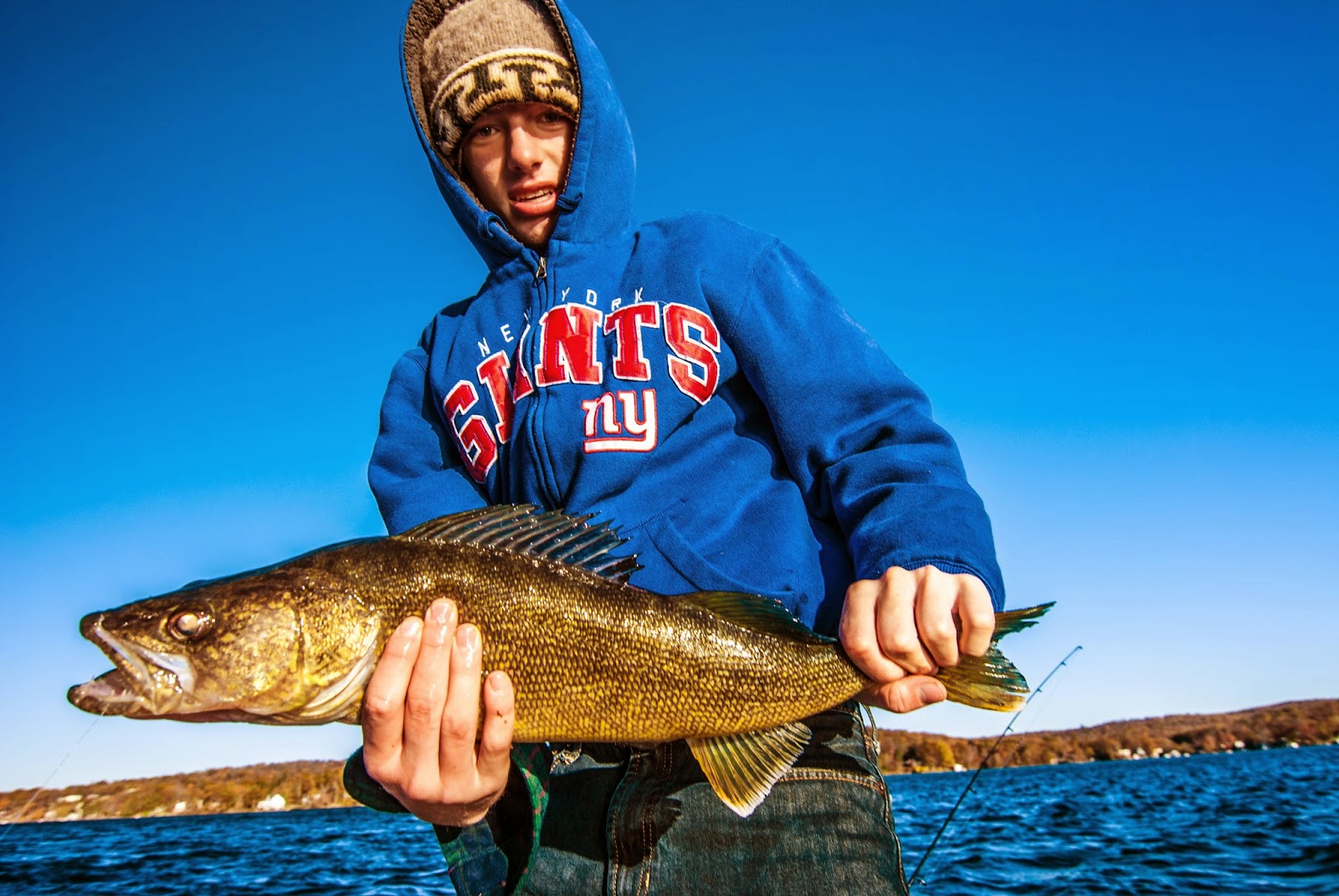
          I never forget the first time my son and I tried weighting live herring along the bottom edge of a Lake Hopatcong drop-off in October 2007, but I don’t remember if we got clued in by secondhand information or the rig seemed obvious. A half-ounce egg sinker ahead of a small barrel swivel and a four-foot, six-pound test leader of monofilament tied to a size 6 hook. The only change we’ve made since involves the use of size 10 treble hooks. I owned a topographic map, selected a sharp drop, used a fish finder to determine the edge between the slope and flat deep bottom, anchored shallower and cast our rigs to that edge. Sure enough, we caught good-size walleye of about four pounds.

          We kept coming back for more each third week of October. We’ve caught walleye every fall, and after a couple of years, began catching hybrid stripers along with them. On several occasions, a lot more stripers than marble eyes. Lake Hopatcong is not the only New Jersey destination for either species by the same method. Hybrids grow perhaps just as large in Spruce Run Reservoir and may be as numerous. Manasquan Reservoir features them also. Average size is about three pounds, fish slightly less than two pounds abundant, four-pounders common. I’ve caught a few five pounds and a little better, but so far, I’ve been jinxed at catching one of the six, seven, or eight-pound fish that so many of us read about in fishing reports, see photographed or catch ourselves. I’ve hooked and lost a few in this range and they fight like nothing else in freshwater. They just don’t leap as smallmouth bass do.

          Walleye inhabit Swartswood and Greenwood lakes, Monksville and Canistear reservoirs in addition to Hopatcong where they average about four pounds, six-pounders commonly caught with a number over eight pounds caught each year. We don’t catch loads of walleye less than two pounds as we do the bass, and though walleye do gather together in pods, the explanation for the catch discrepancy involves their not schooling in large numbers. On one occasion early in October, I witnessed fellow Knee Deep Club member Marty Roberts catch the last of about a hundred hybrids on one outing. He stayed anchored in a single spot, his fish alarm sounding off like Christmas bells.

          Many ways exist to catch both of these species and most of them cross over. In almost a decade, I’ve successfully used different approaches, but I like the bottom line of drop-offs in October best. I sit back and let the world unwind. Nothing else has been so relaxing and productive for these species. One caveat. Not all of the fish will cruise right along that bottom edge. In general, we set from 20 feet down to 45 feet, but throughout the month of October, be aware that on either Lake Hopatcong or Spruce Run Reservoir, fall turnover and oxygenation of the deepest water is not likely complete until the end of the month. We have marked fish as deep as 33 feet on October first, and yet as late as the third weekend, have witnessed herring dead reeled up from 40-foot depths. Your live bait is the canary in the coal mine, so check on it to avoid wasting effort.

          We follow no hard and fast rules on where to set, besides always putting at least a couple of six lines total between two of us right on the deep break. A good idea for beginners is to mark that edge with inexpensive buoys. Most often, we rig four lines with live herring and cast to shallows for bass and panfish with a rod apiece while keeping an eye on the open bails of the herring sets. Other anglers set drags light, tightening them upon setting the hook, but especially with quick-running hybrids, this can make a mess. Walleye, on the other hand, take the bait slow, line poking off the spool. You really know when a hybrid hits. Grab the rod, engage the reel and set the hook so that treble hook doesn’t catch in the gut, a problem we’ve never caused.

          Trebles allow herring liveliness. A single-shank hook turns inward upon a herring’s eye when placed through the nostrils, so a treble is preferable. Slip a prong through that bony opening for the most secure and liveliest arrangement. The tiny treble rides on top of the herring’s head like a thorny crown. Since the little hook with those hazardous extra prongs often catches inside the fish’s mouth, use a hook disgorger or long-nosed pliers to remove it.

          We miss a few hits. Not many. Medium-power spinning is all that’s necessary, and we’ve caught nice walleye on ultra-lights. However, with six-pound test monofilament and an eight-pound hybrid on the terminal end, power the fish when you can, but never force it. Hybrids have convulsive power like no other freshwater fish, sure to explode in sudden bursts of muscular force that will snap line instantly if the drag is the slightest bit too tight. Some veterans would never go so light, but on the other hand, Marty Roberts, last I spoke to him about it, catches hybrids only with ultra-lights, so it is a matter of preference as much as a matter of fact that a big hybrid will test any gear. I have caught five-pounders on 10 and 12-pound test, and though I felt relief in having a margin of more control than with lighter line, the fights remained long and sustained. The point is—these fish aren’t leader shy. If you use a 12-pound test leader, no problem. Fluorocarbon is all but invisible anyway. Hybrids must have good eyesight, as walleye certainly do, and yet many get caught on chicken liver, so they rely on smell, too.

          Herring happen to be rich in Omega 3 fatty acids. If you are good with a razorblade or very sharp knife, slightly incise live herring along the back, never so much as to impede liveliness much, just enough to release a little scent. Muscle gets cut, so a little of the fish’s vitality and endurance will be compromised, and yet so long as the fish remains active on the hook, a compromised life is more of a target to a predator. Walleye floats made of Styrofoam—black is best—help keep crippled herring out of rocks and other bottom obstructions. They slide onto the leader like an egg sinker and the hybrids and walleye don’t mind. Or just slip a little junk Styrofoam on the line, although the typical whiteness may not be ideal.

          There’s nothing else like it. Whether the wind howls like Halloween banshees or the lake lays calm and flat, this method works all day, but get on the water before dawn for the best action early. When the wind blows 20, 30 knots and everyone else hunkers down behind shoreline ridges in the calm, we anchor right in the blow, don’t even bother to double anchor, and let the boat ride the swells. Wind’s where the best action awaits.

http://littonsfishinglines.blogspot.com/2012/10/lake-hopatcong-hybrid-stripers-strike.html

Once that Summer Weather began to Stick Around...and a Little More yet

Presently 46 degrees in Bedminster, nothing else so cool is forecast until the 12th. During the recent heat, Lake Hopatcong water temperature hit 80 degrees, according to J.B. Kasper's "Freshwater Report" in The Fisherman. Fortunately for fishing--though I love heat--nights and even afternoons cooled off a few or more days before Joe Landolfi and I would have fished the lake yesterday, but temperatures are forecast to rise back into the 80's before we get out--I hope--on the 9th.

Landolfi is a kite in a tornado, and I accept the likelihood, based on past experience, of his not making any outing we commit to, but most often, we get on the water. And every time he's taken another turn, he's sincerely wanted to stick to the plan. I assured him that I was fine with missing this one. We'll get out next Monday.

I had a great 10 hours or so writing two essays instead.

Interesting point Kasper made in that report. He claims rainbows started to come in close to shore at Round Valley more than two weeks ago. (I believe he gets that sort of information from Mike Roman of Round Valley Trout Association, who I firmly believe is reliable.) Any case, those rainbows high-tailed it back out deep, once that summer weather began to stick around.