Showing posts with label Salmon River. Show all posts

Monday, July 31, 2023

Lake Ontario Salmon Aboard the King's Ransom


Scott Tarnoski's boat the King's Ransom consistently decks king salmon, Coho, brown trout, and steelhead on Lake Ontario. Cronk and I rode up to get onboard at Sodus Point in New York, from Mine Hill, New Jersey. We caught kings. 

We were in town long before departure time, so we located a bait and tackle shop, where Brian bought his fishing license, and where we asked about where we might try for smallmouth bass. We ended up at Port Bay, where I quickly placed a Mepp's Aglia along an inside weed edge, hooking and catching a 10 1/2-inch largemouth. A little later, I caught what might be a variant of warmouth. (A sunfish with large mouth and less circular body profile.) I once caught the same species or subspecies ice fishing a pond in Bedminster about eight years ago, and on another occasion while fishing salmon eggs on Wickecheokee Creek in Hunterdon County. I also fished a rocky but mud-stirred shoreline with the spinner, no hits, but further back in the bay, Brian took a heavy strike on a Zara Spook.


We began trolling over 500-foot depths, Tyler, the mate, switching out spoons, adjusting the depth at which downriggers set them, as well as adjusting the depth at which Dipsey Divers presented spoons. At least some of the presentations included large attractor devices about 15 inches long and four inches wide, set two yards or so up the line from the spoons. I asked Tyler what pound test leader. Twenty. And he said the point is to call the fish in from a distance, not finesse them as if they're leader shy. I couldn't imagine fighting a big king on much less.  

At the center of the stern, an electronic device allows Tyler, Scott, and clients to view any arriving fish from several hundred feet down up to the surface. Since the downrigger weights are the size of sizeable fish and must weight about 12 pounds, they show up as little semi-circular illuminations, steadily occupying the screen. My gaze was fixed on that screen for an hour or more. On several occasions, fish appeared on it as little illuminations moving up and across, and a number of times the dot would merge into the dot of a downrigger, meaning the fish was right at the lure. Tyler watched, too, of course, and that's why he switched-out spoons. 

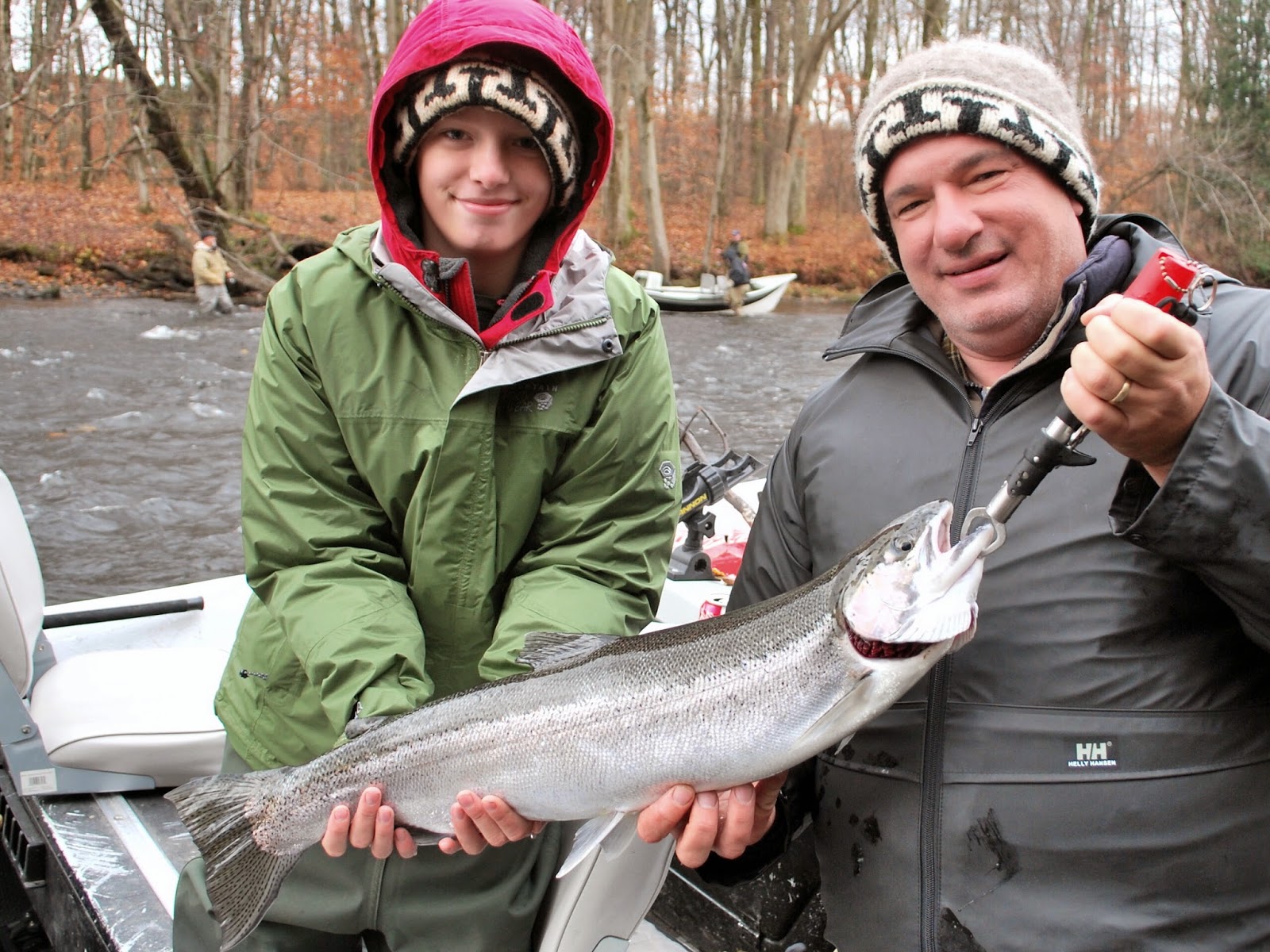
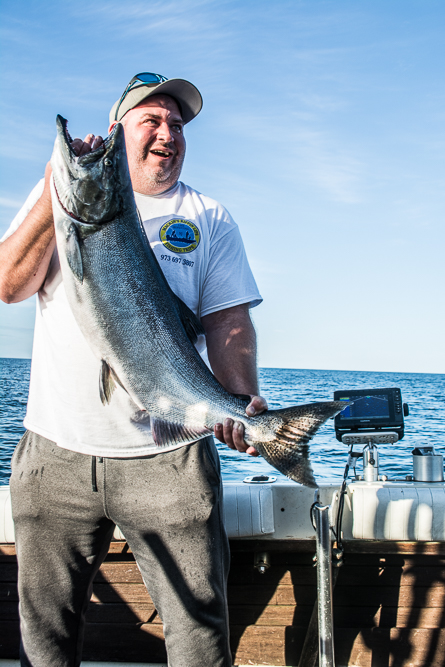
Finally, salmon did hit. Brian, first on deck, caught the one photographed above, about 25 pounds, a really good fish. (I asked Scott what's the biggest he's boated--36.8.) I caught one about 13 pounds and a two-year-old fish about 10 pounds. (I'm not clear on whether the first was also a two-year-old king.) Brian's second fish might have weighed 22. 

The struggle requires a lot of rod-pumping. You never want to allow slack. Both of my salmon used drag, but runs aren't long and smoking. Brian hooked a fifth salmon, and he could not move that fish. I watched. He had got the 25-pounder moving his way in no time, but how big this fifth fish--no one ever quite knew that, because eventually the hook pulled free.

I viewed the dashboard graph and noticed at one point that we fished over 735 feet of water. We did eventually find some baitballs--clouds of forage--and in general the whole experience between the four of us deepened as light began to get low. I felt very much impressed by Scott and Tyler. Tyler's knowledge of fishing is inexhaustible. He guides on the Salmon River, too, and if I'm not mistaken, leads clients on ice fishing adventures. The perch fishing is some of the best on the planet, and Tyler also spoke of 15-pound walleye and big northern pike. Scott I had known years ago when we both served on the board of Round Valley Trout Association, but yesterday I knew him in his element. He spoke of having to travel 60 miles in the ocean to reach such depths. He also plays music as the fishing unfolds. He asked me if I'm into music. I told him I am, which is true, though I prefer classical, and sometimes rock just seems overplayed. But once we got into those salmon--it didn't seem overplayed. I think every life is posed a question. It isn't as simple as being home. Or perhaps it's posed many questions. One that confronts me is how do I reconcile my so-called cultural and intellectual values with the gritty down-to-earth quality of my fishing? Well, you read my blog. You know there's a mind behind it. But not only did Scott nail the issue on the nose--from out of the blue somewhere--when he asked me for my opinion about the Doors. His playing music fused fishing with rock culture. 

But about Scott and the Doors. (I forget which song, but one of the Doors' played as we entered the inlet at Sodus Point.) "Jim Morrison was really far out," Scott said. It's a criticism I share to some degree, because Morrison didn't necessarily have his distance under control. (Anyone might laugh at that as an understatement.) Morrison was out of control, but no one else I've read has put it better than Morrison himself did: "If you can't control your mind, someone else will." So it's evident that Morrison himself didn't feel out of control.

We docked in deep dusk. Brian and I reached his truck parked conveniently in the municipal lot. In the dark. We bought ice at the Sunoco nearby, then we hit the road, stopping soon at a McDonalds. Sometimes a Big Mac hits the spot. 
  
Is it a variant of warmouth?

Lake Ontario shoreline
Brian and his truck
Brian's Zara Spook got hit to the right of the culvert. I fished on the other side of the street, but I clearly heard the water heave when whatever it was struck. 

Maybe about 22 pounds.

Scott Tarnoski on the left, Tyler, and Brian
My first was about 13 pounds.


Sun sets on a fluid horizon like the Pacific Ocean.


Tyler cleans salmon.


Scott and Brian


Saturday, November 12, 2022

Tried for Round Valley Trout

My son's over from Costa Mesa, CA. We went to Round Valley yesterday, his mother along. I felt astonished at how steeply the main launch drops off, there to the right of where boats go in. Looks like the water level is eight feet lower than this time last year.

We fished. Got six lines out. It began raining the moment we got there. Rain volume increased while we waited on the take that never came. (Trish sat in the car. We joined her.)

Orange Powerbait. It worked last year. And you'd think that with a steady rainstorm just coming on, trout would hit. But trout don't think. And besides, nature is more complex than any thinking we do. 

Saturday, November 7, 2015

Light Fly Rods for Steelhead

"Where do you want to start?" Matt said.

"The tailout," I said. He understood. Three years ago during summer, I caught a big smallmouth in the spot.

We clamored out of the Honda in the dark, and sort of miserably slipped on waders in the chill. Using a four-door sedan for purposes better suited to an SUV can be a mess, but we would get through the day without losing anything.

I was surprised the spot wasn't crowded out. Together we waited 20 minutes or so until enough light made it legal to fish. Matt got into position just slightly upstream of where I knew to loop my cast. The size 8 Estaz egg produced the first steelhead of the morning up and down the Salmon River in our view, not a very big one, but certainly a challenge on my limber six-weight fly rod. I was eager to have Matt net the fish.

We wandered off downstream, walking to stop here and there to fish nearly a mile of the river, before we turned back after nearly four hours for a hearty lunch. The walk back took about 20 minutes. During the interim, I had briefly hooked a larger steelhead, and missed two hits. The fishing we favored all morning happened in about two feet of water at the furthest distance we reached from where we began. Matt had a spectacular fight before he lost one that raced downstream, briefly breaking water as it got loose. He was using a five-weight rod and five-weight line.

Perhaps we just can't land any of the really serious fish weighing more than 15 pounds, maybe not even the typical 10-pounder, but I like the feel of my light rod better than the heavier I used yesterday.

Friday, November 6, 2015

Matt's Salmon River Steelhead


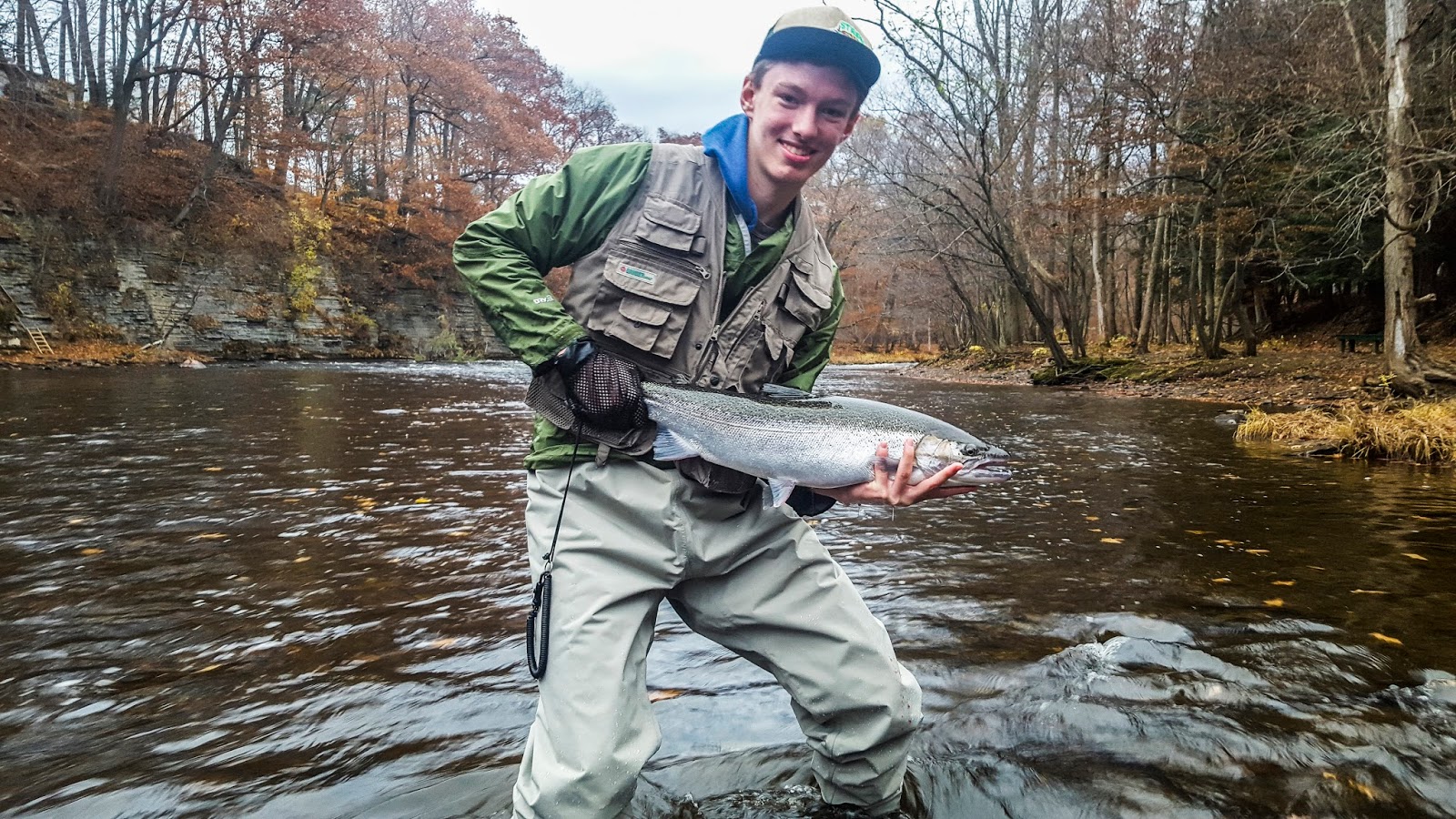
From what we gathered in communications with the Douglaston Salmon Run river walker, Matt's steelhead was the one and only this morning. Matt's weighs (the shot shows him releasing it) about seven pounds. I lost one at the net longer in length that looked skinnier. Both chromers.

Copious online reading before we came up informed me, but actual fishing comes down to trial and error and habit, and of course as a spin fisherman, I have a habit of holding the rod high as if it's no problem. After this venture with my son, I may hold the rod to the side more often. I told myself to hold the rod aside, having learned that's what you do with noodle rods four years ago, and reminded of the same for fly fishing numerously in my reading, but Nate caught me holding the rod high, and apparently it was too late before I could have adjusted position. I guess that's why I lost the steelhead. I had one other hit on a chartreuse streamer near the end of our seven hours, a pretty strong strike.

We fished three stretches thoroughly, but could not escape leaves. If not for the mass of them--I mean they were thick and cast after cast got interrupted by having to pull a yellow leaf off the hook--I think we would have caught more fish. The leaves cut into our time and grace. We began with a calm, warm air mass of about 60 degrees just after 6:00 a.m. Leaves were bad enough, but once the wind picked up, they got to be the mess I've described.

Since I've had severe herniation in my lower back for years, my spine is somewhat scholiotic, twisted, with the result that sometimes my upper back pains me badly. No problem on Lake Hopatcong recently, nor while casting spinnerbaits the week or so before my son got out. But I had to take several breaks today, finally saying the hell with giving into the pain and just exerting myself past the difficulty, which resulting in--less pain. I fished the last two hours with wilful determination that made me feel great afterwards. We had fished hard all morning, but it took me hours before I fully got into it; not that I wasn't trying; I just hadn't stirred the manic power in me yet.

When my son hooked up about 7:30, I got my camera, the $600.00 camera with the $525.00 lens, my favorite lens, and got in the water--with Korkers on of course--to get the shots, and my very last shot--about two seconds before I heard Nate whoop, saw him lift the steelhead in the net, and a split-second later fell flat on my face in the river--is the best. I'm saving it for possible magazine use after we get more experience yet. The file card never got wet, and I got the last picture my camera and possibly my Tokina lens will ever take. Sort of like a mother who dies giving birth. I took emergency measures to try to save the equipment, and, finding the electronics unresponsive, said, "If I broke my leg, that would be worse." Nate got some good shots of Matt and his fish, and later my son said, "If you told me a year ago I would catch a steelhead on a fly rod, I wouldn't have believed you."

You just play the cards in your hand, however expensive. Once the camera and lens got submerged, it was done. As I edit this last paragraph now, a tech has told me an upgrade is less expensive than repair. The camera will be replaced and soon; the lens either fixed within three weeks or replaced by the same model. Most of all, my son succeeded, and he's since talked about fly fishing the river that runs through town, the North Branch Raritan. And we'll be back for steelhead next fall.  


I wanted Nate to fish when I took a break with my aching back.

Thursday, November 5, 2015

Arrival at the Salmon River and a Little Fishing

We made Route 13, Pulaski, NY, in four hours, 15 minutes from Bedminster, NJ, stopped at Whitakers, bought our licenses, flies--including a couple of wild marabou streamers with blue and pink, about four inches long, just in case--and some leaders. Clouds overhead had the staff wanting to be out. It's been very slow with a lot of sunlight and I guess just not enough flow to get all that many steelhead in the river, although I was told some are moving up in pods of two or three. The weather is very unusual with temperatures in the 70's today, and for all we know, maybe 80 tomorrow with more clouds and thunderstorms and showers besides. The river's flowing at 350 cfs and that's the only figure I've seen in a week or so, unless I missed something. That weather forecasted tomorrow is the break in this week's pattern. Sunday it's supposed to be 53 at most. The last my son and I fished steelhead in 2011, we had 33 degrees on November 7th to start in the dark, with the most mysterious boat passage in the McKensie driftboat I've ever experienced, before first light, and then--with snow off and on--temperatures reached a high of 38. That was steelhead weather and we caught five, losing two or three.

We had time for more than an hour of fishing into dusk today right here behind the Steelhead Lodge. I found a nice, dark run at least three feet deep, and I guess since I had some practice at the Ken Lockwood Gorge recently, I was in really good form, way better than I had been there. I fished a pink Estaz egg, size 8, and after a dozen or so drifts through this run, got life on the other end, a double tap, pronounced, unmistakably a hit, but the hookset only initiated the next cast. Sometimes the steelhead take the fly a little deeper than other times, and when they do, that's when you get a solid hookup. After a dozen more casts with the Estaz, I switched to a size 10 brown stonefly nymph. I figured the fish had seen enough of the egg form. Nothing more happened. I fished a few other runs not so promising.

So did Matt. But he had no hits, yet a lot of gumption in moving about the river in his Korkers, trying to find a steelhead. We fish with Nate Adam tomorrow and I hope we do well, despite the ominous news that the fishing just isn't good. And Sunday? Well, if we catch any Sunday, that's really the icing on the cake, since we'll have found those fish on our own.

Saturday, October 10, 2015

Prismatic Steelheads: Choose the Color They Want


          The clear plastic float with red top marker vanished in a split second. I reared back, felt weight, and the drag began screeching, my 11 foot noodle rod in a shock-absorbing C-curve almost horizontal to the water. The steelhead approached the stretch’s tailout when it stopped and I began pumping, the rod’s light power with super-slow action absorbing thrusts against the five-pound test leader. The fish within netting range, I kept the rod at full bend low to the water, to my right side. Time and again the fish raced off a number of yards, but tired with each attempt and finally yielded.

          Noodle rodding with plastic beads is a most popular method for steelhead and the battles the best you may ever know. The salmon egg imitations that tempt strikes come in an array of colors, because the fish often show a preference for one over the other. Steelheads will respond to a specific color at a given time because their eye structure is so sensitive they are thought to see ultraviolet and infrared portions of the light spectrum. In other words, make no mistake; these fish are color sensitive. Load a clear plastic tote with beads of all colors and experiment as though you’re a chemist trying to get the right mix.


          A guideline you can follow takes light into account, since color is nothing without illumination and the name of the game more than pattern. Steelhead beads are usually 10 mm, with center holes, and though they resemble salmon eggs steelhead feed on, you’ll never find a green salmon egg in nature any more than you would a unicorn, and yet sometimes steelhead may prefer green. In bright sunlight on clear water, white, orange, apricot, peach, and red are good choices to start with. If the day is dark and water visibility limited, fluorescent red or fluorescent chartreuse may get snatched from the shadows. These hot colors spook steelheads in clear, bright conditions.

          A trick you can pull out of your bead kit is to contrast colors on a single bead. Dab on iridescent nail polish at home. You can’t find color contrasted beads on the market, at least none I know of. Contrast makes it easier for the eye to pick out color. Spawn sacs are typically color contrasted, perhaps not with this reason in mind, but a difference between the color of netting and eggs may mean a strike or not. Placing a single bead of contrasting color in a sac produces an “eye” effect that steelhead seem to like. We don’t expect these fish to think something’s looking to get away, only to see something that might trigger aggressive response.

          A consistent bite is the one relief from uncertainty, but so long as this isn’t happening, which is much of the time, you’re free to play with color. As painstaking as this effort can be, it’s better than standing in a river and feeling you’re there for nothing. Remember that available light and changing water visibility affect the absorption and reflection of light, which literally causes colors to change underwater. You don’t exactly fish what you see in your box, and if clouds ensue after sunshine, the fish don’t see the same color they did before, either.

          Believe it or not, the color of the float you use may make a difference. Those with mostly clear bodies are less obtrusive, color on the top helping you see it disappear, dip, or pause suspiciously. The color contrast against the bead may make the difference sometimes. Steelhead can see in a 300-degree arc, so they see the float and the bead in relationship.

          Make sure to use a float with soft plastic line sleeves at top and bottom; you can instantly adjust the float’s position on the line. Add a series of split shot to the line underneath, heaviest near the float to make it stand upright with just the buoyancy to stay afloat. Pinch smaller split shot in descending order with BB at bottom of the rig near a micro swivel. You’ve created the classic J presentation. The current pulls the lighter shot forward as the bead is swept out ahead. The idea is to hit the steelhead on the nose, so be chary about the depth you set that float.

          Also when rigging up, tying off the bead is critical. Using a toothpick to peg it in place inevitably allows slippage. It’s better to pass five-pound test fluorocarbon leader through the bead, loop back, and pass it through again. Now pass the tag end through the loop created and turn it six times like a clinch knot. Tighten into the bead and it will stay in place. Finish by tying the hook to the tag end with a clinch knot. You end up with 2 ½ inches of leader separating bead and a size 8 to 12 wide-gap, beak-style heavy steel egg hook.

          Look for current breaks where salmon eggs get funneled and then fall into pockets. Good water isn’t very hard to find, and until winter really sets in, is shallower than not. Steelhead fishing is usually a trying effort and may make you think no fish are present where you cast, though plenty fin just out of sight. Hours of effort yielding even just a few of these glorious fish are enough to fill the rest of your life with a desire to get back out and do it again.

Tuesday, October 14, 2014

Steelhead Sight Responses: Noodle Rod Fishing

Midwest Outdoors published a similar photo to this one, but the position of the hands, the smiles, and the tilt of my head, among other things, such as that the other photo was taken in a larger frame, distinguish the two. Don't mean to step on anyone's toes! This photo actually was published in Fur-Fish-Game about a year ago, but the six month term of rights is passed.
 
 
Noodle Rodding Steelheads with Beads and Spawn Sacs
By Bruce Edward Litton
 
          Steelhead beads and spawn netting come in multitudes of color hues for good reason. Highly visual and selective, steelheads can choose color preferences that change with the hour. According to scientific research, their eyes sense infrared and ultraviolet light, although ultraviolet is visible only at the water’s surface, which leads anglers to suspect that smolts use it to distinguish floating insects. While ultraviolet light will not be a concern for pursuit of grown steelheads, and we can’t judge the infrared hues they see, the steelhead’s ability to perceive in these two spectrums is an indication of the extreme sensitivity we deal with. We have plenty of concern by experimenting with colors we can see.
          Absorption and reflection of light determines color, so available light and stream conditions can be judged as a starting point in selecting what color bead or netting to use. Depth absorption of light is not quite the only factor. The color a steelhead sees 20 feet away will very likely shift as the object gets closer to the fish, but lateral light absorption is not a major concern because steelheads tend to move little more than a couple of yards to strike a bead or spawn sac. Nevertheless, it’s worth knowing about because in water clear enough, a steelhead may see a bead coming 20 feet away. It’s wise to place casts well ahead of target for a stealthy approach.
          Sometimes steelheads on a particular river will strike one color all season, while steelheads on another stream nearby will strike another, or shift preference by the hour, day, or week. Ultimately, color preferences are a mystery we don’t know about. But we can begin our approach to the unknown by contrasting color with background. For example, if the water is clear, yet slightly tannic brown and weather is sunny, a bead painted over with iridescent nail polish (can’t find these commercially), or white, orange, apricot, peach, red, or bright fluorescent chartreuse stand out against the brownish background and may work. A fluorescent color may stand out too much and spook steelheads. In any case, you should be prepared to experiment. Whether or not steelhead will continue to hit a color drawing consistent strikes through the day is up to more than we may judge. If you’re not getting strikes, weather conditions or the spot you’re fishing may not be the problem; it may be because you haven’t tried the right color, so long as your presentation is otherwise in order.
          I got interested in color after I had fished for hours a run of the Salmon River in New York known to produce. I was using a nail polish colored bead I had previous success with, but failing to experiment with others. Laziness can feel all too comfortable. At the time I knew comparatively little about steelheads’ selectivity, but certainly enough about it to act. Another guy walked up, waded in, and caught two steelheads in 15 minutes’ time.
          So invest in many colors; fill the pockets of your vest. Standard sized beads are 10mm in diameter, some a little smaller, some as large as 14mm. Most are hard plastic with a line passage through the center. The soft plastic beads you can pin on a hook are marginally popular for salmon. I’ve never used them for steelhead because I fear the hook looks too unnatural and won’t hook up as effectively. And although the salmon eggs that steelheads feed on are singular in color, color contrast on individual beads may make a difference. So you can doctor beads with nail polish and/or model paint. With spawn sacs, contrasting netting with eggs is worth trying, as is placing a small bead inside a spawn sac to produce an “eye” effect. We don’t really know why it works, but results are that it does.
          Float rigs by use of noodle rods are effective for placing the bead or spawn sac at steelheads’ eye level. Noodle rods are 10 to 15 foot, light power spinning rods with super-slow action to absorb the thrusts of 10 to 20 pound steelheads. Six pound test monofilament line on the reel spool is standard. Much more than this would easily result in a broken rod if the leader were also heavier test. The famous C formation is achieved by holding the reel upward, the rod in a total bend with butt forward directly under the tip high above, the rod taking shock in that absorbing bend to protect a five pound test leader. Fighting a large steelhead is an arduous exercise—the fish may depart on more than a dozen runs—but with careful determination and practice, you will catch most hooked. When netting a steelhead, let it run if it wants to go. Don’t force the issue. Awkward netting of fish results in some losses after long battles. Lower the net lip to bottom and let the steelhead in.
          Steelhead floats come in many brands. Those that are mostly clear bodied may be less obtrusive, but a color top allows you to notice when it suddenly goes under. Use those that allow you to pass line through soft plastic sleeves at top and bottom, so you can adjust the position of the float on the line. A series of split shots, heaviest near the float to anchor it (medium sized split shot), and a few BB sized near a micro swivel, create a J pattern as the rig moves downstream with current. The heavier split shot up the line lag behind, while the end of the J curve presents the bead out in front.
           Beneath the last BB split shot, the micro swivel is tied to six pound test monofilament and five pound test fluorocarbon fly leader. Fluorocarbon sinks and that’s perfectly fine for fishing a bead along bottom. The knot is simple. Pass the leader through the bead; loop back and pass it through again. Pass the tag end through the loop created, and turn it six times as if you were tying a clinch knot. Tighten into the bead and it will stay in place. You will tie the hook with the tag end so you have two and a half inches between bead and hook. This way, the steelhead takes the egg and it slips free when the hook is set; the hook usually meets the corner of the mouth for a clean release later. Tying off the bead to hold it in place is critical. Using a toothpick inevitably results in slippage on the line.
          A size 8 to 12 wide gap, heavy steel egg (bead) hook is needed. These are not the same as gold salmon egg hooks and more than several brands produce the like. They are clinch knot tied with the tag end of the bead knot.
          A note on split shot. Lead has become unpopular as environmentally friendly alternatives are on the rise. Don’t use shiny tin split shot. They spook steelheads, especially on sunny days. Use a tin/bismuth combination even duller in appearance than lead.    
          Typically the fishing is in water three or four feet deep, especially through current breaks where salmon eggs have funneled and fallen into a pocket. Steelheads clean up some of the mess salmon make. This is the whole point of using beads, even though many colors do not resemble salmon eggs. Imagine a green salmon egg. It would be like something out of Dr. Seuss, but green is a color steelheads will respond to on occasion. Green eggs and slam!
          Cast well ahead of your target zone and hold the rod high to keep a fairly tight line off the water and on the float, not so tight that it affects drift. Trout fishing of all kinds in streams is about drift. More often than not, a little experimentation is required in setting the float and shifting the split shot to get that J presentation coming right at the eye-zone, bead first. This can be more daunting than it is for me to relate it to you in words. But if you are new to steelhead fishing, you have to begin somewhere. And the surest indication that the float is set too high is that it gets hung on bottom or drags at less than current speed.
          A float riding right along can be deceiving. If your bead is riding two or three feet off bottom with steelheads six or seven feet deep, as on occasion there are, none are likely to rise for it. And if you’ve got the float set right, remember that steelheads have 300 degree vision. If water is clear, you can bet they see the color indicator on the float. It’s a good idea to contrast bead and float color, since color against background arouses interest in the fish. A float isn’t much of a background, but the color is very distinct and steelheads see it. So buying more than one color float is a good idea.
          Most of the time, a float set a little more than three feet above the hook is right. With the J effect, the bead is presented close to three feet under the surface. When the float dips under, rear back on the rod immediately. When I first began steelheading, I found it very counterintuitive that most of the fish are in about three feet of water, sometimes two feet. The size of these fish made me feel they would naturally gravitate to holes. If brown trout share the river you fish, you will more likely find them deep and dark. After all, browns are nocturnal. Rainbows leap for the sun; browns dig for bottom. There’s more poetry in the previous sentence than truth, but nevertheless, the two are very different species and browns clearly seem to be more nocturnal. Steelheads like shallows even in the middle of winter to warm their backs the slightest degree on sunny afternoons.
          Nevertheless, the best weather conditions are nasty. Snow in November is a real good sign. Get out and fish in it. Drift boats with three inch drafts float all day on the Salmon River in January, equipped with propane heaters. And if snow is piling up on the banks, it’s usually for the better. If water is clear, remember the list of colors I outlined. If it’s somewhat stained with visibility reduced to a foot and a half, try bright colors like red or fluorescent chartreuse first.
          Particularly while wading a river, persistence is worth a lot more than routine on the job left behind for the outing. True enough, if you finish a drift boat trip, you may feel the duration of it all the way down, and it feels real good. But your guide knows the river like the steelheads do by plying it for years. This advantage is worth money spent, a smart way to get started. But if you beat back the bushes against waders and roll the rocks under wading shoes, remember that experimenting with colors and adjusting the float to get it about right is possibly more important than finding spots with fish in them. Typically, moderate runs of current about three or four feet deep will hold some steelheads.
          You can experiment with both beads and spawn sacks noodle rodding, not so much that you get frantic, but enough that you feel your own effort sort of like coffee water simmering. It’s the sort of involvement that never gets bored and tends to eventually hit it right—score—and allows you to leave happy. Spawn sacks are presented by float or by simply using enough split shot to feel the occasional tick of the stream bottom, but the hook penetrates the sack and rather than size 8 to 12, a size 4 outset hook is appropriate. The first several casts with a spawn sack may be the most valuable because the release of oil and fluid from hook penetration flows along with the sack, dispersing. Sight is not the only sense steelhead have. By analogy, I think of another sight feeder, the bluefish, which have a highly developed sense of smell, although more of smell and far less discrimination by sight. No fish seems to compare to the steelhead for sight. There’s no end to appreciations of the steelhead’s sight abilities because their preferences change in truly uncanny ways. Unless you become an expert at matching color for response, you may feel the suspense of uncertainty more than assurance, except by keeping yourself busy experimenting or catching fish. You don’t want mere fish sense to beat your reasoning mind.
          Don’t forget to layer clothing sufficiently and carry some ultraviolet light wader repair fluid, which hardens by sunlight exposure even on cloudy or rainy days. Most drift boat trips include wading. Vermiculite hand and toe warmers are a must. And a pair of wading cleats can save you from more than wet clothes and pneumonia as a result. On the Salmon River I fish, it’s understood by everyone that cleats are a necessity.
          Steelhead fishing is for hardy anglers who find an attraction not only in the beauty, size, and subtlety of these fish, but the chilly weather conditions and stark environments confronted while going after them. I know people who have drift boat fished at three degrees in the afternoon, taking every advantage of the propane heater, but catching steelheads nevertheless. To be fully functional when weather and environment oppose you—active with a will to succeed, steady as river flow—is something relatively few pursuits offer anyone, and those who experience never forget.


Monday, October 14, 2013

Salmon River Lost Brown Trout, King and Coho Struggles


We all had great times fishing the Salmon River October 2009-2011, and me, my son Matt, brother Rick, and nephew Kyle enjoyed this most crowded Columbus Day weekend too, but the results aren't happy this time. All of us got skunked.

Fishing is, in an important aspect, a primordial venture of going out and returning, if not with actual fish or meat from them, at least abstracts in the forms of numbers and memories. Those memories serve a lot better than fodder for fantasy confined only to the head, as well. As anglers we all know it's not just about being outside, but satisfying something deep in ourselves that goes back in the history of mankind long before civilization. Making a catch fulfills that.

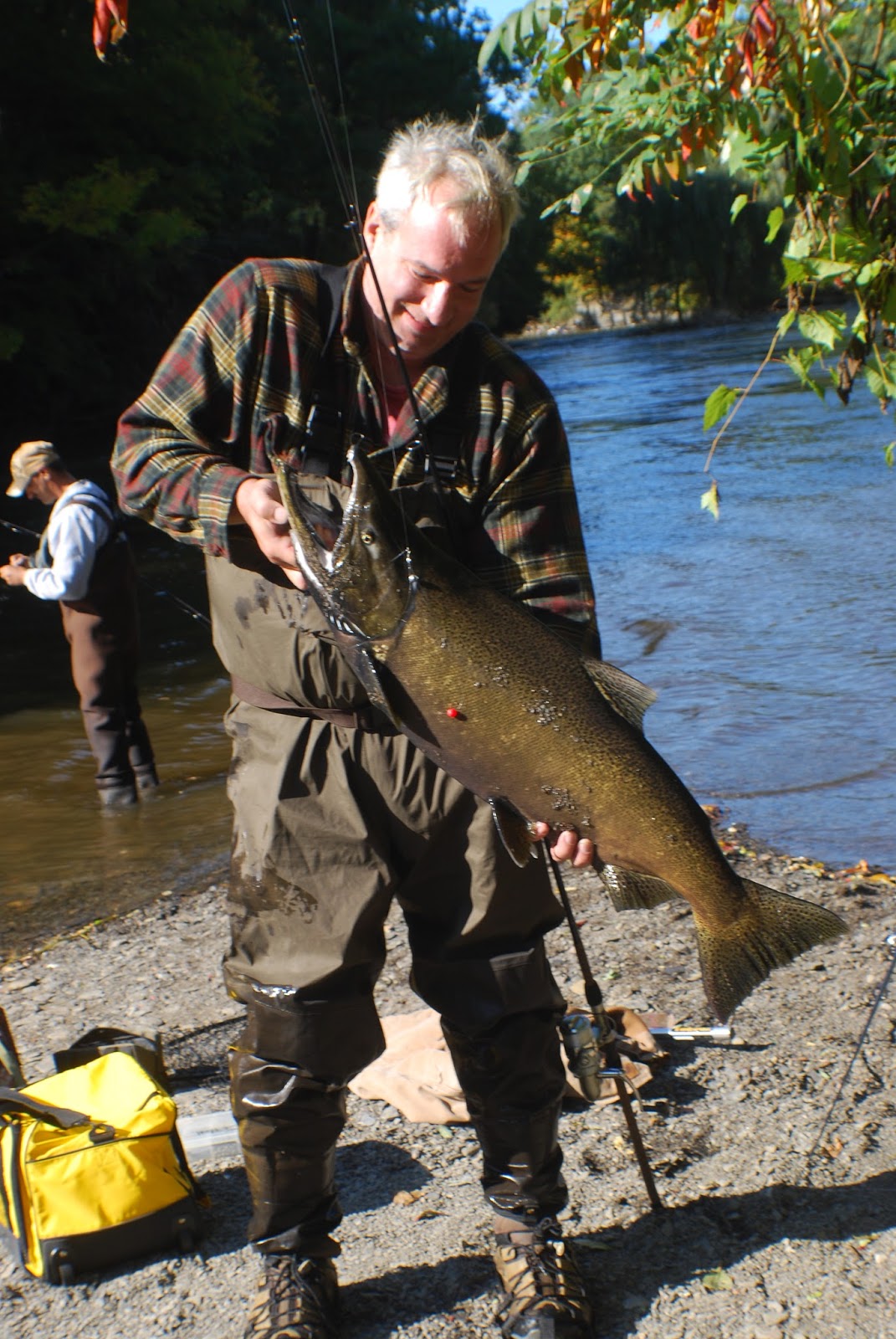
We all had fish on, so at least we tangled with salmon, and quite a few. I got to play out half a dozen inadvertently foul hooked kings at length, feel their power and turns, and practice at playing these fish in order to be better prepared for the much less frequent mouth-hooked salmon. None of these fish were foul hooked from "lifting" the split shot weighted hook and bead off bottom. (Anyone who tries to snag salmon is breaking the law.) They pretty much hooked themselves. Suddenly a great fish ran fast before I even had time to set the hook. I lost only two of these to jumps, which is the typical way they come off.

Salmon leap as high as six feet, often otherwise lost by turning downstream and gaining through rapids below a pool. Only mouth-hooked salmon may be kept by law, and of course to hook a salmon in the mouth probably means a better chance at landing the fish, since a hook snagged in softer flesh on the belly, back, tail end, etc., is more likely to pull free.

The debate on the river about whether salmon strike beads, flies, egg sacs would be eternal. Many people say it's just the luck of the bead drifting into a salmon's mouth, or even of the line entering the mouth crosswise and the hook being pulled inside. But something provokes a salmon on occasion to take an egg into its mouth. Since they're running to spawn and their biology shuts off the urge to feed, the intent is not to eat the presentation, but something else no one seems to understand. Rick fished the Douglaston Salmon Run Saturday morning and found a pocket where five kings staged before they would move upstream. One of them turned on the bead and took it.

The highlight of the weekend for me was hooking an enormous brown trout at least 12 pounds in the corner of the mouth, fighting the fish long, but losing it when the 12-pound fluorocarbon leader frayed on the rocks it ran against near the bank. It was an outrageously fortunate moment to have hooked it on a red 10mm bead. This happened during the first hour of fishing Saturday at Ellis Cove, so it seemed then as if the weekend was well in our favor, and the rush of excitement mixed with regret for the loss felt intense. We were there for salmon--although Rick prefers steelhead and I certainly do in November--but hooking a brown trout and especially one of enormous size came as a big surprise. Relatively few brown trout run the river compared to king salmon, Coho salmon, and steelhead in that order. During summer, an even lesser number of Atlantic salmon run, and whether or not the abundant smallmouth bass are resident or come up the river from Lake Ontario in June after spawning, I don't really know.


Tuesday, September 3, 2013

Pulaski Salmon Surge: Salmon River Run Soon

(Red spot is 10mm bead having slipped down the line.)
Salmon River Showdown
A Month of Salmon Surge
Especially on Columbus Day weekend, the Salmon River running through transforms an ordinary American town with a business district into a Mecca with thousands of anglers converging on Pulaski for their shot at king salmon, Coho salmon, and possibly a brown trout better than eight pounds or an early steelhead. Some restaurants post prohibitions against wearing cleats, but none of them disallow wearing waders. From the numbers of vehicles toting rods parked along roads and anglers strolling through town, you would think the river would be as jammed everywhere as Clinton Falls on Opening Day, but my son and I have always found enough room to fight these great fish.
Kings run as large as the Salmon River record, 47 pounds, 13 ounces, and average 15-25 pounds.  Cohos are less common, usually 6 to 12 pounds, with the Salmon River record at 33.45. Rods and reels don’t need to be as beefy as you might think. In fact, a noodle rod used for steelhead later in the fall may suffice with 8 pound test mono and good knots. These light power rods, 10 to 15 feet in length, absorb the fish’s power in the bend. I haven’t tried a noodle rod on a king, but others have with amazing play. 6 to 18 pound steelheads test these rods regularly with 6 pound test—not much more line strength would break the rod.
        
Most salmon chasers use the sort of rod you might use surf casting in the fall with light Ava’s for stripers, 7 or 8 foot medium-heavy power rods with 12 pound test mono. Make sure to use a reel with a good drag set at a third of line test, you’ll need it! Fly fishermen have a great time with salmon, but fly tackle is not necessary to catch loads of fish. Salmon are in the river to spawn, and some of them end up in the hands of fisheries employees who take the spawn, hatch it, and safely replenish the river and Lake Ontario. None of the salmon feed. But for some mysterious reason, they do take salmon egg imitations into their mouths. In fact, a foul hooked fish must by law be returned to the river, but most are mouth hooked. We’ve had the most action on plastic beads, although small pieces of sponge, and spawn sacs (about half dozen eggs in netting) have worked well. We tried homespun yarn flies and got very little action. I think yarn flies seem more like some kind of bug.
         
By law, hooks must be less than a half inch between barb and shank. We use Mustad #92141 off set hooks, size 4. They are designed to be snelled, but hook fine with 12 pound test fluorocarbon tied directly to the eye. If you do choose to snell, carry several leader wallets because the bottom consumes untold millions of terminal tackle pieces.
         
Rigging is simple: tie a small barrel swivel to main line keeping about 6 inches leftover. Tie about 18 inches of fluorocarbon leader to the other swivel eye, the other end to the hook. On that leftover 6 inches of line place 1 or 2 medium to large split shot. The amount of shot is determined by drift. Get the presentation down and just clicking rocks so you don’t get hung on every cast and it doesn’t ride high over bottom. Hang-ups are inevitable, thus the leftover line. The split shot usually gets caught and pulls off so that the hook and swivel are sparred. I take along over 300 split shot to Pulaski. Plenty are lost after a hook set grabs bottom instead of a salmon, but most of the time you can tell the difference when it’s a fish.
With 12 pound mono, a medium-heavy power rod casts large split shot rigs plenty of distance. The sizeable river is more like an oversized Musconetcong than Delaware, running 13 miles from Salmon River Reservoir hydroelectric dam. Flow volume depends on the amount of cool water release, measurements posted online.  In our experience the river’s packed a punch, but remained altogether fishable as always except for truly torrential rains. Last year a great Nor’easter extended back into Lake Ontario before we arrived, but although two days were shot, we had plenty of success despite turbid, but not thick-muddy water, clear enough for salmon to see our offerings.
         
Beads come in myriad colors and different sizes, 10mm standard. You will see on tackle shop walls many shades of reds, yellows, beiges, tans, even greens, among others. Salmon seem mercurially selective about color, but how and why I have no idea, besides that I would expect them to take a pale shade resembling an actual egg. Last October this was not the case at all, as we got 4 or 5 hits to 1 on green, of all colors, over reds and pale beige. A twist to the story exists, though. These green eggs measured smaller than 10mm and had a soft plastic texture, and we placed them on the point of the hook, rather than jamming a toothpick in the hole of a hard bead between it and the line an inch above the hook, and breaking off the remainder. Why I don’t know, but my intuition felt strong that the soft texture had to do with our success. A salmon sensing that texture before taking it into its mouth makes no sense to reason, especially since the water was turbid. Who knows?  Sponge is also available, many colors even include black. Bring a pair of scissors and cut a roundish piece small as a salmon egg, embed it on a hook. Spawn sacks come in a variety of colors, the netting easily catching the same kind of hook. Salmon are almost everywhere to take these presentations.
The run’s stage determines the section of river to fish. Late September fish are chiefly below Pulaski. By the third week of October there may still be many at Altmar, near the dam. Just ask for info at the many shops. They come in waves, and run in waves, too. They’re available in a foot of water, and we’ve caught them 12 feet deep. Search for spots that allow optimal drifts—3 to 12 feet deep and a good current. Salmon even run up small creeks: Sandy Creek, Orwell Creek, and Trout Brook—25 pound salmon in holes like those hosting suckers for boys.
         
Go online to get maps. FishSalmonRiver.com has them. Fantastic holes, pools, and stretches await. Best times to fish tend to be early and late. Salmon usually get well on the move with low light, but hit throughout the day. We usually find a run plenty strong in the middle of the afternoon. Few fish hooked get landed. Perhaps a dozen will give you a tussle to each netted. Most foul hooked pull free easily. Powerful currents downstream of where a salmon is hooked engulf some, but most fish pull the hook and some snap lines. Be ready to run as a salmon takes off up or downstream—always run with cleats like Korkers—other anglers will clear the way. Salmon fight tremendously, and sometimes leap 6 feet over water. If it’s your first time trying and you catch one of these fish, after a battle like that, you should be satisfied. 


Friday, July 6, 2012

Lunker Smallmouth Bass, Brown Trout or Atlantic Salmon, in View but Off Limits


The Salmon River's flow level is adjusted by hydroelectric dam release. When we arrived yesterday, the river flowed low and invitingly. Late last night the level rose and today remained higher. We began fishing at the Black Hole this morning at about 8:30, 60 feet deep with beautiful shallower currents, ledges, and eddies. Turbidity turned me off, but I did get a few hits from something on a Mepp's #1. I figured maybe the risen water level had stirred up the river to reduce clarity, but felt relieved to later find clearer water upstream.


We made a whole day outside except for lunch at a sub shop. We caught a dozen bass on plugs and shiners, fly fished for hours, Matt catching a couple of rock bass on a big, brown Wooly Bugger, while a couple of fallfish fell for my large stonefly beadhead. Snorkeling at Altmar in the fly fishing section afforded us views of great fish we couldn't attempt since it's closed from May until September 14th  We spotted in this section about half a dozen smallmouth bass around four pounds, one five- pounder, and either a brown trout or Atlantic salmon of about eight pounds. I also noticed a number of rainbow trout six to nine-inches long spawned from thousands of steelhead.

We got around. More than half a dozen spots got our attention. Compared to yesterday, today felt different. With limited time to fish, I felt driven to make every cast count last evening and the two good bass we caught rewarded the effort. Today never fell into sync as strictly a fishing effort. Taking time out to swim and snorkel, to practice fly casting, and to just slow down and enjoy being outside took precedence over trying to score. It made a difference in my life to slow down and just let my physical senses reign for many hours.

Matt sighted a smallmouth of about five pounds with just enough daylight left to see, last evening, and I spotted it today, which explains the shiners. This bass was not at all eager to take the Strike King worm as others had been. We trie for this bass today by scheme, making sure to have half a dozen large shiners for sunset. But it didn't cooperate.

More elusive than five-pound smallmouth bass in the Salmon River this time of year perhaps, Atlantic salmon are a thrilling possibility. I came upon no one targeting them singularly, but what a reward one of these most valued gamefish would be!


Smallmouth Bass Salmon River


We fished by 5:30 p.m., quitting at 9:15. I got word in Pulaski before we got our sneakers wet that smallmouth bass fishing on the Salmon River is relatively slow. The stories I have heard over the past few years amazed me, but I had a feeling we wouldn't have 100 bass-a-day action.

We got two good-size bass and a few others over 12 and 14 inches. I caught eight, Matt three, but he had butterfingers, having taken as many hits as I did.

He caught a bass on his first cast with a Storm Hot 'n Tot crankbait. Plenty of light yet on the water, the silver sides reflected great flashes, and my silver Rat-L-Trap did much the same. I had one hit on the plug, having waded upstream along the stretch a couple hundred yards before I switched to a five-inch Senko-type (Strike King) worm rigged wacky. I chose crayfish brown and stuck to this. I missed a couple of light takes that later I felt sure were rock bass, since I caught a couple of these over the course of the outing.

Matt and I returned to the deeper, slower pool at the bottom length of the stretch, surprised how far shadow had advanced.

"It's amazing how you forget time when fishing," I said.

It amazes me even more now as 1:00 a.m. approaches at the Steelhead Lodge near Pulaski. I had a nice bass on in no time many hours ago now that seems minutes, and for awhile had taken a hit on every cast.

"How are you doing that!?" Matt said.

"When we got here, we saw no bass at all in that sunlit water. They were under rocks and now they're out in the open. Each cast I make to a completely different range--all the way across, then straight up to my right. Bass may dart 15 or 20 feet to grab the worm, so when I get a hit there, the next cast I aim to a different place with the intent to come back around later. The hits are coming within two seconds of the worm hitting water."

Matt walked around and upstream of where I fished and nailed our best bass.

We drove to three more areas, and caught more bass at the last of these. At the Trestle Pool we found a recently dead Atlantic Salmon of about eight pounds. Joe here at Steelhead Lodge informs me that bass fishermen connect with Atlantic Salmon fishing plugs for bass from time to time.

After dinner we went back out to try for big brown trout. We had gone into Pulaski first thing to try to buy Muddler Minnows. Only small ones available, we bought big, bushy streamers with foam heads instead of with bead weights. We soaked them with floatant. The idea involved stripping them right across the surface of our deep hole of choice.

On Matt's third cast--I was still rigging up, but happened to be watching--something gargantuan erupted upon his streamer. It worked. But Matt didn't hook the fish. We fished over an hour savoring the night and the mystery of the strike. Matt caught a fallfish.


I had the notion to abandon ourselves to the night, to fish at least a few more pools for several hours and forget about blogging. At least I did feel this and I hope that Matt does as he grows into his most vital years. It just didn't really grab me, but for the nearly four hours that we fished in daylight, I never took a half-willed step.


Tuesday, April 10, 2012

Don't Throw Out the Baby with the Bath Water: Keep what each Decade Offers

It's a prettier spot than I saw on the South Branch Raritan today off Route 523 near Flemington, but despite what everyone else seems to say, I think water levels are great right now. The river looked beautiful, and no one fished it, nor the Neshanic River on the other side of Route 202. At any rate, I like clear water, and from my vantage in the lot above, the South Branch looked good enough to drink.

That's the Salmon River photographed. In some respects, no comparison.

As my son and I walked out the door this past Friday, I had an insight. By current social standards of cool celebrity, we could seem awful square walking out the door with snake sticks. Who goes into the outdoors to encounter creatures and photograph them?

Instead of succomb to any sort of embarrassment about it, I immediately had the idea: "Don't throw out the baby with the bath water." Each decade we pass through offers something to keep. I was born in 1960, but this was just after the 1950's when people stood ramrod straight. Developments in the 1960's progressed, and so on with each decade since, but to fail to keep what is good from each is to have learned nothing along the way.

Sunday, November 13, 2011

Third and Last Day for Us on Salmon River this Year

Passing through the kitchen on our way out the front door of the Steelhead Lodge this morning at 5:50 a.m., my son, Matt, and I had the good fortune of running into James Kirtland, captain of the Row Jimmy drift boat on the Salmon River. He insisted that we follow him and his client to Whitakers Sporting Goods, where he picked out three packs of beads, and instructed me to select yellow for low light, tan after the sun came up, as well as the pink-purple, "They don't see a lot in this color."

James put us on fish upstream of the 2A bridge. This passage of moving water is almost exactly like that we fished with Eric Geary, Row Jimmy just ahead of us, on Friday, catching about 10 steelhead between three boats. I know steelhead were there this morning because I had two on, saw several more leap, and witnessed one caught. It's generally understood among Salmon River fishermen that to have a fish on doesn't count for nothing. After all, "Fish on!!" is the common battle cry.

We fished about three hours. Just as Matt and I began to head upriver, James had asked to see my float set-up. It would have passed--five-pound test Drennen leader and all--if my split shots had been lead, not tin. "They're shiny," James said. He also expressed particular concern about the relative lightness of weight. I confess that yesterday I felt concerned myself. But I dropped the rig in front of me a number of times in the current to see how it behaved, and it seemed OK. Nonetheless, I took the shiny, expensive tin off, and put dull, heavy lead in place of it. Again I tested the rig several times and it rode about right down at bottom level, with the bead riding out ahead of the weighted line above the 15-inch or so leader attached to a micro-swivel.

It was a great trip. Now back in New Jersey, we've had a steelhead dinner and much of the putting away of gear is done. I had felt that if we caught a steelhead apiece on Friday, I'd be happy. I sort of felt maybe I'd catch two; this seemed the expected, but I also doubted this. And after all, we had great weather the other day on Friday to make this better than expected catch of five between my son and I--30's, intermittant snow, sleet, and cloud variations, strong breezes. That's proper weather on a steelhead river. The bluebird Saturday and easy sunrise this morning made the fish timid.

I think it's never luck. It only seems luck. It's being. Each of us is individual and hits it differently--there's really no shared standard between us all to judge luck at bottom, despite all of the objectivity of conditions and skills which generally we interpret to make expectations and confirm them after an outing is done. And yet, the world's being is different in relation to each of us, and the quality of individual involvement, regardless of skill, can have a lot to do with success or lack of it.