Showing posts with label canal. Show all posts

Tuesday, May 6, 2025

Lockatong Creek Delaware Raritan Canal Confluence Access and Fishing


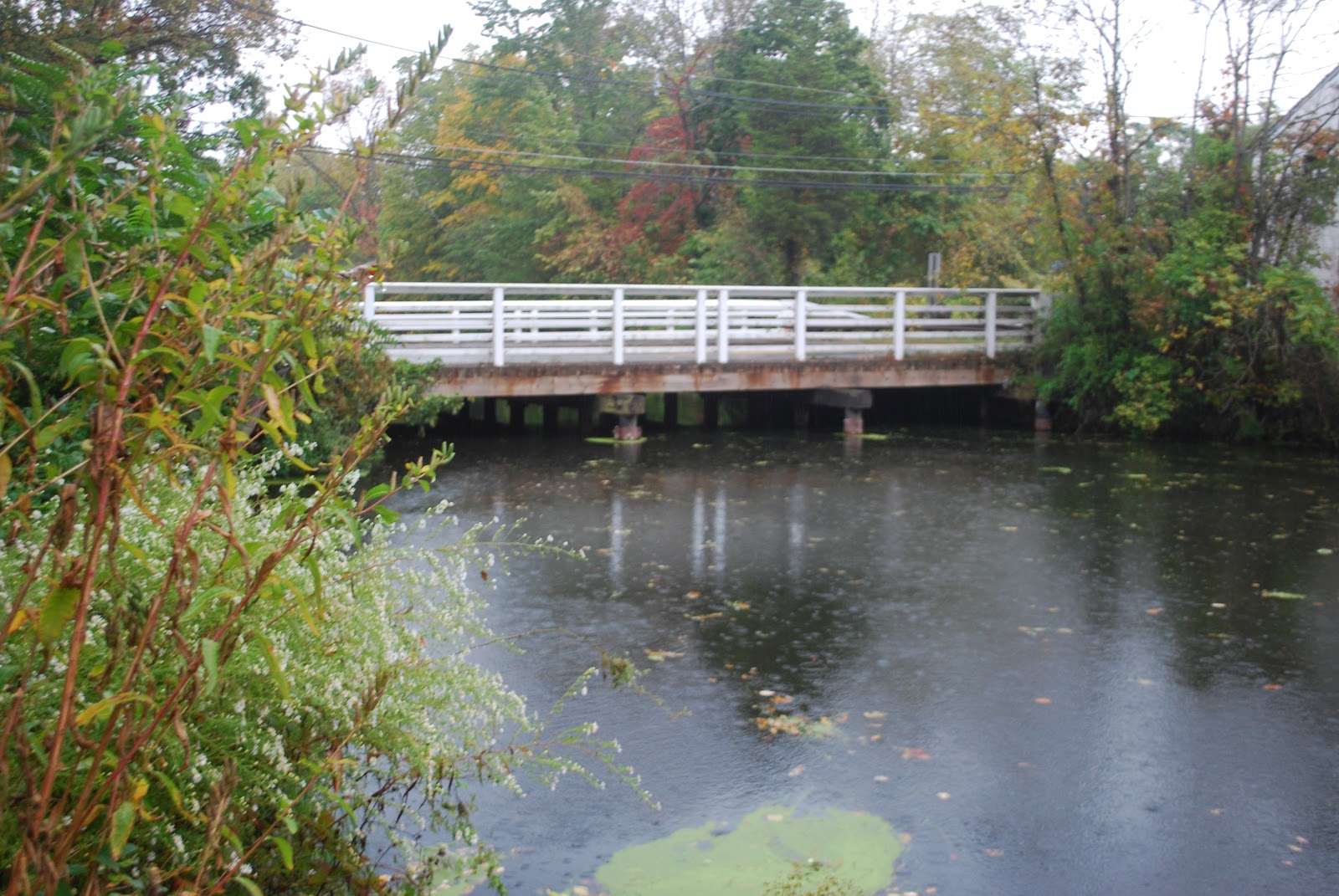
Foremost is the towpath bridge. Behind it, State Highway 29.

My wife and I are staying in Lambertville. The town situates along the Delaware River. Naturally, the possibility of fishing that river again, since Thursday last week at the wing dam, arose as a clear and present urge to act, the forecast thunderstorms not having arrived. Off I went, headed for the Tea Table Rocks upstream, also known as the Fingers, a series of rock formations jutting far out into the river, creating myriad pools where we've caught smallmouth bass. And walleye have been caught there. I once saw one about 22 inches on someone's stringer. I caught a couple of smallmouths while wading among the Fingers in December, too. 

I got a momentary view of the river from Highway 29, and it did not look good. So once I got into Stockton, I took a left and parked near the bridge to Solebury, PA. From there I walked out on that bridge and examined the river below. Running high. Deeply stained, but not thickly muddy. Too stained to fish comfortably, let alone probably too high to wade among the rocks effectively. I did catch a smallmouth from the deeply muddied Delaware on a Rat-L-Trap during summer once.

We didn't have too much rainfall down here. The river's level rose upstream. I felt certain that streams like the Lockatong Creek flowed clear. Before I left home in Bedminster on Monday, I was confronted with the choice to put my waders, salmon eggs, and microlight rod back in the car. I knew I couldn't foresee what might possibly arise, but I felt set on fishing the river, if it didn't rain much. But what I didn't think of was rain to the north, river high and stained, Hunterdon trout streams clear and fishable.

No big deal. An alternative fascinated me more than trying to pick off one or two rainbows late in the season given the stocking schedule pertaining to those streams. I hadn't fished in a long time the mouth of the Lockatong where it forms a confluence with the Delaware and Raritan Feeder Canal. Judging by the looks of a photograph I took on Opening Day 2012, my son and I visited the spot when access was better. Many decades ago, an earthen lot existed across the road, completely grown over and fenced off now. 

I felt surprised to find any pullover at all. Privilege is clamping down on access--as if we're not all privileged in America--at what I feel is an alarming rate, pushing American values back before the years of the American Revolution's defeating Great Britain. You can't fish in England as we can fish in America. No matter the British democracy. That society is essentially ruled by monarchy, which means--as it does in any case of monarchy--that privilege has an upper hand that excludes so many opportunities ordinary subjects would have to fish. 

I parked, despite the "No Stopping. No Standing" sign. I took note of the Division of Fish & Wildlife stocking sign posted on a tree there. Absolutely, I resolved to fish--come hell or high water. With that sign from the Division present, I knew I had a chance in court. 

And I felt disgusted at the effrontery to access that "No Stopping" sign represented. Can you believe it? In 1979 three friends and I camped here. We put a 12-foot Starcraft on the canal. One of my friends and I fished muskies. After doing that, I walked upstream, fishing as I went with a Mister Twister, catching 10 smallmouths over the course of about two miles and having climbed untold vertical elevation. The Lockatong flows pretty quickly down and out of the hills.

I guess the other guys wanted to get high, rather than fish hard.

But I fished today. Up here, only about three miles from where the canal begins at Bull's Island, the canal flowed high and deeply stained. Only where the tannic flow of the Lockatong flowed into the canal was some clarity present. I fished all the clarity I could find, and deep into the edges as well, except for upstream of the bridges. 

I hooked a musky about 30 inches long here in 1977. It didn't stay on the hook, but you can imagine that such a deep break in the canal structure as this confluence would attract them. I witnessed a friend of mine, Joe Kasper, fight another musky the same year at the same spot. It leapt right in front of our faces, throwing the hook, a small one about 24 inches. Tiger musky. I saw the vertical markings clear as day. 

When done below those bridges, I walked across the road and looked down over the bridge, curious about any further possibility of access. I saw that to the left, a deep hole might hold some bass. Black, tannic water. (I've caught Maine smallmouths in tannic water.) I don't remember the creek being tannic here in the past, but that's beside the point. I didn't want to fish any longer today. That disgust I had felt had taken over, and I just wanted to get back to the Air B & B and write my post. But before I would walk back across the road to my car, no ticket on its windshield, me feeling as if I were being judged by passing traffic for being in the wrong, not in the right we sportsmen understand, indeed I stayed in the right, turning the corner of the metal fence and making my way to where, yes, it's possible to access the creek. 

If I were to be ticketed, I'd already conceived a defense by the rights of the American Sportsman. (Last I checked, this nation still is the United States.) I would study the constitution, because, seriously, it must be open to the interpretation that public water must be allowed convenient access.  

The Lockatong Creek enters the Delaware and Raritan Canal to the right of the picture. Across the canal, some of the water overflows into the Delaware River, as if the creek would flow across and into the river. Because the canal is only about three miles downstream of its origin at Bull's Island, building an aqueduct for the creek to flow under was not possible. The level of the canal is only so much--maybe a few feet at most--above the river here.


Thursday, April 3, 2025

Baker's Basin and Moving On


First of all, let me say today was a strange day in many ways. It coincides with the fallout of so-called Liberation Day, though I wasn't thinking about that. Since I've got home, I've made sure to watch Fox News, but I remain skeptical about the President's idea about bringing back manufacturing, as if that cultural implication will actually revive the country. And I say that because I believe the future is new forms of advanced digital industry and energy--thus new jobs--not the past forms that are simply obsolete given the mind's advance since then. I fear that we've simply been set way back on the flourishing aspect of a future that is inevitable, while threatening to increase the heat of climate change. 

Not to mention that it would have been nice if the bull market didn't end once the President was inaugurated. Gas prices going up. What next? And the big question--what for? Nothing, right? Isn't that how vengeance always works. The vengeance takes down both the assailant and his victims. 

I rode over to The Sporting Life in Whitehouse to buy a dozen shiners. Not because the weather is too cold for lures, but because I had in mind my favorite spot on the canal in Lawrence Township near Princeton by way of Quaker Bridge Road, where I've usually fished colder water with shiners. Ideally, it's a mild day when I fish there, because a pipe drains a small, very shallow pond into the canal, and that water flowing out can be warmer. I would fish there for maybe half and hour and then move on to the place I had most in mind: Bakers Basin, at Carnegie Road, Lawrence Township, and I would get there by way of U.S. Highway 1.  

I quickly caught a bass of about 13 inches by casting from up above so as not to spook anything in close. Got it up on the bank, the circle hook came free, and it plopped back in, so no photo of it. Then I missed a few hits from something that seemed to play with the (large) shiners, more than get serious about eating. I got hit again and reeled in the small crappie. Had a few more hits like that afterwards and caught the bass photographed.

I had bought size 4 and 6 circle hooks from Melton Tackle. It's a good price, but not only will a bass swallow a circle hook as quickly as it will swallow any other, a circle hook will not rust out easily, unless it's bronze like my Eagle Claw J hooks. Have seen only corrosion-resistant finish, which of course means resistant to rusting. So you can end up killing more fish with circle hooks. Not only that. It's quite difficult to hook a shiner through the lips with a circle hook. Had little trouble hooking them through the dorsal area when ice fishing, though. So today I switched back to a J hook and consigned my circle hooks to ice fishing. Maybe for Yum Dingers, too, 1/0. 

I fished my canal spot as if alienated from something I love to do. I said I did not think about what happened yesterday and the fallout today. I did see the Dow was down four percent before I went out, so I knew for certain but put it out of mind. Or so I would have thought. It felt as if I were being drawn into facing some unpleasant truth about myself and the fishing, which for decades has vitalized my energies. It was interesting enough to keep at it there for 45 minutes, but it seemed oddly incongruous to something having to do with the present year compared to long ago.

I mentioned Baker's Basin in a recent post, and today I fully intended on visiting the place. It's in Lawrence Township near the border with Hamilton Township. Why, I wasn't sure. As I rode U.S. Highway 1 from Quaker Bridge Road south, it didn't seem good. I turned right onto Carnegie Road, after turning around at Darrah Lane, and noticed the old Allied Van Lines warehouse is now a storage company. I rode a little further to see that indeed, Baker's Basin no longer has a parking lot. Instead, I parked in a lot adjacent the canal and walked the trail along the canal to the pond. 

The first thing I noticed is that the pipe connecting the basin to the canal--when I first saw the basin in 1971, there was the large opening to the canal where mule barges of the 19th century crossed--is broken. (I think they moved coal.) The front section apparently rusted away and sank into the pond, but there's still a flow between canal and pond. Bass go in and out.

Pads were up. Usually, I'd feel that's kind of nice, but it seemed like something from Jurassic times, the way the leaves protruded above the surface. I cast along an edge and a small bass tried to take the large shiner, too small a bass to hook. I did work my way down to the deep corner, hanging out there awhile. Some people do fish the Basin; litter gave that away. Not the other side, though. It's grown over and possibly holds more bass and pickerel, though I don't think the fishing pressure here is anything like it used to be, when it consistently produced. A fence with No Trespassing signs hugs close to where we always used to park and fish on that other side. Warehouse a little to the left. 

I fished where, 50 years ago, I caught bass in late February on shiners by fishing them very slow in the 12 foot depths, live lined. That inspired my first published article in The New Jersey Fisherman in March, 1977, "Early Largemouth." That magazine became The Fisherman. You might think that would be cause for celebration today, at least a leap of joy, but neither happened. Instead, the world seemed a pretty dead place. 

I have to get a new website up before I return to my book and finish it. 

All writers suffer self-doubt. Chris Pierra of the NJ Multispecies Podcast famously said, "Suffer for the fish," and there's no doubt that artists, writers among them, suffer as well. Sometimes I do in horrifying ways, but by always applying a pinch of salt as if I'm skeptical of the frightening scenarios the mind drags up from hell. I neutralize the moods. I always have plenty of control, and my friends might be relieved to learn it always seems to happen when I'm alone.

Not that I don't like being alone. I'll always fish alone on occasion. Come hell or high water. 

Besides, Loki the black Lab came along today. It's just that voice ought to be given to this weird thing coming down the pike as stocks plummeted. According to some psychologists with advanced degrees, there's such a thing as the collective unconscious. something I've taken for granted since I was 19, and it's as if today I blew around in the winds of the spirit. Not a good thing with such loss all the way across the country and around the globe.

I did catch a pickerel as I headed back towards my Honda Civic. There was an opening between trees and brush, where obviously some fishermen approach the pond. It was a saving grace to have one of my hunches. That's something I love about fishing. The psychic aspect. The ability to have a feeling about a spot, even when all the others have failed me. And for that spot to produce. Small pickerel. But even though I had had that feeling and had followed through, it seemed kind of absurd to have caught it. I even felt today that I should be working a job. What? Now we can't retire, because we have to all lose money for no purpose but some delusion about return to outmoded forms of production?

But I mean, really, I'll get the website up. It's not the end of the world. Takes some work, but I'll do it! I'll get the book done. I'll write the novel next. It's just that 51 years since I began fishing the Basin is a very long time, and I guess the message it relayed is that I damn well better move on.    


More Big Sliders Than in the Past

Pads Up

Beavers weren't here in the past. This is a big tree, and it's as if the beaver knew that, backed off, and is awaiting heavy winds to bring it down.


Friday, March 7, 2025

Front Came Through and Put Fish Off


If you remember from yesterday, I wrote about muddy water from the Delaware River possibly reaching the Island Farm Weir area of the Delaware and Raritan Canal today. 

I rode I-287 to exit 12, seeing as I passed over it on the bridge that the canal was clear. I felt a little surprised at that. And then I began riding north on Weston Road. Within a mile, almost to the area of the weir where I would park, the canal became muddy. Muddy water had indeed reached the area where we fishing yesterday, but I simply turned around and parked at the little park by the South Bound Brook canal lock and fished there. Water was plenty clear. I saw my shiner three feet deep or more. 

I fished hard for two hours. I grew all the more convinced that because the front came through, the fish turned off. Extreme winds gave that away. The temperature really wasn't bad, as high as 52, but it felt cold out there. Gusts came through of perhaps 60 mph. I saw a fat limb fall from a tree into the Raritan River, enormous splash, and I was careful when standing high over the water at any edge, because I could have been blown off my feet.

When I had got there a few small cumulus formations floated in the sky. When I left, I saw only one very small puff up there. All blue otherwise. 

I usually catch at least one fish when I fish the canal. Any time of year. As it went today, I was just glad I gave it a sincere effort. I did see a large turtle. Probably a slider. 

Near the end of the outing, I went into a mild reverie. Often that's when the fish hits, but not today. I began ruminating a little bit about catching up on a few spots I haven't fished in decades. For what they are, they're a long drive away. I routinely drive an hour to access spots to the north. Mostly, they're promising places. I wouldn't say the two I have in mind are bad this time of year, however. Not when temperatures have warmed. 

One of the spots is a very shallow, very weedy pond that warms five to 10 degrees better than the canal when temperatures spike early in the spring. The pond empties through a pipe into the canal, and while lots of fish can be caught in the pond, they're usually small, although I did once catch a 20-inch pickerel. But at the pipe, I've caught some of the biggest fish I ever have in the canal, which come and bask in that warmer water. A 22-inch pickerel and I have a vague memory of encountering a nice bass. My biggest crappie, too, and lots of that species. 

Thirdly, there's Baker's Basin, which I suspect is no longer fished. I might not be able to fish the pond effectively, because overgrown, but in any event, it will be interesting to evaluate. 

Maybe next year when I have more time. 


Thursday, March 6, 2025

Bass from the Cold Delaware and Raritan Canal


The bottommost photo is of the flooded Raritan River. I believed the canal might be clear enough to fish. If not, my idea was to fish Round Valley Pond, which Oliver corrected me on. The park closes at 4 p.m. We'd have no time. 

We met at my house, then rode over to the Sporting Life in my car. Me, Oliver, Brian. Bought a dozen large shiners. Dead ones work, too. 

Brian said he wanted to throw paddletails. (At the end of the outing, he was throwing a Chatterbait.) 

Driving over really wasn't bad. We took 22 East, cut over to 28, went through Somerville Circle, connected to 206. Over to Manville. Onto Wilhousky. Soon we saw the canal. 

Normal color.

It takes a while before muddy water from the Delaware gets over here. I love fishing that canal so much, I want to do it again tomorrow, but it's possible muddy water is on the way. If I get there and that's the case, I'll go over to Round Valley Pond, unless the thought of something else crops up. A really interesting option is Baker's Basin Pond, but Lawrence Township is fully an hour away.

Besides, when I last visited there, trails had some pretty heavy overgrowth, so it's possible those trails no longer exist and the pond is just a safe haven for gamefish that is no longer fished. 

We can't "go back to the 70's." If no one's fishing Baker's Basin, it's not the 70's. The place was hit every day back then. 

It produced, too.

Do you believe for a moment a pond that's been abandoned, possibly even the extensive parking lot grown-in, is going to become the place again, fished every day by local residents? If we're going to fish in the future, we need to embrace the technology of the future, not attempt to escape it into the past.  


It was so nice to forget about all that for a while today. 

I've caught a lot of winter pickerel on crappie jigs around brush, wood, stuff in the water. That's fun, because you see the pickerel bolt out of the sticks and hit. Oliver saw the like today, when he fished a paddletail and got the paddletail bit off.

I prefer live-lining shiners. This time of year. During the summers in recent decades, I've fished Yum Dingers. But I love the cold and cooler weather of the canal, because I like the feel of pickerel taking a shiner sidewise and bolting a few yards. Today, the pickerel that hit one of my shiners bolted from a couple feet away from the bank, directly to the bank, underneath some stuff. I got to feel the fish turning the shiner around in its mouth, but I was sure it was a really small fish, like a 10-inch pickerel. (Little ones like that are common in the canal.) I didn't let it take the shiner too long, afraid of gut-hooking it, and when I set the hook, I simply pulled the hook from that shiner in its mouth.

Brian and Oliver didn't quite dress for the weather. Especially with a heavy wind barreling down the big river, it was especially cold out there. Forty-four degrees felt much worse; it was miserable, but especially after I encountered the pickerel, I felt motivated and happy. 

It was time to go. Brian has Raynaud's disease, and even though he never dipped (Oliver and I did barehanded) into the minnow bucket, his numb hands turned purple without gloves. 

I understood the fishing wasn't going to go further. I would cast some more but not much more, and before I could tell myself to stop, I saw green gills flush and my shiner disappear.

I was standing beside Brian and Oliver. "I've got a nice one on," I said. I felt the fish pulling line out into the canal, tightened up on that line, and set the hook, expecting some fun from a pickerel about 18 inches long, a nice one for the canal. 

Turned out to be a little bass of about 10 1/2 inches. It's always a blessing to catch a bass in the cold canal.    

Brian Cronk fishing for walleye

Raritan River


Saturday, February 25, 2017

Spring's Here

Today's temperature of 75 here in New Jersey is the highest in memory this early. I got word of trout rising for tiny midges a week or two ago. We've had mild weather with more to come. Trout were rising on the Musky on a recent morning. Not by my witness. Another informant.

It would be easy to check out Facebook and get more word on the trout, but I'll let this pass. Prefer word in person.

A friend of mine fished the Delaware and Raritan Canal on a mild day last week, three pickerel on a jig tipped by Keitech.

Spring is here.

Tuesday, February 2, 2016

Delaware and Raritan Canal State Park: Mule Barges, Rough Men, and Bass

Delaware & Raritan Canal


The Basin


Coal barges pulled by mules, maneuvered into Baker's Basin by muscle, took refuge here from the Delaware & Raritan Canal current. Rough, wearied men rested on the 10 or so acres overnight, not so exhausted. They built bonfires, partied and drank. The stories told here are legend no one will ever know. Nineteenth century history never printed. Free as the air we breathe. The lusts that gleamed in fire-lit eyes as men rapped back and forth about women must have been enough to power a tractor trailer.

I heard about bass caught here when I was 10, so I cajoled my father to drive me over to have a look, having memorized directions from the father of a girl I knew, a father who cast big bass plugs into the pond.

Dad drove me over. There were about a dozen black men hanging out, and I felt deeply curious, because they didn't seem in the same space I came from at all. One of them turned and glared at me with wide open eyes holding great power. Mine didn't flinch. From the passenger seat, I held his enormous gaze, and analyzed it as I concentrated. Not exactly hatred or negativity, though that was there with rage just behind. I swore I saw the faintest glimmer of desire to know, rather than destroy.

"This place is wild!" My father said. Without saying another word, he simply swerved the station wagon around before he ever stopped, and vacated the grounds.

I understood and said nothing.

Four years later, by my request, a friend's father drove the friend and me over. We fished. Maybe that's when I first noticed the Allied Van Company immediately in front of the gravel lot, off U.S. Highway 1, loaded with tractor trailers. One form of commerce transportation to another.

I caught a bass and couldn't believe fishing as good existed so close to home. I had caught bullheads in the canal downstream, crossing Route 1 on my bicycle as a 12-year-old. But largemouth bass?

I fished here often, completely unafraid of my neighbors from Trenton. I don't know what Dad thought. Probably nothing. Most adults repress their fears and hope for the best.

It's good I went that first time with Dad. Then, the original mule entry existed. Four years later, a mere ditch pipe exchanged water where the open swath had been filled in. I saw something that existed since about 1830, when canal construction completed.

Now, not mule barges, but bass cruise in from the canal and winter over in the calm basin water, deeper and better habitat for bass in cold water, water in which they don't have to expend such energy with low metabolism struggling against a current. Just like the barges at night.   
 

Thursday, September 3, 2015

Fall Forage Shift is on the Way


           “Sounds like Christmas bells!” Marty’s fish finder alarm sounded constantly, a school of hybrid striped bass right under his boat 29 feet down.
          
          Nothing comes to mind to signify fall fishing so much as the memory of Joe Landolfi’s astonishment. Last October we witnessed our fellow Knee Deep Club member catching hybrids one after another on Lake Hopatcong. They stayed put for three or four hours. 
         
          By late September, all the gamefish in Lake Hopatcong and elsewhere begin to feed especially on forage fish as the smorgasbord of summer insects and other creatures begins to decline. But there’s more to the story than what finned forage is available to predators.

          Fish don’t fatten for winter. Cold blooded, they don’t hibernate—metabolism determines feeding behavior. However, every species has an optimal range of temperature response in which they feed most actively and grow best. Fall feeding is all about that optimal growth, the unrelenting drive to more life and power. 


          It may seem counterintuitive that fish come alive in chillier water. The colder the water, the more metabolism slows. But temperatures above optimal ranges condition fish to feed by the conservative strategy of reducing activity to save those calories that burn faster. Insects are an easy meal, rather than, for example, a smallmouth bass burning energy to pursue an alewife herring. Even largemouth bass may feed on insects alighting on the surface, and they certainly leap for damselflies.

          With temperatures optimal September through November depending on the species—walleye and hybrid striped bass especially thrive in colder water—gamefish give chase. Fishing with Joe last October, the action never ceased all day long. The hybrids and walleye feed on Omega 3 fatty acid rich alewives with a drive to live and grow awesome to contemplate for its ferocity.

          On the Delaware River, shad fry begin to come downriver in late September, headed for the Atlantic. Smallmouth bass will on occasion school up and herd these schools of Omega 3 forage, blitzing by attack formations like cocktail bluefish at the mouth of a coastal inlet. Walleye in the river busily feed on the same forage beneath the surface, as do young striped bass hatched as far north as Barryville, New York and possibly further. Even channel catfish get in on some of this action, especially on whatever is wounded by schools of smallmouth bass, which falls or flutters to bottom.

          Farm pond largemouth bass now go after bluegills any time during the day by sudden, swooping ambushes with gaping mouths open, water rushing past gill plates. The bluegills don’t swim passively along with the predator bass as they typically do during summer afternoons. I once fished in a heavy rainstorm with early October temperatures in the mid 70’s. Water temperatures warmed from about 68 degrees, and dozens of bass as large as four pounds struck, some of them leaping two feet out of the water to come down upon and engulf the spinnerbaits I buzzed, retrieving the lures just fast enough with rod held at 10:00 o’clock position to create a wake across rain-studded surface. I’ve never seen largemouth bass in such a manic state since, but have found that a warm rain any time from late September through October, so long as water temperatures warm, is a good time to fish.

          Pickerel feed primarily on fish year round, but fall is probably the best time to catch a big one, as they too experience optimal feeding conditions. During my teens, the Delaware and Raritan Canal had sand bars at the bridge over Quaker Bridge Road, Lawrence Township. By October, silver shiners schooled on top of the bars in a foot or two of water. Pickerel grouped around, and on occasion could be seen rocketing up out of the dark depths of four to six feet, snatching a shiner, and diving back down. During the 1980’s, the canal was drained and dredged. All the bars are gone and haven’t returned, but pickerel present in the canal today and elsewhere are emboldened and quite gullible for a live shiner, in-line spinner, or Rapala plug.

          The feel of a chilly, gray, fall day with a strong breeze is like the mood of walleye and other gamefish—harshly active and making their presence felt. Winter weather freezes the water and, comparatively, the angling action. But until it really gets cold, October and November’s subtle beauty, instead of feeling desolate and barren, invigorates and enlivens.      

Saturday, April 18, 2015

Raritan Headwaters Association Stream Cleanup a Success

Raritan Headwaters Association held its 25th Annual Stream Cleanup today. Thirty three sites along the South Branch Raritan River, North Branch Raritan River, Raritan River and tributaries to these three great New Jersey waterways kept volunteers from throughout the region active for three hours this morning.

I volunteered at what was designated as Drake's Brook in Ledgewood, since I had never before visited the creek and wanted to have a look, shoot photos, and spot any wild trout as well as pick up trash. Copious volunteer turnout felt encouraging and hundreds of pounds of trash taken out leaves Canal Park in better condition. The area really appears clean and natural now.

Canal Park hosts remnant ditches once part of the Morris Canal. Back in the woods, I found stone structures which may have been part of the canal system, although Roxbury Township Historical Society hasn't marked them to give any wanderer certainty. Beautiful day to be in the woods and on a stream, the temperature climbed to about 70 before noon.

I did spot three wild trout, very sure rainbows. Each nine or 10 inches long, they scooted about together before dashing from view. Markings and fins distinguished them as trout, but before I could look closer, I couldn't get over feeling nonplussed that they were rainbows instead of browns. I searched other holes, but found no more. Water quality is not what I hoped for. Frankly, I felt surprise--and bliss--upon seeing the trout. The rocks have that ugly brown algae covering them, which indicates water purity that could be improved. Suds on the surface just below riffles indicates phosphorous in the water, I think. I've seen much purer stream water in New Jersey.

I hoped for better, but I was warned. I attended the Association's Stream Monitoring Conference this past December. From what I've gathered, the Canal Park area hosts Ledgewood Brook, which is renamed Drake's Brook just downstream. Ledgewood Brook currently has moderately impaired water quality and the suspicion centers on the dump in Roxbury Township, which has been a big news item as residents have been ill affected. The Association has plenty of evidence to suggest the stream should have much better water. The good news is that wherever the Association monitoring took place on Drake's Brook, the team provided evidence for a perfect score on water quality. I imagine the flow much further down has filtered out impurities a great deal.

Nevertheless, I can't imagine the water downstream of what I witnessed has the quality of, for example, the Dunnfield Creek in Warren County at the Delaware Water Gap. The Dunnfield is so well spring-fed that the deepest pools have a fresh, aquamarine coloration and perfect clarity. It could be embarrassing to confide the following, but it will really back up what I have to say about the Dunnfield's purity. An older friend told me back in the 1970's the Dunnfield's safe to drink. He demonstrated. I took his lead. By all the evidence, it seemed so. For years, I visited the stream trout fishing, hiking--and drinking from it, no purification tabs or boiling. I never have experienced any ill symptoms whatsoever and it tastes very clean. Then I became associated with professional naturalists and spilled the beans. They urged me never to do so again, but I might, though their concern is the possibility of an amoeba. It's clear the stream isn't safe to drink, though I think it's a wonder that a stream in New Jersey can be liberally imbibed with no ill effects, not that any guarantee against illness exists if I try again.

We once fished the Dunnfield many years ago on a trout Opening Day washout. Every stream in our purview raged muddy, and we sought a place that just might retain clarity, a smart move. Dunnfield Creek ran too high to fish effectively--flooded--yet the water remained clear. No, it hadn't the perfect clarity normally so appealing, yet no one would say it ran stained.

http://www.raritanheadwaters.org/
Further down this gulch are a few stone walls that may have functioned as part of the Morris Canal system.
Stone walls left, right and further back in the upper right, which possibly served the Morris Canal system. The Delaware and Raritan Canal flows into the Raritan River at New Brunswick to this day, and I think it's pretty cool that the lost Morris Canal ran in very close proximity to a South Branch Raritan River tributary. And this tributary Ledgewood or Drake's Brook (the brook is named Ledgewood closer to the source) runs within a fraction of a mile to the Black River headwaters, the Black River renamed the Lamington further below, flowing into the North Branch Raritan River down in Bedminster.


Thursday, October 10, 2013

Delaware and Raritan Canal Recreation at Weston

Tried the Delaware and Raritan Canal again, at Weston, attempting pickerel with shiners--nothing happened. But I fished with vital enjoyment, practicing my pitching and casting in and around thickets. I must have made half a dozen really good casts that barely missed getting hung up, one of these angled around a whole row of branches allowing me to reel the shiner underneath them. Twice I got hung up. Duckweed is still present and the tactic was to allow the shiner to swim into the darkness underneath the matts. I was a little surprised nothing was ever there to grab the bait. I walked a good eighth of a mile downstream of the lock, fishing hard as I went and really enjoying the solitude, no one having braved the weather to bike, jog, or walk the towpath.

The canal is a small waterway 66 miles long, but it's no place for an expensive boat. Most of the fishing I do is in small waters, and while I would like to fish larger waters with better fishing more, I stay within my means as I have to--and get out there. I don't limit myself to the big trips I take a number of times each year. If I can have a half hour's fishing and get my head cleared out, the positive gain is more than time easily invested. That's what recreation does--refreshes you for more serious matters.

And a lot can be said--a lot more than I will note right now--for small waters, even small waters that typically provide poor fishing, like the canal has for me during the past 20 plus years, better longer ago. Why do I keep returning to the canal? I could have fished Round Valley instead. I could have tried plastics on top of remaining duckweed at Colonial Park for bass--last I did that, I missed seven explosive hits. It's a funny thing, but while I unambiguously love lakes, rivers, the Atlantic, bays, I won't give up on little places like those I first began fishing. The first place I ever fished was the canal, when I was eight. It no longer has the mystery for me it had at that age, but I know the mystery is there and when I go, I don't want to leave detached and bored. I want to tease out a response that makes me happy, to tell me not everything in this world is good only because it is big and costs a lot.

Friday, October 4, 2013

Delaware and Raritan Canal Pickerel and Bass Fishing

(Poison ivy changed color)
 
 
Back in the 1970's, the Delaware and Raritan Canal was consistently good for pickerel and largemouth bass. Since its being drained and dredged, I've never caught more than two fish on an outing. A friend and I even canoed several times in the 1990's and didn't do any better than I have in recent years. On my recent outing, a bass about a foot long nosed my dead shiner. I quickly put on a live kicker, but guess the bass was gone.
 
I could smell the creosote on bridge pilings when I was 12 years old, catching bullheads near Route 1 in Lawrence. I guess I'm sort of hooked on the place, even though the fishing is so poor. If anyone does well on the canal, please tell me about it. I'm very curious. I've fished it from Bull's Island to just north of New Brunswick, most recently finding it nice to be outside in near 90 degree weather and fishing hard for nothing but a close call. I wonder if any of the muskies Fish & Wildlife stocked have been caught. I haven't heard of any, but I rarely see anyone fishing the canal anyhow.
 
Earlier plan was to fish Round Valley Reservoir, but I figured I better leave the trout alone. I bet the water temperature has moved back above 70. Same with the South Branch Raritan. I could have put wading shoes on and caught smallmouth bass on plastic worms wearing shorts, summer style. No use fishing for the recently stocked trout in the river, which I would release, with water temperatures over 70. My neighborhood bass pond, which I walk my black Labrador by, has a fresh algae bloom reminiscent of August.


Thursday, December 13, 2012

Delaware and Raritan Canal State Park, South Branch Raritan River, Neshanic River, Round Valley Reservoir, Subtle Portals to Places

Delaware and Raritan Canal in great shape--haven't seen it so clear in years. I may fish it this fall or winter after all. South Branch Raritan has perfect level, but I don't intend to try for trout here, or smallmouths. The little Neshanic River is also photographed. I once photographed a mink here where I stop on occasion for a breather.

Put out a line at Round Valley, nothing. I thought of what I wrote in a recent post about living as seamlessly as possible. Certainly, if seams are denials, repressions, complications, walls by which one refuses to get up and live, then living "seamlessly" is a nice suggestion. But the facts include that every situation is unique and bound to what it is, and to move into another occurence means passing through a change, which implies a limen, a seam. Be grateful reality is this way, because if things go wrong in one place, it's possible to go elsewhere and correct them.   

Delaware and Raritan Canal
South Branch Raritan
Neshanic River (The way I shot it, resembles the canal)
Round Valley Reservoir
Round Valley Reservoir Angler


Friday, November 2, 2012

Try the Delaware and Raritan Canal for Pickerel, Largemouth Bass, Muskies, Walleye, Smallmouth Bass, Channel Catfish, and Giant Grass Carp


This piece is fitting for November, on through winter, into the warm water season, and once again in November, because fishing the Delaware and Raritan Canal is a yearly circle. For nearly 40 years, I've most enjoyed it during the months of October, November, and on through January. It's a very special place for me because my father is an acute amateur historian--being an Episcopal church musician necessitates this, epi-scopal meaning overseeing scope--and his introducing me to the canal at age 10 made history concrete like nothing else had for me. From 1830, when the canal's construction by individual man and shovel was completed, the coal industry was served by manned mule barges. The canal nowadays has many fish species, including gigantic grass carp as large as 55 pounds or more, as well as channel catfish, the more common gamefish, and rare muskies, walleye, and smallmouth bass. I once heard report of an 11-pound northern pike that someone probably caught in the Raritan or the Millstone River and released in the canal.  All of these species and some more are to admire and pursue. Fish have scales you can almost see a human reflection upon. After all, we evolved from fish. They are the central symbol of all that is fishy within us. But what makes this place--all 66 miles of it--particularly special for me is the history, an interest for as long as I can remember. My brother-in-law Iain does hands-on historical preservation work, is presently busy trying to defeat architect Hillyer in Princeton for George Washington's sake, and if it's inevitable that the Princeton Battlefield looses, his fight is worth the gain in the loss, absolutely. All of this goes on record and good men will judge. I best admire hands-on work, like his, above financial boards and other organizations that involve committees, which tend to lose touch with reality for abstractions that are groundless. However necessary boards and the like are, in fact, the little that they may be effective tends to be lost to the sorts of complications I have written about in previous posts. Without finances, what can be done? But without the creativity that makes money possible, everything civilized collapses anyhow. I am a grass roots intellectual who does not know much about institutions that move money about; I certainly know enough to work within them, but what I know most of all is that the greatest intellectual ability of any kind has close connections to the source of reality--nature. I honor both George Bernard Shaw and the rock band named after William H. Davies' Supertramp, Shaw having written the book's preface, because an angler always finds a way, at least so long as I'm concerned. If one has to abandon all and go live off the countryside, isn't that better than sleeping over the grating of a Manhattan sidewalk? 
I desired to go out in the hurricane and fish largemouth bass at sundown Monday. Actually, I had the situation in mind for several days or more. As soon as I got the forecast I was ready for it, and my son, Matt, mentioned the same independently as a good possibility, but I felt so involved with writing since getting off my job early at 11:30 a.m. Monday that walking our black Labrador in heavy winds, awesome ghosts of rain traveling horizontally over the local pond we walked beside, a large branch deposited on the bank, served as sufficient experience of Sandy--the name of the dog a former girlfriend rescued from a shelter and gave to my parents in 1985. How's that for concrete? As if a Powerful Puppy Hound came down from the clouds. Abstraction is no enemy--so long as it's grounded. Abstraction is what makes us human rather than a dog like Sadie, the Labrador, or Sandy, the terrier. But that's really the only way abstraction proves effective, by making it concrete, so that life on earth is lived rather than people wasting their lives waiting on heaven. Psychiatrists have two names for ineffective or pathological abstraction: schizoid personality is the mild disorder; schizophrenia is the severe. You have no choice about possessing abstraction. If you can read and speak, you're abstract. Perhaps if Albert Einstein got out a lot more than he did--although he used to walk along Stony Brook in Princeton on occasion, parting brambles, deeply inspired--and actually lived in the unified field by frequent enough visitation, he might have solved the theory. Just playing with the idea, but a shopped photo does exist in which Einstein drives an Indy 500 car. That, I think, is the sort of field experience he would have needed--more than pedestrian speed.
But here's the situation I met perfectly, although without a rod and reel, and I admit I felt twinges of guilt for not fishing. Up above this pond we fish is another; a six-foot diameter pipe runs underground, under a roadway, and under large parking lots connecting the two. Essentially, a stream from a spring out of Schley Mountain, the mountain the very northernmost beginning of Watchung Ridge, which some 300 million years ago was a series of major volcanos, the stream connecting the mountain, the ponds, and North Branch Raritan River. Some of the largemouth bass in the North Branch Raritan and Raritan rivers have their origin in the ponds of our neighborhood. These mountains o 300-foot vertical elevation were once enormous, not as large as the Himalayas--as were the Appalachians--but much more than the worn down remnants, just as the American nation was greater in the 19th century; playful comparison that this is, we've been wearing down ever since, going more and more insane, which is why I prefer to be by myself much of the time. (As you might infer, I'm wildly extraverted.) My son finds pumice at the North Branch Raritan River. The mountain looms brightly over Bedminster and over the North Branch serving as the excellent river running through town, clean like champagne and inviting anyone for a summer swim; my son and I explore underwater nooks and crannies by snorkeling. Situations discovered can tell you all sorts of unexpected things. The Wood Duck Pond above the local pond we fish has been off limits to anyone but an occasional maintenance crew and whatever overseers, has for many years before my family moved to Bedminster, and is absolutely packed with largemouth bass. When we moved here in 1999, I just had to leap the fence once like a kid, take one cast, hook a bass and see the others trying to snatch the topwater plug from the hooked fish. That was all! One cast, and I got out of there fast because I was visible from the road; all I needed was to be arrested upon beginning here. (I can say so on the world wide web because you can't really know if I'm telling a tale or not.) So springtime bass spawn and some of the tiny hatchlings take a tunnel journey to the pond below. The pond is loaded. And certain rainy conditions also mean a load of water entering at that pipe. Bass move in to take whatever forage comes through--essentially they are attracted to the mud-thickened, fast water--and all I have to do is toss a spinnerbait and unless it's winter, it's bass every time, gingerly released. Bass sort of smell like ginger. If you ever try a bass on the dinner table, add Old Bay seasoning and it will very vaguely taste like ginger, although this can almost mean anything, but not quite. Walking Sadie, I viewed the water coming through that pipe at near perfect volume for action.
Well, at least I predicted it days ago and just walked out at sundown with my dog, having forgotten that I might go witness the storm. 


Try the Delaware and Raritan Canal for Pickerel, Largemouth bass, Muskies, Walleyes and Smallmouth Bass

By Bruce Litton
(Written for my Recorder Newspapers "Reel Time" column and updated for the Hurricane.)


          Having fished the Delaware and Raritan Canal in New Jersey since 1970 I hold a special affinity for this hand-dug waterway. Construction began in 1830, the same year Woolrich came into existence, maker of fine outdoor shirts appropriate for fishing this time of year, the best time to fish the canal. Mule-drawn coal barges on the canal had little to do with shirts or sheep, but the men leading these hauls got plenty of exposure to wind, chill, rain, and snow. Since they made their way from as far north as Bull's Island near Raven Rock to New Brunswick outside, some may have worn Woolrich in the spring and fall.

          Today the barge tow-path still exists, but between it and the water, trees and underbrush grow densely enough to provide excellent fish habitat. Between thickets space opens irregularly every ten yards or so where an angler can stand on the bank at the edge of water and cast. Depths of eight feet move at a very slow pace, most of this water irrelevant to finding largemouth bass and pickerel. Always fish for them near submerged brush, wood falls, aquatic vegetation, and shade, only a very few of these structures are out in the middle, and the best are combinations of wood and vegetation.

          Before the canal was drained and dredged during the 1980s, sand bars existed at Quaker Bridge Road in Mercer County. Every fall, shoals of shiners huddled in the shallows of these sand piles. Pickerel stalked them. On occasion a pickerel would rush up on top of a sand bar and take a shiner. It must have taken many years for such fish habitat to form, and I’ve never seen a sand bar in the canal since. These sand bars constituted the very best October structure for pickerel and largemouth bass.

          But another unusual structure will exist for as long as does the canal. Widely interspersed throughout its 66 mile length, locks regulate flow. Fast water below these locks attracts rare walleyes and smallmouth bass. I’ve never caught either in the canal, but I am witness to both. Since the canal flows out of the Delaware River, walleyes, smallmouth bass, muskies, and channel catfish make their way into it and have been caught all the way down to New Brunswick. The New Jersey Department of Fish & Wildlife took the clue from reports of muskies in the canal, and now stocks it with six to 12-inch muskies, 150 of them this year.

          While this is not a profusion of fish, muskellunge are solitary, uncommon, and large. Among most freshwater anglers they are understood to be the pinnacle prize--beyond Atlantic salmon--because of this mysterious and enormously powerful solitude they possess. Compared to other freshwater fish, each muskellunge is in a class by itself. I have great admiration for Atlantic salmon, and my son saw a live specimen in the Salmon River this past summer, but they lack the ghostly solitude of muskellunge, the paradox of muskellunge with their ability to vanish and be unseen, yet dominate singularly more area of a lake, river, or canal by their visceral presence than any other fish by a very long shot. Perhaps a single muskellunge will dominate an acre of Lake Hopatcong, for example, far and away with more power than any hybrid striper, channel catfish, or bass. And walleye in their lake bottom, stone palaces reminiscent of Aristotle's architectural glory in the darkness of hell, as accounted for by poet Dante--these couriers of messages too dark to be shadows, walleye have little status to compare with muskellunge. Though we hold them in great esteem, walleye. Not in Hopatcong, but maybe in Monksville and Cansitear they do indeed have such rocks. Without the fish, the Philosopher could not do business. But the philosopher's greatest courage is the secret of Elektra and the Greeks are not forgotten here below: The musky rides on lightning under its belly. Atlantic salmon, compared to muskellunge, are bound to fellow feeling, although they are more independent than other salmon species, and this, I believe, is their special allure. The New Jersey state record 42-pound, 13-ounce muskellunge came from Monksville Reservoir. As unlikely--I think absolutely impossible--as the canal is to host a musky close to this size, 15 or 20 pounds is certainly not out of the question. Fifty-five-pound grass carp have been caught, so it’s clear that the canal produces very big fish. But leave it to a monastery to produce a giant muskellunge. A certain slant of light so transforms Hopatcong, even though honey can seem out of place. Monksville certainly cannot be far behind the Philosopher's shoes. It's all in the words.

          In 1977, I experienced a musky of about seven or eight pounds attack my large Redfin floater/diver plug at the mouth of Lockatong Creek where it enters the canal in Hunterdon County. I knew this was a likely spot and used a much larger lure than I usually do for pickerel and bass. It was also the right time of year—October. The fall produces a forage shift from summer morsels of many kinds to fish forage, especially fish with soft-rayed fins, that affects all gamefish species, and besides, muskies are most active in cooler temperatures. Most streams flow underneath culverts that support the integrity of the canal’s steady flow. The Lockatong Creek near Raven Rock is the most interesting exception.

          From the mid-state Highlands and Piedmont region, the canal is easiest accessed in Somerset County, near Manville and Millstone, far from the Lockatong and Hunterdon County. Solitude is abundant, interrupted on occasion by a biker or tow path walker who usually is friendly. I find it much more interesting and enjoyable to achieve a comfortable pace moving from one clearing along the bank to the next, rather than staying in one place. I've always roamed and will never change. If I'm not walking in my 90's, what's the use? Better to live beyond age 61 but vitally and with encompassing range. No insult to Stephen Hawking; he remains productive long after his estimated time of death. Even ice fishing--which often involves some sitting--I best enjoy while walking on bare ice. To walk on ice is elevating. I feel the lift. It is water, in fact. I like it best when I'm successful at the fishing, running after tripped flags, but walking on ice transcends success or failure. No doubt, more fish will be caught in the canal this way, too, by covering range, walking, although I believe I never have ice fished it, but considered doing so in the winter of 1977/78.. The object is to locate fish with your lure or bait, not sit in place and wait for a fish to come along as if you are dependent on what they do, instead of defiant of everything but what you choose to do.

          The canal is stubborn to yield in the winter. But don’t give up—keep placing a small, weedless jig, or live shiner on a size six, plain shank hook near submerged brush and aquatic vegetation, keeping retrieves fairly slow, and you will be surprised. Pickerel often race out of cover and strike magnificently in clear view. Most fish are fairly small, but four pounds is possible.

          Don’t forget that pickerel have razor-sharp teeth. I recommend 15-pound test fluorocarbon leader tied to a small barrel swivel. This little piece of metallic technology is the link between you and a fish on a lighter line you can cast effectively. The main line can be 15-pound test Power Pro braid—the diameter is about as thin as six pound test monofilament--but braid is more visible to fish than fluorocarbon and vulnerable to pickerel or musky teeth anyhow. I’ve never had a problem moving a fish from cover using six pound test, but heavier braid is good insurance. You never know if a tiger muskellunge will boldly attack when least expected. 


Tuesday, October 2, 2012

Delaware and Raritan Canal State Park, Round Valley Reservoir, Consciousness and the Globe

Thought I would just get by and visit the Delaware and Raritan Canal despite having forgotten my rain gear, when the rain began to come down heavily enough to stay in my car. I got out and shot this photo at Manville, another at Round Valley just before it really began to pour, having adored the water quality of the canal. Recent summers it's been disgusting, especially compared to crystal clarity I have seen in the past, although usually it's of normal clarity--not dingy, not clear. Today it was as clear as I've ever seen it, like the upper Delaware River.

You can see some fall coloration coming into New Jersey trees, and this brings back memories of fishing the canal Octobers in Mercer County. We always switched to shiners from Rapalas and Rebels we cast during summer and caught many pickerel, a wonder of pursuit and reward in what looks like a very small waterway, but on foot you could walk 66 miles on the tow paths. Variations in fish habitat allow fine tuning of your game all along the shorelines.

Trout anglers fished Round Valley from shore today, but caught nothing. It's early. Fishing for bass in the rain would have been interesting. I like to loosen my consciousness through environmental beauty as I fish. I don't lose it; I loosen it just like a jogger loosens hamstrings for flexibility. Fishing's a game with a single purpose--to catch fish. But that purpose encompasses the entire globe just as water does.

Who would forget air....