Showing posts with label catfish. Show all posts

Saturday, July 20, 2024

The Outdoors is Good for Your Health


There's never a time I don't escape the lethal routine when I go fishing, despite the influence of the former mention on my initial attitude--the resistance to going I always exert better will over to get out there. I say lethal routine, because making a living will only kill you, if you don't counter-act the stress by life-affirming activities like fishing. And anything outdoors is good for your health. A proven medical fact. 

What stress? I question it, too, Much of my typical work day is free of it. So I can imagine people out there who experience little or no work stress. Besides, most of my "work stress" is really post traumatic stress. That's not normal stress. I'm like a rescue dog. But when I get out and fish, I get over any of that altogether. 


I drove west on Interstate 78 when Brian Peterson from work messaged me. He and his daughter Kinsey needed to be reminded of the meeting point, so I exited at West Portal/Pattenburg, pulling into a convenience store lot, taking note of the sign posted to a telephone pole--Live Bait. (Well we didn't need any more than Brian bought, I figured. Two dozen nightcrawlers, I had suggested.)

I told him we'd meet at the green space between the Free Bridge and U.S. Highway 22 (Phillipsburg). For me, just to think "green space" feels refreshing. Even though Phillipsburg is a city, the bank along the river is wild. I got there some five minutes before they did, not surprised that people's access to open space here has restrictions now. Some 17 years ago, I fished with my son here on multiple occasions. I believe even in the middle of the night with live eels for stripers. I know others fished the stretch at night. I remember even more clearly at present that we did. I'm all but certain Matt and I fished there after midnight. Free parking. No time restrictions. As you can see in the second photo below by clicking on it to expand it, the 30-minute free parking is suggested for activities other than accessing the river. It's like politicians do not want you to be healthy. 

There's no money in being healthy.

Well, as we were finishing up our preparations at our cars parked in 30-minute slots, cops drove by. By the time the police unit faced us on its way back out, we walked towards the river entry, carrying rods. Since they did not stop to tell us we were improperly parked, as the sign might be interpreted, I figure they were OK with it, anyhow. 

We fished 25 minutes. We lost a few Yum Dingers. Nice depth and the bass have cover down there for sure. Brian caught one, a smallmouth. 

He knew of a spot on the Pennsy side. Since our licenses were good on either side of the river, (Brian lives in PA), I looked forward to exploring.

Brian's spot is good water for sure. A long seam between rapids and slow water, a huge eddy, good depth. I had one bass on a Yum Dinger that got off, and I missed two whacks to a Ned Rig. I felt befuddled, because, clearly, bass would stage among those rocks beneath that eddying current. I'm sure they were there, and I told Brian as much. 

I began this post talking about the outdoors and health. You're reading Litton's Fishing Lines, so you probably get out to fish. Catching a few may only better that health. As I told Brian, there's an encompassing approach to the river's bass: 

These bass see dozens of lures, but it's good to start with one you can fish fast, covering water, 

and though for me, that was a Yum Dinger when it could have been a jerkbait perhaps with better results, smallmouths will swim at least a few yards to grab a Dinger dropping by, and besides, you can retrieve it pretty quickly. My first bass hit it as I reeled fast to cast it again. Yes, I had a Rapala on my mind from the very start when I threw that Yum Dinger. Oh, well.

It's a good idea to switch out search baits, though it's a losing game.

Because the bass will see what you're throwing and only become less interested in that offering. Something else might jog a reaction, but then it, too, will get ignored, and so on... 

Then you need to slow down, fish subtly to tempt fish that would be turned off by the noise of search baits.

Fishing a Yum Dinger by twitching it lightly in the depths, for example, though that wasn't working. 

Ultimately a nightcrawler might out-fish anything else.

The bass were certainly there in this second area we fished, but since they've seen just about every kind of lure we could offer, drifting a live nightcrawler through the currents might have worked. 

Brian had got his fishing license at Dick's, which had no live bait. I said, "Check your phone for nightcrawlers along Route 611."

Minutes later, we headed for a convenience store 3.7 miles away. 


"I know a boat launch across the street from a cement factory," Brian said. 

We cast Yum Dingers and let the swift current carry them well downstream, but nothing hit in the visibly shallow water of three or four feet. I believed if any bass staged in that current, they'd grab a Dinger. We soon left. 


The next spot was a park where Brian told me the Belvidere Free Bridge was right around the corner. We didn't see an easy way in, so we crossed that bridge in hopes that the green space my son and I enjoyed there about 17 years ago is still open.

It is. We parked--freely--as I excitedly expressed the fact that I had caught a bass and a little striper. Privately, I thought, "A bass. I would hope for at least a few." When Matt and I fished down below in Phillipsburg years ago, I think we caught seven of them. 

We fished nightcrawlers. Something did pull most of one of mine from my hook, but other than that, go figure. Obviously, fishing pressure. Brian had a few bites from something. Kinsey reported nothing.

And...my channel catfish. Nice fish. Twenty-two inches long. Good fight. 

We had relaxed and we settled in. You know you've reached that point of letting all the stress go, when you no longer feel anxious to try what's next; when you openly accept all you're doing from now and until you go home. That's a real pleasure, fish or not. After all, you look at the quality of the spot and you know fish could be around. You see that carp or whatever makes a mess of the surface. Kinsey felt awed at seeing, I think, two big fish make a ruckus.  

The weather was perfect. A setting sun. Temperature warm. 

You feel healthy--directly--and have no doubt it's good for you in the long term.


A boat launch existed nearby. As we walked out, I spoke to someone I had seen launch. 

"I didn't catch a single smallmouth bass," he said. 

I told him about my catfish. 

"There was a guy here mid-day," he said, "Caught a 10-pounder." 

I don't target channel catfish, but I might. I'd enjoy catching a 10-pounder on a light rod.  


The Second Spot


Belvidere


Belvidere


Monday, July 8, 2024

Brian Cronk Reaches 47 Birthday Celebration on Rippin' Lips

Brian Cronk's 47th birthday celebration on Eddie Mackin's Rippin' Lips pontoon--a fun time for all! I realized, as I left the parking lot where I live...to get there just on time, that my whole anticipation of Sunday involved worrying about the weather. Completely unconsciously, but I had.

Look at that blue sky in the photo. That's Gen Wong in the foreground, Ken from the region of Manasquan Reservoir behind him on the left, Max Wilson in the back, Brian Cronk on the right in the back, and Mark Licht with the great smile. Eddie Mackin was at the wheel, Joe Santiago behind me, Brenden from Ridgewood behind me. 

Brian had told me a few of the guys "on" Mayhem would be there, so should I take it that means they're staff members? I said so in a Facebook post, carefully framing my words with "from what I understand," and was trenchantly questioned, to which I replied, having pointed out how I framed my words with "from what I understand," that I don't take it Mayhem is a drug.

Mayhem is short for NJ Multispecies Mayhem Fishing on Facebook, and the New Jersey Multispecies Podcast. Joe Santiago is the Mastermind. Gen Wong and Max Wilson are onboard with him, in whatever capacity that is, be it staff or something else.

As for myself, when I was on the board of Round Valley Trout Association, I wasn't staff, so being "on" Mayhem may signify membership in some special way that's simply recognized and need be no more formal than that. So I say more here on the blog than I did on Facebook, though I don't care to go into edit function and revise my remarks on Facebook. 

Feel special if you've read these words. Everyone in America should fact check by reading Litton's Lines.

I don't know what capacity on Mayhem!

Except that it's some sort or other among more than the two who appear on the Podcast by what I understand! I may be mistaken.


Even at our first stop--Pickerel Point--a fish got caught. Smallmouth bass of maybe a pound and 3/4ths for Mark Licht, who let his live herring swim freely. Naturally, we hoped for a hybrid or plural of them. I've been in the same boat before, when I live-lined herring with my son during summer, and instead of catching hybrids (or possibly walleye), we caught a number of smallmouth bass. 

Second stop--a smallish smallmouth for Brenden. I lost what I believe was a crappie.

Byram Bay--as dusk began to gather, the catfish came alive. Just as Eddie had said they do, back when we fished Pickerel Point under intense sun and heat. Must have been four or five catfish caught, including a black bullhead of about 14 inches for me. I'm not entirely certain, but that might have been my biggest ever. I have caught yellow and/or brown bullheads of 16 inches. Apropos to Brian's birthday celebration, I caught those big bullheads in one of the Princeton Day School ponds. I fished those ponds through my teens more than I fished anywhere else. Brian was born in 1977, shortly before I abandoned them for the most part, going on to college and Long Beach Island commercial clamming. He fished those ponds obsessively during the 1990's. (I did then a little, too--we almost crossed paths.) Virtually no one else fished them. The syncronicity is spooky.


And...little white perch got caught. Little crappie. 

Summer is really here, my friends. When the Lake Hopatcong boat traffic resembles the traffic on the Manhattan grid, go with the flow and it feels fine! Made me want to buy a boat for the lake. Not just to fish and shoot photos from, but show my wife the sights! Can always bring a friend and his wife along, too.  

Eddie Mackin at the Wheel

Mark Licht & smallmouth.

Brenden from Ridgewood and smallmouth.


Tuesday, October 3, 2023

Narrowing It Down to the Big One


Our Lake Hopatcong ritual remains potent as the 20th fall of my getting on the water there approaches. I've invested good money in renting boats from Dow's. On the way to the Ledge or possibly Sunken Island, Jimmy Welsh swept by us in his center console. I was certain he headed for Sunken Island, and when I saw him there, I stopped short at the right-angle turn of the Ledge, immediately marking loads of fish. 

As expected.

There was no wind. That made putting out unweighted herring easy. With four herring lines over the side, I also put a nightcrawler out, by which I quickly caught a white perch. And then herring lines ran though rod guides. I caught and released a 16-inch hybrid, then caught the 4.8-pounder photographed later in the afternoon (below). It had died in the livewell. My wife and I will have it for dinner tonight.

I missed the hit from another hybrid. Setting the hook too soon may be better than setting it too late. After that, I maneuvered the boat with my electric behind an island with no sun on the water. Overhead, not a cloud in the sky.

Kevin quickly caught a smallmouth bass of about 14 inches on a nightcrawler. Got that worm close to rocks. I ended up catching two largemouths on a Senko, losing a nice one on that blue-purple worm and missing another hit. I got a smallmouth on a live herring and a nice black crappie on another of the same. 

I very much enjoyed throwing the Senko. (Actually a Yum Dinger.) Fly casting isn't the only way for fishing line to satisfy. Putting a worm--repeatedly--right where you want it to go is fun. And once and awhile a bass takes that worm. 

We had two dozen live herring and I felt determined to use them. I told Kevin about the time I caught a six-pound walleye on the Ledge at about 2:00 p.m. shortly before my son and I would leave, under a cloudless sky. Today, I had caught what were as yet my only two hybrids before the sun rose. The sun came up shortly after I weighed my big one. No necessity existed that would limit us to that catch owing to the conditions, but I wasn't entirely confident that the Ledge would work out for us. But we would mark fish. 

So, well, we should work for them!

A slight breeze had come up. Unweighted herring rode pretty high over fish marking as deep as 33 feet, as the boat slowly eased along the drop-off towards Halsey Island. Water temperature was 64 when we got on the lake; now it approached the mark of 70 where it would be when we left. Obviously, the lake had turned over quite a bit, though today's heat ran contrary to that. I did miss a hit, and immediately thereafter noticed big fish marking only eight feet down, but I'd say 95 percent or more of the fish were deep. 

I put medium split shots on our four lines. Some of our herring died, needing oxygen. They were getting down on bottom about 38 feet deep. So I looked for smaller shot, found some, and situated them about six feet up the line from the herring. The idea was to give the bait some mobility with the lighter weight, as well as the ability to swim above that weight, should it get down on bottom too deep.

The breeze ceased. A little fine-tuning of our position by use of the electric motor resulted in a couple of little 14- and 15-inch hybrids for me. We floated over the drop-off at 38 feet where fish marked at 31 to 33 feet deep. Where we had fished over 30 feet of water, no fish marked on the graph. Then the breeze picked back up. I repositioned with the electric and lowered anchor. We continued using the little shot, and Kevin caught a hybrid over 16 inches. I caught a smallmouth bass. Kevin caught a big bullhead by turn. 

And then I said, "Kevin." I had seen his rod tip lower. He wasn't paying attention, but it became immediately evident he had hooked a big one. The fish took off on such a sustained run, I wondered if he'd hooked a musky. Or, more likely, a big channel catfish. I would have to coach him. He's not very experienced and I knew the fish was no easy. "Pump the rod. Then reel as you lower the tip back down. Then pump again. Keep a bend in the rod." He kept reeling as the fish took drag, but his getting the pumping motion right enough was critical to getting the fish to the net. It took a long while. 

"Look at the size of that fish! It's eight or nine pounds!" I said, having just netted the biggest hybrid I'd ever seen besides a mounted eight-pounder and a huge hybrid I witnessed getting caught from shore at Spruce Run Reservoir. I weighed Kevin's at 7.73 pounds. Quarter pound shy of eight. It measured 27 inches long. 

4.8 Pounds


Not a bad smallmouth.


I do like catching bass on these Hopatcong outings.

They always appear pretty.

Hopatcong crappies can be pretty big.


Little hybrids fight hard too.


Trolled Hybrids
 

Monday, July 24, 2017

No Outing Fails to Surprise


Many outings fulfill their expectation and may leave a little wanting, but no outing fails to surprise. We caught nothing, and though for me this meant we broke even, Oliver really believed we would catch something. Big striped bass, flathead catfish, channel catfish exist in this river. Night requires time, patience, and perseverance to catch any, but on my first night attempt during August 2008, I caught a nine-pound flathead, which I thought must be a big channel cat before it came into view, and I lost a striper. Since then, I've tried two or three more times, neither myself nor my son and a friend caught anything but a smallmouth bass on a shiner, and a nine-inch striper on a Rapala at the mouth of the Pequest.

I don't believe it's a chuck-the-bait-out-there-and-wait appeal, even though all I did to catch the flathead was bait up with a dead eel, lob it out un-weighted (flow slow) just before sunset, and attend to baiting a live eel on the rod I intended to man. Within minutes, the flathead was on. The striper took some doing by drifting eels with current.

When Oliver and I left, he mentioned shallower currents and I knew he was onto the right idea. I knew current like this existed upstream a couple of hundred feet, but the way were situated with a party going on where he could venture, neither of us felt any gumption to try. He had anchored live sunfish with heavy pyramid sinkers. That might work, but we were aware it's hit or miss regarding the make-up of the river bottom, even with the long three-foot leaders. A number of times he found himself snagged before turning the reel crank to check on the bait.

Flatheads sometimes move into shallow, hard-bottomed riffles at night. In any case, working a stretch--and riffles at the head--makes sense. Involvement of any kind tends to yields results. But river night fishing for these big targets...I felt sure the first time I bought live eels for bait that this takes some time and figuring out. Every outing since has confirmed this feeling, and I wasn't fooled by the first, either.

I wanted to get out under night sky, fish, and above all enjoy good company...possibly gaining just a little more insight into the workings of this endeavor for elusive stripers north of tidal water. All expectations felt fulfilled. It's not that I'll ever become a regular at this, either. I'm just satisfied to meet the mysteries on rare occasion.

On the way there, we drove across the Pohatcong. Oliver had his mobile device pinned on the spot. Suddenly, I braked before a huge tree on the road. Rain had fallen, but at least in Bedminster, no wind accompanied.

"We're not far," Oliver said.

"Let's park and walk."

"Better back up and park on the side."

"Yeah."

I put it in reverse and as I began to maneuver, Oliver said, "Is there another way?"

"Not that I know."

He was working that mobile device. "There is." Soon it talked to us. I typically find the likes amusing more than annoying. It showed us the way. We rode up and down two mountains. About five miles, I guess. I never would have needed a mobile device. I've never been in a situation when I needed one and have no desire to upgrade from my flip phone. Time it took us to drive around the tree....was probably more than walking would have entailed. Just an amused thought I had.

Mysteries. No stunning meteor on this night. But I haven't heard a screech owl in years.

Surprises. Dead wood tree on the road. Two dead-wood fallen branches on the road, separate places. And weirdly, as we fished near the time we quit at 2:30 a.m.--same time three fishermen across the river quit (they had fish on)--a large tree fell in the woods nearby. Not a trace of wind. I could tell by the sound of the trunk breaking it was dead and rotted. I reasoned and told Oliver that just maybe there had been wind earlier...which loosened that tree. Not much more likely than it falling after what we had witnessed. Another surprise for me is valuable for fishing knowledge. Still on I-78, headed for Exit 3, Oliver asked me if this rain would raise the river level, and so increase our chances. He didn't mean raise it dramatically. I said no. But coming towards Carpenterville, he remarked on us getting close to the river as the road began to descend fairly sharply. Some seconds later, I realized that even with the relatively light rain--sustained and for a little while pretty heavy--a lot of water was coming downhill, and said that, yeah, that level might be coming up a bit. As we set up a little while later, Oliver wedged a surf spike between rocks at river's edge. Just an hour later, he remarked on the level having come up a couple of inches. When we began packing to leave, I noticed three or four inches of water had climbed up that spike. For fishing, yes, a rise in water level not dramatic can be very good.

That screech owl. "We hear them in our backyard," Oliver said. That impressed me, but took a little of the faraway quality of the bird's call away. Some light haloing over horizon to the north made me long for my tripod...and reminded me I need to learn manual camera functions. More than any other attraction, the big fish that repeatedly broke surface mid-river interested me. One of them slashed water close, and I saw the break--immense and exciting. Oliver believed them carp. But he did remind me that carp typically break water around spawning time in spring. I drifted eels right down their ally.

There the current takes a great eddy formation. As far as I could cast--and with my eight-foot Tica I cast a 15-inch eel very far--the eels drifted upstream. The situation reminds me of tarpon fishing behind Big Pine Key. We drifted blue crabs directly on tarpon that turned over at the surface, never taking a crab.

I got into play. The little insight I gleaned involved  a definite idea less than further confirmation of the efficacy involved in letting all go to guide an eel the right way. The humble idea of conscious attunement was enough for me last night. I got snagged three or four times, and the first two or three mishaps resulted in lost eels and hooks....which didn't sit right with me. I knew it possible to open bail, let the eel find its way out and then to continue the drift, because I discovered this that first night in 2008. The last time I got snagged, the eel did just that and redeemed all former losses.

Above all, when drifting an eel, I do not impart much action. I figure the less a striper is alerted to any guidance extraneous to the river itself, the more likely it takes. So naturally, the more I'm attuned to the river, rather than distracted with myself, the more I am like the environment any striper out there occupies. There was often silence between Oliver and I, but more between myself and my activity. We spoke freely without any hindrance. At my best, I felt sleek and active while measurably doing very little. It was about 85 degrees out--at least 80--and upon setting up I had taken off my Woolrich wool shirt, which I used to help subdue wriggling eels to get them hooked. I felt all the more there in the wild with no shirt bagging my skin.

Most of my hooked eels wriggled and scurried. Once and awhile, I enticed them to do more of this. I was curious about where they swam in the water column, but not concerned that they cruise at bottom where they try to get under rocks or whether they swam freely. After all, if stripers were breaking water on occasion, it didn't seem best the eels swim deep. Somewhere out there in the vicinity we fished, the river is 35 feet deep. I've always felt this is probably excessive for stripers, but where I placed most of my casts last night, I hooked and fought a striper almost 10 years ago. A very different style of resistance to a rod than any kind of catfish. When Oliver tried a shallow-swimming surf plug, I thought it an interesting idea.


http://littonsfishinglines.blogspot.com/2012/05/river-channel-catfish-delaware-river.html

Saturday, July 22, 2017

How did the Ayn Rand Institute get my Mailing Address?


I-78 Exit 7. Highway 173 begins to uncoil. "I Keep Holding on," Ambrosia, completes as Warren Glenn Road unfurls on my left after a mile. Motion feels smooth as the low register of a French horn, and I wouldn't be surprised if one of the band members plays the instrument. They had performed with Leonard Bernstein at least once. I reach into my stacks stuffed in the driver's door and come up with my Outlaws c.d., load it, and select track 5."Green Grass and High Tides."

Through Finesville, into Riegelsville, I listened to what Tom Breen, during the 1980's, named our Clammer's Anthem. Tom and I had shared a house in Brant Beach or Ship Bottom during spring 1987. I lived in so many houses and apartments and rooms on Long Beach Island, Cedar Bonnet Island through which the Causeway channels, and Manahawkin on the mainland side of the bay during my 13-year adventure, I can no longer place each rental. Breen had enrolled at the U.S. Naval Academy, Annapolis, Maryland, but absconded for the free-spirited and self-employed Long Beach Island and bay life. He wasn't the only Navy man among us. My 1983 and 1984 Surf City housemate, George Cunningham, served in the Navy for a number of years as a scuba diver. He came to Long Beach Island for some of the same reasons as had Breen. George summed his motive in one word. Freedom. 

George read literary classics. His favorite wasn't a classic I would have read at St. John's College, situated across the street from the Naval Academy in Annapolis and dubbed "the American Oxford," where I enrolled during the spring 1982 semester. Kon-Tiki by Peter Mathieson is the true story of crossing the Pacific by raft in 1947. I happened to read The Snow Leopard by the same author--about a soul-searching Himalayan quest--during my March and April 1984 Appalachian Trail hike from Springer Mountain, Georgia, to Hot Springs, North Carolina. 

But about The Outlaws. The Outlaws achieve, to my appreciation, a very interesting evaluation. "Green Grass and High Tides" suggests an author I've read. During my second stay in Surf City, this time with George and comprising almost a year of my Island adventure's early period--I came in 1980--I had my most inspired encounters with Friedrich Nietzsche, who I began reading in 1981. The Superman idea is part of the philosophy, but Nietzsche actually names the possibility the Overman. It entails mankind beneath Nietzsche's hero and serving him, a notion that always struck me as absurdly un-American. But the Outlaws' refrain line about kings and queens bowing and playing for the implied hero of "Green Grass and High Tides," I feel amused by this.

Early in 1986, a brochure from the Ayn Rand Institute based in California mysteriously arrived in the mailbox at my front door. I had never sent them any of my contact information; I'm very sure of this. The brochure loudly proclaimed that Nietzsche's Superman idea is NOT....well, whatever were the words, not a good idea. Because, the brochure stated, it's socialist. I've lost the brochure along the way of my travels. Whether or not Nietzsche was socialist, for me it's that simple issue: Imagine you, my reader, in service to me. What more need be said? Nietzsche's notion is ridiculous.

If you read Nietzsche, though, perhaps the only way you would imagine him socialist targets that sense of him as effete despite his work--for the most part--roaring. As if an epic paean to greatness and vitality.

Ayn Rand claimed that man adjusts his background to himself, a notion which, without detail deduced from the broad grasp it implies, might seem almost as ridden with error as Nietzsche's idea. If I adjust my background to myself, this seems to include you, adjusted to me. But my background cannot possibly be your background, and if you adjust yours to yourself, we play a fair game in this world where the only good power relies on free trade and free society.

By the time I post this story, it will have been yesterday when I was on my way to Riegelsville, Pennsylvania, where, two years ago, my wife and I ate at the Riegelsville Inn. (I shot the photo of the Inn, above, before crossing the bridge to return home.) My destination Mueller's General Store. Eels awaited. So I hoped. I had phoned a second time the day before and was assured.

There I parked, slung out my camera, got a photo. Bagged the camera, went inside. "American Woman," the original version by the Guess Who, began to grind. Song I loved as an 11-year-old and still have a liking for. I thought of Rand, a novelist besides philosopher, whom I took seriously in my early and mid-20's. Conflicts with her presence in my life have continued since, though for the most part, now this is evened out, and the song was a recollection rather than any stormy confrontation. It's one thing to be very young--21, 22--and very idealistic. Another to have to earn a wage in a society that does not comprehend your artistic and intellectual ambitions. The latter is not the position of a loser. I grew in many directions. Including marriage. Any married couple knows what stormy confrontation is.

I don't know how that brochure from ARI got to my front door. Maybe I am mistaken. Maybe I mailed for information or subscribed to the Intellectual Activist. But I distinctly remember feeling completely baffled at the time it arrived in the mail. The Guess Who shouts at American Woman, telling her not to come hanging around the door of the assumed man in the song. He don't want to see her shadow no more. I felt, for an instant I remember, benevolence coming from the ARI represented in that brochure. It wasn't until many months later that I felt differentlly. Was I mistaken about the nature of the initial benevolence?

I bought nine eels. Nine to about 16 inches long. Drove home, listening to some of the rest of the Outlaws. I heard my second favorite song, "Hurry Sundown," and though I know the musical and lyrical quality doesn't measure against my upbringing--my father is Director Emeritus of the American Boychoir School--I still like the song and have my personal reasons.

"How do you like my pets?" I said to my wife as I opened the cooler, took hold of an eel, and held it for her to see as it coiled and uncoiled.

Laughter.

Oliver Round and I fish a dark bank of the Delaware miles from mainstream civilization until about 2:00 a.m. Sunday morning. Striped bass, I hope. And for Oliver's sake--flathead catfish. Last I heard from him, he's catching some bluegills to keep alive and use for bait. Flatheads have got very big in the river. I guess 20 or 30 pounds--at least--is possible. I caught a nine-pounder in 2008.

They are not scavengers. Live bait is--almost--the only way. Mine did take an eel that had died. I baited an extra rod and just lobbed the eel out there, where it settled to bottom about 15 or 20 feet down. This was at the beginning of the game that evening, before sunset. I also hooked and lost a striper.

Don't sparkle striper eyes with a lantern or fire. We had a lantern burning after midnight, and when the striper got close to the bank--and that light--it took off on a run so powerful I could hardly believe it. Pulled the hook free.

Mueller's General Store


Common Roadside Attractions. Chicory (blue) and Queen Ann's Lace.


An old Riegelsville, New Jersey, station. Riegelsville, Pennsylvania, is directly across the river.


Monday, August 3, 2015

Lake Hopatcong Report & Knee Deep Catfish Contest Soon


Laurie Murphy reports from Dows Boat Rentals that a lot of smallmouths 1 1/2-two pounds recently have been caught from Lake Hopatcong, including a three-pound, four-ounce bronzeback weighed in at the shop.

Here it is August, and this past week walleye and hybrid stripers still got caught on surface plugs after midnight. Maybe this is a new trend. The weather's been plenty hot, so maybe these fish have been vulnerable at night all along, I don't know. An eight-pound, four-ounce walleye got weighed in, though most--in the three to five pound range--get released.

Laurie also reports panfish on small jigs and pickerel with live baitfish or spinners along the weedlines. Don't discount pickerel if you can help it; at least, this is my advice. They're a fierce gamefish worthy of respect and Hopatcong is legendary for them.

Knee Deep Club's Catfish Contest will be held August 15th beginning at 6 a.m., ending Sunday, August 16th at noon. Anyone who wants to fish in the many contests is welcome; membership is not expensive. If you have no boat, you can rent, so long as you procure a boater safety certificate.

Sunday, October 26, 2014

Walleye and Hybrid Striped Bass Hit at Drop-Off Bottom Edge


At least I thought I heard the temperature was supposed to rise well into the 60's today, chance of some sprinkles in the morning. Some of the Highlands region did get a little rain well before sunrise, and then a cold front pressed down on New Jersey. When we motored across Hopatcong, powered by a 9.9-horsepower Susuki--one of Dow's Boat Rental's--the wind already kicked up enough for me to get drenched back in the stern. Overhead, the stars almost had wilderness quality, very bright and numerous. I kept at full throttle despite getting wet.

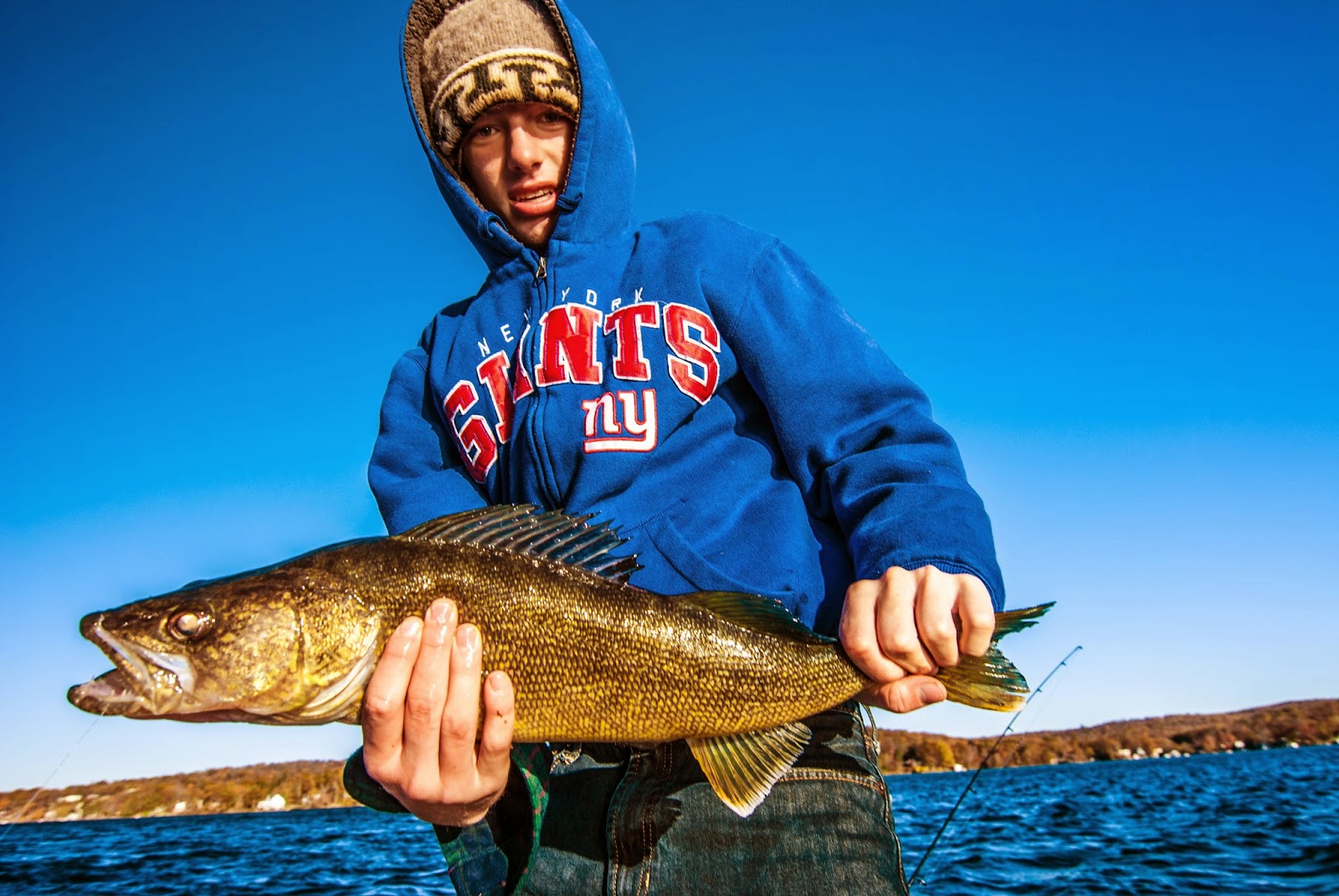
I felt surprised when I opened the photo (below) of me with the first walleye. I caught it before sunrise, but it seemed as if we had fished a long while, yet the light reveals an early moment. Matt had caught a bullhead on a live herring; herring, by the way, are available only in small two-and-a-half to three-inch sizes. I don't know if that's why we caught two more bullheads and apparently lost another. Jimmy at Dows told me not to expect any large herring for the rest of the season. We certainly have no complaints; we caught some nice fish.

After Matt caught his walleye and I had caught both of my hybrids, the anchor began to drag, and I averted the boat and motor crashing into rocks. We had been taking turns with our herring rods, one fish, and then the next.

I don't reflect on issues like this well when I'm on the water, but now I see that it's appropriate next time that bullheads don't count. Matt got a smallmouth, a nice crappie, and his walleye was bigger than mine, but I got two hybrids in addition to the walleye I caught. We caught yellow perch and sunnies on nightcrawlers besides. It's a different way to fish, the setting of herring on bottom, more like ice fishing when you take turns with tip-ups collectively. We used to designate our own two herring rods and go with that, more like the individualistic tradition of every angler for himself, even in good company. On an outing in October 2011, my son & I tallied up nine hybrids for me, eight for him, which is pretty much an equal cut, except that my son should have the privilege of catching more than Dad. We did it the individualistic way by dividing our own rods apart. Now I like putting all four in use, taking turns, and next time not counting bullheads, or crappies for that matter. Even though a crappie is a gamefish, it's not on par with walleye or hybrids in our opinion.

At least when we began fishing Lake Hopatcong in the summer of  2007, Matt caught a five-pound walleye, and I just caught a few bass. He caught some bass too. And he caught our first keeper hybrid, along with others, and walleye on other occasions. He has no complaints. For all I really know, I was right to start him out by minding his own rods rather than pooling them all together. That's how we began ice fishing when he was eight, pooling them, but tip-ups are more and less identical. A rod and reel is specially your own, and more than "teach" Matt to value his own things, I provided things for him, and I pointed to opportunities for his acquisitiveness. He bought his own Nikon D-60 when he was eight. It cost him more than $600.00; a significant amount of that money he earned by getting photos he took published along with articles I wrote for fishing magazines. Before he owned his own camera, he was using mine.

Before we arrived (and learned that it was supposed to really blow, and that fishing has been very slow), I expected to fish Binsky and Cicada bladebaits for the most part. We did fish these for an hour-and-a-half at the end of the morning and just after noon, but got nothing on them. We hadn't seen but a couple of other boats. Now that we fished out of the wind, boats appeared plenty.

I wonder how they did. We had let wind rip right through us for hours. In the fall, I find windy conditions better, so I'm less likely to fish where we would feel more comfortable and take care of things easier. But fishing a bladebait among whitecaps would have been ridiculous, at least I think so. Otherwise, anchored in the wind, line remained just at the edge of being all over the place, I mean, you would think the tangles would be constant with four out and two more fishing crawlers, but we've done this before a number of times and it works out. We soaked bait and fish found it.


 Matt did his sleeping early in the morning. He told me he was very comfortable.


Saturday, September 20, 2014

Lake Hopatcong: Too much Summer, not enough Fall


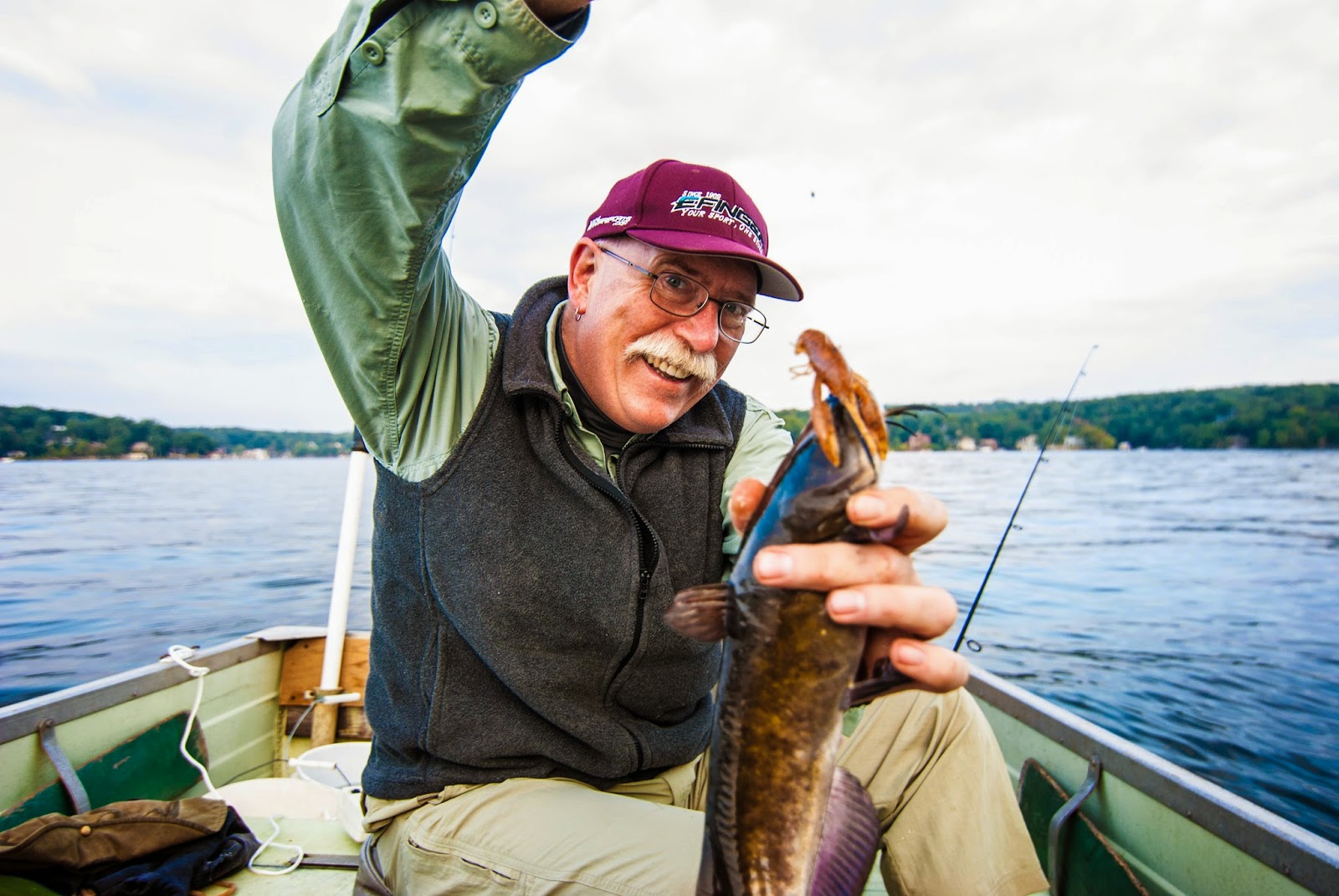
Fall is certainly here with a lot of leaves beginning to change and chilly mornings. And this morning began without much wind, while nothing seemed to vow against the auspices of a good catch. Knee Deep hosted a walleye tournament, and a BASS club had another, but Hopatcong is a big lake and seems to accommodate all. I caught a little largemouth on a Senko in five or six feet of water within minutes of beginning with a Torpedo, and not very long thereafter Fred caught this big brown bullhead (not channel catfish!) on a jig tipped with a plastic crayfish. I thought he would hoist a small walleye; the catfish hit about 25 feet down.

Meanwhile, we had our herring out. We watched one of the Bassmasters catch a couple of small largemouths down the way from us. I had a tugging desire to give up on the bait fishing and pick away at docks. But Fred put it better than I could.

"I can fish bass like that any time I want. We're after other species we don't get much of a chance to catch."

And I've caught both walleye and hybrid stripers jigging, but once I got over my initial anxiety that Fred might be impatient with live lining herring, I touched base with my usual familiarity fishing this way. I only get a few chances each year to do it. And it moves me to a watchfulness of intent--with this, deep relaxation--that only soaking clams or bunker surf fishing, or fishing live shrimp in the Florida Keys approximates. Live lining herring--or weighting them, besides--allows you to fish a Senko or a nightcrawler while you keep watch, or just keep your eyes on the lines in a way that the rhythm of casting, over and over again, breaks the concentration, the meditative focus on something so simple that it can have the effect of opening your senses and mind to a much wider aperture than daily demands allow. I tend to prefer nightcrawlers to plastics because I can fish them in much the same way. All you have to do is attend the lines quite as if something will happen.

And on Hopatcong, something usually does. Besides the nightcrawlers--we caught crappie, a white perch, bluegills, pumpkinseeds, green sunfish--nothing touched the herring all eight hours. This was a first for me. It's as if it's still too much summer, not enough fall. My son and I have always done much better in July. And we've caught crappie on herring. Fred found them 25 feet deep today. We caught four all told, and just about big enough to swallow a herring. We ended up weighting herring on bottom with slip-egg sinkers, and this didn't kill them 25 feet down. Oxygen is getting deep now.


Tuesday, June 17, 2014

Pepacton Reservoir Memories

I found these shots in a folder, stimulating memory instantly, me inferring the striking comparison between Pepacton Reservoir near Roscoe NY, and Lake Hopatcong NJ where we will fish in two weeks, so long as all goes well. The lake is our favorite home water and we truly love the place, but look how wild this much larger body of water. No homes along the shores; it's all wilderness, the water as clear as Round Valley Reservoir and full of trout and smallmouth bass even though we did poorly for the bass, this our first time fishing and only one day. We got a tip later about where we may try next time. The shelves we found--drop offs stacked with undercut slate--looked delicious, but they just either did not hold bass or those hiding would not hit.

No electric motors allowed, we rented a rowboat kept with many dozens of others on the reservoir shore, chain-locked to trees. Driving along the reservoir, you can see these boats back along edges of certain deep coves. I don't think Pepacton has any shallow. From those shelves I mentioned, we rigged with lead core line and a thin, ribbony spoon to row-troll a half mile to a promising shoreline where another angler fished in the nearing distance. We saw him hook up with a large frucus on the surface. He had cast a spinnerbait, and the bass he lost a second later seemed to be about three pounds. Before we got that far across, we passed the rower photographed above, greeted each other, and inquired about catch. He had a small brown trout of about 2 1/2 pounds on what they call razorbellies--herring.

The lead core was kindly lent us by the camp proprietor in Roscoe. Camping on the bank of the Beaverkill, I awoke well before first light the morning we departed for Pepacton. I didn't expect preparing breakfast would be so satisfying. The simplicity of cooking over fire proved to be one of summer's highlights. Once the bacon and eggs cooked sufficiently, only then I woke Matt. I must have slept real well because I felt great for the 45 minutes or so, temperature in the upper 40's, before we departed for the half hour drive to the reservoir.


This channel catfish was so white with spots it resembled a trout.

Saturday, July 27, 2013

Pepacton Reservoir Smallmouth Bass, Channel Cat, Rock Bass; East Branch Delaware River Fly Fished


We began by drifting out of the large cove or hollow where the rented rowboat is kept. Using 3/4- ounce slip sinkers, our herring or sawbellies as they're called in the Catskills rode at almost a vertical angle, line easily measured down by two-foot increments to just deeper than 30 feet, barely below the thermocline. We had tied eight-foot leaders to barrel swivels and hoped for the best. I found the batteries to my graph recorder dead, must have forgotten to turn it off after Hopatcong. Perhaps the one item I forgot to bring along was a Phillips head. But a couple of other boats fishe
d nearby and marked trout, so we moved through the vicinity.

The day had begun before sunup at about 48 degrees and as we trolled, four and  five colors of leadcore line out and a very thin metal Sutton spoon tied to a fluorocarbon leader six-pound test, a cool breeze felt just like October. I had a look at a topographic map before we left New Jersey and found that no shallow flats exist. All the shorelines fall off into great depth quickly, some from sheer faces of giant boulders and continuing down underwater with shelves and cavities below--excellent smallmouth bass habitat. Pepacton is about 20 miles in length with even the back sections very deep. The reservoir's mean depth is 70 feet; deepest water is over 160 feet and acres of it exist.

We rowed to the shoreline at the right of a cove facing out upon the reservoir's main body. My son caught a couple of rock bass and I noticed--through very clear water--the bottom become too uniform a mix of gravel and small stones as we drifted, no real structure to hold bass. I heard a wood thrush in the woods--my favorite songbird--and my son spotted a deer maneuvering the slope. All was very quiet out here. The area has very high quality wilderness value and you feel at the center of things, since after all, reality is mostly without us. We rowed out of the cove and headed just to the right, trolling again over water that must have been at least 70 feet deep, attracted to rock formations on shore which, if they extended into the depths, would certainly be bass habitat.

On my first cast, I hung something good-size and soon felt puzzled. Could this be a walleye? It wasn't a bass, I could tell. Not even a largemouth. It fought just like a walleye, but we soon saw in the clear water a channel cat. It was a beautiful, white fish with black spots like a trout and a gray back and head. The bottom here had more boulder-size rocks and Matt soon caught the first bass after I released the cat. Further west, underwater shelves and surely cavities inward in relation to what we could see form magnificent structures. I got into casting my jig on top of the shallow shelves I could plainly see and letting it slide over the edge to drop in front of the recesses from two down to 15 feet or so. I fished the jigs right in the rocks as deep as 35 feet or so and lost plenty to wedge snags, although I suppose most or all of the bass stage shallower than the thermocline at 30 feet, although every bass we caught was at least 25 feet down. Some of the rock bass seemed to be deeper, but I'm not certain.

None of the bass we caught larger than Matt's photographed, which is pathetic and unfortunate judged against my hopes that we might catch our year's largest, perhaps even that elusive five- pounder we've come closest to on Lake Hopatcong. But you don't let inevitable broken hopes determine a day's value. We had a deeply absorbing time and it's not easy fishing from a heavy rowboat with strong breeze and water too deep to anchor effectively. And once the mist burned off, the sky felt like an empty expanse with a huge blue curtain, letting all that light in. We heard of two trout caught, one by each of the guys who marked fish to the left and right of us as we drifted herring early. Two browns about three pounds each.

We drove back to Roscoe Campsites, had a late lunch in town, and stopped in at Beaverkill Fly Shop, picking up a couple of #20 sulfurs as fit the report for the East Branch Delaware. We grabbed power naps and then headed out. And then we drove as far west as some grove or other, stopping along the way where we could to judge the water, but not actually walking and wading the river to find any holes. The spot that looked best was at Downsville by the covered bridge. Nothing rose at all, so I cut off the sulfurs I had tied on back at camp, and we tried to provoke interest with Woolly Bugger streamers. A fast run and pool down below looked better than the run and pool below Roy Bridge on the Flatbrook where I always catch trout on streamers in late May, but I got no hits at all. Finally evening came on, and I tied the sulfurs back on. We did see a very few rises, but I suspected at least most of these were carp! Here we were at the fabled East Branch Delaware with its 55-degree water in July and trout tales to fill volumes, and I had spotted a school of small carp of some unusual specie I couldn't judge, from between a pound to three pounds. I watched the water surface intently and finally I clearly made out the back of a carp break the surface.

Oh, well. Back in Roscoe, before we arrived back at camp to fix a steak, we checked out the confluence of the Willowemoc and Beaverkill. Both of these streams were about 70 degrees, so we didn't dare fish them, although we saw quite a few more rises than at the East Branch and suspected these were indeed trout. It's a beautiful hole at the confluence. It would be sacrilege at this world famous fly fishing stop, but if you were to roll a nightcrawler along the bottom at night--given that the water is lower than 68 degrees so as not to kill the trout by lactic acid reaction--you might find that hole holds some real lunkers. I think the real reason it's so famous is because back in the 1940's a train connected Roscoe to NYC and the wealthy came in the spring, summer, and fall. Not that some real nice trout don't reside there. I don't know if it's fly fishing only or not, but we didn't fish it with water warm to the touch, although a size 20 dry fly of some sort would have been about perfect.


 The blue haze wasn't really that dense.


Friday, May 24, 2013

Flathead Catfish: Delaware, Schuykill, Susquehanna Rivers

Flathead Catfish

Three Rivers’ Native, Here to Stay in NJ and Eastern PA

Structures and Tips


Heavy bodied with monstrous, shovel-like heads, flathead catfish are the second largest catfish species in North America. The world record 123-pounder caught in a Kansas reservoir fell just shy of the world record blue catfish, 124 pounds, from the Mississippi River. Pennsylvania flatheads are native to the Allegheny, Monongahela, and Ohio rivers. But the Pennsylvania state record, 48 pounds, 6 ounces, came from Blue Marsh Spillway near Reading, in 2007.


Flatheads are an invasive species which surely have taken permanent hold in the Susquehanna, Schuykill, and Delaware rivers. The only way to get rid of them is for anglers to catch and kill them, a losing battle. But they serve good table fare, often considered the best among catfish. Flatheads devour live fish, which would seem to have to do with the tastiness for us, since forage includes river gamefish species. Thus Flatheads are unwanted.  Nevertheless, they add some interest for anglers. By August 2011, the largest on record from the Susquehanna weighed 40 pounds, 1 ounce, considerably larger than what can be expected from channel catfish populations. Big ones swim the Delaware too.


Two major differences between flathead and channel catfish: flatheads prey almost exclusively on live creatures, and will not be taken on stink baits or chicken liver as channels will, and they tend to be found in deeper sections of long pools, rather than immediately below a set of rapids. Both species orient themselves to currents; moving waters are native for them, not still water and mud bottom suited to bullheads. Big flathead catfish like boulder strewn, rocky bottoms, and if sunken logs, trees, discarded refrigerators or auto engines get lodged among boulders as big as a kitchen, all the better for the fishing within sensible limits, if dubious for the environment.


During daylight flatheads hide in such thick cover. It’s possible to tempt them out with live bluegills or fallfish, but most fishing is at night when they leave to travel long distances. Radio telemetry shows flatheads may move for many miles. At night, and only at night, the largest flatheads may move into shallow riffles, exposing dorsal fins above surface, opening mouths wide to lure fish that mistake them for caverns.


Most flatcatfishermen in the Southern United States swear by live bluegills hooked under the dorsal fin. In our region, large chubs take preference, which survive on a hook about as long as panfish. Fallfish make excellent bait, as do eight to 10-inch suckers. Live eels will attract flatheads, but eels easily make their way into snags, although they often make their way out, also. Some anglers prefer fresh cut bait, which does work despite flatheads’ predatory inclinations.


Weighted bottom fishing is standard, whether from a bow-anchored boat with lines extended from the stern and from the sides downriver, or from shore using heavier weight, since current will drag line, and carry light weight into snags. Look for holes 15 feet or deeper, boulder strewn with a persistent current. Bridge abutments positioned in deep stretches make great catfish structure, whether immediately upstream, downstream, or to the sides. On the Delaware above Trenton, bridge abutments are usually situated in water too shallow, but Dingman’s Ferry is the great exception. Make sure you have plenty of terminal tackle on hand since rigs inevitably will be lost to snags.

No-roll, bank, and egg sinkers from an ounce to as many as four ounces anchor a rig on bottom. The double-chub rig is popular. Cut what will make a 2 1/2-foot length of leader attached to a barrel swivel. Attach the sinker to that barrel swivel with a short length of weaker line. If the sinker gets snagged, it breaks off. A one-foot length of leader secures the second hook.


Wire frame sinkers reduce snags when fished behind a boat. Resembling a spinnerbait frame, the weight is in lower position, main line tied to loop-eye. A leader attaches behind. For either rig, Matzuo sickle hooks, size 1/0 to 4/0, Eagle Claw King Kahle, same sizes, especially prove popular, although more now use circle hooks.


Heavy monofilament or braid, 25 to 30-pound test, takes strain necessary to muscle a heavy fish from dense cover. In the South, 60-pound braid is choice, but flatheads grow twice as large. (We don’t need huge flatheads here devouring full grown bass.)  A medium-heavy power spinning rod, seven or eight feet, fitted with a matching reel will suit the size of most our flatheads—a 10-pound fish is a good struggle to match. And make sure to bag your catch!