Tuesday, October 4, 2016

Ice Fishing for Pickerel: A Complete Guide to this Classic Winter Quest


Classic Ice Quest: Pickerel


The sudden strikes of chain pickerel mark this species as one of the most impulsive freshwater fish, perhaps the chief reason they take scorn from some fishermen. The thick scale mucous is often cited, but some call them jacks, a sure indication that the eagerness is unsettling. On the other hand, many of us admire pickerel and all members of the pike family for the fierce determination and focus. Pickerel often miss the target when they strike, and yet there’s no denying the missile-like intent. Traditionally, pickerel regain seasonal popularity among ice fishermen. They remain a little more active than bass, and last winter, a number got caught in three feet of water beneath 18 inches of ice while it continued to thicken.


Ice Fishing Basics


If you’re unfamiliar with ice, don’t go out on it until it’s established by the community associated with a lake as safe. Early on, any large lake may be safe in certain coves, and yet feature open water at the wind-blown points. Be safe and begin a process of familiarizing yourself with ice conditions too numerous to discuss in this article. Like many fishermen, I got introduced to ice fishing by someone mentored years before by someone else. Guides will teach a fisherman of whatever experience plenty for a worthwhile fee, and books on the subject will too.


A plastic, flat-bottomed sleigh will carry the weight of a power auger and all of your equipment with ease. If you’re young and strong enough, you can cut thick ice with a splitting bar. It’s a workout I used to prefer, until I began to complain about the time it took to set tip-ups.


Tip-ups and jigging rods serve effectively. Secure hooks by impaling dacron tip-up line at the spools, but to avoid getting the hooks stuck, don’t press beyond the barbs. The simple, inexpensive, wood-framed tip-ups are all you need. A propane catalytic heater helps warm hands, as do vermiculite hand and toe warmers. A small hibachi fits on the sleigh and hot dogs and burgers never taste better. If you jig some yellow perch, you may never enjoy them fresher. Keep tackle to a minimum--hooks, split shot, jigging spoons, fluorocarbon, barrel swivels, needlenose pliers. Place a straining ladle in the bucket with shiners to keep hands relatively dry when baiting up. Warm, waterproof gloves are available at many venues this time of year. Folding chairs for each participant make life easy. Don’t forget the coffee!


I’ve heard guys complain about cold feet. A good pair of pac boots will keep them comfortable and completely warm. We’ve ice fished at zero degrees without the slightest chill, and have slogged through water on the ice late in the season. Don’t skimp on gloves, layered clothing with quality thermal underwear against the skin, wool cap, and face protection if the wind is cold enough. Layer clothing with moisture absorbing wool, not cotton. You can always take layers off if you get too warm.


Shallow, Deep, and Always Weedy


Finding pickerel is an engrossing, absorbing pleasure if you really get into it. It’s possible to do a little roaming with the sleigh and quick-cutting power auger. Open water knowledge of a lake or pond isn’t absolutely prerequisite, but helps a lot, as do contour maps. We’ve caught pickerel in three feet of water in the back of a frozen cove on New Jersey's Lake Hopatcong, 12 feet deep among the residual weeds of sloping shorelines, and 15 feet deep on a weedy flat of the same lake’s Great Cove. Years ago, we fished a pond in Princeton Township, tip-up flags popping up constantly throughout the range of the pond’s middle 10-foot depths, the bottom just fuzzy enough with residual weeds to hold pickerel.


As with any other species, you can find sweet spots and score a big catch while others never get the skunk off them. Most of the time, you may have to settle for a fish or two and be happy you connected. No doubt, weeds hold them. But if you know of any spots combining weeds with cover like submerged brush, always fish them. It’s also a good idea to take note during the warm water months of any weedbeds combining plant species--Eurasian milfoil with pads and the like—because any break that stands out in a pattern of homogenous habitat tends to hold more fish.


During the previous decade, before New Jersey's Lake Musconetcong got treated with weed killer to combat water chestnuts, pickerel catches of a dozen fish, many of them over three pounds, commonly accompanied efforts at placing tip-ups just right. The weed mass remained thick, and you could never tell for sure if the shiner would bury and entangle itself. So careful tending of the tip ups allowed corrections, and new holes cut increased the likelihood of getting a shiner in place, where it wriggled and swam about on the hook to entice a strike. Since Lake Musconetcong is about five feet deep everywhere, getting the shiner near the bottom wasn’t necessary. In some situations, we placed the bait halfway down, thus allowing free swimming.


Other lakes have heavy weed cover in the winter, which may characterize the best spots to fish, but carefully. In any event, we tend tip-ups by giving them a lift every so often, both to make sure the shiner isn’t stuck in weeds, and to give the bait a little life.


I’m the guy who involves himself in possibilities out there. The rest of the crew may be content to sit back and tell stories, but while I have my say, the edge of my mind is always ready for any crazy notion butting in that just might lead to a better cut. And besides, jigging with a chrome-finish spoon is a way to cover ground by cutting a lot of holes, letting things quiet down, and fishing the route you’ve created. The one-eighth or quarter-ounce Kastmaster is perfect—compact and fitting for jigging directly down.


A fine line exists between intuition and superstition, but on any lake, there’s a lot of water out there. Even the water featuring weedy habitat is extensive. It’s better to think you might have a sense of where a pickerel might be, than to just stand back passively and feel nothing’s doing. It’s true that some days—especially early and late in the season—pickerel feed more under the ice than on others, and the witching hour of sunset and dusk is typically best. But on any day, a lot goes on down there, and by meditating on your approach and experimenting with sets and jigging, it’s possible to meet a little of that activity halfway, when just setting up and sitting would have yielded relatively few fish or nothing.


Details About Tip-Ups and Jigging


One of us cuts holes and one or more of the others sets. With a power auger, this is quick business. We used to use size 6 plain shank hooks placed near the large shiner’s dorsal fin, but nowadays we're experimenting with size 1/0 circle hooks. (It's possible we'll try smaller size circle hooks, but 1/0 is actually pretty small.) By setting the hook as soon as we got to a flag-sprung tip-up, we rarely gut-wrenched the fish, anyhow. The exception is when we stand so close to a flag when it springs that we need to let the pickerel complete its initial dash, stop, and begin mouthing the shiner. A firm pull on a tightened line usually resulted in fish on, but the circle hooks pretty much set themselves. Needlenose pliers kept in the pocket quickly disgorged any hooks within the cavity of the mouth, the pickerel released in active condition. Circle hooks supposedly always catch in the corner of the mouth, but we'll see, and maybe I'll get back to you about that with an update in a few years. Pickerel strike so that the shiner is immediately mouthed in the middle, although sometimes we do miss a hit, and sometimes have caught a pickerel hooked by a J-hook at the tip of the mouth. Often the pickerel takes the shiner at the middle portion of the belly, not the dorsal area, though a shiner gets worked into the mouth after that first quick run.


Braided dacron should neither be so heavy that you can’t fit much on the tip-up spool, nor so light that you don’t get a good grip on it when playing a fish. Forty-pound test is about right. Tie a small barrel swivel to the dacron and about three feet of 15-pound test fluorocarbon leader to the other end. Tie on a hook and crimp a medium split shot to the leader with the pliers about 18 inches above. Don’t crimp lead with your teeth. We used to do that in our teens, but since any amount of ingested lead affects the brain, it’s not a good idea. Since fluorocarbon resists abrasion, 15-pound test will do for a single catch, but it often does not for two. Always check the leader after each fish on, and retie the hook if any nicks or scrapes present themselves.


The alternative to using fluorocarbon--and we have lost some pickerel that cut through leaders used for the first time--is 20- to 30-pound test wire leader. Especially if you use large shiners, the wire won't negatively affect the bait's liveliness on the hook by much. We started using wire four or five years ago as of January 2025, when I've given you an update, and we've caught a lot of pickerel that neither shied away from the visual presence of that wire, nor cut through, certainly not. 


The shiner's being enabled to swim more and less freely is why, if you do insist on using fluorocarbon, you should use 15-pound test, rather than heavier fluorocarbon or monofilament. We haven't tried size 6 circle hooks as yet, but even 1/0 and the relatively limp line will allow the bait freer motion.


To finish with my description of setting up a tip-up... The line will go loose when the rig reaches the bottom. Tighten the line by wrapping dacron onto the spool as you lower that spool to water level, making sure the split shot is directly on bottom. Wrap seven more turns, so the split shot situates a couple of feet or so off bottom. Make any adjustments needed for heavy weeds or other cover.


The advantage of using a medium split shot for weight, is that you can use a long leader, which you can tie to the swivel of the wire leader, and put that split shot about a foot above that swivel. Another possibility is to shorten the fluorocarbon whether you opt for wire or not. Allow no more that 18 inches to two feet of fluorocarbon below the swivel attached to the Dacron. But before tying off that Dacron, slip a quarter-ounce egg sinker onto it. There's always an advantage to choose with a trade-off, and in the case of using an egg sinker, it makes setting the tip-up easier. That quarter-ounce weight brings the shiner straight down to bottom, and that weight makes the rest of setting a tip-up as I've explained easier, too. Rather than making sure the split shot is directly on bottom before wrapping seven turns, making sure the egg sinker is on bottom is a little easier.


My jigging rods don’t have the sensitive panfish tips. They’re stout, but allow enough play. I attach an ultralight reel loaded with 15-pound test Power Pro braid. A uni to uni knot connects a 15-pound test fluorocarbon leader, to which a small snap is tied, the Kastmaster snapped on. Experiment with jigging by using your imagination as if it’s a perceptual power, rather than frivolous fancy. Some research suggests active imagination helps create possibilities as if from thin air. Possibilities that may actually happen, because the energy of intention is energy just the same as any other form. Pickerel will likely hit a jig that suddenly behaves erratically, but tempt them in by subtly twitching the spoon.

Any guide that claims to be complete is so only within the parameters of a certain logic. A whole world of other possibilities will exist outside it. One thing that's obvious, for example, is that ice fishing develops year to year. I haven't even talked about sonar side scanners, but suddenly it seems as if everyone's using them, not to mention lithium ion augers. Besides, I've only updated the guide during 2025, when I've mentioned the use of circle hooks. I don't mean to disparage my effort to communicate ice fishing for pickerel, only to offer you a friendly reminder that any kind of completeness is mortal, so to speak. 

Never forget that pickerel provide that jolt to make an otherwise frozen environment come to life. Ice fishing is a way to connect with friends and fish alike. 


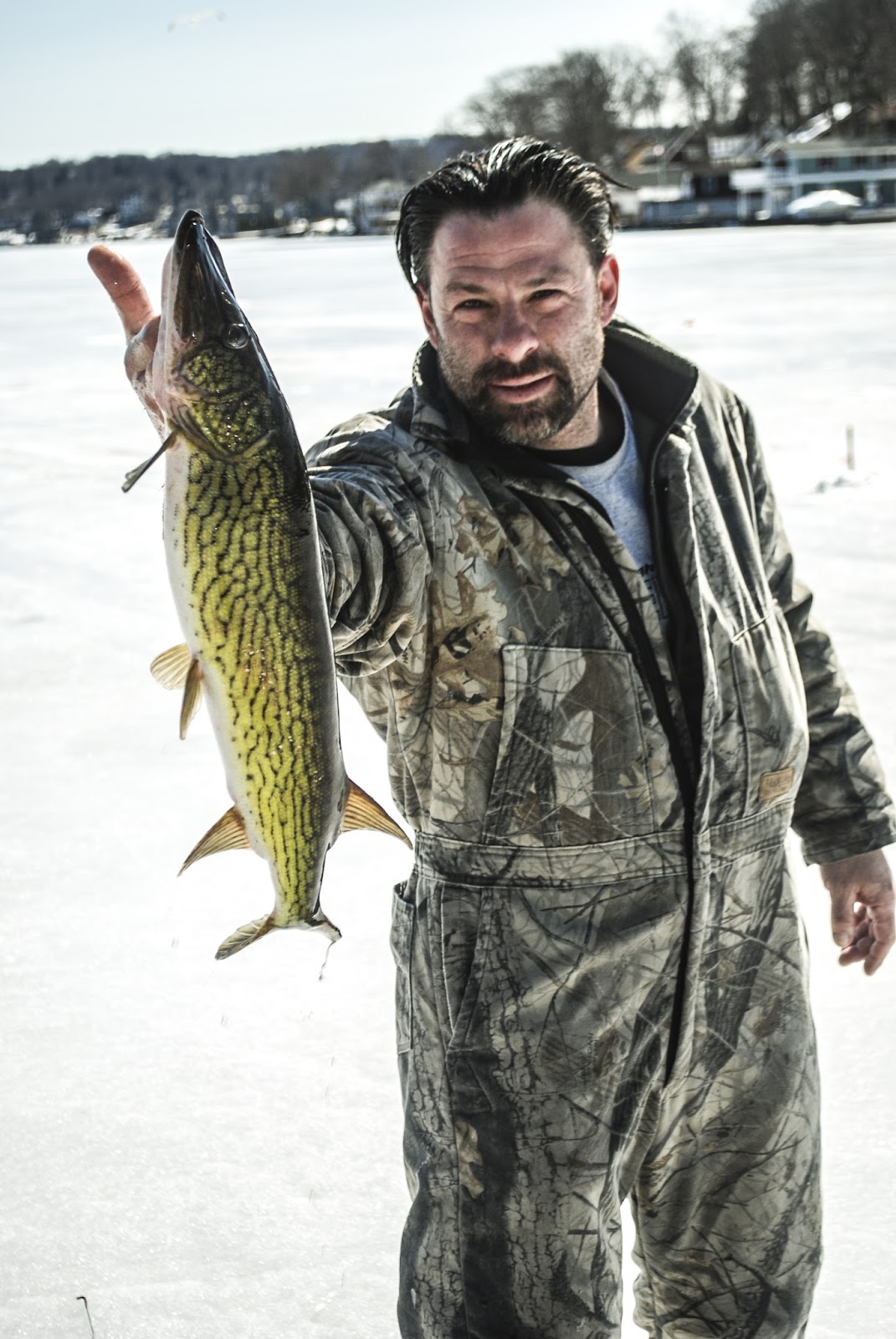
The writer Bruce Litton with a nice pickerel.

Caught before we began using circle hooks, but pliers were at the ready, and the pickerel was released.
Notice the orange ice spikes Brian Cronk looped around his neck. Never ice fish without wearing a pair. Their purpose is to allow you to jam the spike into the ice to give you a grip to pull yourself out, if you go through. Safe ice is a reality, but it's not necessarily absolutely safe. Sometimes underwater springs make thin spots. 
A hand auger is an option for younger ice anglers.

Friends...and family, too. Matt Litton with a nice one.

Ice fishing for pickerel isn't only for the guys.


It's a great way to gather together. Conversation on this occasion photographed will never be forgotten.


Wednesday, September 28, 2016

The Place isn't Swarming with Them, but They can Grow


After a tough couple of days, I gave the local pond a shot, but it really didn't do much to soothe. If I passed the exam after two days of classes, I'll have my first professional certificate. Sure I did well, it's just that after so many questions and tricky, I can't be certain. Looks like this evening's slow bass fishing in a shallow pond exhausted after severe winters is what I get after refusing to graduate college with a B.A. or B.S., just like they told us in the high school auditorium: You'll regret it, if you don't toe the line. But down deep I don't regret any of it, not that I would persuade any young reader to drop out, and certainly my son is an example of a young man about to take every aboveboard advantage. I certainly understand how someone could regret it, but only for not having dug deep enough with the rake of the mind. Down to bedrock to build one's own foundation of a worldview. Besides, if I've earned this certificate, I think it bodes well for mobility in society, after I spent years as a clam digger.

Started with a Strike King Senko-type, had a few very small bass play with it, and after 10 minutes decided I better pull that black spinnerbait out of my bag. I then caught a six-inch bass, fortunately hooked lightly, and then managed easily to make my way to the far shoreline, since the water's so low I got around obstructions. This is where starry-eyed Mike Maxwell believes the bass have gone. No. I did catch another little one like the other swiftly put back.

And then I was back in my safety spot, catching a bass nearly nine inches long. I thought of past half hours under very good fishing conditions like this here--water temperature in the bass optimal range, falling barometer, clouds, a fall breeze--and hooking one nice bass after another. It made the value of those little ones I caught stand out, not because they'll get bigger, but because they're just there, although the fact is some of these little ones around will likely grow, though the place is not swarming with them.

Where did they come from, I wondered. Offspring of resident bass? I thought of the mystery pond above with a fence around it and No Trespassing. And above that, a secret spring on Schley Mountain where this water I fished originates. That's what really counts. The wildness of that. Many years ago, my son insisted that we hike the mountain, and we spent hours exploring the slope, finding the tiny rill that feeds both of these ponds and eventually the North Branch Raritan River. We found a very small pond up there no one else or very few seem to know about, let alone have stood beside and seen. The rill flowing in, flowing out. All of these little bass stand a chance because of a source no one seems to have discovered.


http://littonsfishinglines.blogspot.com/2012/05/mounthope-pond-offers-chance-at-lunker.html

Monday, September 26, 2016

Vertical and Diagonal Jigging for Hybrid Striped Bass and Walleye


Vertical and Diagonal Jigging for Hybrid Striped Bass and Walleye


          Octobers have become a habit. Eight years ago, I first sampled the walleye action on Lake Hopatcong during the month’s third Saturday with my son. Every year thereafter, we’ve been back for more, having added hybrid striped bass to the pursuit. A number of friends and I fish together throughout the month, catching walleye up to six pounds, hybrids to just over five. We always tell the difference as soon as the fish is hooked. I would never say a walleye doesn’t fight, but hybrids are fantastic. Perhaps this year we’ll catch larger, as walleye and hybrids get caught in New Jersey every fall in the seven to 10 pound class.

          Besides the big lake, Greenwood Lake, Swartswood Lake, Monksville Reservoir, and Canistear Reservoir have walleye vulnerable to vertical and diagonal jigging from October on into winter. However, the method is equally effective for hybrid stripers at Spruce Run and Manasquan reservoirs.  

          Traditionally, Rapala ice jigs and Sea Striker jigs catch fish during fall. Both resemble plugs with tie loops on top. The Rapala Jigging Rap, classically an ice fishing jig, comes in five sizes from 1 ¼ inch to 3 ½ inches, the tie loops near the centers, treble hooks directly underneath, each with a single shank hook with the bend turned upward from the rear, and a single shank upward from the head. Sea Striker Got-Cha jigs come in 10 series from 1 ¾ inches to four inches with tie loops on top of lead heads, the rest of the bodies hard plastic or chrome metal tubing, with either a forward and rear treble, or a forward treble with rear single shank hook and bucktail. For walleye and hybrids, the larger sizes are preferred.

          These two types of lures have a proven track record of effectiveness by dropping them over the gunnel, allowing descent to 15 to 50-foot depths, and jigging straight down. The idea is to drift with the breeze, compensating with an electric outboard to maintain desired direction, or if the lake or reservoir is calm, using the electric at slow speed to cover range. Line drag slowly carries the jig from straight down on bottom, to a position slightly off bottom as line moves towards a diagonal position, and rather than constantly reeling the lure to surface and dropping it again, a little line is let out so the jig makes bottom contact once more. When the angle of the line becomes too steep, the jig is reeled in and the process repeated, jigging motions generally conducted by quick snaps of the rod, keeping line taut as the jig drops back. Often, a hit comes as the jig falls, and then you often must detect the subtlest of unusual motion or a tap. 

          Another option is to continue to jig at these more or less diagonal angles that develop without reeling back so soon to start over, and I have caught fish on the Got-Cha and Jigging Rap this way, saving myself the effort of keeping the lure straight down. Eventually, I discovered the Binsky bladebait, which I find more effective for diagonal rather than vertical jigging. I soon found I like bladebaits better than the two classic vertical jigs, though I’ve yet to catch many fish on them, since they’re still new to me. The vibrating action of any bladebait brand not only attracts walleye and hybrid bass; it imparts a tantalizing feel through 15-pound test Power Pro or other quality braid line to a graphite or lithium rod. I keep my index finger on the rod just above the reel seat. If I feel vibration cease, I set the hook. Sometimes the hit is a slam, other times it’s barely felt.

          Bladebaits seem most effective retrieved, ideally by casting ahead of the boat on calm water or when the boat is propelled by a very light breeze at most. If a fairly heavy breeze guides the craft, it makes sense to jig from behind with the boat positioned for you to fish off a side while drifting, although you will have to repeatedly let line out to maintain bottom contact. The other option in windy conditions is to anchor and cast, never staying very long in a single position, just enough to fish a range of drop-off thoroughly.

          Whether you prefer the traditional jigs or bladebaits, fish them on sharp drop-offs, particularly with rocks or other structure. Main lake points, ledges, humps—wherever drop-offs fall into at least 30 feet of water—serve possibilities. It’s possible to distinguish rocks or soft bottom by the way the lure makes contact—hard or soft. Take note of what you find, because rocks in one spot usually mean more in proximity, and the area should be fished thoroughly. Casts or drifts should run as parallel to drop-offs as possible. In early October, we’ve caught walleye as shallow as 15-feet among rocks on the Got-Cha; they go deeper as the month progresses with action in the 25 to 50-foot range for both species.

          I especially try to fish on or near a drop-off’s bottom edge, not always achieving the target, but no matter if the bladebait shakes along the slope. Not only do walleye and hybrids move up and down drop-offs; a lake or reservoir’s deepest drop-offs may not necessarily be the best. Lake Hopatcong has a couple that drop to 50 feet, but my favorite isn’t quite 35 feet where bottom evens out. I know of another more than a quarter mile long, most of it panning out at about 45 feet, some of it at 50 feet—43 feet or so the deepest I’ve hooked a walleye.

          Bladebaits can involve casting as far as possible, which is a long cast, and yet the line angles more or less diagonally as the lure is retrieved back to the boat, since water is deep and line angles downward. Simply hopping the lure upward, feeling that tantalizing vibration, and letting it fall back to bottom is all the action needed. Hybrids especially, compared to walleye, swim through differing levels of the water column, often suspending off bottom, but the best opportunity for a strike is among rocks where predators station as if to wait in ambush.

          Bladebaits no weightier than a silver dollar invite you to take a bet on every cast. Know the structure of the water you fish by use of both a topographic map and fish finder, but depend ultimately on nothing but your own mind. The feel in your hand keeps you directly connected.

Maintain that feel of the lure, whether casting or drifting bladebaits or traditional jigs. A matter of persistent concentration, the challenge is to fish a deep structure thoroughly and keep fishing more, if none produce, until contact with fish is made. And then action can be surprisingly quick. However, many days are very tough, but we find no matter how severe a cold front shuts down hope, it’s always possible to avoid getting skunked.  


Friday, September 23, 2016

Merrill Creek Reservoir Largemouth and Smallmouth Bass Outing


Fred Matero has talked about Merrill Creek Reservoir all of these years we've fished from his boat Round Valley Reservoir, and neither of us have fished this other reservoir in at least three. First time I came here, with my son and a friend of his in 2009, I caught a four-pound largemouth and another bass smaller from shore. Maybe most impressive about that introduction lingering in memory isn't the bass, but the beauty of the surroundings. Or really, my boy and his friend getting their feet wet. And they really did.

We got on the water at 7:30, sun having risen not long, shadows deep on the east side, and headed straight across through the middle of about 650 acres, because Fred had caught eight bass last he came here on the spot he had in mind, including a smallmouth nearly three pounds and a largemouth nearly four. He spoke of timber and rocks, and there is some timber (and weeds associated), but what caught my attention is its isolation along this shoreline--a real bass magnet. I felt that when conditions are right, there must be quite a few around. Well, eight bass for Fred wasn't bad. He told me he caught them in the middle of a September afternoon under bright sun.

As you can see in the photo, he did have a fish on. A smallmouth bass that lost the hook boatside. Senko rigged Wacky, about 12 feet down among submerged tree branches.

I later watched him miss two hits on two consecutive casts with the Senko cast to an isolated weedline eastward--surely the same bass--and then I watched five minutes later a largemouth of at least two pounds leap and throw that Senko. Fred was fishing further along the same weedline by about 20 yards.

That's all the action we had. Merrill Creek Reservoir is a New Jersey marvel of environmental value, but the bass see a lot of lures so they're less eager to strike. I suppose quite a number inhabit the various sets of habitat, but bass are hard to catch in New Jersey where nearly a dozen boats prowl on so small an acreage on a weekday. Some of the bass that get caught and released suffer mortality, but the figures I've read put the percentage at about five. That is a pretty high figure over the course of a year, though.

Witness the fallen timber. Before we got in the midst of the trees, I told Fred I had forgotten to study my Lake Survey Map Guides of the reservoir and bring it along. I told him surely bass are deep--about 30-35 feet on rocks--in this sunlight, especially smallmouths. Water is very clear, not as clear as Round Valley and Tilcon, but very. On Tilcon recently, my son and I caught largemouths with plastic worms weighted by bullet sinkers 30 feet down. But once we got in among timber here on larger acreage, I felt satisfied fishing a 3/8th-ounce skirted jig with a weed guard 35 feet deep, amazed at such depths with timber looming overhead. We fished long and fairly thoroughly, and I say only fairly so, because there's acres of water like this, excellent habitat, weeds mixed in where relatively shallow as deep as at least 15 feet.

Later, at the boat ramp, a bassboat owner from Pennsylvania docked right behind us, remarking that he had seen the guys we also saw out in the reservoir's middle catch two smallmouths back to back. I inquired, and he said there's a hump that rises to 30 feet. Surely plenty rocky, and altogether confirming of my earlier thought about smallmouths deep down under today's sunlight.

After nearly six hours of fishing, total, I had relaxed pretty deeply. Later, when we returned to Bernardsville, Fred remarked about getting work off his mind, and I readily agreed, although for me, it isn't my job I have to shake so much, since I've pretty much put it in place where I think about it only while on it, but so much writing I have to get done. I also told him I haven't quite felt like this since driving home from the Outer Banks last summer, thoroughly immersed in flow of experience, though nothing does it like a full vacation. And driving. I love jet travel. But that doesn't compare with driving long distance and total lack of concern about where I'm getting to. But what really makes the difference are the stops along the way. I slow down. I just set the goal and then do my best to utterly forget it.

It was my amazement in that timber environment. A long-duration epiphany that took me out of myself. As we eased off towards the ramp, Fred said, "It makes a difference with no gas outboards allowed. It's so much quieter."

Absolutely. It makes a total difference for environmental quality.

Moment of exalted loss after two-pound-plus bass leapt free.


Monday, September 19, 2016

Allamuchy Pond Largemouth Bass


This year seems to have absorbed my ambition to explore new places in the New Jersey Highlands as deeply as desired, not because I ticked off as many numbers of sites as my imagination had inspired early in the year, but because I feel satisfied with enough and more to come. I'm busy otherwise and manage life well, so to get out as often as I do feels like I'm filling a big canvas. Today, I fished Allamuchy Pond my first time, along with Mike Maxwell, who's never visited this place until today. I did perhaps come here once with my wife in 1996 to hike the trail surrounding the pond, but nothing about the views reminded me of that venture. It's as if we went somewhere else entirely, and just maybe I had Deer Lake confused with this body of water.

Before we trolled hybrids in May this year, Mike fished trout constantly, mostly along the South Branch Raritan, and I kept in constant touch. Lake Hopatcong served as the background for a lot of talk between us, and Mike got me thinking more about guiding people fishing. I know he did, because I brought this subject up today as the two of us talked nonstop, telling him that's what I should do, and he immediately told me that's what he tried to convince me of months ago. But of course, with family responsibilities, it's not as simple as offering services and off we go, which he understands, though the ought is obvious, regardless of how things are. I'd like to do it, but it will be awhile yet if I ever do. Mike's not the only one who's suggested this. It's good advice from another friend also.

Sqaureback canoe launched, we immediately rode outward to see how deep, and I got 26 feet on the graph, flat bottom, before swerving the canoe in toward shore, expecting a weedline as Fred Matero has told me rounds the shoreline. Allamuchy Pond is 50 acres and we pretty much fished all the way around twice, so after one round, we knew this first edge we came upon to fish is the pond's steepest drop, quickly slanting to 20 feet. I caught a bass a little over a pound on my fourth or fifth cast with a spinnerbait, rolling it pretty slow in about eight feet of water. In the middle of the afternoon when we arrived, after effects of the heaviest rain in a long time remained as breezy conditions, and with relatively cool air circulating into the water, I knew spinnerbait time has come. Water temperature is 72 today. (Bass take chase after forage in water meeting the optimal range for their activity.) Water clarity allows about three feet of view, a greenish tint with some micro algae mixed in. Not bad clarity, and some bass fishermen prefer water stained, though I like it as crystal clear as possible (give me the Florida Keys reef). Clear water may mean wary bass, but it's cleaner.

Most of the nine bass total we caught hit my Chompers worm and Mike's Rapala floater in about four feet of water--a weedy flat towards the dam. None of these weighed more than a pound, nor did any of the other bass, besides a single nice fish of not much over two pounds that hit the black spinnerbait along a weedy shoreline of much less slope near the pond's back.


Thursday, September 15, 2016

Pond Purview


With just a short window between working on an essay about a redfish adventure my family took in Charleston, South Carolina, and making the monthly Round Valley Trout Association meeting on time--which I did not make on time, due to traffic--I grabbed my tackle tote in search of Wacky Worm O-rings, and failing to find them, too harried to dig around in my study/tackle storage room, I managed to pull a Senko pre-prepared off a pile of nick-nacks on my desk, tie it on, grab my camera, and take that favorite rod to the neighborhood bass pond half a minute's walk from my front door.
I must have fished 15 minutes before I caught my first bass, feeling despair lurking somewhere down there safely at least a few miles deeper than any possibility threatening me with sinking, but I really like this pond I fish a lot less than visit nightly with my black Lab Sadie, often viewing meteors overhead, sometimes scouting a fox (Sadie barking), and once encountering a black bear.

I've reported on the fish kill here of a couple winters ago. Obviously, the pond has a long way to go before it fishes as well as used to. All three bass I caught weighed less than former average, and it took me nearly 45 minutes to catch them. But they're real, beautiful bass, and to encounter any of these fish anywhere always signals hope to me. I live in the most corrupted state a free country has ever seen--New Jersey--and yet these wild predators of astonishing vitality, coloration, and innocence coexist amidst the most dense society in the nation. Why not laugh at ourselves and take that word dense more ways than one? Our crumbling roadways may be loosening up, but we're as stiff as mythical Jimmy Hoffa's bones somewhere in the Meadowlands when it comes to change that serves everyone's well being.


Monday, September 12, 2016

River Recharge


Day off, I got some writing done, and then took our black Lab, Sadie, to the North Branch Raritan River at the exit from AT&T, sort of hoping to add some photos to my river collection, but mostly just following through on my commitment to get away from nonsense we call real life. I didn't stay more than an hour, quickly catching the little longear I photographed on the same Muddler Minnow I've been using it seems forever now.

When I first stepped in the river wearing the Simms wading boots I enjoy not for the name but the result of design and workmanship, it felt cool--like fall--and the weather's shifted to cooler temperatures, well into the 90's late last week...and I had hoped those 90's would remain indefinitely. (Not good for trout, but I love really hot weather.) But the river's really low, and what will happen when October 11th arrives we might all guess--a lot of trout that would have been stocked in rivers like this one, may get shipped to South Jersey ponds. I hope to fly cast at least once or twice for whatever trout remain when I get at them.

Some other longears took the Muddler, and then I saw a smallmouth bass that wouldn't, so I cut off the Muddler and tied on a beadhead earthworm. Nothing seemed to want to take it, until finally a largemouth of about eight inches in clear view whomped the fly. I set the hook, feeling just for a sliver of  a second as if the hook might catch before the fish vanished.

I got some photos I'm not displaying that I like, only because they suggest future possibility. (I need to use my tripod well after sundown to get them sharp.) These photographs involved my interest just as I thought I was leaving, and more than anything else today, the effort went deep and sort of flushed out refuse that accumulates working a full time job at a specialty meat counter. It's not good form to complain about jobbing, when more than a few of us are out of work and need it badly, and it's not my intention to complain but to point out--as I try to do in this blog in so many different ways--that work and family and friends are just two of three basic necessities in life. The third is recreation. Whatever form re-creation of your human self takes. Tonight is another example of fishing and photography--dog walking too--merging seamlessly together.

Result? I enjoyed a long, deeply solemn--but solemn like drinking pure mountain spring water from between rocks--moment when hope just welled up from the river I stood in the middle of up to my thighs. Re-creation. Motive to move on. Had I not gone on this little venture, my batteries never would have recharged. Either you move towards some personal goal in life, or you go backward not to childhood, but to the inhuman animal.