Thursday, May 12, 2016

Smallmouth Bass: How to Catch Them in Streams


Small Rivers Smallmouth Bass


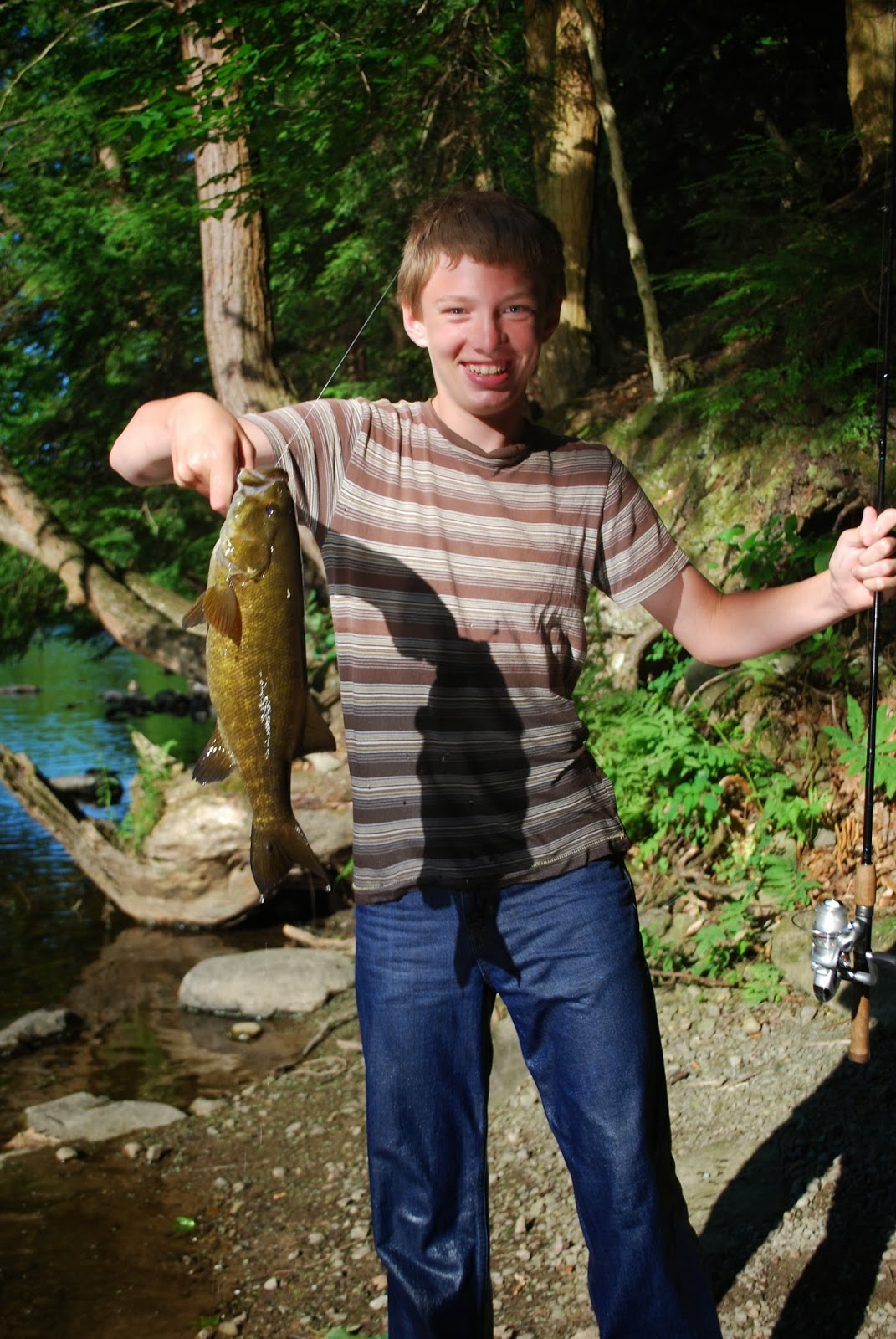
          After springtime crowds of trout fishermen thin out to a few persistent fly casters, small New Jersey rivers and rivers elsewhere present smallmouth bass a smorgasbord of feeding opportunities, and great fishing can be expected all day long. From Mercer County’s Stony Brook and Beden’s Brook to Somerset, Morris, Warren, Sussex and Passaic County rivers, smallmouth bass appear surprisingly plentiful in part because most who fish practice catch and release. Average stream bass bulldogging nine-inchers that play well on light spinning outfits, consider the 6.6-pound smallmouth weighed in from the South Branch Raritan in 2010 at Efinger Sporting Goods. Big bass inhabit all of New Jersey’s freestone rivers. Catching them isn’t necessarily easy, but the effort may be enjoyed as a long term pursuit.

          Rather than selecting a single river to seek out stretches, holes, undercuts and other whereabouts of big bass, it’s a good idea to familiarize yourself with many rivers in your region. After a few years of finding spots and perhaps catching a few nice bass in the three pound range, you may begin to feel the rivers you fish bear relation according to personal knowledge gained. Subtle clues learned along the way key into possibilities directing where to go. Nothing is more rewarding than having a distant hunch and following it through to a four-pound smallmouth on the end of the line, which happened to me two years ago. Hunches don’t happen unless the groundwork of basic knowledge firmly takes root first, so get to know your rivers and they will begin to inform your outings in unexpected ways.

          I’ve fished small rivers for smallmouth bass since the mid 1970’s. Of all the variety of river structure, I judge long slow stretches best for warmwater fishing. Deep holes may seem to hold the big bass, but don’t necessarily. I know a stretch of the South Branch Raritan with moderate current leading into nine or 10-foot depths. A nice, big hole with sizeable rocks on bottom you might think loaded with bass. I fished this hole at least half a dozen times, and caught no bass from it until, finally, one September evening, I caught a bunch of them. But the same stretch extends downstream more than a hundred yards, water four feet deep close to the bank opposite from where I cast. Close to the stretch’s tailout, a modest tree with a trunk I can almost fit both hands around bends close to surface. This is where I’ve caught all of the other bass, including a two-pounder and four-pounder.  

          A favorite stretch of the North Branch Raritan is very shallow for most of its length, panning out to four-foot depths, but always full of bass. Some we catch in a foot of water. Submerged flat-topped slate marks the bottom here and there. Bass hide under this cover, darting out to grab Senko-type worms cast near. Often we sight fish. It’s always in our favor to see bass that don’t see us.

          Senko-type plastics cast a mile to visible bass. Average-size bass pounce on the five-inch size, so I never bother with smaller worms that don’t have the casting reach. Many swear by tube plastics rigged on plain shank hooks without leadhead jigs. The plastic tentacles produce tantalizing action smallmouths don’t refuse. Twister tails work too, so long as the size 1 or 2 plain shank is positioned so the lure rides evenly upon retrieve. Whichever variety chosen, plastics are almost universally acknowledged as the best summer stream smallmouth lure. Other lures work, and I believe I've discussed a diversity of methods in an earlier article, but if you want to keep it simple--and a lot of anglers prefer to try all sorts of snazzy things instead--go with a soft plastic lure and relax.  

         In my own experience, nothing beats the thick-bodied worms I can cast further than see into the water, but the drawback to taking hits from far away involves hookset. Especially where current bows the line, driving the hook home may prove impossible in some instances, not all. In any event, don’t let a bass take plastic for more than a few seconds before setting. You will miss some hits but kill fewer fish. Instead of using a flimsy ultra-light rod, employ a medium power, five-and-a-half-foot spinning rod. I tried an ultra-light just once and returned to the heavier I have much more fun with. The hooks get set and bass fight hard.

        I’ve also tried fly-fishing. From late May into September, smallmouths feed voraciously on a variety of larval and winged insects, nematodes, molting crayfish and other stream denizens besides forage fish. Before you think streamer or popping bug, try nymph. Doesn’t have to be outsized, although big black size 4 Stonefly patterns and the like with lots of attractive appendages catch bass. Casting little size 12 nymphs of any variety—brown, black and gold or any combination of color—with five or six-weight floating line can be devastating on smallmouth bass’s peace in the afternoon.

         Unlike largemouths typically feeding early and late in lakes and reservoirs, stream smallmouths strike any time during the day throughout summer, the big ones better approached around dawn and sunset. Big bass have subtler feeding habits than newbies over-wound and pouncing like kittens. Big bass will take big baits, but cast a half-ounce Hula Popper at noon and nothing big or little may take it. At dusk, something might happen.

          If you specialize in the big ones or just want to catch bass, the five-inch Senko-type worms are plenty suitable. Not restricted to long, slow stretches’ opportunities for arching casts, they work in every situation a river presents. Always, I rig Wacky with hook attached to the worm’s middle by a plastic O ring. Slip that on using a Case Plastics Wacky Tool. Place the worm inside the device, pull the O ring onto the middle. Rigging Wacky better ensures hookset, and in some situations, flutter action draws strikes, although most often bass rush the worm on initial descent.

          I’ve caught bass on these worms everywhere, including riffles with strong current, at the bottoms of deep holes by lift-drop retrieves and by flutter retrieves through the wide V’s of tailouts. Not every stretch has a tailout suitable to hold bass. Some end in inches of water, but others have one to three-foot depths with strong current and a noticeable V formation produced by current sucked downstream. Food gets sucked into the V as well. A three-pounder once nailed a worm retrieved right into dead center with force enough to wrench my arms. A fish I’ll never forget.

          The summer smorgasbord lasts into September, when smallmouths begin to feed especially on soft-rayed forage. It’s no coincidence that in the Delaware River, bass gorge on shad fry headed to the Atlantic. Inland rivers don’t offer the same situation, but in October I cast a silver-sided Rapala and do better in fast moving water. When winter comes it’s not impossible to catch bass on lures, if you want to try dead-sticking a weighted tube plastic, letting current do the work on tentacles. Those deep holes are the end of story.        


Monday, May 9, 2016

Favorite Bass Pond Visit

Got to my favorite bass pond of about 15 acres, surface wind-chopped, so I began with a spinnerbait. With sun breaking through clouds, I guess I should have brought along a few more in chartreuse and fire-red, but absent mindedness is a trait I just have to live with. I caught three on a black quarter-ounce, all of them well over two pounds, one of them about three.

This pond always fishes slowly, except once in June last year, my son and I caught nine, five of my seven bass over three pounds, and one of his just making that mark. Almost always the bass weigh more than two pounds, many of them in the three pound class, which makes the fishing good for the rate of return. I fished less than two hours this afternoon, and then beat the traffic down to Morris County Library, looking for back issues of the Boston Globe Magazine. The world-class newspaper has a personal essay opportunity, and I need to read a about two dozen before I make the attempt.

One of these three bass I caught struck about 20 yards straight out from the bank. Two years ago, the sunlight hit the water just right so I could see a different shade of color hue, so I inferred shallows. I cast my Chompers far out and got a take. Every time I've fished towards the pond's back, I've done the same to no avail, until today.

When I arrived today, no one else fished, but as I got all the way into the pond's rear, I noticed two pickups had come in, and two guys fished where I hoped to finish. I fished the front anyhow where they had pounded the water with whatever, finally switching to my favorite Chompers, getting a take, but missing the hit.   


Natirar Hike and Photography: Mother's Day Special


Usually I make the suggestion on where to go, although sometimes an offhand reference to someplace I speak of gets tackled by Patricia. More often than not, a place she picks from my brain becomes a family tradition. Such as Hot Dog Johnny's on Route 46 near Buttzville, NJ. My idea to bring her along with Matt and me to fly fish the Flatbrook on Memorial Day weekend years ago, we've headed up there every one of those weekends since, and a few years ago, I mentioned Johnny's and she riveted upon the idea. I felt she would, once I thought of it, but I also wondered why I hadn't thought of going there with her three years before. Well, go figure. A guy in the habit of selecting spaces that fulfill his own interests...can be a little slow about thinking of those that suit others.

Not today. Mother's Day, my wife reserved full rights on where to go. She didn't want to go far, but she did want to go someplace she feels is special. When she told me this will be Natirar, immediately I thought of getting some river photography and whole-heartedly agreed on her idea. I admit I'm selfish. If I don't see some advantage in whatever I do, I'm just not inclined to be there, and very often when things aren't going my way, I find out how to turn events in my favor--in others' interest too. Best of all, things mutually work out for two or more of us together, and while--as you can see--I shot some pictures today, I knew I couldn't spend a whole lot of time at it, and although I went into my closet and reached to get the waders, I told myself, "What am I doing?" I let them be. It wouldn't have been appropriate to put them on for better river position with my tripod on her day, and even when we recently visited the Ken Lockwood Gorge, I didn't go that far.

Natirar used to be the famous Walter Ladd estate, named in 1905 after the river--actually the North Branch Raritan--that flows through near the Far Hills/Peapack, New Jersey, border. Natirar is Raritan spelled in reverse. Originally, the estate comprised about 1000 acres, and today it's a Somerset County Park of 491 acres, which seemed to draw about that many people today. It's a thriving, very popular park that includes an expensive restaurant. Situated in the Highlands, just three miles to the east and a little south, our home is on the Piedmont.

We came to hike, and I suppose we walked as many as three miles, perhaps not quite more than two, but we walked for nearly an hour-a-half, though we stopped to sit on one of the benches provided along the way, relax and talk. As we set out beyond the river, I got to thinking that my favorite hikes entail regions of the Highlands wilder and less crowded. In fact, I usually pick spots where we might see two other people during our entire outing. More than once, we've seen no one else. When we hiked Marble Mountain recently, we spoke as freely as the space around us existed entirely as our own, but as we began arduous walking today, I felt put off by so many others.

And then we reached the belly of the hike, the midway regions, and I paid peculiar attention to a group of people ahead of us; they obviously enjoyed a very nice time, speaking just as freely as we had on Marble Mountain. I felt like a suck, groping for some way out of my silent discomfort. All of a sudden, I began to talk. I can't recall what about and that doesn't matter.

Two or three minutes into conversation, I realized I'd done it again. I had dug myself a little hole on a bad premise, as if a place full of people out-of-doors isn't as good as a place that doesn't attract many, a place that doesn't have the same sort of prestige, but about which I am a snob because I know wilderness quality trumps the sort of trails grassed over with mown sod.

And now? Once again, I had taken a wrong turn and reversed the polarity. I guess that means I'm bipolar, but then that's a good thing, because I can always find my way to a better place.

We came home just in time to meet Matt after he came home from work, and Patricia looked into movie possibilities. The latest movie about Ernest Hemingway seems too cheap to bother with at all. We don't like a Nobel Prize winning novelist getting made into some sort of superficial action figure. So she decided on Sing Street, an independent film showing in Montgomery about teenagers starting up a rock band, really about the same principle poet Rainer Maria Rilke challenged artists to take up. Going all the way, never settling on halfway. The 15-year-old takes his 16-year-old girlfriend and they leave home for good, crossing from Ireland to Wales, England, in a little boat of about 17 feet and 50 horsepower to start life anew.


Saturday, May 7, 2016

Trout at the Zoo


Thought of fishing the neighborhood pond tomorrow evening, and then changed my mind during a Facebook exchange with a friend, looked over my shoulder, and grabbed my St. Croix already rigged with a spinnerbait. I knocked the bass out using this one just a couple of weeks ago.

I could have turned around and come home, reminded by the looks that the pond has since weeded in. I could have then rigged up with a weightless Chompers rigged with an inset hook, but why not a little folly to remind me of how good fishing can be? Besides, I began casting actually thinking a bass would loom up behind and hammer the lure down. Just the matter of dodging algae would bring a quick result. I can't remember getting skunked at this pond since 1999.

Did get a follow. A big wake behind the spinner's wake. Also spooked a few. One of them, a big one, reacted to my Power Pro braid line nearly running across its back as I retrieved. The fish hung right at calm surface.

I woke at 4:30 this a.m. and went trout fishing on the Lamington, where a 14-inch rainbow hit my Muddler Minnow stripped across the surface and creating a V-wake. I quickly released the trout. Making a presence at the surface seemed the only thing to do with the water muddied, though not thoroughly muddied, but I tried one more option by tying on a big, bodacious streamer with a red head of fuzz I could hardly cast--wind resistant. The tapered leader just didn't want to lay out straightly, but that fly drew three strikes before I had to soon leave for work, including the roll from a rainbow that had to be 18 inches.

After pedaling my bike to the Bedminster dog park this afternoon to meet my wife and friends, I stopped at the Zoo on the return loop. Here, the North Branch is in much better shape than was the Lamington at dawn. Quite a few trout got caught; I learned by posing the question.

At least it used to be AT&T World Headquarters. I'm not perfectly clear on whether or not the AT&T facility, which the Zoo appropriately fronts, remains so, but global communications it is, and a springtime menagerie of participants of all racial descents and many national colors got named by a good friend not after any zoo in particular, so let's just say the peculiar word that prefixes the study of animals, including the apex predator who uses reason and not only sense, includes the both of us and our fishing here quite a bit--with a full cognizance of the company's significance.

AT&T, I applaud you. I've heard bells ringing all my life. The memory never fades of how a telephone used to sound off, and I never dreamed that one day, I would walk into the Bell Labs facility at Murray Hill, New Jersey, employed as a temp, and not only--but especially--stand in awe of a statue of the inventor. And besides this unforgettable moment, be introduced for the first time to email in May 1994.

Of course, it's all useless if there's nothing worth saying.

And did you think anthropology trumps zoology, as if the human species is excluded from the latter? It's the Garden State that reminds me of a line from Pink Floyd's "Dogs," on the Animals album, about reaping the harvest you've sown.    

Friday, May 6, 2016

Capoolong Creek Photo Shoot


Came to Pittstown to photograph the Capoolong Creek, bringing my two-weight fly rod and vest just in case, and even my St. Croix with a spinnerbait for any bass pond encountered, if time. I did find a public pond so small I didn't feel motivated to fish.

As the morning before work unfolded, I just managed to do photo sessions in two places along the creek, the second requiring waders. Experimenting with both manual aperture and shutter settings together, I found out that it's easier to overexpose a shot than get the right balance. Once you do that, it's really no use in Lightroom. These shots featured I did in Aperture Priority, an easier setting.

At the second area of the stream I came to, someone trout fished and caught one as I passed him by again to go suit up in waders. Got my tripod, too, as I like to shoot at slow shutter speeds and narrow apertures both for allowing moving water surface to blur, giving that flow appearance, and better depth of field. Increased depth of field means the range of focus extends further into the picture so that objects at a distance get captured crisply. Even with today's overcast, at about noontime, necessary shutter speed at f22 closed at a quarter second, and that's too quick to create the effects I hoped for.

Always feels good to be out there, once I do something practical that involves bodily intelligence. Birdsong invited my musical sense, as if a reminder less of the environment's need of our respect, than my need to spend time in nature.

I got to work on time.


Monday, May 2, 2016

Small River Smallmouth Bass Trophy Quest


Small River Smallmouths Can Rattle Your Thumb

Trophy Quest


          They’ll shake your hand loose from the rod handle if you don’t hold on. If you haven’t tried little rivers some anglers drive over while trailering their boats, you may be amazed at the size of the big bass, clapping their gills to celebrate leaps. Rare enough to dream about more than attain, lunkers don’t symbolize an impossible Holy Grail, not if you care to catch one and do the footwork. In between the lordly females and the little bass eager to slam soft plastic offerings, good-size bronzebacks anywhere from a pound-and-a-half to three pounds can represent milestones along the way.

          A river is like a living example of philosophy. All it asks is appreciation for what offered, perhaps not bass as big as lurking in the depths of a favorite reservoir, yet unmistakably, stream bass fit an environment of boulders and eddies, fast water leading into slow stretches and 10-foot holes.  Smallmouths should be released to remain wild. I caught one over four pounds in a stream I can cast clear across at a 45-degree angle by a flick of the wrist, and I’m convinced bigger exist, because my son spotted one. Besides, he caught another bass almost as large as mine on the same afternoon.

          Stories take some time to grow into as your own. If you want to catch big stream smallmouths, you should get acquainted not only with one river, but a number of them in your region. Less find certain spots, than learn how to catch the feeling of where flow leads. Become familiar with rivers, easier then to locate fish not because you know where to look, but because your senses attune to the rivers’ lead.

         Go with basics. Soft plastics known as the popular lure for stream bass, this shows for good reason. Floater/divers such as Rapalas and Rebels will catch some fish, but I never use these hard-bodied plugs from late May until September, because I’ve given them a try and have found them more effective from mid-September through October when bass’s diets shift from an opportunistic summer smorgasbord to soft-rayed forage fish. And in-line spinners shimmer more than produce during the summer months when most of the stream smallmouth fishing happens. Second to soft plastics, streamer flies and nymph patterns prove very productive with a fly rod.

          Tube plastics without lead jigheads to get caught between rock crevices—just a size 1 plain shank hook—can catch bass sun-up to sunset. Mid-afternoons on hot days come alive with average steam bass. To catch a mid-day lunker may require stimulating weather, since these old-timers choose movements selectively, making appearances early and late, but bass of a half-pound to a pound or more, fiercely pugnacious, don’t shy of conditions that largemouths in lakes and ponds respond to a lot slower.

          Before the invention of tubes, my favorite three-inch Mr. Twisters caught scores. The trick? To position a size 2 plain shank hook just right so the lure rode straight on steady retrieve. Naturally, light-power spinning rods accompanied, six-pound test monofilament limp and lean. In recent years, my favoritism shifted to Senko-type worms, and rather than cast the smaller three or four-inch selections, I go with full-sized five-inch worms that cast a mile. Even small bass strike eagerly.

          Especially with low water during drought conditions, long casts from a lure make important marks. Slow stretches hold bass shooting 20 feet to grab a worm, but if you get too close before the presentation sails in to alert fish first, they’ll dash in the opposite direction.

          Preferring slow stretches to the many other stream features, some favorites are no more than four feet deep and productive in two to three-foot rocky ranges of flat shale, under which bass stalk if not actively on the prowl. Don’t get stuck on sight fishing. Cast among rocks and bass dart out, take the plastic and dash back for cover. Give the fish no more than a few seconds before hook setting. Don’t gut-hook and complicate release. Deep holes may hold the largest bass, but not always. The biggest my son caught came from a pocket between rocks and riffles about three feet deep, this spot’s diameter not larger than a car hood.

          This bass’s residence? Evidence from many sources, including the snorkeling of my son and me, suggests that stream bass migrate between various spots on a small river or stream. We swam several holes repeatedly, which held many bass one day, none the next. This doesn’t prove anything but stands as some evidence. A particular lair may have more value to an angler’s sentiment than catch rate, although certain places on a river tend to be better than others. We have favorites, but don’t let complacency undercut faith in the big picture.         


Sunday, May 1, 2016

iBass360 Spruce Run Reservoir Outing


Smallmouth bass spawn when temperatures in the shallows reach and sustain a temperature of about 59 degrees. This morning, I arrived at Spruce Run Reservoir at 6:15 to find Eric Evans had got there just ahead of me, other iBass360 members already launched, some coming in after us. A chilly morning, I really should have worn my winter jacket, because for the first few hours with a slight breeze, I felt pretty miserable. And the water registered 57 degrees. Here it is May as I write this, and Spruce Run is a fairly turbid reservoir, which means it warms quickly, especially since it's not especially deep as is Round Valley.

As we scooted off, I felt interest pique as Eric asked where I thought we should try, because I felt sure of a spot we had discovered last summer, lots of rock, deep water nearby, and an extensive flat with rock and gravel bottom where surely smallmouths will spawn or have so, as water temperature is said to have fallen. I thought little of largemouths all week before this event. The foregone conclusion just sort of sat in my stomach that we would encounter smallmouths. And my hunch did not involve the flat itself little, but the slope just to the side and in front of it.

We approached by fishing an entire length of shoreline down to the flat for not a hit. I felt lost out there. Any of you who follow this blog know I haven't fished much this year, and until I caught a smallmouth--on that flat itself--a couple of times I thought of my older mentor back from during my teens, an outdoorsman who is wholly just that and principled as the most conservative individual I've ever known. I wondered about myself, all I espouse in writing, sitting there out-of-sorts while I tried to fish with sincerity, and it seemed as if this man would never be the way I plied the water out-of-touch with my own practice.

Eric fished what to me seemed an awfully heavy jig for shallow water, a quarter ounce. I noticed he fished it really slow, right on bottom of course, and a minute later the Keitech lured a nice smallmouth he lost boat side. Now his approach made sense, but I persisted with my weightless worm, though I had tried half-a-dozen other lures. The ways to catch bass limitless, often someone else's method seems odd until you catch a glimmer of the beauty.

In 10 more minutes' time, Eric boated two smallmouths of 14 or 15 inches, and all of this action, including the bass he lost, happened right where I suggested we go. He lost yet another smallmouth that sort of sluggishly leapt off. And before we abandoned Valhalla for an early lunch with the rest of the team, he caught a largemouth of about two pounds the same way up on the flat in about three feet of water.

We beached the boat just after Eric asked would I like to fish more after lunch. Yes. And that's when I came fully back to myself, the weather having moderated, for one thing, my clothing more suitable, unpreparedness a mistake you should never make.

I caught nothing more and we tried a lot of new spots that looked promising; some fish marked on the graph, too. Just about all of the dozen-and-a-half of us fishing had caught bass, the largest five-and-a-half pounds, a largemouth, another over four pounds, some smallmouths and largemouths near three pounds. And another boat of two not in the club we had first met back at the flat had caught 17 between the two of them.

Spruce Run is a vibrant fishery, but man, it does get pounded.

Before we quit at 3:00, Eric motored us back to the flat and that sloping edge, to catch one more largemouth of about two pounds the same way, with the same Keitech, up on the flat. I fished a heavy jig and Keitech some, too. But during this last half hour, I felt determined to hook a bass on a Storm Hot-N-Tot, a crankbait I've done well with on the Delaware. I didn't burn the lure; I kept retrieves moderate and switched them up with pauses and tics, trying to make manufactured plastic come alive.