Saturday, November 21, 2015

Jockey Hollow Grand Parade Trail Hike

Angulated fence near Wick House

My wife and I hiked the Grand Parade Trail today in Jockey Hollow, actually part of Morristown National Historical Park. Many books are written on the crucial history lived out here, especially by the troops of George Washington, who suffered record cold during the winter encampment of 1779-1780, some of whom didn't make it. Washington himself was well-protected, I'm sure, though he was no stranger to the situation and profoundly concerned for his men.

I've read none of the books, unfortunately, though I would like to, and the Jockey Hollow Visitor Center has many for sale I have perused in some detail. My first experience hiking Jockey Hollow and Morristown happened back in 1973, when as a Boy Scout with Lawrenceville's Troop 28, we hiked a grueling 18 miles. I remember how tough it was, up and down hills.

Today, we hiked about three miles total, and though the day began for me with very sour feelings, waking at 1:15 in the afternoon after having stayed up to 4:00 a.m., once I got my camera out of the bag and photographed that classic wooden fence, all swiftly rose back in place for me, as the world suddenly made sense again.

For us, a real nice hike, and even though perhaps two tenths of a mile near the end of it made me feel very old, rather than youthful as I usually feel, I accepted the feeling as pretty accurate. After all, in five very short years--as years pass these days at my age--I'll be 60. So I may as well feel it on rare occasion. And then the sun angled upon us after we crested a hill and I felt vital, despite my left leg with nerves that fried from extreme sciatica, the leg feeling weakened as if the nerves simply can no longer support the muscular action fully. It's only after I've hiked a couple of miles that I feel this slight pain and unease. Done hiking, we opened the car trunk and chugged water, and upon arriving home, felt the world from a deeper sense of its peace, despite the association of Morristown with war.

Years ago, I took lunches in Jockey Hollow, while working for New Jersey's largest credit union. Doing this for about three straight years through all four seasons, developed a deep awareness of this land as hallowed ground, although I felt the affinity especially from November through winter. Land that is lush with flourishing summer life relates all too well the success of life in the present, but with the added sense of space late and very early in the year, we may know a deeper presence in the very absence of life. Usually, when we visit a place, we're only conscious of it in the context of the very thin strip of present time. But history is not just "past." Remains are in fact existential, and the present and future cannot, in fact, exist without the past. Past, present, future are what time is.
 Wick House. Here the Wick's lived...not really so long ago.
 Lots of fallen, cut trees on the Grand Parade Trail
 Kids are just as eager to meet new dogs, as dogs are.

 Approaching the Soldier's Huts from above. The four huts, of course, are model renditions. Since enough men camped here in the Hollow to fill a 400 by 300 yard space during the daily Grand Parade--a formality that kept organization intact--I wonder how many dozens of huts existed. 600 acres of forests were cut down entirely to build the huts and make firewood. 

Hut rendition interior.

Thursday, November 19, 2015

First Ice for the Best Bite


Typically we get about two months of ice thickening to at least a foot, sometimes twice this amount in northern, high elevations of the New Jersey. In 2008 we had no more than two weeks of marginally safe ice; to get no safe ice over winter’s course is very rare.

For any first timers at ice fishing, paying heed to safety is a life requirement. I never recommend any newcomer go out on ice fewer than five inches thick of clear, hard ice--not refrozen. No one really wants to go out on a deep lake for the first time, poking ahead of himself nervously with a splitting bar, and no adequate knowledge about whether or not the ice he stands on will give way to water that would kill him in 10 minutes. Get a guide to show you how until you feel comfortable and knowledgeable. Joining the Knee Deep Club of Lake Hopatcong may suffice to meet people.

The larger lakes freeze unevenly. Well inside a cove—where pickerel and perch especially get caught—the ice may be quite safe. But walk towards the mouth of that cove, where winds have kept water open until it froze an inch the night before, and into the water you go. Always, no matter how safe the ice, wear a pair of ice spikes available at many sporting goods shops. If you do go through, as unlikely as this is, the points can be jammed into ice so you can pull yourself out, then belly squirm away from the thin area.

In my experience, there’s really no other outdoor pursuit like ice fishing. I have, many times, broken the thin ice of Barnegat Bay as I ploughed in bodily, wearing layered wetsuits for commercial clamming. Once I worked in the bay for five hours beginning at dawn with 10 degrees Fahrenheit and snow, ending at 17 degrees, 45 mph winds, and the wind chill 29 below, that’s the figure I heard on the radio. Clamming was more of an adventure than ice fishing. But ice fishing is serene yet plenty adventuresome. It allows you to get in touch with nature in quiet, leisurely ways, so long as not too many snowmobiles, quads, and power augers are nearby. Plenty of fish species get caught in our region—pickerel, largemouth and smallmouth bass, muskies, northern pike, walleyes, trout species, channel catfish, hybrid stripers, and all manner of panfish including roving yellow perch in some waters.

First ice is best ice. The “black ice” we sometimes have before snow blocks sunlight reaching through clear water depths, often safely covering two to 10-acre ponds that freeze first (and evenly). It’s easy to cut with a splitting bar since it’s not thick as a vault door. Sunlight’s the secret to this fishing. Try to get out on a cloudless day, the kind of day that “isn’t good for fishing.” Fish water 10 feet deep or shallower, clear water among residual weeds preferably, bait tip-ups with live shiners, and try some chrome finished spoons using short jigging rods.

Shiner scales serve the schooling behavior of these fish, since the flashes of reflected light confuse perceptions of predators. But when isolated on a hook beneath a tip-up device (available at many sporting goods stores), these light-reflecting shields do just the opposite, attracting gamefish like a beacon to zero in upon and hit. Silvery, chrome spoons like small Kastmasters do the same.

I go for largemouth and pickerel when I have first ice opportunity, ice which hasn’t been corrupted yet by melting and refreezing. These two species prowl relatively shallow water penetrated by light. With adequate fish holding depths nearby (if any), and fairly thick residual vegetation present if the pond or lake has any (hard cover like fallen trees in combination with weeds can be excellent) fish may be skittish, off the feed, and in the thickest of cover, but will strike by aggressive reaction, just as they do under summer cold fronts. I’ve experienced tip-up flags flying high, bass stripping off five or ten yards of line and dropping shiners, refusing to swallow. After first ice, when a bass takes a shiner under a tip-off, it will strip the spool if you don’t get to it in time.


Wednesday, November 18, 2015

Round Valley Reservoir Rainbows Hitting as Low Pressure Comes

As often is the case, I'm a little reluctant to pack up and go, owing to so much work I can get done. But of course, the work doesn't actually exist unless it goes as planned, and since I'm ahead of plans two days running, once I got out the door, I felt that little rush of excitement that leaves all else behind to hit the road. I got to Round Valley at about 2:30, checking out the main launch area and abandoning it, since no one else was around fishing, and I wanted to hang out. Besides, Lot 2 is my favorite.

There I met Dave, who has a favorite spot elsewhere, but tried today in the vicinity I wanted to fish, setting up just as I got there. I rigged up my 11-foot steelhead noodle rod--never to be used for steelhead again, since we fly fish them now--and lugged a cast that soared out seemingly twice as far as I can reach with my 6-foot Ugly Stick. (After I left, I figured next time I'll add a half-ounce slip sinker to the line in addition to a 3/4 ounce and see how far that goes.)

I got that cast out, and visited Dave before rigging up the other two rods. As we spoke, a trout splashed about three feet in front of us. Shortly after I had my second rig set, I heard the bell on his rod jingle and a moment later he was fast to the rainbow he let me photograph. That south breeze really had power come sort of across into Ranger Cove, and it kicked up mud. Dave got his marshmallow and mealworm in close at mud's edge. Nothing like my long, light power noodle reach. I set other rigs close in also.

But Dave emerged the victor by far. We had to leave Lot 2 at 4:00. (Actually, we drove off at 4:08.) Park closes all too early, and I guess that's a good thing so staff doesn't get over worked. Who wants to tend regulations all day. The main launch area stays open 24 hours. That's where we went after Dave landed his third rainbow, these fish ranging between 14 and 16 inches.

We hung out for another 20, 25 minutes before Dave left and I lingered into dusk, my brother Rick phoning, the two of us talking fishing another 20 minutes, finishing with his invitation for my family to come over Thanksgiving. I won't even know if I have to work my job that day until Tuesday. So perhaps another year passes without us getting over to my brother's in Brick.

I left Round Valley in the dark, and though I hooked nothing, sure had some encounters with trout, and more important, one of the guys who go for them. There's a lot of cold season at the Valley. It really runs from late September until May, and it's fitting that most of the year is the cold season at the reservoir with depths that never warm above 40 degrees or so. We fish the Valley because the place abandons us, and so we have a little freedom.


Tuesday, November 17, 2015

Stripers are In: that's the Word


Since I've completed work on an essay with a December 5th deadline--it needs to sit before final revision--I decided to make a run for the shore, arriving at Seaside Park shortly before sunset. By all the word I've heard, I hit it right this time. Bass are in. It's just that of the eight others I saw fishing--nothing at all. And all I caught was a 12-inch fluke that hit a fairly large Krocodile spoon, not the teaser. Nowadays they seem to be called Gator spoons. Way back in 2007, I caught a small striper on the same spoon I used this evening. Also used a Kastmaster and paddletail. Surf fairly rough, my needlefish remains wrapped in its packaging. I fished a nice, sort of tongue-shaped bar that extends outward, both pockets that broke the line of the breakers, as well as casting as I walked along in my Simms. Years back were good to my son and I, using fresh clams and bunker, but we never quite broke the 30-inch mark, though I once lost a bass that weighed at least 30 pounds. We never became more than committed visitors, living an hour or more away, but we must have surf fished half a dozen times a year.

Betty & Nicks said a lot of bass came off the beach today, including a 36-pounder. I decided today that if I have the money, I'm buying an SUV in retirement, and I'm going to LBI in November when bass are in and spend a whole week roaming beaches and the like.

I fished into dark. A nice time, and the waves have a way of calling you deeper into the elements. But once I got off the beach, I was happy with familiar civilization and snapped a shot of Park Pavilion to signify the value.

The camera that got fully submerged for at least two seconds in the Salmon River works! I tried it before leaving, was able to reset the time, so I put the file card in, snapped a shot, and there it was...there these shots are, too. Matt told me to put the camera and lens in dry rice, so in Pulaski I bought rice and a container to fit all of it. My high end Tokina lens is being repaired back to factory spec for $229.80, and that's a deal, considering the cost of a new Tokina. I'm loyal to my equipment, although I want to someday move on to a full-frame camera and appropriate lenses. All that is very costly, but I just don't know that I won't be able to afford it. Perhaps I will be able.

 Last I was here, beach was open on down to Seaside Park Pier, I think, though I've been here since Sandy...
Park Pavilion

Friday, November 13, 2015

Boat Launch Reconstruction at Delaware Water Gap: Opportunity for Winter Walleye and Smallmouths

Work began on the boat launch ramp at the Delaware Water Gap, officially designated as Kittatinny Point, earlier this month. The ramp had been badly damaged by floods in 2004 and 2006, testament to the river's amazing power. Construction is slated to be finished in early December, so all you walleye anglers who want a winter opportunity, the river at the Gap reaches 55-foot depths, although the fish won't likely be so deep, particularly on any mild afternoons with sun slightly warming shallows. I like the area around the Interstate 80 bridge with some deep runs that aren't so deep the fish get lost under you, but shallower edges without too much current can come alive after warming. I've fished among the pillars by wading, caught lots of bass, and have for years desired to come here in a boat during November. This is good-looking water and always respect the seams between faster and slower.

Around sunset is the time to be prepared, and jerkbaits like the suspending Rapala Husky Jerk can be effective. Smithwick makes suspending jerkbaits that get down eight feet, also; for a minnow plug without the typical diving lip, these are an opportunity to try. Smallmouth bass hit throughout the winter too, and while deadsticking a tube jig by letting it sit on bottom may work, since the soft-plastic tentacles move in the current, if you want to feel assured, go with jigs tipped with live shiners, or even a size 6, plain shank hook and heavy split shot on the line. Walleye will certainly take live shiners also, though the place to fish them is especially in holes with slower current. I've caught smallmouths in the river during December, and not very deep, but my bass were average river fish, and I've heard plenty stories that relate bigger fish in the cold. Look for those holes, but don't spend all day fishing the deepest.

Saturday, November 7, 2015

Light Fly Rods for Steelhead

"Where do you want to start?" Matt said.

"The tailout," I said. He understood. Three years ago during summer, I caught a big smallmouth in the spot.

We clamored out of the Honda in the dark, and sort of miserably slipped on waders in the chill. Using a four-door sedan for purposes better suited to an SUV can be a mess, but we would get through the day without losing anything.

I was surprised the spot wasn't crowded out. Together we waited 20 minutes or so until enough light made it legal to fish. Matt got into position just slightly upstream of where I knew to loop my cast. The size 8 Estaz egg produced the first steelhead of the morning up and down the Salmon River in our view, not a very big one, but certainly a challenge on my limber six-weight fly rod. I was eager to have Matt net the fish.

We wandered off downstream, walking to stop here and there to fish nearly a mile of the river, before we turned back after nearly four hours for a hearty lunch. The walk back took about 20 minutes. During the interim, I had briefly hooked a larger steelhead, and missed two hits. The fishing we favored all morning happened in about two feet of water at the furthest distance we reached from where we began. Matt had a spectacular fight before he lost one that raced downstream, briefly breaking water as it got loose. He was using a five-weight rod and five-weight line.

Perhaps we just can't land any of the really serious fish weighing more than 15 pounds, maybe not even the typical 10-pounder, but I like the feel of my light rod better than the heavier I used yesterday.

Friday, November 6, 2015

Matt's Salmon River Steelhead


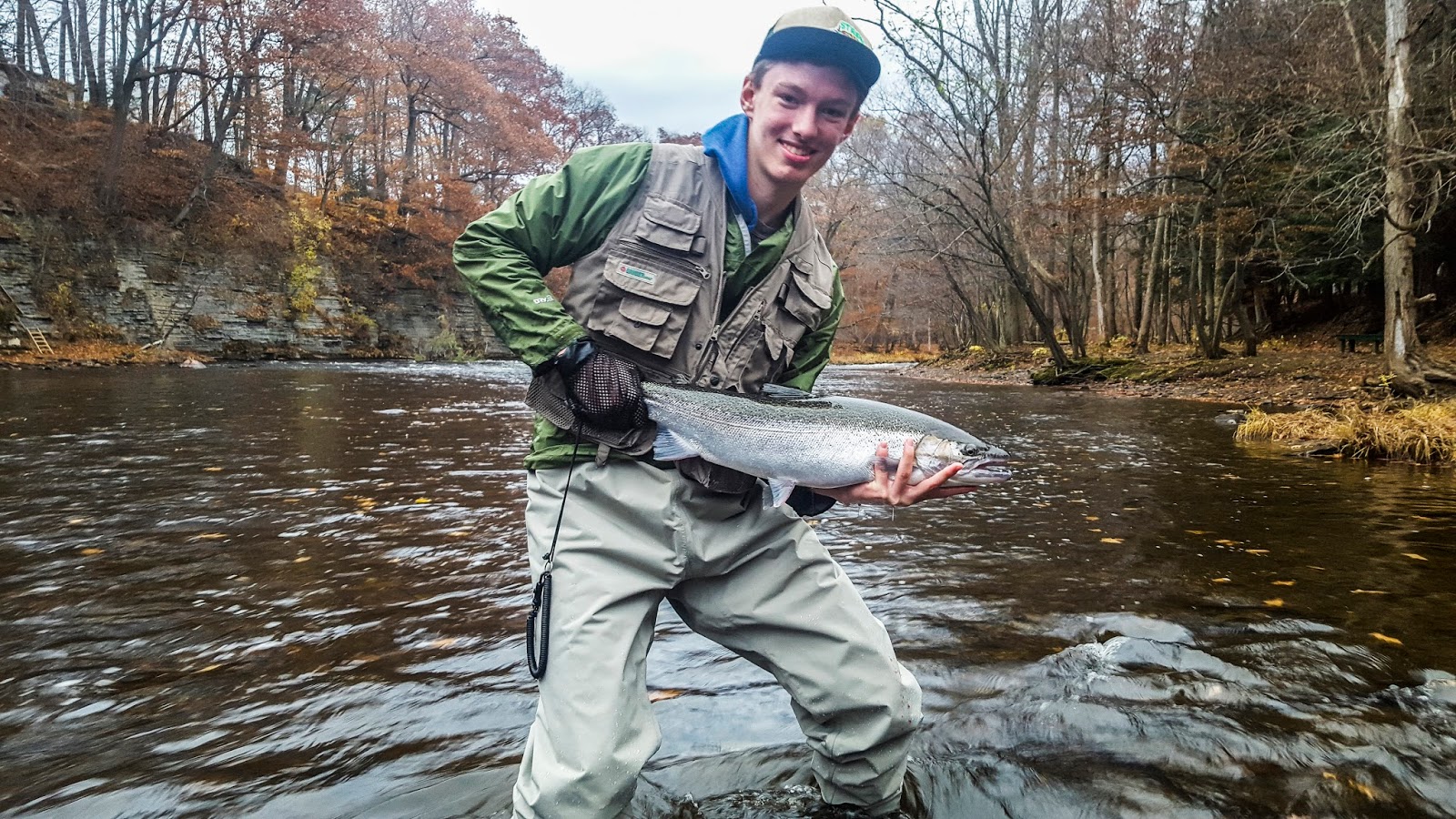
From what we gathered in communications with the Douglaston Salmon Run river walker, Matt's steelhead was the one and only this morning. Matt's weighs (the shot shows him releasing it) about seven pounds. I lost one at the net longer in length that looked skinnier. Both chromers.

Copious online reading before we came up informed me, but actual fishing comes down to trial and error and habit, and of course as a spin fisherman, I have a habit of holding the rod high as if it's no problem. After this venture with my son, I may hold the rod to the side more often. I told myself to hold the rod aside, having learned that's what you do with noodle rods four years ago, and reminded of the same for fly fishing numerously in my reading, but Nate caught me holding the rod high, and apparently it was too late before I could have adjusted position. I guess that's why I lost the steelhead. I had one other hit on a chartreuse streamer near the end of our seven hours, a pretty strong strike.

We fished three stretches thoroughly, but could not escape leaves. If not for the mass of them--I mean they were thick and cast after cast got interrupted by having to pull a yellow leaf off the hook--I think we would have caught more fish. The leaves cut into our time and grace. We began with a calm, warm air mass of about 60 degrees just after 6:00 a.m. Leaves were bad enough, but once the wind picked up, they got to be the mess I've described.

Since I've had severe herniation in my lower back for years, my spine is somewhat scholiotic, twisted, with the result that sometimes my upper back pains me badly. No problem on Lake Hopatcong recently, nor while casting spinnerbaits the week or so before my son got out. But I had to take several breaks today, finally saying the hell with giving into the pain and just exerting myself past the difficulty, which resulting in--less pain. I fished the last two hours with wilful determination that made me feel great afterwards. We had fished hard all morning, but it took me hours before I fully got into it; not that I wasn't trying; I just hadn't stirred the manic power in me yet.

When my son hooked up about 7:30, I got my camera, the $600.00 camera with the $525.00 lens, my favorite lens, and got in the water--with Korkers on of course--to get the shots, and my very last shot--about two seconds before I heard Nate whoop, saw him lift the steelhead in the net, and a split-second later fell flat on my face in the river--is the best. I'm saving it for possible magazine use after we get more experience yet. The file card never got wet, and I got the last picture my camera and possibly my Tokina lens will ever take. Sort of like a mother who dies giving birth. I took emergency measures to try to save the equipment, and, finding the electronics unresponsive, said, "If I broke my leg, that would be worse." Nate got some good shots of Matt and his fish, and later my son said, "If you told me a year ago I would catch a steelhead on a fly rod, I wouldn't have believed you."

You just play the cards in your hand, however expensive. Once the camera and lens got submerged, it was done. As I edit this last paragraph now, a tech has told me an upgrade is less expensive than repair. The camera will be replaced and soon; the lens either fixed within three weeks or replaced by the same model. Most of all, my son succeeded, and he's since talked about fly fishing the river that runs through town, the North Branch Raritan. And we'll be back for steelhead next fall.  


I wanted Nate to fish when I took a break with my aching back.