Tuesday, January 14, 2014

On/Off Trout Fishing at Round Valley Reservoir


At Round Valley Reservoir, Hunterdon County, New Jersey, I fished marshmallow and mealworms on size 6 hooks, weighted with steel egg sinkers, the marshmallows floating three feet or so off bottom, me marveling at the fog patterns and a little dismayed with my camera in the rain, not getting a hit. This is the third time out since I caught the rainbow in December, short stints usually for an hour or so, coming up with no hits. I last fished on the 8th and had the company of two others fishing, catching none, but taking one hit in 17-degree weather. I felt surprised the reservoir did freeze a little at some of the edges, ice sheets extending as many five to 10 yards out. I saw this on Friday in the snow. With an average depth of about 80 feet and maximum depth 180 feet, the reservoir rarely freezes.

I had the company of another angler today, who caught three rainbows just under 15 inches yesterday, missing six hits. Today, no hits at all. You would think with the rain the trout would be in and feeding, but they preferred the partly cloudy skies of the day before.

 Two Ugly Sticks
17 degrees on January 8th.

Friday, December 27, 2013

December Trout at Round Valley Reservoir


I was beginning to believe I'd catch no trout in December on my short stints at Round Valley Reservoir, but landed this chunky 15 or 16-inch rainbow this afternoon on marshmallow and mealworm. A couple of guys left as I set up my two Ugly Sticks with size 6 hooks, barrel swivels, and half-ounce steel egg sinkers, and they caught half-a-dozen or so, but started early. Their largest was 16 1/2 inches, smallest 14. I also fished on Monday and once during last week, and spoke to someone who had caught three. He said they're running smaller, about the size I caught today. 15 or 16 inches is the average Round Valley trout. I've never heard of any under 14 inches, but we've all heard of much larger.

I thought, after I cast each line, that I just like the satisfaction of putting a couple of lines out. Doing that is sufficient to breathe fresh air and move my sore thighs with the L-4 nerve pain still persisting from the herniated disks in my back. I thought that I know it's possible to hook a trout, but if none come along, it's still a worthwhile outing. I let the lines sit for 15 minutes, bails opened, and when I came back to the rod with the trout, the line was spooled, all the way down to the spool knot. I lifted the rod and reeled, feeling nothing, so at first I thought the trout got off. It had only changed direction. If it hadn't, I suppose it would have broken that weak knot.

Next time I reload line, I'm tying a clinch knot to the spool.

Silvery reservoir trout have been in the depths a long while.


Friday, December 13, 2013

Clear Sky Trout Fishing Before the next Snow


With clouds earlier in the morning, I thought atmospheric pressure might be falling, ahead of the coming storm, with more clouds coming yet. Instead, the sky became cloudless. Nevertheless, one rainbow about 15 inches was caught on bright orange floating synthetic Berkeley Gulp salmon eggs, not by me, but a guy who rode all the way up from Hamilton almost an hour away. Other Round Valley catches have been made recently, I've gathered, but today and Wednesday I got not a hit.

Conversation by the water was good. We winter trout fishermen at Round Valley may not get much action, but at least often have words to exchange. Matt was very happy about his trout this late in the season. Among other things, he mentioned some trout being caught at Amwell Lake, but Round Valley beats places simply stocked for the winter and without the prospects of anglers catching trout silvered and grown large through years of living in the reservoir's two-story fishery. Matt also said that someone ventured the opinion that the next New Jersey state record largemouth will come from here, and although I think the likelihood is low of anyone's breaking the 10-pound, 14-ounce mark from Menantico Sand Pit Pond, Cumberland County, it may be possible. The 7-pound, two-ounce smallmouth caught here in 1990 is the state record for this species. It's nice to imagine a largemouth over 11 pounds swimming the clear depths, but to be honest, it's easier to imagine when you're there fishing, desiring to catch something. The reservoir's low fertility does make it questionable to me, also. More big bass seem to come from Merrill Creek Reservoir.

I spoke of ice fishing on the horizon, but mentioned that the nerves in my legs are giving me trouble. Unless they improve, I can't handle the stress of doing that this winter. But at least I can put a couple of lines out and wait on trout at Round Valley, reading in my car if no one's around to talk to, making sure to check lines often. Twice the reel was almost spooled, which would have meant the rods and reels would have been pulled right into the depths, or hung up on rocks out of reach, I suppose, if I didn't get to them in a nick of time.

I think next week I'm going to make myself deal with shiners. It's so much easier to use marshmallow and mealworms. Even easier than that to use Power Bait or Gulp eggs. But if a lake trout comes along, it would be good to be prepared. The only time I have actually seen a laker caught from shore was during a rainstorm in February with very heavy winds. But others have been caught, although I wonder under what sort of conditions.


Friday, December 6, 2013

Quiet in Ranger Cove: No Trout Respond as Rain Pauses


Quiet in Ranger Cove. The rain quit. The slightest breeze barely stirred. I was all alone until I gathered my two rods to leave after 45 minutes or so. Guy drove up from Hamilton. Asked him if he fishes Stony Brook. Yes. This puts an interesting twist on a post from September this year. My brother Rick claims the smallmouth bass fishing is all over with at Stony. This guy says it's good. What concurs is that the water level is lower (due to lowered water table, increased impervious surfaces). He also mentioned pickerel. I'm convinced they come from the lower of what used to be Princeton Day School ponds. They managed to get in there late in 1977. Before the 80's, chain pickerel were unheard of in Stony. I know the stream that enters into Stony from the PDS ponds above.

I fished two days here at Round Valley prior this week. Like today, nothing. Someone I spoke to Monday caught a 15-inch and 16 1/2-inch rainbow. The weather conditions seemed good for fish feeding, raining when I arrived. That stopped, so who knows? Higher pleasure blip? It's raining now. It's ridiculous at bottom to try to explain the likes of this anyhow. But it's good to be aware of environmental changes because you can't fish without being there.


Wednesday, November 27, 2013

Brown Trout for Thanksgiving


The rainy weather seemed right for fishing, and I had just over an hour at Round Valley, putting two lines with marshmallow & mealworm out, getting one hit, and catching the 16-inch brown. I set the half-ounce steel egg sinker in 20 to 25 feet of water, but when I set the hook and began reeling, the trout thrashed on the surface to my left right near shore in about five feet of water. It swam into the shallows and wrapped the line around weeds. I heaved at the fish. The weeds were already a great resistance, but before it got stuck in the weed mass, it had leapt clear out of the water. Thought I would lose it, but after working that six-pound test hard, the fish came in bunched in milfoil or whatever that vegetation is.

Keeping any lake trout caught becomes legal again after November 30th. I guess I'll try shiners. I don't understand why plenty of lakers are caught from shore in that reservoir inside the city limits of Boston, forget the name, and so few at Round Valley. The population is abundant, but the fish seem to stay out deep.  


Monday, November 25, 2013

Trout Options for Reservoir Winter; 35 Degrees with Arctic Ducks


Managed to fish Round Valley twice since I last fished, at Lake Hopatcong with Oliver, November 2nd. I've had some serious trouble with sciatica and while I kept busy with other things, fishing wasn't something I could do. Thursday last week I had a hit from a trout on the marshmallow and mealworm just a couple of minutes after the half-ounce egg sinker took hold. Today, nothing, but it was fully worth being out there, no disappointment at all.

After fishing all fall, winter, and into April last year, I'm fully familiar with how slow this fishing is after some possible fast action in October and perhaps November near the main boat ramp. Some guys caught some on artificials last winter--Redfin plugs, Binsky bladebaits, spinners, Kastmasters. Someone casting Redfin plugs claimed he was catching a lot of browns. Since I like to take it slow and get reading in, I probably won't follow suit with lures, but fish two lines instead of one and possibly some shiners pretty soon. I have lake trout in mind, but the chances of catching one seem to remain slim. The reservoir is loaded with them up to about six pounds, but the rainbows and browns are chiefly the species in close for the winter. And they have many of miles of shoreline to cruise, which involves why fishing is typically slow.

I met two birders and saw a few others. All I spotted was a loon, but heard report of a bufflehead duck, eared grebe, coots, and a common merganser besides. So birds that summer in the arctic are here--buffleheads with their white-barred wings that look like strobe lights in flight.


Friday, November 15, 2013

Fly Fishing the Claremont South Branch Raritan River


Fly fishing the Claremont, South Branch Raritan River

By Bruce Litton
This is another of my Recorder Newspaper column pieces, published recently in September or early October.


          Perhaps no length of river for fly fishing in New Jersey is as mysterious as the Claremont section of the South Branch Raritan. Last stocked in 1995, wild brown and rainbow trout, and native brook trout, flourish in a 1.1 mile section of river from the fence dividing off a private fishing club upstream, and Electric Brook in Long Valley downstream. An abandoned rail line is converted into a pathway that runs straight parallel to the river, but the river itself is out of sight in dense woodland well off the path. Climbing over downfalls and through brambles to wade it may be difficult, and many fishing situations allow roll casting at best. But the heart of the mystery is the size of some brown trout that may be there. They’ve been caught as large as eight pounds apparently.

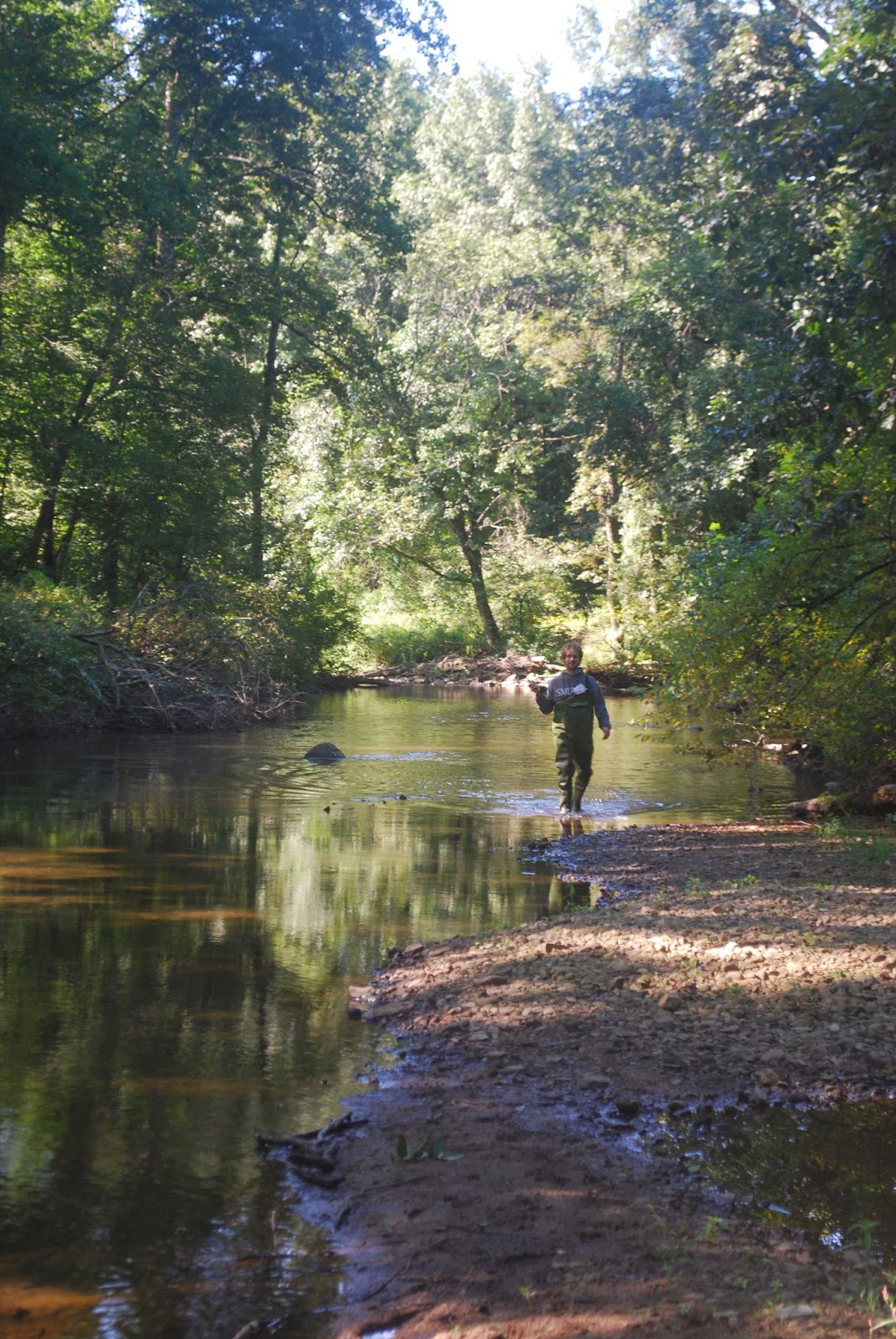
          Fly casting the river recently with Oliver Round, I wondered just where such a fish could possibly be. The hole just below the bridge where Patriots Path crosses is very deep, but not really very large. Wading upstream, I found that the river averages about 20 feet wide and two and a half feet deep, not exactly territory for any browns to be expected over 17 inches or so. No doubt, a real large brown is a rarity. Even a 17-incher is a seldom encounter, and nothing has convinced me that the eight-pounder I heard about was a wild fish. Perhaps it made its way down from stockings by the private trout club above. More mystery yet to add to the picture; if the thought of a huge but stocked trout is disappointing, at least we consider realism.

          This was one of the first of this fall’s chilly mornings when Oliver and I fished—about 42 degrees. However, Oliver has actually waded this section in January—downed trees, brambles, briar patches and all—and happened to catch eight browns that cold day on flies which imitate trout eggs. After all, these trout reproduce and feed on one another’s spawn, as odd as the behavior may seem. This September morning, we spotted a lot of trout but caught only one on a size 14 stonefly nymph. The water was clear, the trout skittish, and time in fairly short supply. A few rose in the hole below the bridge where we first arrived, but I was disappointed that none would take my size 18 parachute ant, size 20 blue winged olive, or size 20 Adams. I tried a fly that resembles a small worm, then switched to a white-bodied streamer with a golden flair of hackle rising over its back and walked over the bridge the way we came, to crawl between bush boughs and begin roll casting to the spot where I had seen a trout rise three times. I got a strike and believe it was that fish, but missed it. Meanwhile, Oliver had three hits from the same rainbow trout on a streamer just upstream of the bridge.

          We waded upstream and the day got more interesting as my hands warmed, and we had the sense of a wild place isolated from the byways, homes, and businesses that fill New Jersey. Once it was the other way around. Villages, towns, homes, even cities, scattered about isolated in the general wilderness. I checked my phone for the time, and of course it had service too. Oliver took out his phone and showed me a video he had filmed of a spring in the woods somewhere nearby between the path and the river. It is immense, wherever it is exactly. Oliver spoke of bringing a GPS and trying to find it again. It didn’t bubble; it welled up like a fire hydrant flow from the ground.

          On the high end of Schooley’s Mountain, Budd Lake—a shallow warm-water lake—is the origin of the South Branch Raritan River not many miles from where we fished. During summer, the water flowing out of the sluggish, weed-choked lagoon at the end of the lake is very warm. But all the way down the mountain the river is spring fed. I had no idea springs like the one Oliver showed me on video exist in New Jersey. But I have read that the river is so rich in springs keeping the water cool that native brook trout exist within a quarter mile of the lake. In any case, there are wild and native trout in the South Branch Raritan’s upper reaches, and exploration may reveal surprises unexpected.