Friday, September 20, 2013

South Branch Raritan River for End of Season Smallmouths


I fished the South Branch Tuesday and once last week, also Round Valley, and caught nothing but a redbreast sunfish using Senko-type and slower sinking Chompers worms. I didn't have time today to go downstream around that bend to explore, but did catch an average stream bass and another smaller near the edges of fast water to the right.

We may read about a new spot this year. Even with today's time limit, I can relate a new spot upstream that's deep, a bass lost to it. No further action would be a surprise because it looked good. I thought about two favorite rivers--North Branch besides--and the possibility for really taking some time on the North Branch, possibly getting further downstream from the Lamington River confluence than I've gone, leaving my Nikon SLR behind, taking the waterproof GoPro and a waterproof backpack. Not far below the bridge abutments, where wading the edge used to be no serious problem, Sandy downed a couple of trees and holes have been dug out by the current around the bases. These can be waded waste deep, but I would swim a section further downstream. When my son and I penetrated about a half mile down from Cowperthwaite Road and the old iron bridge over the Lamington, we managed to get by through some thick brambles, but it would be easier to get thoroughly wet, possibly necessary further down.

In my teens, I used to catch a lot of smallmouths in Stony Brook, Princeton, NJ. I had a deep passion for that stream. I'm older now and should move on. I want to try bluewater fishing off the Outer Banks, for example, and have tried the reef in the Keys, etc. etc. But a real longing to reawaken more of this passion goes back to when I was eight, and later knew it best as a teen, if I only manage to fulfill it for a matter of hours on a given day. When I fish the South Branch, I'm limited to about an hour. It's also further from home. But even little time makes a big difference. And it calls me back to try and put some more time in, even though I know I can't promise myself I'll do it next year with the demands of writing a novel.

I keep a detailed fishing log. Perhaps this evening, or soon, I'll revisit Stony Brook by the symbols, numbers, and notes marked many years ago and draw some comparisons. The bass were much more abundant, and over the past decade I've fished Stony half a dozen times or more and found the bass depleted. I don't know why. Fishing pressure doesn't seem to explain it. Legal size is 12 inches and no one seems to fish bass in Stony anyhow and never did, besides myself and my younger brother. Few fish bass in the South Branch, and all those who do seem to release them.

At any rate, all sorts of vistas sweep through my mind and grounding them with some facts from the log will help put them in organized perspectives. Rivers are places that mean a lot more than meets than eye, and why be limited to just catching fish? If so, plugging away at the old South Branch, usually catching one or two average stream bass about nine inches long within an hour, would seem futile. I love to wade and photograph the river, even though many of the photos are pretty bland, and I've done some snorkeling with my son on the North Branch, which is very relaxing and interesting. With the GoPro more snorkeling yet is imminently possible. There's something about experiencing small rivers that brings me home, yet a lot of what life is all about is not home, but novelty far afield and breaking free from such roots, establishing yourself by broader, more expensive adventures--and bigger fish! There's always a lot besides fish to experience on an expensive excursion. But I don't want to turn my back altogether on what I started as a boy, because the river seems to inform me that this business just isn't finished yet.

The most compelling question is that I don't really know what this experience is. I do know it is something that cannot be answered by thinking alone. If whatever it is that pulls were only answerable by a question, then I could answer by framing the question in words and, through thinking, arrive upon a sufficient answer. Or could anyone? Many questions of philosophy go unanswered, or do so at least for most of a philosopher's lifetime. Einstein asked what would be the unified field theory, devoted much of his later years to arriving upon the answer, and failed. And in my case, this unexplained X about rivers, if it can be answered through a question, could only be met through a quest, physical and demanding--and only then perhaps the answer might dawn in the form of a thought. Interesting to consider that such a thought would be no more than a shadow of life lived out. Who hasn't been thoroughly active in hot afternoon sun and relaxed in the shade thereafter, feeling as if all the world's his possession?

It goes back before my ambition at age nine to become a zoologist. I told a Boy Scout parent last weekend that I'm just good enough a naturalist to kill myself if I'm stupid, commenting on red berries I think were edible wintergreen. But not even my passion for science and collecting and observing live specimens when this sort of thing was not punishable by law, which never became a career, explains it. I could read scientific accounts of rivers, which I'm not opposed to doing and have read some, which might help inform my quest. But I keep a sparing pace in the departments of naturalism and scientific explanations. My quest is more related to poetry, perhaps, if this is ironic for the physical demand I mentioned and described in a post on the North Branch earlier in the summer. But the idea doesn't move me to write poems so much as to get back out on the river.

Thursday, September 19, 2013

Backwoods Bedminster Bass Pond Silted In

This evening I read one of my posts from early October, 2011, thoughts I gathered while fishing the North Branch Raritan River for smallmouths, this actually posted on my dormant blog, Fishing in New Jersey. At the end of it, I made the point that the best a government can do is protect a man's right to get up and go out alone, an opinion I still hold of course, that a just government's primary role is to protect the individual rights of the citizens of the nation it represents. I had been mulling over whether or not to post anything tonight and instead of deciding one way or the other, I remembered that this post from October 6th, 2011, was a good one, and typed in "North Branch Raritan River Release," which brought it up on Google. That last sentence hooked me. I had gone out alone earlier today, fought briars, dense vegetation, and deadfalls hiking back in woods I had never visited, trying to find a pond I was told about six or seven years ago or more.

I wasn't sure how I would really feel. I'm not 16 anymore. I fight brambles in other places, so why not. But this place had limited parking. At least I had believed it did, discovered otherwise when I got there. I had to get there by bicycle. I hid my 4 piece Ugly Stik in a backpack in its original container--some of the total sticking out the top--so I would not look like a fool pedaling a bike with a fishing pole. I slung my camera bag too and certainly appeared interesting I'm sure in rush hour traffic on 202-206. I hid my bike in the woods and followed deer trails. I had to maneuver around a lot, but I finally came to a dam. First I heard the water and figured that's what it was. But when I made my way up top, I found that the guy who told me about this place--loaded with bass, which made sense since it's below private Sunset Lake (loaded with bass) on the same stream--was no liar, but had a very long memory. There's been no bass here for many years. The entire pond is silted in. Cattails everywhere, some big, lotus-like aquatic plants but no pond at all, although the dam betrays that at one time long ago, this was a pond back in the woods.

I hiked out, still feeling good. I had found that once I was in the woods, the boyish feeling of being alone on the trail of something--possibly--enlivened me and restored an acuteness of my senses. There are places back in the woods in New Jersey that do have bass. Some of them are many miles back. And it's not aversion at inconvenience and pain at pricker bushes if you have a mind and body that can respond to this land we share. What is America? Most think of the people and of course the American people comprise the nation, but America is also the land on which we live. It might be nice to get off the sidewalks on occasion.

Wednesday, September 18, 2013

Hybrid Stripers and Walleyes on Live Herring


Three Herring Approaches for Fall Hybrid Stripers and Walleye

By Bruce Litton


          The bite persists until ice arrives, thereafter by other methods, and using herring is a rival approach to vertical jigging that pays off better sometimes. Bundle up if it’s cold and bring a coffee filled thermos and sandwiches to burn calories. The elements can take it out of you, so fish hard.

          Last year I discovered steel bottom walker rigs that get around snags and click audibly, if clicks make any difference to fish, possibly not at all. Drifted deep along drop off edges, herring on size eight treble hooks tied to 40 inch, eight pound test fluorocarbon leader swim over rocks as the heavy gauge wire extension trips on catch surfaces, the steel weight avoiding wedging. The treble hook increases the chance of swifter set and prevents a single shank hook turning in upon the head of the herring. Hook herring through the nose. If you buy a walker with a swing arm, it prevents line twist and tangle.

          Fishing a walker is simple and certainly riles up walleye that live among submerged stone palaces, as well as hybrids that frequent the bottom also. Keep your hand on the reel seat and index finger on the line, bail open, to give a little line before setting the hook. Some use several rods in holders with drag set just tight enough for the fish to hook itself, but more hits may be missed this way. Watch the graph and if a lot of fish are marked suspended, try the second method I have to offer. But fish right on bottom usually can’t be seen on the graph, and they are down there.

          I fished last year with Lake Hopatcong veteran Joe Landolfi, who showed me how to drift herring in the mid-range column. Until then, I had always fished right on bottom, typically along the break between flat depth and the rising rocks of a point or other drop-off. Summer hybrid fishing means weightless live-lining, but now I know using a ¾ ounce steel egg sinker, and the small treble, is effective for suspended fish, plenty of them. Simple, easy for me to have overlooked, herring usually school mid-range in the water colume. Even walleye may rise up and get them.

          This is a great way to kick back, tell stories, and enjoy the weather compared to the rigors of vertical jigging. Setting rods horizontally so that guides lock them in place against gunnel edge allows you to hang back, let the wind blow, and relax. Set the drag just tight enough for a strike set.

          Catching the right wind angle is necessary. Some points may come right up on you as wind drives you directly towards them, but if you have an electric motor, so long as wind isn’t too heavy, you can vertical jig instead.

          Or you can anchor and try the third approach. Last year we came upon Marty Roberts fishing the deep edge of a drop-off, anchored. He had a school of two to three pound hybrids right under his boat, and dropped herring on lines weighted by large split shots 29 feet down, cranked twice, and awaited strikes that came left and right—he fished two rods, standing or seated between them. Double anchoring doesn’t help, according to Marty; he likes a little swing to cover some space. But if the wind blows like an arctic invasion, double up.

          When anchored and fishing directly under the boat, chumming is effective. Keep and freeze any herring that die for this purpose, mash, and mesh them, tying off a bag with thin diameter cord. You can buy mesh online and at hobby stores. Placed a few feet under the boat, a snapping turtle won’t get it this time of year. But the boat rocking in the chop will release tiny herring pieces and oils, striper attractants.

          For all three methods, that break between flat depth and drop-offs is the primary edge of concern this time of year, all the way down at the deep end of a drop-off. But it’s no absolute that all fish travel the line, nor do those suspended necessarily hang over it. They might not even be on or over a drop off, but off structure by 50 or a hundred feet or so, suspended at sporadic depths over 45 or 50 foot depths, or whatever. But they are not all over the place or just anywhere. Marty swore that if he placed bait at any depth other than 28 to 29 feet, he’d get nothing. And when the anchor drifted a little, he didn’t catch any. What I never understood was why the school stayed in place so long. But a lot of things mystify me. It’s an absolute, though, that fishing’s a pursuit, and when you do find fish, you should feel good about it.

Friday, September 13, 2013

Vertical Jigging for Rambunctious Walleyes


Vertical Jigging for Rambunctious Walleyes

By Bruce Litton


Every September walleyes begin to orient to proper habitats after summer suspension—deep, rocky drop-offs, points, and humps frequented by schools of alewives. Lakes such as Big Swartswood, Canistear Reservoir, Monksville Reservoir, and Greenwood Lake may not be so limited by oxygen depletion during summer as Lake Hopatcong--all of these lakes and reservoirs in New Jersey.  But everywhere walleyes are on the fall feed and vulnerable to a method which at first glance may seem counterintuitive.


Rapala ice fishing jigs are—supposedly—for ice fishing. Likewise, Gotcha jiggers have for many years been the staple lure for fishing a range of species, especially Spanish mackerel, from North Carolina Outer Banks piers. The line ties on top of the plug-like jigs--Rapala ice fishing jigs are constructed with line ties on top also--allows for effective retrieves from high up on the rails. The Gotchas sold at Dows Bait and Tackle have packaging that features an artist's depiction of a Spanish mackerel, not a walleye. But both lures are long standing for open water walleyes in New Jersey, and Al Linder has written about the open water use of Rapala ice fishing jigs in Minnesota.


The description “vertical jigging” may be slightly misleading since most fall days are visited by brisk breezes. Drifting with graph recorder doing its magic, darkness at the depth registered, and the Rapala or Gotcha striking rocks as it touches down after the rod is snapped up, drag on the line demands that more be let out to retain bottom contact. Water temperatures above the lower 50’s means line out in shallower depths of about 20 feet can be advantageous, though fish may be deeper. (We've marked fish at 33 feet on an October first with Lake Hopatcong not fully turned over.) Walleyes respond well to Raps or Gotchas whisked off bottom by long rod sweeps, then allowed to plummet back—hits usually come just after contact with bottom, so be ready. Most jiggers, however, prefer to fish as close to directly under the boat as possible. Walleyes are active in fall water temperatures chasing alewives, and turn on jigs with ferocity in any case. Through ice fishing season, vertical is all that a walleye can get if you are fortunate to drop a jig down near it.


Heavy wind happens. Some wind is too strong to drift, so anchor and jig the area the boat swings around, then re-anchor downwind. If you were to double anchor to hold the boat in place, you would defeat the purpose of covering water by a relatively slow curve. I fished with vertical jigging veteran Joe Landolfi a couple of years ago as we do each fall. I left my tackle box at home and just brought along a clear plastic tackle tote filled with Gotcha’s and some Rapala jigs—and a few 2 ½ ounce, quality saltwater bucktails tossed in for curiosity sake. Early in the day the boat got chugged by strong wind. Joe caught sight of my bucktails. “Hey, I bet those would work!”


“No doubt they will get down faster and keep the line vertical longer,” I said.


We didn’t hook any fish on them, but they looked real good in the water. We had no doubt they would work. The Rapala’s and Gotcha’s are 3/4th to 1 ¼ ounce, about three to four inches long, and get carried back by line drag much easier than heavy bucktails. But instead of worsening, as I had feared, the wind lessened and it felt right to return to using Gotcha’s.


This fishing is not a boring ordeal of sitting in place and moving a rod up and down for hours on end. If the lake is dead calm, the use of an electric motor moves the event along. Vertical jigging is an efficient way of covering a lot of territory, of finding walleyes which respond fiercely as predators. All of our walleye lakes feature multiple structures. Joe showed me places on Hopatcong where he had caught walleyes in the past as well as during our outing, which I had overlooked before. All of the lakes have obvious points and drop-offs that garner most of the attention. But any rocky region with 30 feet of water or more nearby, whether a drop-off, ledge, hump, or point, are surely visited by both herring and walleyes, walleyes that boost their health on this Omega oil-rich forage. Most of the fishing after mid-October is in water 25 to 40 feet deep. Walleyes are caught any time during the day, even under sunny skies. You can be sure they will be deep because the herring are too, and the walleye’s retinal eye structure, the tapetum lucidum, advantages predation in darkness. These tissues behind the retina reflect light back out through the eyes so that walleyes can actually see much more in darkness than other gamefish—and forage—can.


A graph recorder is typically helpful in unforeseen ways, but insisting on fishing only where it marks herring schools may not only mean missed opportunities for walleyes sovereign enough not to follow little baitfish around, it also means that you kill the element of surprise, of drifting into fish. It’s more important to fish the jigs than it is to chart a graph.


You need a medium power rod. We found that the heavy saltwater jigs did not overload such rods—they would have if casted, but not dropped straight down. My only apprehension was with the size and thickness of the hooks on them, of driving one of those into a hard jaw. But Joe checked the sharpness, and sure enough, I think setting those hooks would not be a problem, especially if Power Pro braid is used. Perhaps the heavy weight of the jig would allow it to shake free, but walleyes don’t shake their heads as furiously as bass do, nor do they leap.


Seven foot length is ideal for range of jigging motion, particularly if shallower 16-20 foot depths are fished early in the game by those sweeping motions. During ice fishing season we use two foot jigging rods to hop jigs, rather than snap them.


Fall walleyes are not a game limited to boat owners. Dow’s Boat Rentals offers great hours, lots of boats available into November, and affordable prices. The marina is situated perfectly at the mouth of Great Cove, just around the corner from Nolan’s Point. Just do the boat safety certificate course and get verification posted on your driver’s license. Then jig hard for walleyes with a 15 pound fluorocarbon leader—you never know if a ticked off musky won’t swipe at your lure.


Saturday, September 7, 2013

Fly Casting the Claremont, South Branch Raritan River

Fished the Claremont with Oliver this morning, extending the range of my experience with the South Branch Raritan River, although we were after trout, of course, not smallmouth bass. I began with a parachute ant and Oliver with a big, ugly streamer that took three hits from a 10-inch rainbow. My ant got ignored, even though a few trout rose in the deep pool. I switched to a worm imitation, then to a white-bodied streamer with an orange flair. A trout had been rising on the other side and when I had got into position, took a solid strike but missed it.

We waded upstream and saw a lot of trout as large as 12 inches, but all we managed to catch was my four-inch brown on a stonefly nymph. Oliver's had some success here in January on tiny egg flies, since trout reproduce and eat eggs. The Claremont is trout production water and most of the year the limit is one trout over 15 inches. In March and until Opening Day no take is allowed. As far as I know, everyone who fishes this long section of river puts the trout back as they should. It hasn't been stocked since 1995 and for the most part it's a wild river in dense woodland with deadfalls to maneuver over and around and thickets complicating trails. A lot of it allows only roll casting, if that. So for the few who propel themselves over such challenges, there are trout here.


Friday, September 6, 2013

Four Pound Smallmouth Bass South Branch Raritan River


Had just enough time to go upstream to the spot where I caught a two-pounder this time last year, also on a Strike King, Senko-type worm. I approached quietly, winged in a long cast, and waited, the water at least four feet deep, nothing happening. Anxious that rocks would hang up the worm, I moved it slowly and felt a tick, gave slack, then tightened up and set the hook.

"This is a real nice bass," I told myself. I couldn't move the fish; the drag gave. Within a second I knew I had a better bass on than the two-pounder from last year. The drag gave several times, although the bass never jumped. It looked smaller in the clear water than I knew once I had it at my feet. Nineteen-and-a-quarter inches and chunkier than appears in the photo, this fish was nearly four pounds. Happy to release it, I wondered, while walking back to my car, if it will be there next summer.

A week ago I caught a two-pound smallmouth on Round Valley Reservoir and told Fred that it would probably be my biggest smallmouth of the year. We had tried Pepacton Reservoir; my son had caught the two big ones on Hopatcong, and we got washed out of another likely smallmouth trip. When I spoke to Fred, I hadn't placed much hope in the South Branch, but I've been fishing it pretty persistently over the past four years.

Two days ago the South Branch was running too high and somewhat stained. I did manage to catch an average stream bass on a Strike King worm, but that was the only hit I got. Today, stream level was just right, nice and clear, and even chilly after last night's upper 40's or low 50's. Maybe I'll get a chance to try elsewhere on the river next week.

So after four years fishing this river for smallmouths, I finally catch a real nice bass. It takes that long, at least it's taken me this long, to begin to know a few spots, just little niches that hold nice fish. The river makes an impression on me as a wild place not visited much by people, except at the bridges and other road access, and for the most part, bass live without angling contact. It takes some effort to walk through brambles where water is too deep to wade, and wade for many hundreds of yards without finding fishable water, and when you do find places where bass reside, you know better than to tell anyone.

Tuesday, September 3, 2013

Pulaski Salmon Surge: Salmon River Run Soon

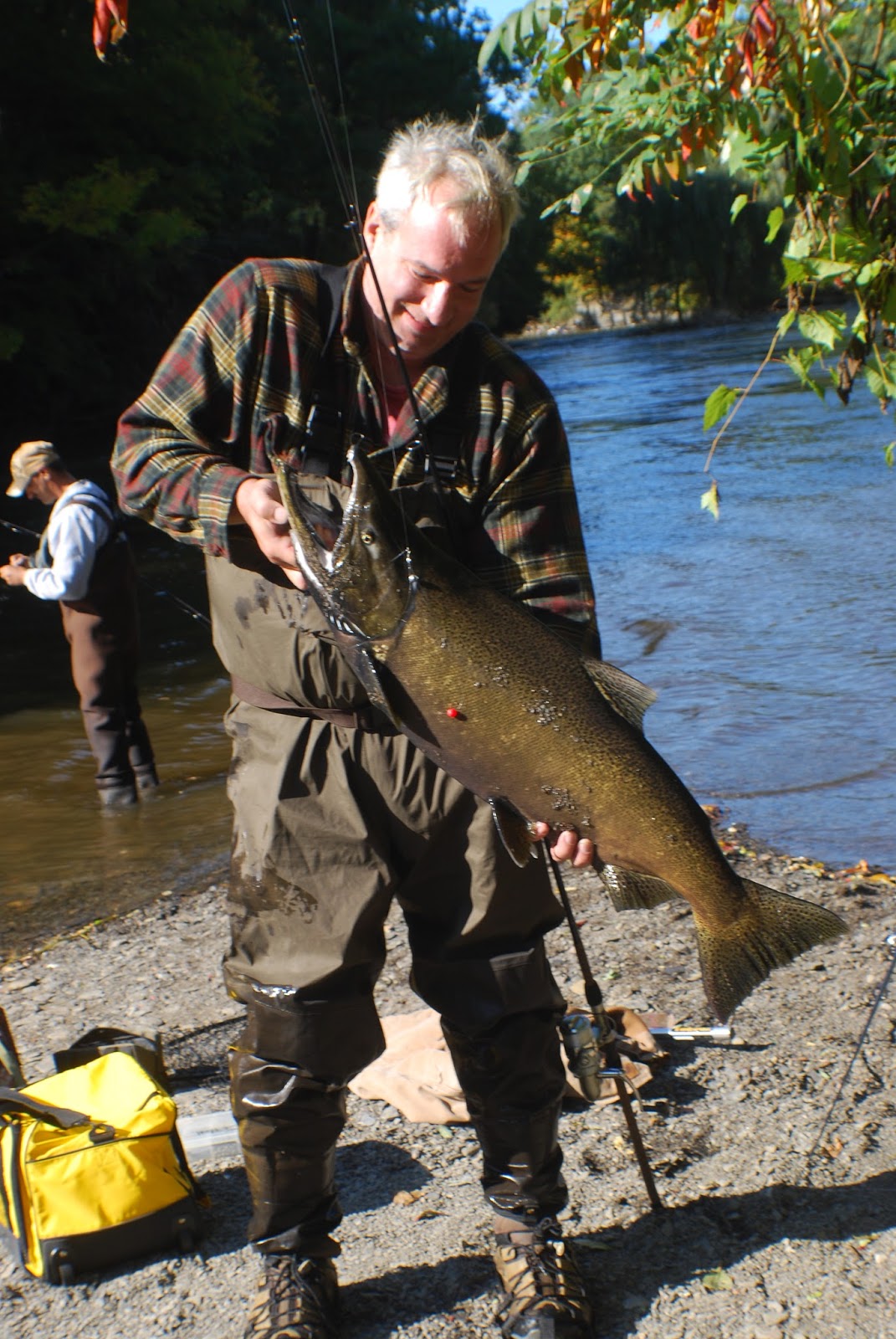
(Red spot is 10mm bead having slipped down the line.)
Salmon River Showdown
A Month of Salmon Surge
Especially on Columbus Day weekend, the Salmon River running through transforms an ordinary American town with a business district into a Mecca with thousands of anglers converging on Pulaski for their shot at king salmon, Coho salmon, and possibly a brown trout better than eight pounds or an early steelhead. Some restaurants post prohibitions against wearing cleats, but none of them disallow wearing waders. From the numbers of vehicles toting rods parked along roads and anglers strolling through town, you would think the river would be as jammed everywhere as Clinton Falls on Opening Day, but my son and I have always found enough room to fight these great fish.
Kings run as large as the Salmon River record, 47 pounds, 13 ounces, and average 15-25 pounds.  Cohos are less common, usually 6 to 12 pounds, with the Salmon River record at 33.45. Rods and reels don’t need to be as beefy as you might think. In fact, a noodle rod used for steelhead later in the fall may suffice with 8 pound test mono and good knots. These light power rods, 10 to 15 feet in length, absorb the fish’s power in the bend. I haven’t tried a noodle rod on a king, but others have with amazing play. 6 to 18 pound steelheads test these rods regularly with 6 pound test—not much more line strength would break the rod.
        
Most salmon chasers use the sort of rod you might use surf casting in the fall with light Ava’s for stripers, 7 or 8 foot medium-heavy power rods with 12 pound test mono. Make sure to use a reel with a good drag set at a third of line test, you’ll need it! Fly fishermen have a great time with salmon, but fly tackle is not necessary to catch loads of fish. Salmon are in the river to spawn, and some of them end up in the hands of fisheries employees who take the spawn, hatch it, and safely replenish the river and Lake Ontario. None of the salmon feed. But for some mysterious reason, they do take salmon egg imitations into their mouths. In fact, a foul hooked fish must by law be returned to the river, but most are mouth hooked. We’ve had the most action on plastic beads, although small pieces of sponge, and spawn sacs (about half dozen eggs in netting) have worked well. We tried homespun yarn flies and got very little action. I think yarn flies seem more like some kind of bug.
         
By law, hooks must be less than a half inch between barb and shank. We use Mustad #92141 off set hooks, size 4. They are designed to be snelled, but hook fine with 12 pound test fluorocarbon tied directly to the eye. If you do choose to snell, carry several leader wallets because the bottom consumes untold millions of terminal tackle pieces.
         
Rigging is simple: tie a small barrel swivel to main line keeping about 6 inches leftover. Tie about 18 inches of fluorocarbon leader to the other swivel eye, the other end to the hook. On that leftover 6 inches of line place 1 or 2 medium to large split shot. The amount of shot is determined by drift. Get the presentation down and just clicking rocks so you don’t get hung on every cast and it doesn’t ride high over bottom. Hang-ups are inevitable, thus the leftover line. The split shot usually gets caught and pulls off so that the hook and swivel are sparred. I take along over 300 split shot to Pulaski. Plenty are lost after a hook set grabs bottom instead of a salmon, but most of the time you can tell the difference when it’s a fish.
With 12 pound mono, a medium-heavy power rod casts large split shot rigs plenty of distance. The sizeable river is more like an oversized Musconetcong than Delaware, running 13 miles from Salmon River Reservoir hydroelectric dam. Flow volume depends on the amount of cool water release, measurements posted online.  In our experience the river’s packed a punch, but remained altogether fishable as always except for truly torrential rains. Last year a great Nor’easter extended back into Lake Ontario before we arrived, but although two days were shot, we had plenty of success despite turbid, but not thick-muddy water, clear enough for salmon to see our offerings.
         
Beads come in myriad colors and different sizes, 10mm standard. You will see on tackle shop walls many shades of reds, yellows, beiges, tans, even greens, among others. Salmon seem mercurially selective about color, but how and why I have no idea, besides that I would expect them to take a pale shade resembling an actual egg. Last October this was not the case at all, as we got 4 or 5 hits to 1 on green, of all colors, over reds and pale beige. A twist to the story exists, though. These green eggs measured smaller than 10mm and had a soft plastic texture, and we placed them on the point of the hook, rather than jamming a toothpick in the hole of a hard bead between it and the line an inch above the hook, and breaking off the remainder. Why I don’t know, but my intuition felt strong that the soft texture had to do with our success. A salmon sensing that texture before taking it into its mouth makes no sense to reason, especially since the water was turbid. Who knows?  Sponge is also available, many colors even include black. Bring a pair of scissors and cut a roundish piece small as a salmon egg, embed it on a hook. Spawn sacks come in a variety of colors, the netting easily catching the same kind of hook. Salmon are almost everywhere to take these presentations.
The run’s stage determines the section of river to fish. Late September fish are chiefly below Pulaski. By the third week of October there may still be many at Altmar, near the dam. Just ask for info at the many shops. They come in waves, and run in waves, too. They’re available in a foot of water, and we’ve caught them 12 feet deep. Search for spots that allow optimal drifts—3 to 12 feet deep and a good current. Salmon even run up small creeks: Sandy Creek, Orwell Creek, and Trout Brook—25 pound salmon in holes like those hosting suckers for boys.
         
Go online to get maps. FishSalmonRiver.com has them. Fantastic holes, pools, and stretches await. Best times to fish tend to be early and late. Salmon usually get well on the move with low light, but hit throughout the day. We usually find a run plenty strong in the middle of the afternoon. Few fish hooked get landed. Perhaps a dozen will give you a tussle to each netted. Most foul hooked pull free easily. Powerful currents downstream of where a salmon is hooked engulf some, but most fish pull the hook and some snap lines. Be ready to run as a salmon takes off up or downstream—always run with cleats like Korkers—other anglers will clear the way. Salmon fight tremendously, and sometimes leap 6 feet over water. If it’s your first time trying and you catch one of these fish, after a battle like that, you should be satisfied.