Wednesday, August 14, 2013

Fall Walleyes: Two Approaches


Golden October

Turnover Time Walleyes, Fall Peak

By Bruce Litton


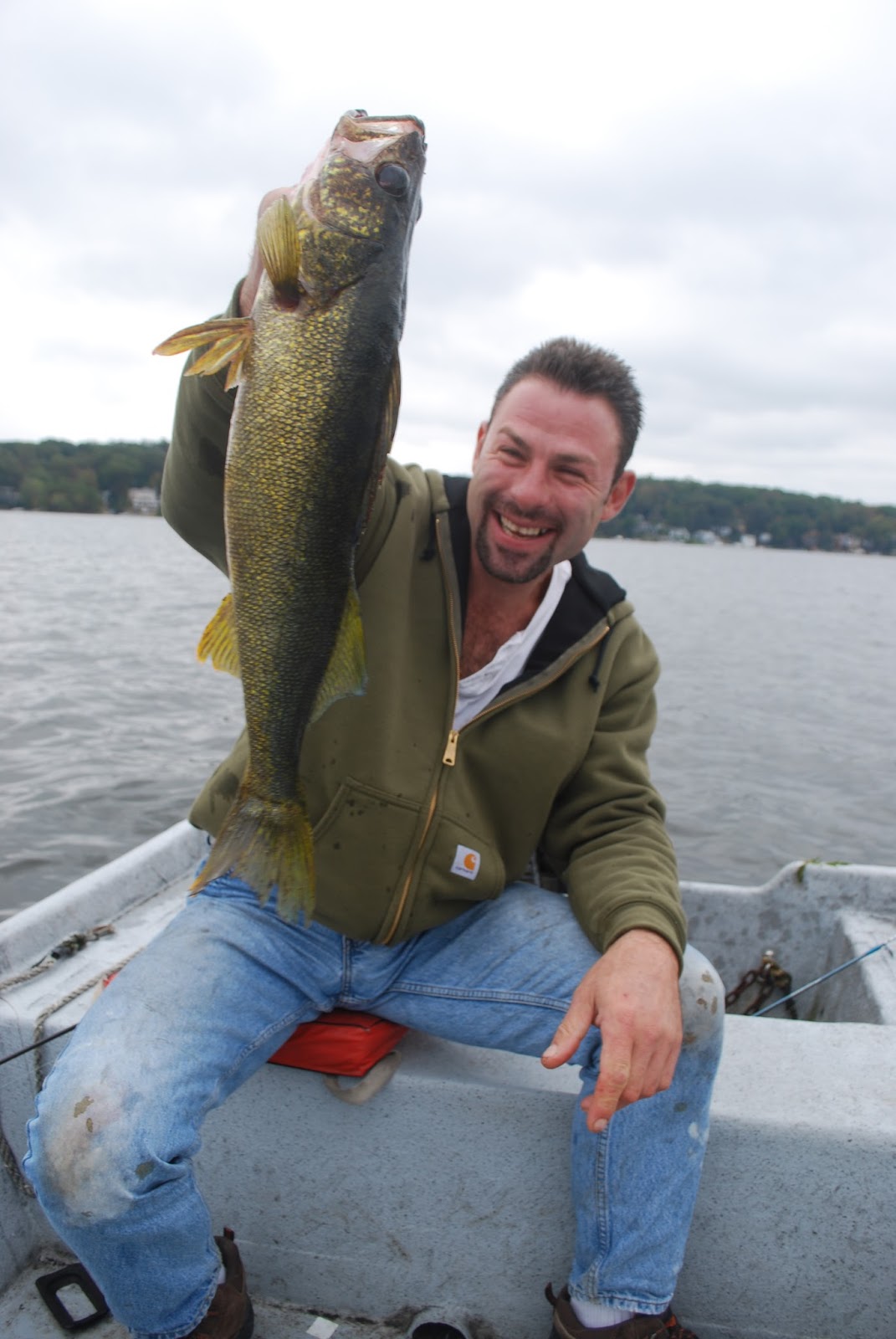
          Timing isn’t perfect between peak leaves and re-establishment of oxygen throughout lake depths-- the fall turnover--but it’s close. And like the color of oaks this time of year, walleyes may give us a deeper experiential tone than do other species more readily caught in shallows and which do, in fact, have lighter body coloration, besides smallmouth bass anyhow. All lake species are available now, but walleyes are especially worth pursuit, since throughout long, hot summer days they may have suspended at 15 feet, but fed almost exclusively at night. It depends on whether or not a lake has oxygen at the bottom during summer or not. Now they may move into deeper water of 25 feet or more suited to the low-light vision afforded them by their namesake, the tapetum lucidum immediately behind their retinas, which reflects light back through so they can see prey better than they see them. Walleyes may now be caught anytime during the day, although fishing hours may be best early and late and under overcast skies and wind driven surface.


Alewives

          Two general approaches to fishing fall walleyes may be appropriate, depending on your preference for one or both, and whether or not the lake or reservoir you have chosen to fish has a population of alewives, choice forage for walleyes. In New York, walleyes thrive on a healthy diet of Omega oil rich alewives in Conesus Lake, Otisco Lake and other Finger Lakes, and Lake Ontario. Lake Hopatcong, Swartswood Lake, Greenwood Lake, and Monksville Reservoir are beautiful bodies of water in New Jersey with populations of large walleyes running with alewife herring. I have caught walleyes on shiners in Lake Hopatcong when alewives were not available for bait, but the value of alewives as forage, not to mention their liveliness on a hook, is superior to shiners.

          Naturally, one of the two approaches I have in mind would be the use of alewives for bait. The second involves the same rocky drop-offs that fall walleyes feeding on alewives typically inhabit, but relies on lure imitations.  Since the time walleyes first reached lunker size in New Jersey lakes and reservoirs—having first been stocked in the early 1990’s—someone struck on the clever idea of using Rapala ice fishing jigs and Gotcha Jiggers (used to catch Spanish mackerel from North Carolina piers) directly under a boat.  Other jigs, 3/8th to ½ ounce, can be used the same way, possibly tipped with an alewife to combine the two approaches. Binsky blade baits have become very popular.

         Perhaps no better time to fish walleyes exists than mid and late October, but the beginning of turnover is the inauguration of a long period for these two related forms of fishing that persists through November, into December, on through the winter, usually until early or mid-March through the ice, and even thereafter. (Alewives, however, are replaced by shiners as bait ice fishing since they are not available in the winter.) Shiners are baited on the terminal end of a tip-up line. Rapala ice jigs, and Gotcha Jiggers are snapped onto the 15 pound test braid of a hefty jig rod and light spinning reel backed with enough low diameter braid to battle a musky, since on occasion muskies approaching 30 pounds hit these lures.

          When ice fishing, walleyes and muskies feel lumped together as a difficult specialty, usually requiring a lot of time spent out in the cold. In October, however, quite a few good walleyes of three, four, on up to 10 pounds can grace any given outing.  It can be the difference between happy abundance and scarcity; the reward for ice fishing is chiefly to have functioned against more difficult odds.


Deep Structure

          Alewives are open water fish that relate to deep drop offs and rocks. They mass together in dense schools, and do not congregate in smaller pods among aquatic vegetation as shiners do. Many reports indicate that on some lakes October is the month to catch walleyes in the shallows. Most likely, those are lakes without alewives. Walleyes will spawn in early spring shallows and strike surface lures at night through the rest of the spring into early June, but their surface presence at night is a function of the alewives’ being there, probably after zooplankton.

          In any case, whether surface fishing in June, or fishing deep by October first, always study a map of the lake if you’re new to it, then find on your graph recorder the presence of alewife masses 25 to 40 feet deep, or deeper, along drop offs. This is where walleyes are likely to be. Main lake, rocky points that ultimately drop off into at least 35 feet of water are, as a rule, excellent. So are other drop offs with rock structure and such depths. But points that contain rock structures along any sort of path from deep water into the shallows may be best because both alewives and walleyes have the full range of available depths. Very early in the morning or during a windy rainstorm, it would be wise to check such rocky shallows as well as the darker depths. However, with wind driven water crashing against a rock face, walleyes would be advantaged. Turbulent shallow water is also good for walleyes’ special vision, since the same eye structure advantages them in rough water as well as dark. But if no alewives are present in these shallows, it’s likely no walleyes will be, either.

         I like to imagine that turnover is an enormous relief for walleyes because they get to be themselves again down near the bottom, ambushing prey from among rocks. But walleyes are not the stalkers pike are; they are not even closely related to pike.  In fact, the pike family shares the same order of classification as the trout, salmon, and char family, Salmoniformes. On first take it may be hard to recognize a pike as anything like a salmon, but a deep intuition will resonate with similarities, such as smaller scales. Walleyes are of the order Perciformes which includes not only the (yellow) perch family, of which walleyes are members, but quite a number of fish families fresh and saltwater including the sunfish, white perch family (along with striped bass and white bass), and many other families.  Nevertheless, walleyes are ambush predators—just not with the same, snake-like attack as pickerel, pike, and muskies. As awkward and lumbering as walleyes may seem—as if with their reflecting eyes they are hindered by light to travel unsteadily—they love to blend their coloration with boulders hiding next to or between them, or to sense prey while on the prowl in pods to then dash yards into a school of alewives and take one between rounded but very sharply pointed teeth. Perhaps they are awkward suspended over their real homes during the summer stratification, but by mid-October reawakened to the dark regions they enjoy best.

          But a very common myth about walleyes must be dispelled. The truth about walleyes’ tapidum lucidum is that it adversely affects vision in bright light no more than cats’ eyesight is affected by the same eye structure—not at all. Walleyes are like any living organism—they seek their advantage and the tapidum lucidum increases vision in dark and/or turbulent water, giving walleyes the distinct advantage over prey in these situations. When lakes with oxygen depletion turn over, walleyes can behave more like themselves by going deeper.


Alewives as Bait

          Bait is never efficient as is a lure; bait is messy and live bait has a will of its own (and needs to be allowed to exercise it). But bait has the potential to bring an angler closest to nature, any kind of bait does to some degree, even manufactured “mulberry” carp bait is more natural than using manufactured plastic. Bait contains a purity that no lure can replace. Natural essence is the purest of elements—everyone seems to believe that fresh air gives us the purest experience we ever feel. Catching walleyes with live alewives allows one to be a direct participant in a huge life and death drama. It’s not cheating; it’s being there.

          You would need medium power spinning outfits, size 6 plain shank hooks tied to three feet  of six pound test Seguar Carbon Ice fluorocarbon leader (abrasion resistant) between that hook and a small barrel swivel tied to six pound test main line, ½ to full ounce (depending on depth) egg sinkers with line running through them above the barrel swivel.

          Don’t worry about the rounded teeth—unless you would have any intention of placing fingers between them. These teeth will not cut light line as razor-like pike teeth will part it at the slightest touch. 

          Prepare two or three medium power spinning outfits per angler—length is fairly arbitrary because neither pin point accuracy nor very long casts are necessary. Still fish with two rods, bails open, and work the rig of the other along or up a drop. Rigs are identical, but hook the still fished alewives behind the dorsal fin, and the retrieved through the nostrils. If you must be fancy, Lindy bait walker rigs with floats may save you a few bucks in the long run, since snags are common. But herring are so active on a hook they don’t need help.

         Retrieve slowly, let sit for 20 to 30 seconds or longer before lifting the rod slowly to noon and back to 9 o’clock. Eye the spool of the soakers as often as you work the retrieved. The alewives on the still rigs will swim very freely near the bottom and any rocks. Larger alewives, three to five inches long, make their presence known to gamefish; walleyes may find them from farther distances. On the other hand, retrieving an alewife, you try to meet a walleye halfway.

          Double anchoring from the bow and stern is a method to keep a boat in stable position. The idea is to position so that the wind blows against port or starboard by setting anchors, each tied to 150 feet of nylon cord, from stern first and to then motor upwind and aside to place the bow anchor. However, I’ve been on Lake Hopatcong in a 14 foot boat with the wind so strong I just anchored from the bow and let the boat bounce and swing—without water coming over the side. Believe it or not we managed to keep lines out, although lines alternately tightened and coiled.   

          If you are as particular as I am, save any alewives that die in the process of fishing, break them up, and chum the water by tossing pieces over the area fished. Yellow perch get most of the chum. But once perch start moving, bigger fish may be aroused by both scent and activity. It’s not always the case that a mass of alewives will be present on a good structure. And walleyes are not always immediately in position to feed on them because alewives are more suited to open water, while walleyes relate more closely to rocky bottoms of drop offs. So bait and walleyes are not a 1:1 relationship; they often go their separate ways, and arousing interest works.


Straight Down

          On Lake Hopatcong especially, vertical jigging has acquired almost cult status in New Jersey. It is very productive. Sometimes it’s as clean as marking a fish on a graph that trips the fish alarm, then lowering an ice jig down in front of its jaws. Most of the time controlled drifting by graph use, as well as electric steering, is an attempt to keep the ice jig or Gotcha as straight down under the boat as possible for control’s sake. A sharp lift of a foot or two, keeping a tight line on the fall works in October, while subtler motions produce as water gets really cold.

          Fishing deep in freshwater may be an interesting diversion from so many relatively shallow pursuits during summer. And walleyes, for that bronze-golden feeling-tone of mystery that they evoke, are a valuable catch. You can purchase Rapala ice jigs with precisely the same color (they work).

          However, while walleyes may chew up some of the younger of their own, as well as small perch (no doubt muskies consume perch), they probably swallow overwhelmingly more alewives than anything else. It’s no myth that this forage is high in Omega fatty oils, which surely answers in part to why 10 pound walleyes swim in these lakes and reservoirs—good, chunky fish. So jigs that imitate alewives make sense and a good choice, I think, is the Gotcha chrome finish. Those depths are dark, but walleyes have night vision.


Monday, August 12, 2013

Catching Fluke in Little Egg Harbor Behind Holgate, Long Beach Island


Fun in Little Egg Harbor fishing fluke. I always forget to look at the bouy numbers, but I remembered the first shoal we stopped at from 1980 when I nailed a 20-inch fluke using a bass casting rod and a jig, just bouncing it down from shallow to deep as tide fell swinging bait from the bar into the slough.

We shot across and found an excellent sluiceway where acres of water got diverted by outgoing tide around the sand, increasing current dramatically and funneling food to fluke. That's where we caught all the fish. Right in the current from maybe six feet to 10-feet deep, drifting through.

Light tackle did the trick. Can you believe we used the same size six hooks I do for smallmouths? Just hook a killie through the lips after tying eight-pound test fluorocarbon (resists tooth abrasion) to a small barrel swivel with a 3/4-ounce steel slip sinker on the main line. Always use alternatives to lead when using a sinker this light because some diving birds ingest small stones as part of the digestive process. We had bottom contact 20 feet down using light line.

We had a boat full of people and everyone caught at least a sea robin. Sam did mention circle hooks and just maybe my size 6 plain shanks are not optimal, although none of our fluke swallowed any.


Friday, August 9, 2013

Fall Forage Shift: Optimal Catches All Freshwater Gamefish Species


Fall Forage Shift

By Bruce Litton


At first, I don’t like the change of season. I don’t like to snap on a Rapala or spinnerbait when I would have used a worm or topwater plug. Summer was the time all the other seasons depend on, arrive at, and leave. I love to fish a lure as if it can take all day to retrieve because summer’s the home season, and the more it seems to be going nowhere, the more summery it is. But I always catch the fall spritz and let summer go with no regrets. I feel that invigorating chill, and after initial moodiness, it sets me in motion as it does gamefish too.


Ever since my son was able to ride the kiddie roller coaster nine years ago, we’ve gone to the Labor Day Carnival in Mendham. When night falls and fireworks are shot skyward, I typically feel a chill in the air and know we’ve turned a subtle seasonal corner. But generally not until the last week of September does it seem to change the summer patterns, and lures that specifically resemble forage fish begin to produce better.


A Change in Diet


The most obvious change in diet between the summer and fall seasons happens to smallmouths in the upper Delaware. Billions of shad fry have begun the journey to the sea in September, and bass begin to feed almost exclusively on them. This is advantageous to them for three reasons. The summer smorgasbord of insect larvae and hatches has begun to subside, shad fry are easily preyed upon, and the Omega fatty acid rich fry are extremely nutritious for the bass. In the Delaware the forage shift is dramatic with smallmouths schooling to capture the shad.


But I’ve noticed a subtler shift over the years even in farm ponds with only bluegills for largemouth to feed on besides insect species, amphibians (especially tadpoles), and the occasional small snake or mouse lured to water’s edge for those insects that summer propagates. By October fewer damselflies and dragonflies, for example, dimple a pond’s surface or alight on lily pads, targeted in turn. Aquatic larval activity decreases as water temperatures return to optimal range for largemouths, in the upper 60s, at least in the late afternoons. With increased activity, fast swimming bluegills are more appropriate targets than smaller easy pickin’s like insects.


Likewise, in Lake Hopatcong both largemouths and smallmouths bore relation to insects associated with weeds and much warmer water temperatures in the 15 feet of water oxygenated enough to support fish life. Now the lake begins to take a radical turn for the better, culminating in the fall turnover by mid-October. Usually the first week in September sees no improvement over August. The lake is then in its doldrums, but by late September that subtle seasonal change I always feel on Labor Day has begun to change New Jersey’s largest lake as well. Billions of Hopatcong alewife herring are also highly rich in Omega fats, and everything game in the lake begins to devour them.


The Temperature Paradox


I have read research that shows no evidence is available that bass put on fat for winter. Bass are cold blooded, have no need to fatten for winter, and do not hibernate but remain active at the level of their slowed metabolism under winter ice. Apparently, higher levels of fall bass activity are due especially to temperatures closer to optimal, and somewhat to shorter hours of sunlight and less direct rays on the water.


The higher the water temperature, the more bass metabolism burns. But this doesn’t mean bass are actually more active with summer water temperatures in the 80’s. On the contrary, the more water temperature rises above their optimal range, the more they slow in order to conserve calories they burn off while idling, but would burn even faster by a lot of swimming and chasing of baitfish. Naturally, the plastic worm may be the very best summer bass lure because it’s lazy. Topwater plug retrieves that may produce best are slow as the sun sets. Slow summer feeding habits change late in September when bass begin to give chase.


Optimal water temperatures for largemouths, around 70, and cooler for smallmouths, are those by which bass are most freely active. It’s not much of a stretch to suppose that fish forage—especially fish rich in nutrients like shad and alewives—serves their growth best when temperatures are both optimal for growth and for feeding. The fall feed has everything to do with growth and health, not fat for a cold winter.


Forage Imitating Lure Choices


My favorite fall lures are Rapala floaters and Countdowns, chrome finish Rat-L-Traps, and spinnerbaits, although many other lures are great choices as well. Even in ponds with no minnow forage, the Rapalas work wonders from late September well into October. It’s much a less a matter of matching colors (bluegill)—although that can be done—than it is of lure action. I really make a Rapala dance by rod tip action, not because bluegills are behaving erratically, but because bass are stimulated to the chase. The floaters are great in shallows whether along banks and weeds or next to brush and timber. Countdowns work as deep as 12 to 15 feet; I’ve found them particularly effective on Lake Hopatcong among submerged rocks and on the Delaware River.


Chrome Rat-L-Traps have proven effective along Hopatcong’s weedlines, and bounced off rocks (occasionally snagged). I like the half ounce size best because it casts forever and effectively attains depths as great as 20 feet—by mid-October smallmouth bass are free once again to breathe among Hopatcong’s deep rock structures to ambush alewives.  In the Delaware, what resembles a fingerling shad more than a chrome Rat-L-Trap? Sometimes smallmouths actually bust the shad on the surface, reminiscent of hybrid stripers tearing into alewives in lakes and reservoirs after dark in June. A half ounce Rat-L-Trap can be cast to these fish from a distance, then retrieved at top speed with rod tip held high to result in a jolting strike near the surface.


Colorado bladed spinnerbaits producing the strongest vibrations seem to result in more interest from bass in the fall since the guiding principle is: the more action, the more strikes. Usually I will use a large bladed, heavy headed spinnerbait so that I can retrieve it at a good, moderate rate. Too large a blade coupled to relatively light lead demands a slow retrieve more fitting for late March warm spells. Keep a firm hold on the rod because bass strike spinnerbaits harder this time of year. Often best along weedlines from shallow to 12 foot depths, spinnerbaits may also be perfectly effective along banks and in brush and timber.


Good through October


Traditionally, November 15th is the end of my use of lures for bass, and from thereon through the ice fishing season I prefer shiners.  In Mercer County where I grew up, the water temperature dipped below 50 in the afternoon about a week after all the leaves came down. Whether you prefer to use lures or bait is a subjective choice, although no doubt shiners are effective in November. But although water temperatures fall below optimal for bass in October, lures draw strikes as sure as they look snazzy. I do especially well with spinnerbaits as water cools sharply. So many options regarding the blade/lead relationship can provoke bass; generally the idea is to slow down as water cools, and fish deeper.


Wednesday, August 7, 2013

New Jersey Trout Soon to Cool Off


With Cooler Temperatures Trout are Game

By Bruce Litton


          Some streams are now cooler in the mornings than the 68-degree threshold or so above which trout do not survive lactic acid trauma after struggle on a hook and release.  I don’t know the exact temperatures for the different species combined with varying oxygen levels. That’s a general rule—brook trout need cooler water, rainbows tolerate slightly warmer, and browns fare even better through summer—but it’s worth keeping in mind when fishing trout during the heat of summers like this and the previous we’ve got through.

          Some smaller spring fed streams may never warm above 68. But my son, Matt, and I fished the Paulinskill River in Sussex on the hottest day of the year in 2011 through stretches with ample springs, and we finished our short afternoon by swimming—in water that felt about 82 at the least. Both of us not knowledgeable at the time of this 68-degree rule we learned from Chris Lido, no trout would have found our flies anyway, hidden in whatever spring holes, and we caught a few smallmouth bass.

          The Musconetcong River in Morris, Warren, and Hunterdon Counties is spring fed especially below Hackettstown on down through Asbury, but does warm considerably compared to the Pequest perhaps. Trout holdover in all of the streams and more streams than I’ve mentioned; reproduction occurs at least in smaller limestone streams, and I’ve witnessed trout in a summer-warm stream in Mercer County congregate at a shallow spring release with barely enough water to cover their backs, fish I left alone of course.

          Trout fishing for both fly anglers and those who prefer spinning tackle should improve with cooler temperatures and streams and rivers at normal levels. It won’t be long before rivers like the Musconetcong, Pequest, and North and South Branch Raritan receive a generous stocking of 14 to 16-inch, and larger, trout from the state the second and third weeks of October. The volume of fish stocked is less than during spring, but plenty escape angler’s intentions and remain in rivers for a productive winter fishery; some holdover into spring and beyond.

          However, New Jersey trout are not all about the Pequest hatchery. Native brook trout with genetic lines extending back to the end of the Wisconsin Glacier exist in many pure water streams. Some clean and cool water streams are not stocked, yet have abundant populations of rainbow and/or brown trout which have reproduced since stockings many years ago, or feed into rivers that are stocked from which they migrate upstream, in turn.

          The headwaters of the Passaic River in Bernardsville are full of wild rainbows and browns, accessible at Scherman-Hoffman Wildlife Sanctuary, anglers required to release what they catch and to use artificial lures (flies or otherwise) with barbless hooks. Make sure to check at the office for additional regulations. Hooks can be rendered safer to released trout easily by crimping barbs with needlenose pliers. Most Passaic River trout measure five to seven inches, few a foot long, and the very rare catch reaches 17 inches.

           Trout in small streams such as the Passaic headwaters spook easily and require stealth and skill. It may be easier to fish a wet fly, nymph, or streamer in a river’s deep pool where your quarry will more likely be unaware of your presence, but of course dry fly hatches persist into fall. Rivers allow greater casting range as well to reach unsuspecting shallow water trout. Many years ago I caught plenty of nine-inch brook trout in the small, crystal clear Dunnfield Creek of Warren County on small shad darts, jigs used in the spring Delaware run, but the casting angles I took remind me of modern dance rituals.

          For some dry fly hatches, I refer to Fly Fisher’s Guide to the Big Apple: Great Waters within 150 Miles of New York City, by Tom Gilmore for my advice to you.  Parachute Adams, size 18 to 24, Parachute Blue Winged Olive, size 18, Blue Quill and Blue Dun, 16 to 18, Gray Wulff, 10 to 12 represent hatches that may be encountered.  Terrestrial patterns come in fascinating variety which the folks at Effinger Sporting Goods may have further advice to help you with, but ant, inchworm, and caterpillar patterns prove good into October. The Woolly Worm, a wet fly caterpillar pattern I loved in my teens, is effective tied to as large as a size 6 hook. Find a few fly patterns you like, and this may get you started better than trying to outsmart nature. Hatch charts are not really absolutes as to what trout will take.


Tuesday, August 6, 2013

Ocracoke Inlet Summer Spanish Mackerel, Bluefish, Flounder, and a Few Surprises


Ocracoke Inlet Summer

Spanish Mackerel, Blues, Flounder and a few Surprises

By Bruce Litton


For the roadways running from Corolla southward, Ocracoke Village is the end of the line on North Carolina’s Outer Banks. It’s a great angling destination because many fish species are abundant and boats are few in Ocracoke Inlet. Other inlets get accessed with greater ease. Getting to Ocracoke Island is a test of patience, or a relaxing ride. A 40-minute ferry trip from Hatteras is necessary, or over two hours from either Swan Quarter or Cedar Island some 25 miles across Pamlico Sound.


Ocracoke Inlet hosts Spanish mackerel flashing metallic sides like eyes winking, and blues rushing in from behind and below as if attracted to the light. Flounder fill Wallace Channel--on a good day you will want to move on to some surprising species after catching so many. A proud example is large cobia during summer. Sheepshead over 12 pounds, and black drum over 15, frequent tide rips where the inlet either flows into Pamlico Sound, or gathers it out. We've been fishing the Inlet with Captain Ryan O'Neal for many years.


 “No wind today,” O’Neal said. “The water’s flat and that tide is just now creeping in.”


Ryan O’Neal is the youngest charter Captain on the southern Atlantic coast to earn the United States Coast Guard Approved Masters License—at 18. He has fished Ocracoke Inlet, Pamlico Sound, and the Atlantic for many years, and comes from a long family tradition of fishing these waters related to Ocracoke. My son, Matt, and I felt privileged to be in the living presence of the village’s long history, especially in direct relation to the fish of its surroundings. Throttle opening on the 150 Honda outboard on the 24 foot Privateer, ”the Tarheel,” we raced southward from the village harbor, Silver Lake, 2 ½ miles into the range of Oracoke Inlet’s Blair Channel until the skiff lowered off plane. O’Neal leapt from his seat, and deftly reached for trolling rods from holders on the canopy.


“Let’s get some Spanish!” He said.


“You’ll see, dad. Your losing streak on the piers is over,” My son said.


Size 0 Clark spoons, tied directly to 25-pound test fluorocarbon in lengths of 25 feet to size 1 planers lined up about a hundred feet out, left and right behind the stern. The outboard continued to propel the craft at 5 to 6 mph. From the stern’s middle, the same lure soon flashed behind a four-ounce in-line sinker for a shallow troll. The planer gets a spoon down as deep as eight feet.


“The Clark spoon imitates silversides?” I said.


“And small menhaden and finger mullet,” O’Neal said.


From May into October, Spanish mackerel move in pods and large schools along the edges of the inlet’s two main channels, Blair and Wallace, and also outside in the Atlantic. Available on occasion to surf anglers up and down the Banks, they also serve as a favorite summertime target from piers. But for reliable consistency, nothing beats trolling for these speedsters in the inlets. They are a beautiful, blue-toned fish with large, golden spots. Their bodies sleek with deeply forked tails propel them like torpedoes.


The previous day, a stop at Tradewinds Tackle in Ocracoke to inquire about fishing the inlet revealed a mounted 10-pound Spanish mackerel, and Alan Sutton at the register as he took a break from fishing. He said the Spanish began a migration from Florida earlier in the year. Naturally they are drawn to inlets for the forage concentrations. Mackerel are not available off the ends of piers in large numbers every morning, since although beaches have varieties of subtle structures, their slope is more and less even, the depths yawning into ever deeper blue expanse. Fish schools rove dispersed compared to inlet situations. Although Ocracoke Inlet’s two channels fill large expanse, sand banks well define them, and you can bet on finding Spanish somewhere along an edge of a cut or specific channel. Evening sometimes results in a run, although mornings not only feel fresh, the sun rises and fish seem to thrive for a few hours or more after darkness.


“It can make a difference on what side of the channel’s edge you troll,” Sutton said.


Looking for birds to find a roving school may help, but mackerel do not always feed right at the surface. Ultimately, trolling is a search method when mackerel or blues do not become immediately evident. But one factor above others is important.


“See how clear the water is?” said O’Neal, guiding the troll along Blair’s northern edge.


“We’re close to open sea,” I said.


“And the tide’s really comin’ in. Spanish are sight feeders. So I always look for action in the morning on a rising tide with clear water.”


It didn’t take long. A rod bent almost on cue when O’Neal spoke. My son’s first mackerel measured about 18 inches, which proved to be about average size. We caught a dozen or so by trolling along edges of Blair Channel, and about as many blues from one to three pounds. Bluefish tend to move in smaller pods, and situate slightly deeper behind mackerel schools. It’s as if they smell the scraps left behind from slaughters the Spanish race on ahead of in quick, frenzied, lightning formations. In fact, bluefish rely on scent to much greater degree than mackerel.


“Some mornings the Spanish run a pound or two, others they’ll be about three pounds. The world record 13-pounder came from this inlet, and every summer we get Spanish over five pounds,” O’Neal said.


Portsmouth Island beckoned about a half mile further south; a sand bank defines the northern terminus of Cape Lookout National Seashore. Soon we drifted in to almost chatting distance from a couple walking the water’s edge. Wallace Channel cuts the sand close and scoops it out to depths of almost 30 feet. Through summer into early fall, flounder are not the only desirable fish lurking among its mysterious current variations, forage, shellfish and other bottom obstructions, but they comprise the bulk of the fish. Sheepshead, puppy drum, black drum, cobia, and large red drum just outside the inlet on occasion, exist as worthy summer pursuits in these depths. Cobia often prowl nearer the ocean; sheepshead and black drum position towards the sound.


“With just the tide to carry us, no wind, we’ll move at about ½ to 1 knot, which is perfect,” O’Neal said. “1 ½ to 2 knots is too fast.”


Medium power, six-foot spinning rods and reels loaded with 12-pound test monofilament clinch-knotted to spec rigs, red and white, and chartreuse and white polymer on four size 1/0 hooks to each rig, stood by as O’Neal quickly baited them with fresh squid. Mackerel belly strips are also good bait. At the bottom of these rigs, three-ounce bank sinkers are attached to snaps, which take them directly down.


“Let out just enough line to stay at an angle and let drift,” O’Neal said. “When you feel something like added weight, open the bail and let out line for a few seconds before you set the hook.”


The large number of keepers didn’t surprise O’Neal. They averaged about 16 inches and could have been caught steadily all day. A flounder fights with a unique, head shaking persistence that feels like it might throw the hook at any instant. Sometimes they do get off. But in the middle of all the action with flounder, something a lot larger than what we had become accustomed to struck. This fish was no flounder, judging by the quick, steady runs, sudden turns, and smooth power.


“Cobia!” O’Neal said.


“Really!?” I said.


“Uh, huh. Small one.”


The brown stripe came into view. Less than 33-inch legal size, the cobia weighed over six pounds. Drifting spec rigs for flounder, O’Neal’s clients often catch cobia 20 to 25 pounds, occasionally as large as 40.


“Last year I boated one 69 pounds out on the ocean that hit a four-ounce bucktail,” he said.


Alan Sutton had concurred on three or four-ounce bucktails. An eight-inch plastic worm trailer adds appeal. Cobia can be pursued by trying to sight them. With calm surface and clear water favoring visibility, the object is to cast beyond the fish and retrieve the bucktail quickly and close to its protruding lower jaw to tease a strike.


Matt hung something on his spec rig that certainly was no flounder, judging by the sheer weight. This fish departed on a long, unstoppable run, but by the time O’Neal was at the wheel starting the engine to follow, the hook pulled.


“Could have been a big cobia,” O’Neal said. “Or it could have been a shark.”


Either one had been a great pleasure for my son.


Tide Rips Combined with Ledges and Shells Host Sheepshead


O’Neal showed how one look at the mouth of a sheepshead tells you where to look for them: among crustaceans, mollusks, and especially barnacles for them to eat.


“Just like human teeth,” he said. “Some would kill to have a set like that.”


Sheepshead are large, round bodied fish that relate to vertical structures—so a ledge that drops off from a sandy shelf cut by a tide rip around the edge of an island may be perfect. Find a spot like this along Wallace Channel towards the sound with lots of shells at the bottom and you may be on fish. O’Neal positioned the boat as best he could in wind against the tide to fish 16-foot depths.


“Normally I could position the boat so we could put our lines directly off the rear,” he said.


The situation presented little problem, but O’Neal expressed clear vision of the ideal. Fish struggled in no time. Black drum larger than 15 pounds may be mixed with sheepshead at such a hotspot, although the drum may be out in slightly deeper current away from such a ledge. Both species love sand fleas, which may be easy to collect in surf wash. But make sure you fill a bucket because sheepshead are great bait stealers. A simple double hook bottom rig with a two ounce bank sinker is sufficient. But keep a tight line.


“You won’t feel the bite with that much line out,” O’Neal said.


A cast had reached further out along the ledge. Setting the rig set closer resulted in a 5 pound, hard fighting sheepshead. We caught about a dozen, the largest over seven pounds. Often twice this many are caught in a few hours, frequently larger than 12 pounds.


Rising Tide is best for Flounder


Pamlico Sound stays slightly off color. At the public boat ramp in Ocracoke Village, for example, bottom is visible in about two feet of water. When tide exits, it takes the sound with it through the inlet.


“Flounder fishing is better in clearer water,” O’Neal said. “They rely more on sight more than smell, whereas a bluefish or a drum will just smell it. If the water is turbid, a flounder will too. But they lay flat and look up for baitfish such as small pinfish, finger mullet, or two inch long baby flounders.”


Any amount of wind can be tricky for drifting Wallace Channel. But light breezes will not necessarily ruin the fishing, especially if you use an electric trolling motor to compensate against them. If your boat is large enough, it won’t get buffeted about by breezes the way a small craft responds. A big boat will tend to move with the tide. But heavy winds can make this fishing almost impossible.


In windy conditions, to anchor and drift a rig port or starboard works. But it’s not the same as being carried evenly for hundreds of yards by incoming tide, showing those polymer colors and squid or mackerel belly bait to a lot more flounder in clear water, and perhaps to a big, curious, aggressive cobia.


Red Drum, Cero Mackerel, and Southern Flounder


Red Drum serve as Outer Banks theme fish, designated in 1971 by the North Carolina General Assembly as the state saltwater fish. O’Neal pursues them avidly. Although November is the best month, when reds over 40 pounds are an everyday happening, spotty action happens in range of the Tarheel skiff through the summer. Various cut baits are standard, and sea mullet seems to attract fewer rays than does bunker.


“We find them in troughs just outside the inlet,” O’Neal said.


Cero mackerel are a happens-chance fish, but they do enter the inlet, particularly in September through October.  They are larger than Spanish mackerel, blue toned like them, but with a thin, dark, lateral stripe. Like Spanish, they slam trolled Clark spoons, and slice through clear, rising tides by the swift action of pelagic tailfins.


“They average about five pounds,” O’Neal said.


Southern flounder are a fascination for O’Neal. His family ancestors fished them commercially, gigging for large profits, impaling fish as big as 30 pounds.


“They gig them right up in the shallows. You can see them lying on the flats,” O’Neal said.


Late September is a good time to come across one of these finicky feeders. Compared to fishing summer flounder, the need to open the bail and allow the flounder undisturbed possession of the bait is greater. O’Neal says they are not as big as they once had bee


Destination Information


How to Get There – Approach Swan Quarter on U.S. 264, get on N.C. 45 South for 2.1 miles to 2nd Street, .1 mile to Oyster Creek Road. After about a mile’s drive, arrive at the ferry terminal, 748 Oyster Creek Road. Cedar Island is approached on U.S. 70 to N.C. 12, followed to the terminal at the point of the island. Hatteras is accessed by taking the Virginia Dare Memorial Bridge from the mainland, U.S. 264 on over Roanoke Island, which becomes U.S. 64 on the bridges over to Nags Head, and connecting to N.C. 12 south to Hatteras, or by taking N.C. 168, which becomes N.C. 158 from the northeast corner of the state, over Currituck Sound, into Kitty Hawk, continuing south on N.C. 158/12, and continuing on N.C. 12 to Hatteras and the ferry terminal at the end of the road. The Hatteras ferry will take you to N.C. 12 resumption at the northern end of Ocracoke Island; a 16 mile drive south takes you into Ocracoke Village. The Swan Quarter and Cedar Island ferry terminal is in town. Public boat ramp is at end of Irvin Garrish Highway to the right of the ferry terminal.


Accommodations – Anchorage Inn & Marina Motel, 205 Irvin Garrish Highway, (252) 928-3421; Blackbeard’s Lodge, 111 Back Road, (252) 928-3421; Edwards of Ocracoke, 216 Old Beach Road, (800) 254-1359; Silver Lake Motel, P.O. 1716, (252) 928-6721; Harborside Motel, Silver Lake Road, (252) 928-3111; Bluff Shoal Motel, Silver Lake Road, (252) 928-4301; Pony Island Motel, 785 Irvin Garrish Highway, (800) 928-4411; Ocracoke Island Vacation Rentals/Island Realty, 1075 Irvin Garrish Highway, (877) 646-2822.


Monday, August 5, 2013

Upper Delaware River Float Trip for Smallmouth Bass


We floated from five miles north to the Barryville bridge and between us caught 15 smallmouths, the largest about 14 inches. Impressed by the size of the bluegill I caught, it doesn't look so large in the photo. We caught a couple of fallfish--big silver chubs over a foot long--which I didn't mind catching. We've caught these members of the minnow family on Rapalas. Most of the bass hit synthetic leeches on jig heads, whether deep or shallow.

Another float trip without any really big bass. Wind came pretty strong from the north and while it would have been a problem from the south--paddling--it didn't help with positioning to cast, although we did use an anchor. Felt like October.


Friday, August 2, 2013

Butler Reservoir Largemouth Bass and Pickerel in Apshawa Preserve


Hiked over a mile to Butler Reservoir through Apshawa Preserve with my wife, son, and Sadie. Relaxation at the mountain summit was great, then the hike down was steep but short. I casted a spinnerbait for nothing, switched to a Rebel Pop-R as Matt casted a buzzbait, and was just getting into the rhythm when I got called over to the area near the dam because Sadie was threatening to leap over the edge. I switched to a Chompers worm with inset hook and probed the depths. Then I saw the surest opportunity of the outing and laid the cast right between shore and some weeds, the worm splashing right where I wanted it about three feet from the bank. Even though the line was limp, I felt the subtlest tick and knew a bass had taken just as I wanted. I tightened up, set the hook, and the bass leapt for all of us to see--about 2 1/2 pounds online before the hook pulled free just a few yards before I would have grasped the lower jaw.

A number of small pickerel followed the worm in the tannic water. Imagine there are some big ones. This trip was more about the hike and hanging out with my wife and son, but you can find places to cast all the way around and it looks good. I caught a small bass on the Chompers and we hiked back, my son leading the way and walking with his eyes on the ground--almost walking into a black bear with her two cubs. I saw them too. He looked up and saw the mother simply looking at him as if wondering what the hell he was doing. He backed off and they lumbered away.