Friday, August 2, 2013

Butler Reservoir Largemouth Bass and Pickerel in Apshawa Preserve


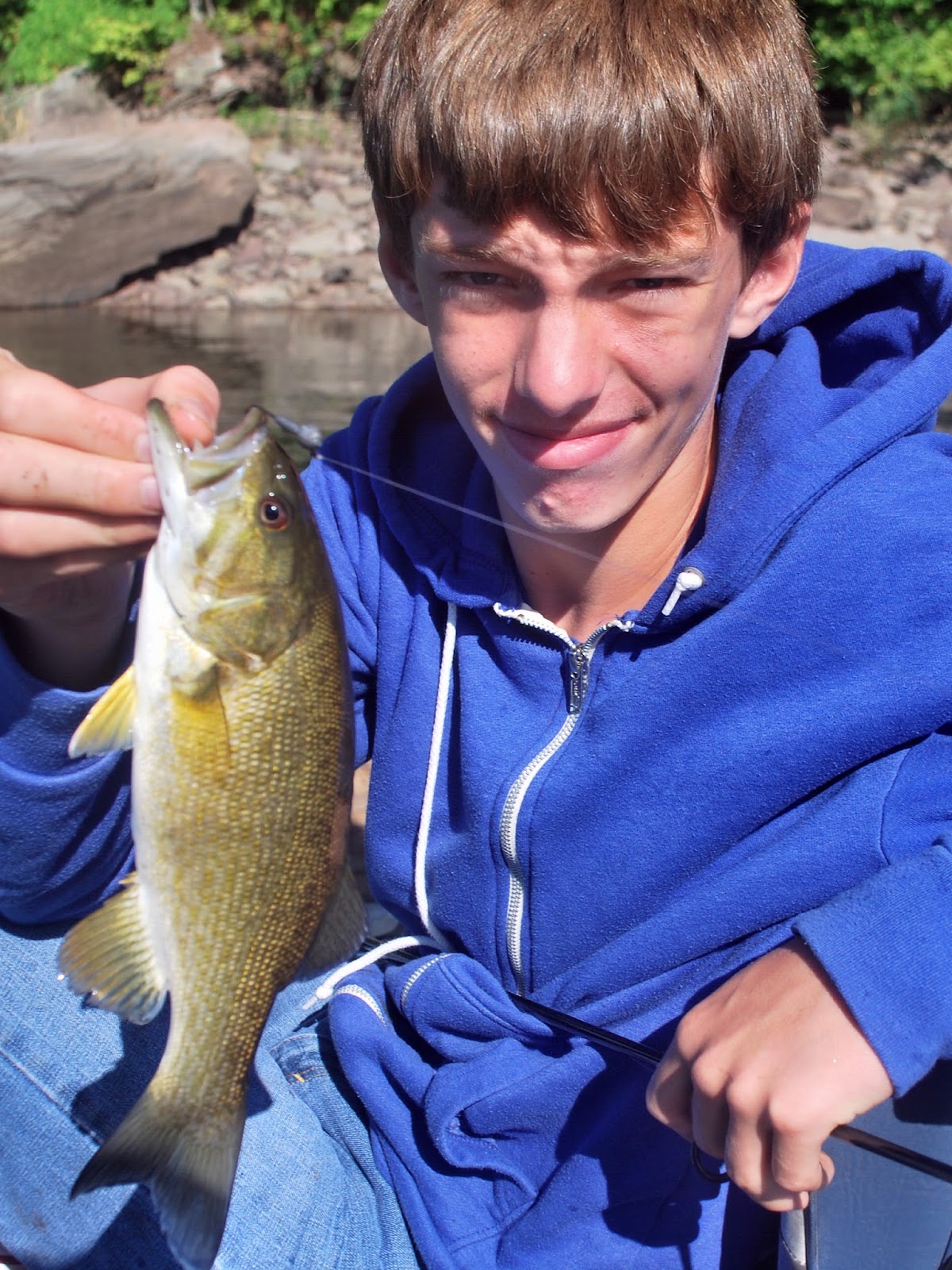
Hiked over a mile to Butler Reservoir through Apshawa Preserve with my wife, son, and Sadie. Relaxation at the mountain summit was great, then the hike down was steep but short. I casted a spinnerbait for nothing, switched to a Rebel Pop-R as Matt casted a buzzbait, and was just getting into the rhythm when I got called over to the area near the dam because Sadie was threatening to leap over the edge. I switched to a Chompers worm with inset hook and probed the depths. Then I saw the surest opportunity of the outing and laid the cast right between shore and some weeds, the worm splashing right where I wanted it about three feet from the bank. Even though the line was limp, I felt the subtlest tick and knew a bass had taken just as I wanted. I tightened up, set the hook, and the bass leapt for all of us to see--about 2 1/2 pounds online before the hook pulled free just a few yards before I would have grasped the lower jaw.

A number of small pickerel followed the worm in the tannic water. Imagine there are some big ones. This trip was more about the hike and hanging out with my wife and son, but you can find places to cast all the way around and it looks good. I caught a small bass on the Chompers and we hiked back, my son leading the way and walking with his eyes on the ground--almost walking into a black bear with her two cubs. I saw them too. He looked up and saw the mother simply looking at him as if wondering what the hell he was doing. He backed off and they lumbered away.


Thursday, August 1, 2013

Lake George at Schooley's Mountain Largemouth Bass


Today I awoke to rain, surprised. We had planned to fish the Paulinskill for smallmouths. I remembered an outing on Lake Musconetcong, June 2006, in light rain like today's that turned out great and decided I might go around 4:30. I called the boat rental and got the answering machine.

Rather than just fish my neighborhood pond, I decided to come here, an eight-acre pond I've had in mind to try for a first time. You never know about new spots unless you've been informed and nothing on the web suggested Lake George.

I didn't feel very impressed, but obviously some fair-size bass inhabit the pond. It's got depth. 15 feet at least near the dam. The water stained by rain, I used the spinnerbait shallow. But with a swimming beach, the water must usually be clear and of very good quality. An evening with topwater plugs might result in a few in the back of the pond. You could probe those depths with a plastic worm during the day, but in my experience, this sort of activity usually doesn't bring much result. More often than not, fishing the shallows where bass leap for dragonflies in the sun is better.

This bass I caught had a lip scar from a hook, so at least some fishing pressure occurs. Good that the bass was released, and most everyone who fishes ponds like this puts the fish back.

It's pretty nice up on Schooley's Mountain. I walked all the way around the pond and while access to casting positions is fairly limited, there's enough for an hour or so of relaxation.


Sunday, July 28, 2013

Fishing Pressure on Pond Largemouth Bass


As I write, a line of thunderstorms develops to the west, so we cancelled our Apshawa Preserve hike and fishing of Butler Reservoir. Perhaps we'll go Friday.

So instead, I grabbed my favorite rod, tied on a little eighth-ounce Strike King spinnerbait, and walked out in the rain to our neighborhood pond. It's not fishing as well as it has been for years, but I caught two bass in 20 minutes, one of them close to two-and-a-half pounds, the other over a pound.

That's the biggest bass I've caught in a long time and it felt good to connect. I thought the fish was over three at first. I guess this year's a lot like last with the bulk of the larger bass caught in May. If I fished this neighborhood pond hard, I would catch a lot more, but the pressure I would put on it would result in declining catches, even though I've never taken a bass and no else does either.

Bass feel sensitive to lures, especially those that catch them, and after they get caught, it's less likely they'll hit any lure again. I think university studies exist to back this claim. I know for a fact some universities do some very interesting studies with us in mind.

It would be interesting to chug a Crazy Crawler at night during hot weather sure to come again. I think at least one five-pounder exists. A five-pounder got caught and released last fall so it's even bigger if it's still alive. But I don't get worked up about fishing a pond that takes 60 seconds to walk to. Besides, I did try it at night once and got no hits at all. Every time I think of doing it again, I feel that indifference. But who knows.

Saturday, July 27, 2013

Pepacton Reservoir Smallmouth Bass, Channel Cat, Rock Bass; East Branch Delaware River Fly Fished


We began by drifting out of the large cove or hollow where the rented rowboat is kept. Using 3/4- ounce slip sinkers, our herring or sawbellies as they're called in the Catskills rode at almost a vertical angle, line easily measured down by two-foot increments to just deeper than 30 feet, barely below the thermocline. We had tied eight-foot leaders to barrel swivels and hoped for the best. I found the batteries to my graph recorder dead, must have forgotten to turn it off after Hopatcong. Perhaps the one item I forgot to bring along was a Phillips head. But a couple of other boats fishe
d nearby and marked trout, so we moved through the vicinity.

The day had begun before sunup at about 48 degrees and as we trolled, four and  five colors of leadcore line out and a very thin metal Sutton spoon tied to a fluorocarbon leader six-pound test, a cool breeze felt just like October. I had a look at a topographic map before we left New Jersey and found that no shallow flats exist. All the shorelines fall off into great depth quickly, some from sheer faces of giant boulders and continuing down underwater with shelves and cavities below--excellent smallmouth bass habitat. Pepacton is about 20 miles in length with even the back sections very deep. The reservoir's mean depth is 70 feet; deepest water is over 160 feet and acres of it exist.

We rowed to the shoreline at the right of a cove facing out upon the reservoir's main body. My son caught a couple of rock bass and I noticed--through very clear water--the bottom become too uniform a mix of gravel and small stones as we drifted, no real structure to hold bass. I heard a wood thrush in the woods--my favorite songbird--and my son spotted a deer maneuvering the slope. All was very quiet out here. The area has very high quality wilderness value and you feel at the center of things, since after all, reality is mostly without us. We rowed out of the cove and headed just to the right, trolling again over water that must have been at least 70 feet deep, attracted to rock formations on shore which, if they extended into the depths, would certainly be bass habitat.

On my first cast, I hung something good-size and soon felt puzzled. Could this be a walleye? It wasn't a bass, I could tell. Not even a largemouth. It fought just like a walleye, but we soon saw in the clear water a channel cat. It was a beautiful, white fish with black spots like a trout and a gray back and head. The bottom here had more boulder-size rocks and Matt soon caught the first bass after I released the cat. Further west, underwater shelves and surely cavities inward in relation to what we could see form magnificent structures. I got into casting my jig on top of the shallow shelves I could plainly see and letting it slide over the edge to drop in front of the recesses from two down to 15 feet or so. I fished the jigs right in the rocks as deep as 35 feet or so and lost plenty to wedge snags, although I suppose most or all of the bass stage shallower than the thermocline at 30 feet, although every bass we caught was at least 25 feet down. Some of the rock bass seemed to be deeper, but I'm not certain.

None of the bass we caught larger than Matt's photographed, which is pathetic and unfortunate judged against my hopes that we might catch our year's largest, perhaps even that elusive five- pounder we've come closest to on Lake Hopatcong. But you don't let inevitable broken hopes determine a day's value. We had a deeply absorbing time and it's not easy fishing from a heavy rowboat with strong breeze and water too deep to anchor effectively. And once the mist burned off, the sky felt like an empty expanse with a huge blue curtain, letting all that light in. We heard of two trout caught, one by each of the guys who marked fish to the left and right of us as we drifted herring early. Two browns about three pounds each.

We drove back to Roscoe Campsites, had a late lunch in town, and stopped in at Beaverkill Fly Shop, picking up a couple of #20 sulfurs as fit the report for the East Branch Delaware. We grabbed power naps and then headed out. And then we drove as far west as some grove or other, stopping along the way where we could to judge the water, but not actually walking and wading the river to find any holes. The spot that looked best was at Downsville by the covered bridge. Nothing rose at all, so I cut off the sulfurs I had tied on back at camp, and we tried to provoke interest with Woolly Bugger streamers. A fast run and pool down below looked better than the run and pool below Roy Bridge on the Flatbrook where I always catch trout on streamers in late May, but I got no hits at all. Finally evening came on, and I tied the sulfurs back on. We did see a very few rises, but I suspected at least most of these were carp! Here we were at the fabled East Branch Delaware with its 55-degree water in July and trout tales to fill volumes, and I had spotted a school of small carp of some unusual specie I couldn't judge, from between a pound to three pounds. I watched the water surface intently and finally I clearly made out the back of a carp break the surface.

Oh, well. Back in Roscoe, before we arrived back at camp to fix a steak, we checked out the confluence of the Willowemoc and Beaverkill. Both of these streams were about 70 degrees, so we didn't dare fish them, although we saw quite a few more rises than at the East Branch and suspected these were indeed trout. It's a beautiful hole at the confluence. It would be sacrilege at this world famous fly fishing stop, but if you were to roll a nightcrawler along the bottom at night--given that the water is lower than 68 degrees so as not to kill the trout by lactic acid reaction--you might find that hole holds some real lunkers. I think the real reason it's so famous is because back in the 1940's a train connected Roscoe to NYC and the wealthy came in the spring, summer, and fall. Not that some real nice trout don't reside there. I don't know if it's fly fishing only or not, but we didn't fish it with water warm to the touch, although a size 20 dry fly of some sort would have been about perfect.


 The blue haze wasn't really that dense.


Wednesday, July 24, 2013

Fishing for Beginners: A Short Introduction


Getting into the Game

By Bruce Litton
 
Thought I would share what was my first column article for Recorder Newspapers over two years ago. It's a short piece for people who would like to fish, particularly in New Jersey, but haven't really begun or haven't had much success yet. A lot of you are still out there, drawn to the lure of a practice that has gone on unabated for many millennia. It's a form of recreation that really works, relieves the stress and strife of everyday affairs and restores you to balance, freedom, and peace.


          The State of New Jersey’s fisheries have expanded over the past 20 years, with targeted marketing and advertising spreading the word. Now many North Jersey waters close to our area have thriving populations of walleye, hybrid stripers, muskellunge, and northern pike, in addition to largemouth and smallmouth bass, crappies and panfish, channel catfish, and rainbow, brown and brook trout. I think the primary reason to fish is to get connected with nature and your deep self to heal the stress and strife of the work world, which is what re-creation is all about, but sometimes the best reason is the thrill of the catch, particularly big ones. Together these motives entail a pursuit that won’t let you down, so long as you commit to learning what it takes to catch fish and don’t let difficulty frustrate.

          All gamefish are selective feeders not just for what they eat but where and when. Catching them requires knowledge, practice, persistence, and the learning process for an angler is never complete. We invent more ways to catch them than would really be required. Fishing is a creative endeavor that may involve learning new methods just to satisfy the desire to do things differently, but clearly skill and wherewithal is involved in catching fish consistently. However, a beginner can follow a few guidelines, make a first significant catch, and be on the way to learning how to be in the game every time out sooner than the massive flux of information in magazines and on TV might suggest. In my youth, I thought fishing was not about relaxing, not if I was serious about it and no one would have doubted that I was serious. Though I was vigilant and successful, when losing out—as happens to all of us—I got tense and perhaps somewhat blocked my ability to learn from difficulty, though I certainly knuckled under with persistence. It may be best not to take fishing so seriously that you subordinate your own enjoyment to the numbers you’re missing. The truth is: none of catches all that many every time out unless he has a secret private pond loaded with bass that get boring pretty quick.

          We do tally up. But although numbers are for the enjoyment of the game, and possibly to add satisfaction at the end of an outing, the most important use of catch numbers is simply to distinguish what is happening over the course of a fishing trip in order to keep doing what’s right or consider possible adjustments. For example, the other day while fishing brown trout, I had missed about a dozen hits on hardhead minnows and landed one trout. Never before had I found browns so picky, some taking and dropping three times and then not picking up again. The numbers told me, “Wow, this is difficult.” But within half an hour I got the knack and filled my limit of six, the last three trout caught in little more than five minute’s time. I had focused subtly on how the trout hit, and had no problem setting the hook to catch the last three trout. But my mind solved the problem on its own: I had only to pay close and relaxed attention, observing how trout took the hardheads and how the current affected my line. I tallied up subtle distinctions by letting my mind respond naturally by what was mostly an effortless process to quickly land those last three.

          The others fishing the North Branch that Wednesday had done some fishing before, although I do meet true beginners from time to time. If you want to try, a NJ Resident Fishing License (Freshwater) available online, or at tackle shops, is required for all aged 16-64; cost is $22.50. For seniors the cost is $12.50. For trout fishing, a trout stamp is $10.50. The most versatile rod and reel is a light to medium power spinning outfit— rod length five and a half feet, six pound test monofilament (Zebco Omniflex at 700 yards for $2.50 or so will do fine).  An easy to carry tackle tote is all that’s needed to carry equipment in most situations, such as a shoulder bag.

           From Bedminster south, the Raritan River North Branch is excellent for beginners. The last stocking of brown trout until the fall is May, but afterwards the opportunity for wild smallmouth bass is excellent. Wear an old pair of sneakers and shorts, and simply walk and wade the river, fishing every deep run, hole, and stretch you come upon. So long as the water is of normal clarity, I could catch smallmouth all day by wading the river at length on four and five inch Senco plastic worms hooked “Wacky” style—in the middle with a plain shank #2 hook. Use no weight, cast and let the worm sink to rest on bottom before you begin a slow, enticing retrieve. Usually bass hit on the initial drop. Let the bass take for as many as four or five seconds, tighten the line until you barely feel resistance, then pull back hard with the rod to set the hook.

          Many opportunities exist in our region and you can find hundreds in my blog archive. Another excellent source is The Fisherman magazine, a weekly available at newsstands and for subscription.


Tuesday, July 23, 2013

Split Rock Reservoir Smallmouth and Largemouth Bass Attempt

Fished Split Rock Reservoir with my son up along this eastern shoreline photographed, a cove in between, and back on the bluffs and near the dam. We began with eighth-ounce jig heads with five-inch synthetic leeches, switched to Chompers worms, then I tied on the popper to approach a very calm, peaceful sunset. Besides the longear sunfish, I caught a tiny smallmouth bass not much bigger than the lure. The little bass got the entire rear treble in its mouth, but unhooking it without damage was surprisingly easy.

We were a little baffled at our slack catch. I brought my graph recorder and got 27 foot depths about as far out from shore as in the photo above. The depth remained consistent; we found no interesting structure. I've found no topographic map of Split Rock, which would really be helpful. Apparently, bass were deeper than along the shoreline today, and had we spent some time probing depths with jigs near the rock bluffs and along the dam, the catch may have been different.

Also, the western shore must be structurally more interesting, since ridges rise from it, and you can see the rock bluffs that just call out smallmouth bass. We sort of took the lazy approach. When we had just got set up, carrying our inflatable a hundred yards to the "launch," we got smacked with wind and rain, which disoriented our entry
 a bit. It didn't occur to me until we were done that heading directly across the reservoir may have been wise.

Matt was impressed with it. When he first came down to water's edge I sensed his awe when he said, "It's huge." I didn't say it's only 650 acres (as compared to 2685 of Lake Hopatcong). I think the longer he remains young and impressionable, the better.

Rainbow is in upper third of photo.

Thursday, July 18, 2013

Memories from Cedar Rapids at Barryville, New York: Camping and Float Fishing the Delaware River

We're headed up to Barryville August 4th for our annual float trip, catching mostly smallmouth bass, but we often catch a walleye, as well as big red ear sunfish, rock bass, and my son has caught a couple of large suckers on his nightcrawlers. We used to camp at Cedar Rapids, which was the first camping my son, Matt, then five, and his friend Tommy Slota, then three, have done. Steve Slota has been coming up to float the Delaware at Barryville since he was 15, almost 40 years ago. He was my connection to this stretch of the river in 2004, and my gratitude will never fade out. We camped about half a dozen times over five or six years, highlighting the outings with the float trip and fishing, yet enjoying the cooking, swimming, and shaded ambiance of the campground nestled in the woodland at the base of the ridge above. It was a wild place with a lot of campers, yet what I remember best is the peace in the outdoors. One morning, my son and I got up just before sunset to witness steam devils on the river, 80 or 90 feet high, spinning vortexes, excitement stirring the peaceful, misty mood of daybreak. It's a part of the Delaware that has called us back every year since 2004, a freedom to be away a fair distance from Bedminster, forget everything else, and enjoy each other's company while focusing on fishing and whatever comes to mind between us. After we're done a full day from 9:00 a.m. to about 6:00, we stop at Port Jervis Diner for dinner, which my wife Patricia especially appreciates. We've also fished Steenykill, Sussex, and Cranberry lakes on the way home

Some of these years we've gone up to fish more than once. In 2004, I drove up with my son in late November and fished the river from shore, catching smallmouth bass, a largemouth, and a pickerel. We caught no walleye, although boaters get the big ones in the late fall and winter season so long as the river isn't ice jammed. Why we haven't caught a big walleye during summer, I don't know. Why they are mostly caught during the cold season, I don't really know, except that are a cooler water fish than bass. However, they need to feed in the summer too. I've heard that walleye migrate up and down the river, so perhaps they hole up in the deepest water during summer. Narrowsburg further north has the deepest hole at 113 feet, which Matt and I visited that November in 2004, but couldn't effectively fish from shore.

When something we used to do--camp at Cedar Rapids--became a yearly event, it seemed almost as if we would do it every summer for the rest of our lives, but of course things change, although the memory and feeling persists in a positive way, which means the value lasts. These places actually live on in us even when establishments no longer exist because the thought of them can evoke the best of the feelings we had there. I think of Steve in the context of the river--fresh, wild, unspoiled--more than I think of his coming originally from Paterson, although Paterson is a wild city I know from visiting it on a courier job I worked in the 1990's. I was amazed at the colorful diversity of people and places. But he explored a fairly distant wilderness rather than remained within the limits of that city, which made a crucial difference in his life. And he passed this on to my family, which has made a difference to us.