Thursday, April 25, 2013

Round Valley Pond Bass Fishing Lost Nice One, Sighted Eared Grebe

Hooked my first plastic worm bass of the season, lost to a bad knot. Felt it. Really good size. Hit about seven feet deep along the less weedy, sharply sloping shoreline. Had little time to fish and when I blew that, felt sure that's all I'd connect with. Water's pretty chilly, not over 60 I'm sure, and sunshine abundantly saturated very clear water.

Felt really good to be out fishing for bass again. So it begins and each new season I anticipate a really big one. Guess I'll never know how big is the bass I lost today, but it probably still has my seven-inch Chompers attached to its maw.

Eared grebe, not a common sight.


Wednesday, April 24, 2013

New Jersey Largemouth Bass Fast Pond Fishing


Hedden Park Lake is Good for Bass


         Small waters like three-acre Hedden Park Lake may be deceiving since lakes, obviously, contain more fish by sheer volume. The by-word to describe ponds and small streams is “overlooked,” and this state of affairs is as eternal as death and taxes. Plenty of anglers graduate to expensive boats and famous lakes, never looking back, and looking away when they happen to drive past a pond or over a small bridge. But I think of Ernest Hemingway in Key West, pursuing marlin with manic persistence for periods lasting months—then suddenly needing to go fish from one of the many Keys bridges for snappers and grunts alone.

          Hedden County Park shadows Dover in Randolph Township a couple of turns off Route 46, but the best access to the pond is from the back of the park, directions easily accessed online. If you like the manicured ease of a county park, it’s a good place for young families or a picnic, but serious anglers have no need to feel out of place. Just focus on catching some of the many bass, and smile and wave if anyone takes interest when you do. It’s a place I have visited for no more than an hour at a time, but I once caught close to a dozen bass, gingerly unhooked and released.

          The truth about New Jersey largemouth bass fishing is that many ponds will yield more bass in less time than any other type of water. A private pond I have access to often yields about 10 bass—on average between a pound-and-a-half and two-and-a-half pounds—in a half hour’s fishing. I would get tired of any more.

          Ponds fish easier than lakes, which is why I fish lakes often. But I have a need to scale way back—bring a single rod and a single lure—and simply catch a fresh zing of pure action.

          Hedden Park Lake typically can produce bass any time of day. The dog day dictum against bass hitting in 95-degree afternoon heat may spare anglers who prefer an air conditioned room, but fish a weightless plastic worm like a slow-sinking Chompers or Culprit to prove opinion wrong. I don’t recommend fast-sinking Senkos except to get casting reach (they are heavier). You need to make the plastic seem very lazily lifelike. A Senko makes for the bottom fast by comparison to other plastics.

            I once walked to the edge of the pond shortly after noontime in a blaze of summer sun to see bass everywhere. The perfectly calm surface invited them to slowly cruise inches to a foot deep in full view. This happens in ponds frequently. Pay attention and you may discover that the bass are interested in the damselflies alighting on any vegetation or sticks that break the surface. I once directly watched a bass score. An amazing sight, the bass leapt in front of me, mouth wide, engulfed a damselfly and dove under.

          Sight fishing with plastic worms of four to seven-inches will occupy you with complicated moves. To try and get these stubborn, heat-phased bass to take the worm is not as simple as just casting to those you see. It’s better than a screen game because you really do slip into what you are—a mortal being requiring food. That the bass is released doesn’t matter. The experience of being part of reality involving relations does. This makes you feel at home in the world just by fishing. Releasing the bass makes you master because you are not bound to the need to actually take it as prey, although on seldom occasion I take a walleye or trout home from elsewhere in place of what my wife would have purchased at Shop Rite.

          Speaking of trout, Jackson Creek flowing from pure springs and feeding Hedden Park Lake has wild brown trout.        

Monday, April 22, 2013

Round Valley Reservoir Smallmouth Bass on the Rocks

 
Round Valley Reservoir Smallmouth Bass on the Rocks 


          Last summer, Fred Matero and I caught a lot of smallmouth bass and one largemouth at Round Valley Reservoir, thanks to Fred’s 14-foot deep V-hull boat. I'm posting this story well ahead of time. For any who read it now, get psyched. It's a chilly day today, but gladly a long winter is gone that didn't even allow us much ice fishing.
           In recent years, I have not managed to catch any bass after Memorial Day from shore, and abandon the reservoir until late April. But Fred catches plenty through the summer. The place to be is the back shorelines; find rocky bottom in about 10 to 15 feet of water and you may be in for some action. Ancillary aquatic vegetation ensures that largemouth may be present too.                  

          Fishing such structure seems deceptively easy. On occasion, I sight-fish largemouth bass in shallows. Simply casting a plastic worm to the bass usually isn’t enough. Years of trial and error have taught me how to anticipate where to place the worm. Nevertheless, failure to get a hit is the rule, although I try to trim the margin of error. So when fishing for bass you can’t see, the inference is that most of the time they ignore an offering near them, but subtle attention to presenting a lure may make the difference. Sight is not your only sense and sometimes it seems that hunches lead the way, whether they are feelings about where to cast or how to retrieve. Persistent pays, but the kind of persistence that pays best is attentive.

         That recent evening on Round Valley, Fred was successful with eighth-ounce jigs tipped with quartered nightcrawlers. Enthusiastic about the huge sunfish that sometimes frequent strips of shoreline in pods, he is prepared. Both smallmouth and largemouth bass eagerly take the bait, the jig tapping rocks lightly, emitting sound that gamefish register perhaps and are drawn to. Always allow the jig to make bottom contact in any case. Few lures get lost to snags here because the rocks are small without edges for a hook to wedge against, but on occasion it happens, and simply using the electric to back behind the hang up usually allows you to pull the lure free. The mistake beginners often make with any type of lure is to just cast it out and retrieve it back. In most fishing situations, the lure should be fished on or near bottom.

          Obviously, topwater plugs offer bass a chance to dramatically break this rule. After sunset, we moved closer to the bank, and caught bass in water as shallow as five or six feet. Coming upon reeds standing in shallow water, my senses became aroused, I reached for a Hedden Torpedo topwater, and suggested to Fred we close in. No sooner had I spoken, a great, audible gush of water belied a big bass devouring forage right up in those reeds.

          No matter that the plugs failed us, or we failed the plugs. Fishing is opportunity, and usually you have to try something else. Dusk set in and we continued to fish as dark enclosed us, making for the ramp under a nearly full moon and stars.

          Nevertheless, the Torpedo is my favorite plug, period. And for over a year I have used only a Torpedo with complete chrome finish because no other color or pattern of colors makes a better lure. This is only personal preference, but go with what gives you confident because only confidence arouses those senses you need.

           Most of the outing, I casted a Senko-type worm, the 10 and 12 foot depths just right for that fast sinking action, in fact a higher vibration pitch is emitted by more mass to possibly arouse bass at some distance in the gin clear Round Valley water. I hoped that with any large bass present, they would go for this chunky offer of a five-inch, fat-bodied plastic that smells good to them.

          Round Valley is full of good-size bass between two and three pounds, and although ours were smaller, Fred lost a smallmouth that may have been two pounds. I have spoken to two separate scuba divers who have spoken of huge bass. Also, I spoke to an angler who told me about a largemouth he estimated at nine pounds, which wouldn’t hit. The state record smallmouth bass, seven pounds, two ounces, got caught here, but the potential for larger seems to exist despite the reservoir’s notorious low fertility, which explains the gin clarity, very desirable otherwise. Bass are numerous, but not everywhere, even though fishing pressure on them isn’t very high and most release their catches. Despite a certain lack of forage, the ecology seems to trade numbers of bass for size.     

       Your outing should be contemplative if you want to catch fish. Openness of mind is what allows attention scope, but fishing is a game, so every cast counts to score.


Friday, April 19, 2013

Fluke and Bluefish Fall for the Hopkins Hop

 
Try the Hopkins Hop

Reach Surf Fluke and Attract Blues


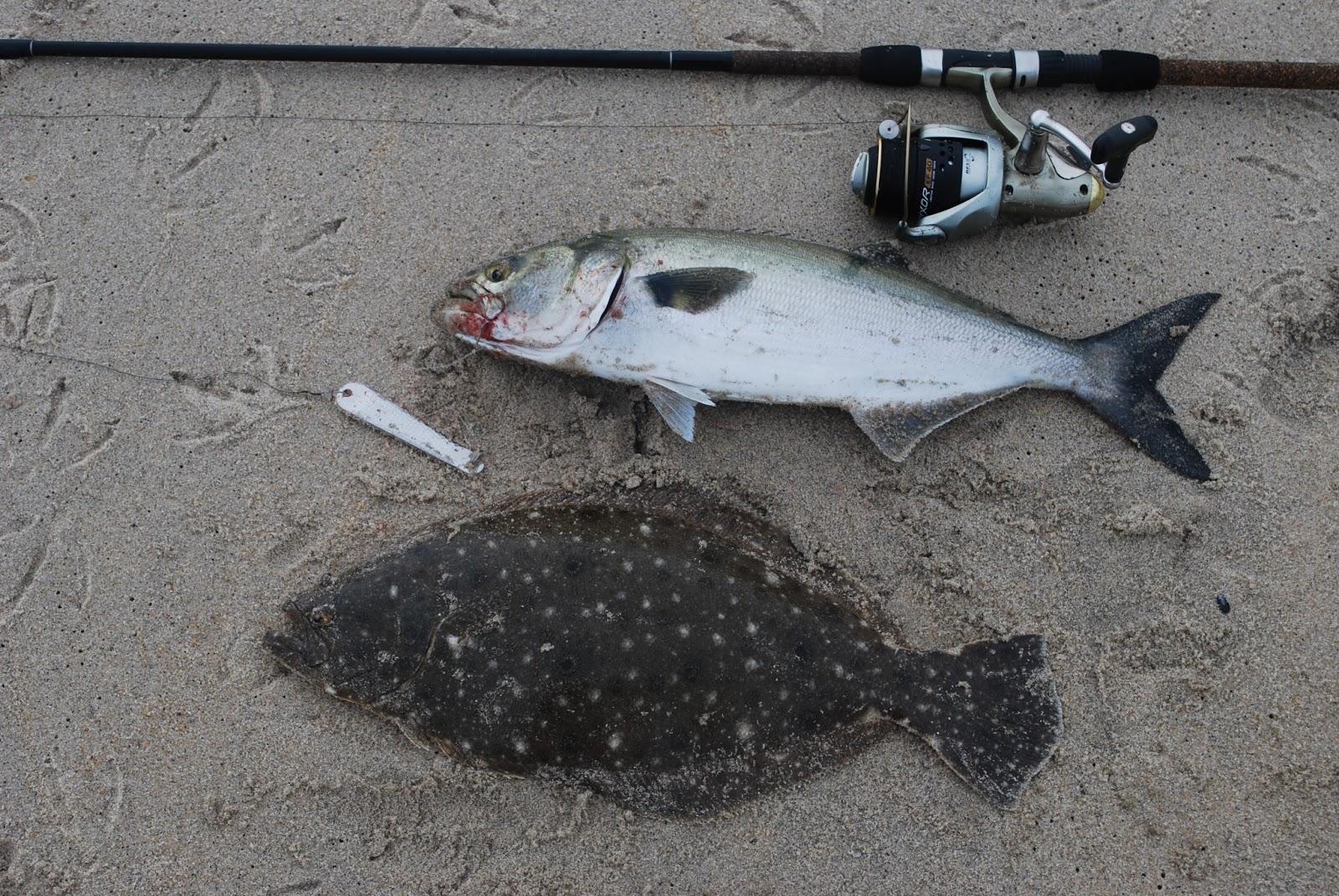
For several years I fished the surf on occasion during fluke season and did well live-lining killies with freshwater spinning tackle. The method is simple and fun. I wade out to my waist and cast a killie on a size 6 plain shank hook on six-pound test with eight-pound test fluorocarbon tied to the hook and a small barrel swivel. The leader protects against tooth abrasion due to fluke head shaking during fights, but I check it after each catch. Just above the barrel swivel a tin split shot is all the weight needed in ordinary surf conditions. I caught fluke after fluke with the same tackle and method reminiscent of one way I approach big smallmouth bass in small rivers.


But last year on a trip to Sandy Hook I hooked one nice fluke after about an hour—definitely a good-size keeper—with no other hits. I strained to get all the reach I could using a split shot. The surf was light and the beach sloped out beneath the waves at a very soft angle. I finally told myself--too shallow.


I checked my tackle bag to make I sure I didn’t have any bank weights or pyramid sinkers—I did have my eight-foot Tica—and as feared, had no such weights. Instead of giving up, I opened my mind to another possibility. Opening my shoulder bag full of lures, I quickly took out a three-ounce Hopkins. Directly, I took the treble hook off the split ring, then tied about 2 ½ feet of fluorocarbon leader from the ring to one of the simple plain shank hooks I had been using.


Letting Sit and Slow Retrieve


It seemed plain to me that if fluke lurked out there beyond the wave rises this would work, and it did within five minutes. That first cast I just let the Hopkins hold bottom and waited for the small fluke to come to the killie. But on subsequent casts I began to feel things out. I would let sit, then lift the rig off bottom and pull for a few yards, let sit again. I positioned the killie for the fluke, rather than just waiting for a fish to come along.


Fluke typically camouflage themselves against the sand and wait in ambush, looking up for any rainfish, peanut bunker, or other forage to pass overhead. As awkward looking as fluke are, they behave as remarkably swift and agile predators. My concern with any sort of heavy weight involves dragging it into a fluke and spooking the fish, but this never seemed to be a real problem with the Hopkins. When fishing a bay channel with a two or three-ounce bank sinker, for example, the situation includes the sand and muck kicked up by the weight attracting fluke rather than frightening them away.


So naturally I began to wonder if my shiny Hopkins might add to this sort of appeal. Fluke mostly sight feeders, they do scent prey much better than Spanish mackerel, for example, which don’t seem to scent prey at all. Fluke love smelly squid and cut baits, and inhabit dark channel depths of 30 feet, and ocean depths greater. But if they can, they’ll use their eyes first.


I continued my slow retrieves, covering range and catching a number of fluke, and became more aware that just possibly the flash of my Hopkins helped attract fish. If you were a hungry fluke and saw a fishy flash four or five yards away, you might be curious and swim over. And once you got there—aha! A nice killie to cramp down on in one fell swoop.


Fast Action


I had got into a rhythmic pattern of swooping the rig up, then letting it flutter back and sit awhile. On one of these rod lifts, I got a solid strike before the flutter. The Okuma’s drag allowed unmistakable straining thrusts to give—bluefish! In 15 minutes I caught two more, all of these about three pounds, with added speed to my retrieve. All of the bluefish hit on the uplift. My hopes rose. Perhaps quite a few blues had moved in and I could have a lot of fun, but as it turned out, I felt happy to find a quicker retrieve works best on the blues, and the Hopkins really does lure them straight in like a beacon.


But all of the blues went directly for the killie. It’s a puzzler, but given a choice between a slab of metal— not that they know its metal—and a killie trailing right behind, they slam the killie. Who knows, perhaps if I fished the Hopkins alone one or more of these bluefish would have slammed it. But they had to choose. The Hopkins fully evident to sight, so was the killie.


Teaser Effect


Teasers are essential surf tools because they excite fish by imitating predator after prey. Fish are like us—we see a happening and have a tendency to want to join in. Savage competitors that predatory fish are, a big striper will steal a little teaser away from seven-inch Redfin plug.


But the Hopkins is larger than the killie. Nevertheless, it works. Blues have no mind to get confused on the issue. What they see is a real fish swimming after something and that fits the pattern well enough.


So particularly if confronted by a slow sloping surf, try the Hopkins Hop to reach fluke distanced beyond breakers, and tease any blues that might show up. My suggestion is to use a 1/0 long shank hook if blues do arrive, not bad for fluke either. Personally, I prefer small hooks and don’t seem to lose fluke to them. Take that split ring off the Hopkins too. The knot can get caught on the ends and weakened.


A method for blues of about four pounds and smaller, I’ve had no problem with just the fluorocarbon because the blues get hooked on the outside of the mouth. I’m sure that with enough encounters some bluefish will bite off. But if you’re targeting fluke, don’t use steel. And possibly blues more likely hit that killie without such obvious and unlikely connection between it and the Hopkins steel would be.


Possibilities are endless for approaches to angling. More often than not we just stumble onto something when we have forgotten something else. But without keeping an open mind to what just might work, we would turn and walk off the beach.


Thursday, April 18, 2013

Post-Spawn Spinnerbaits: Largemouth Bass, Pickerel, Northern Pike


Post-Spawn Spinnerbaiting

Make Optimal Catches Now


          It’s May and aquatic vegetation is returning to full mass offering advantage by not being as thick as it will soon be. Eutrophic lakes and ponds, and weedy reservoirs with clear water, all offer some of the best largemouth bass and pickerel fishing of the year now. Bass and spinnerbaits go together like women and jewelry, but pickerel and northern pike are attracted to the flash as surely as they have struck in-line spinners for almost a century. I have reason for why I like using spinnerbaits to catch these species in water that is at least fairly clear; this will become evident as discussion progresses.

          Everyone hales bass and I have no opposition to this, but I love pickerel and pike for their savage attack nature. It’s as if they possess a much more concentrated focus of attention to unleash with powerful bursts of speed upon prey. Fall pursuits for pickerel are typical and shiner baited tip-ups are popular winter devices, but through spring’s warmer half into summer’s start amazing catches are possible. What adds such appeal is largemouth bass frequenting the same weedy structures just as willing to hit.


Optimal Water Temperatures


           Baitfish are re-established in relation to weeds as water temperatures have reached optimum levels for bass and pickerel. Largemouths spawn in 62 to 66-degree afternoon water temperatures. If smaller males remain on beds this month, be assured that females are feeding in a post-spawn mode, stimulated and thriving among weeds rich in forage with water temperatures reaching the 70’s before summer doldrums. Pickerel spawn shortly after ice-out in 47 to 52-degree water but don’t slow their feeding until July either.

          It’s common knowledge that cold blooded fish have metabolisms that burn more calories as water temperature rises. So the summer slump seems counterintuitive until you consider that bass and pickerel move less when water warms above their optimal range in order to conserve calories for that higher burn rate. This explains why during August heat spells an evening blitz of bass activity may happen for 10 or 20 minutes. They gang up and feed like mad to gorge themselves on as much as possible in little time to feed that metabolism—then return to inactivity so they don’t burn off too many calories gained by the intake.

          Similar to this conservative summer strategy, an individual bass has a built-in response to all conditions to maximize its growth on a lifelong scale. Until water temperatures get above the higher end of optimal—somewhere in the 70’s, probably highest in the south—bass are driven to feed more to take best advantage for their growth and lengthen their lives. In essence, the same phenomenon happens in the fall when temperatures return to optimal. This has nothing to do with fattening for winter; it’s all about maximal growth. The same goes for pickerel and pike, although pike like cooler temperatures, which involves why pike are smaller in New Jersey than northern New York.


Sunlight and Wind are Ideal


           During summer, bass and pickerel gorge at times during certain low pressure conditions. But another counterintuitive consideration for fishing now is that direct sunlight typically means better fishing with spinnerbaits so long as a breeze or wind chops water surface. Commotion scatters light and sets a shallow, clear water environment in motion. With calm sunlight, a clear aquatic environment about 15 feet deep or fewer absorbs the light straight into weeds and bottom with no action at the surface exciting life below. Only the weeds benefit directly. So long as depths are fairly shallow, water clear and wind-roughened under sunlit sky, bass, pickerel, and northern pike in some waters, seem to have a very hard time distinguishing a silvery spinnerbait blade from a nutritious shiner having abandoned caution in such an excited environment.

           The blade or blades of a spinnerbait reflect light irregularly when rays coming through a chopped surface are scattered. These reflections are variable as chop is varied. With calm surface, sunlight steadily reflects a direct light flow from a blade. Fish don’t get confused by subtle reflection irregularities and an excited environment: they don’t have minds as we do to get confused. Rather, the calm environment is simple and the excited relatively chaotic. The complexities of stirred up environments are all exponents of increased action. It’s not much of a leap to suppose that fish, including forage, are more active as well. My fishing log bears this out. So do the strikes. They tend to be much more forceful with windy light.

          Above all it’s that beckoning blade. And the more scattered the sunlight reflected from it, the more it compels. However subtle this difference in reflected light is, it goes along with a relatively chaotic environment, which is the main factor. But I think blade flash of any kind in these rough conditions is more attractive than head and skirt or attached plastic, although many choices between blades that reflect light differently are possible.


Choosing Blades


            What blade or set of blades you choose makes a difference. The following general guidelines may help, but detailed choices are detailed differences too. A hammered blade, for example, will reflect light more chaotically than a smooth finished blade. Blades attached to swivels by split rings are easy to interchange if you care to experiment. Fishing close to the surface, greater blade vibration tends to be better. Ultimately, a buzzbait would be used at the surface and some have triple blades. But tandem blades on a typical spinnerbait are effective buzzed or fished a few feet down. A combination of Colorado and willowleaf blades causes maximum commotion, which shows that the blades chosen may make more difference in vibration than in how light is reflected relative to surface chop or lack of it.

          The ratio of blade size to head weight determines the rate of retrieve at a given depth—larger blades mean slower retrieves are possible. But if you bothered to weigh a willowleaf blade and Colorado blade equally, the willowleaf would produce less resistance allowing a quicker retrieve. Blades produce pressure vaguely similar to aerodynamics, and a spinnerbait with a Colorado blade rides a little higher at the same retrieve speed a willowleaf blade would carry deeper. That pressure from a Colorado blade also releases more vibrations fish can sense by their lateral lines.

          I find large, silvery Colorado blades to be especially effective close to the surface, and rather than combine such a blade with a willowleaf (to combine it with a Colorado of the same size would cancel out action), I like them single. This is no more than personal preference. (Confidence and value go a long way for performance.) Fishing big blades three feet down may be effective among growing weed-tops over a flat or next to a weedline. If you sight isolated lily pad fields among milfoil or other vegetation, this cover is great this time of year. Fish the edges and right through whatever openings allow passage. I treat large pad fields as any other weedline unless openings allow a spinnerbait to get through.

          In six to 10-foot shallows, a willow leaf blade may be more effective since it imitates quieter environmental action at this level beneath an angry surface, not that these depths aren’t affected at all! Often the biggest bass or pickerel will situate to strike at the bottom of fairly deep weedlines, possibly deeper than 10 feet, and a heavy spinnerbait can be fished effectively at 15 feet with a small blade. In the depths fish tend to have a subtler feeding response and willowleaf blades cater to this. Lighter head weights that retain effective retrieves allow slower presentation to possibly tease reluctance to response. But a problem when fishing weedy flats about 10 feet deep with weeds growing towards the surface is that thick weeds near bottom foul your line and lure. Get a spinnerbait down about four or five feet. Bass and pickerel are not necessarily on the bottom. It’s easier to fish deeper now than in July. Otherwise, the time may be just right on a summer morning or evening for topwaters over the tendrils.


Skirts, Plastics, and Color


          Whether or not to use certain skirts or grubs and other plastics in place of them (or with them) are particular choices also. I sometimes use just a four inch section of straight, conventional plastic worm without a skirt, but I love to put on a soft plastic Hawg Frawg. Those rippling legs produce a tantalizing action. Color probably makes more difference as you like colors than fish do, but bright colors in bright sunlight are fitting in a lit up environment below. Bass, pickerel, and pike are not color blind, so color makes a difference. However, so many colors exist that to tell just what “they’re hitting” may be circumstantial. In my own experience I’m better at choosing blades than color.

          Having favorites of any kind may hinder further experimentation, but it may protect against confusion, frustration, and such an obsession with technicalities that your focus on the rhythms of fishing itself is overlooked. I think it’s usually more important to absorb the environment you are probing—besides, what you are fully aware of will generate original ideas. So if color is a concern, for example, see if you can get an answer from the lake itself rather than some compartment in your head. This may sound obscure and irrelevant, but on the contrary, relevant ideas always come from actual experience. Favorites make a fishing experience comfortable, secure, familiar, and often efficacious. But they also tend to make us complacent and stupid. If the day is getting slow, chances are it’s you, not the lake. But one afternoon I found that my green Hawg Frawg on a 3/8-ounce head below a big Colorado blade drew so many ferocious strikes the thought of experimenting would have seemed silly to me.


Habitat Behaviors and Getting a Spinnerbait at Them


          The color of largemouth bass tells us what they like best—aquatic vegetation. The same goes for pickerel and northern pike, although pickerel particularly are weed addicts. They need residual aquatic vegetation in order to spawn. They aren’t caring in the way bass build nests and the males furiously protect eggs and fry. Pickerel drop eggs in residuum; the males fertilize them, and go on their way. 

            Almost always pickerel stage from weed cover to ambush prey. I have caught three pickerel in the Delaware from rock structures, but it’s almost an absolute rule that the rare pickerel in this river stay among the weeds of slow stretches and pocket backwaters. However, as with largemouths, branches, fallen trees, or stumps combined with weeds are especially attractive to pickerel. Being elongated in shape, pickerel mold in to submerged branches. Their color may even shift to a dark golden hue.

           Cast well beyond wood cover, then run a spinnerbait right against it and stop the retrieve. The blade or blades will flutter as the lure falls. Often the strike comes just as you begin retrieving again before the lure would touch bottom. Another trick to try is banging wood with the lure, retrieving faster as you work the lure right into a branch then let it drop. Works for both species.  

          Unlike bass, pickerel will sometimes follow a spinnerbait to the boat and stay in place near the surface in full view. A few things to do include changing the direction of the spinnerbait and pulling it along boatside to provoke a strike, moving the spinnerbait in a figure 8, or grabbing a rod with a Senko worm rigged wacky with hook in the middle and just pitching it to the fish. I’ve found the latter method to be most effective. Yes, pickerel take Senkos, but make sure you use a 15-pound test fluorocarbon leader.

           Pickerel and pike are not as accurate at attacking prey—or lures—as bass. This is our fourth counterintuitive issue. Bass are swimmers. They have nowhere near the agility of pelagic swimmers, but they coordinate on their targets well from relatively open water situations. Pike and pickerel are ambush predators that use cover. They rely on a burst of initial speed to strike prey rather than suck and swoosh it in as bass do. Pike and pickerel contract their bodies in a sort of instantaneous, springing spasm and shoot for the target—or miss it. Since they often rush from two or three yards, the prey may move significantly off the aim fired at, even though pike and pickerel do judge motion for that aim. But pickerel especially don’t give up. If a spinnerbait was clipped or missed by a foot or so, closer to it the predator quickly turns and attacks again. But oddly similar to mammalian play, after initial attack a pickerel sometimes seems clearly to miss a lure by intent as if it senses it’s not food, but exercises aggression anyhow. If a pickerel comes after a shallow running spinnerbait a second time and misses it, speed up the retrieve and the fish may be provoked into a savage direct hit from behind.


Horse Them from the Mess


          Pickerel in New Jersey and New York eutrophic waters and reservoirs grow to five, six, possibly as large as 10 pounds—the former world record nine-pound, three-ounce fish came from New Jersey’s Pinelands. To imagine a grand average, they run about two pounds smaller than largemouths in our region. Like bass, when hooked they dive at the nearest, thickest weeds. If you can’t horse a fish from tangles of thick stems and weed mass, slack line between the lure on the jaw and the mess the line is buried in will result very shortly in head shakes and hook leverage against weeds that head is buried in. This would free the fish, which is why I use 15-pound test Power Pro braid. On a medium power rod I could pull a six-pounder from certain loss. Braid diameter is thin enough to cast freely as six-pound test mono gets a lure out a long way.

          A seven-foot medium power spinning rod with a fast action tip propels spinnerbaits such distances that Power Pro is good for its lack of stretch too. I’ve missed hits on long casts with mono I wouldn’t have missed with braid.

          It’s a great time for spinnerbaits. In my scheme of things the best time; I rely more on crankbaits and jerkbaits in the fall. The weeds are here and spinnerbaits weedless, but space between tendrils is just enough not to foul retrieves much and force you to switch to a worm or topwater plug.       


Wednesday, April 17, 2013

North Branch Raritan River Nice Rainbow Trout and Using Salmon Eggs

Fished for half an hour by the second bridge, above the crowd for which the North Branch Raritan River at AT&T World Headquarters gets dubbed the Zoo. I stepped in among them to try just a few casts as I left, friendly people; it's only a joke about a feeding trough I've taken from also.

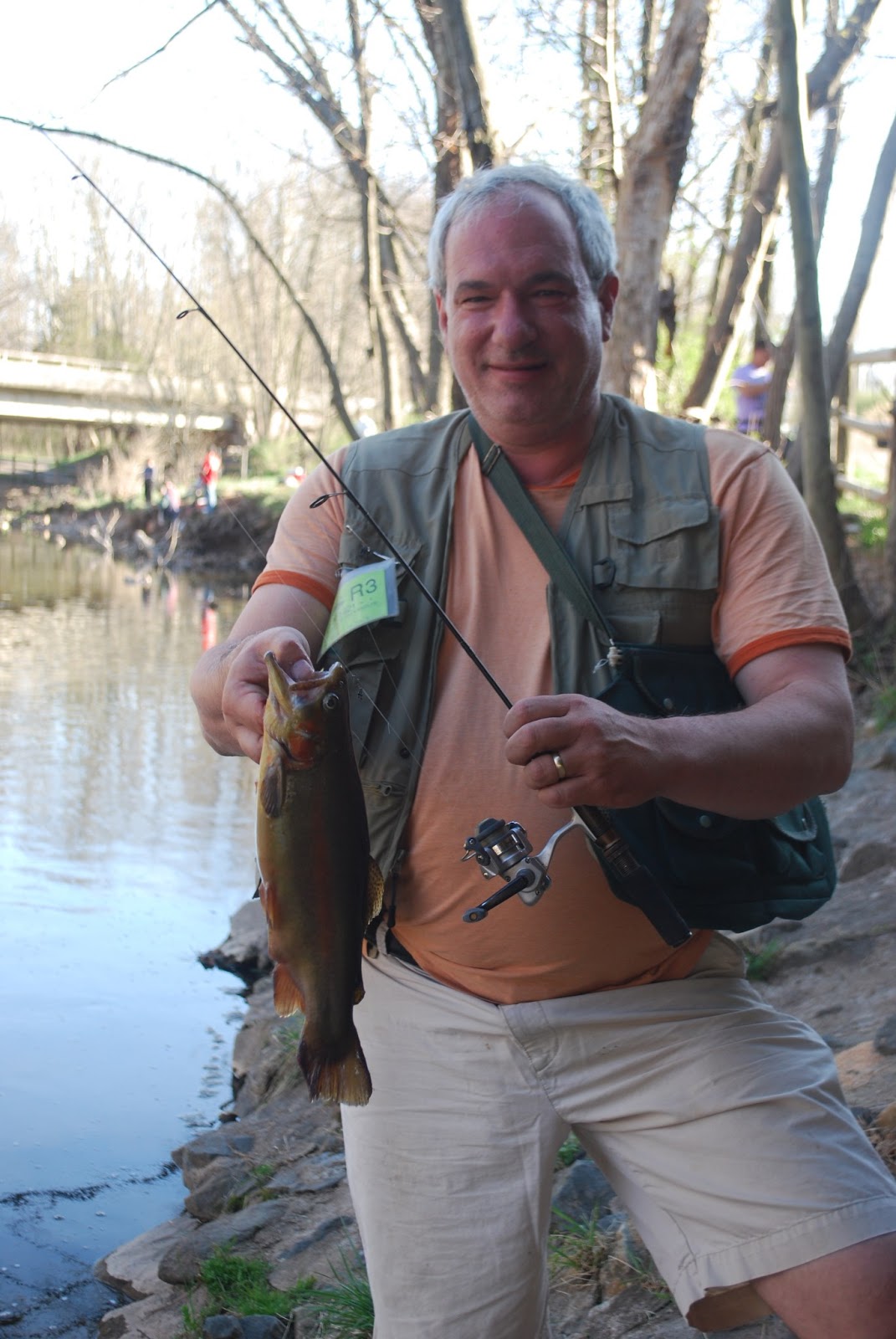
Sometimes the rainbows just don't feed the day they're stocked and today was one of those days. I caught two on salmon eggs, including this nice one around two pounds. It made the reel sing with two-pound test. I saw three other trout caught. More than several others fished in the range of the second bridge. Never saw any caught in the crowd, and usually on stocking days trout come in frequently. Missed one or two good hits, had taps from trout that didn't really take the egg.

Current moved faster than last week, water higher, just slightly off color, so I used two swivel pieces on my snap for weight, which was just about perfect. (I cut the swivels from snap-swivels and keep them on a safety pin attached to my vest.) Felt real good fishing for a few minutes. The second trout hit shortly after the big one, and I thought I was going to have some fun. I left before my mood would have slipped into the negative.


Tuesday, April 16, 2013

No Fishing at DeKorte Park/Tried for Stripers Hackensack River

Hurricane Sandy wreaked havoc at DeKorte Park, of course. I had checked the Commission website--park open. But the Saw Mill Creek Trail is not. I guess they have it closed because construction tractors are back there and need to be protected. Saw Mill Creek Trail is where the striper fishing on Saw Mill Creek Flats happens. Fred Matero and I tried walking all the way down to the back of the rear flat in hopes that we could access the Saw Mill Creek Trail from the entrance I photographed, above. I noticed a couple of greater yellow legs or willets, wasn't certain, on our way back out. The distant ducks looked like mallards, although I've seen shovelers, teal, and other species in the past.
 
With my sense of things and Fred's phone map, we accessed Patterson Plank Road across the Hackensack and finally landed at Trolley Park and a way to fish the river after multiple complications but plenty patience and perceptions, the first time for both of us in these places and fishing this river known for stripers and some big. And the first thing I noticed, besides mud flat exposed, meaning shallow, was the channel marker near the opposite side. It did reach the low to mid 70's earlier today (chilly this evening). But I thought, who knows, if it were 85 or 90, maybe stripers would move on these shallow flats. I did count about five feet deep by letting the paddletail sink.
 
We fished. We had adventure in the urban wilderness, adding range to our experiential scopes of New Jersey, America, and the world.

 Freedom!
 Sawmill Creek Trail photographed through fence bars.
 Jets fly low right over Sawmill Flats.

 Hackensack River/Izod Center