Thursday, May 10, 2012

Where-to-Go Tip for Largemouth Bass: When Fishing is Tough

 When you don't find bass on a large reservoir or lake, you might find some in little, out of the way spots. To catch three bass today fishing from shore on my lunch break at Round Valley Reservoir, after persistently fishing along the breakline from four or five feet down to 10 to 15 with Strike King Senko-type worms and Chompers seven inch, I hiked nearly a half mile to a sort of cove. As you can see in the photo below, banking trees cut off the breeze and eddied pollen and other life-stuff onto the surface. With evidence of life around, including an overhanging willow, a few bass mixed in the fray. This little cove produced because of the soft structure element: I think it was the pollen and stuff, as if the bass could just smell that this might bring in some fish forage.

A bet no boat advantaged bass fishermen on this reservoir with water so clear that largemouth bass spawn 10 feet deep would bother trying this spot. Being on foot gives you an entirely different perspective and sense of time involvement--you can fish a small, shallow area with more patience. I had 10 or 15 minutes left and caught all three--one from under the willow, the other two in the calm water with stuff on it--in about two feet of water.

I've enjoyed recent low hanging clouds and rain. Today cloud cover for the most part spat a few light showers. Yesterday, clouds hung low, continuing the ominous mood present for about a week, which may have put most people in that disagreeable suspense, but I find grand and suggestive of solitude since fewer endeavor in it. It doesn't depress me. Such weather (usually better for fishing) correlates with my appreciations for German writers like Nietzsche and Goethe, rather than Americans like Zane Grey and Mark Twain full of sunshine and leaps more like rainbow trout than browns. (Browns don't leap and happen to be from Germany.) Americans are suspicious of those German writers because of what happened after them. But they weren't entirely responsible for the Nazi's, and if they help you get in the mood for better fishing, all the power to that.

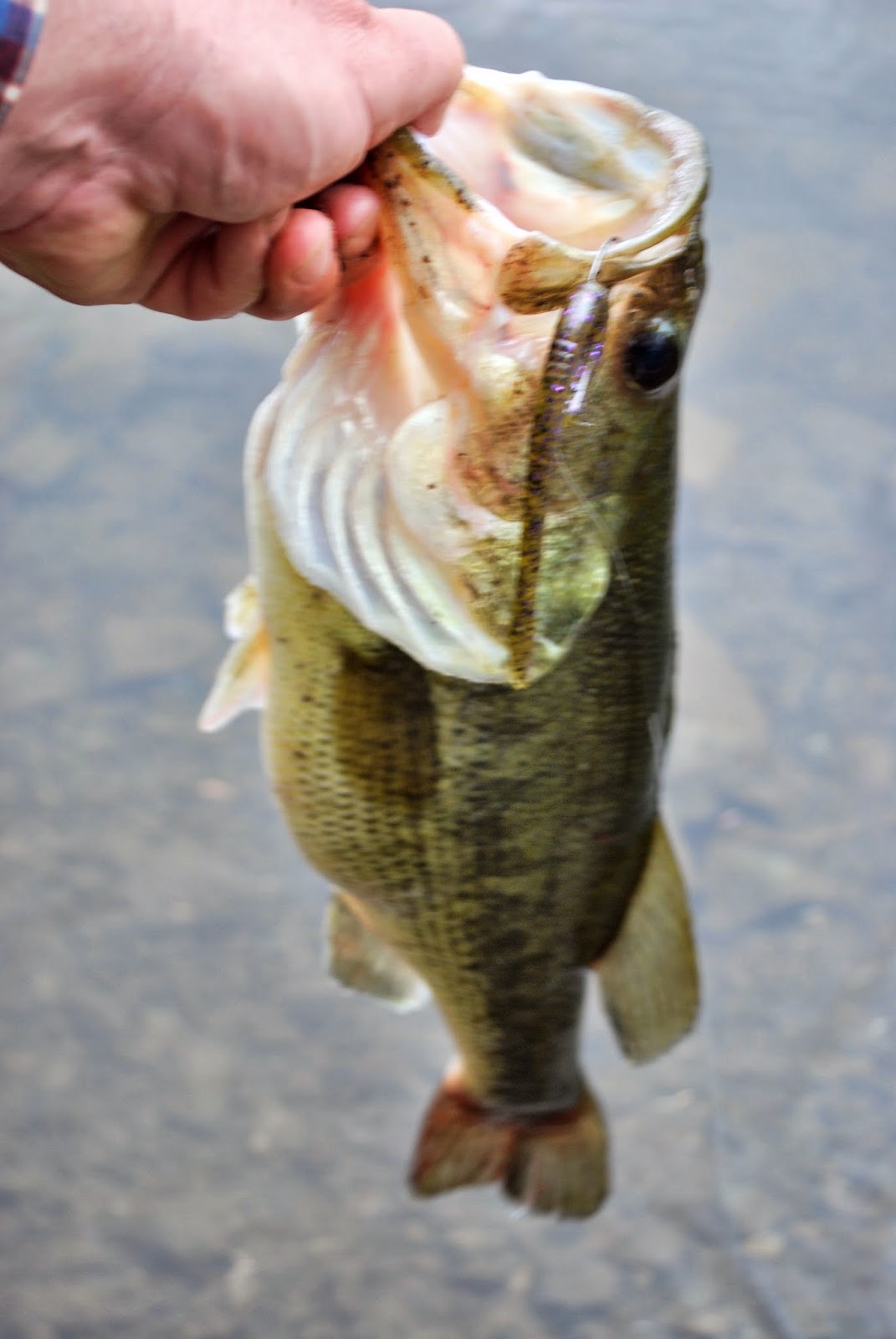
As evidenced by the photograph of one of the bass, they don't seem to spawning in the reservoir yet, although it could have been stuffed with forage. But my brother Rick and I once fished from one of the boats I owned years ago to withness males guarding beds on June 10th. Not only is the water deep and superclear, thus taking long to warm--10 foot depths have to warm to stable afternoon 65 degree temperatures 


Wednesday, May 9, 2012

Plastic Worm Tip for Largemouths: Fishing at a Fast Pace

 Plastic worming is fishing slow? Not necessarily; this is only the presumption and the tendency, since especially fishing a weightless worm requires slow descent and a long patient retrieve. But today the initial drop is about all I allowed, reeling the Chompers in quickly to move on after letting the worm sit a moment. Since last year it's been coming to this at 18-acre Mount Hope Pond. You want to take your time with a worm, but think about it; how often does the hit come on that initial descent? In my experience most of the time.

No need to be traditional and patient, I got the worm to more bass, catching four within my lunch break. Of course, this is much easier to do now that I'm familiar with this pond. In any event, the way to up tempo is to be sure you don't waste opportunity, which goes both ways. It's wise to twitch the worm a few times in some spots. Takes intuitive judgement, which comes with experience and willingness to practice.

I did fish the southwest corner and caught one there. The others hung along the fast breaking west shoreline. I should be back next Tuesday.

Catch Pickerel on Spinnerbaits: Late Spring, Early Summer Optimal Forage Chase


Catch Pickerel on Spinnerbaits


          Pickerel are typically caught in the fall, especially through the ice by using shiner baited tip-ups. However, during the warmer half of spring into early summer amazing catches are had. Aquatic vegetation is returning to full mass, but not yet so thick. Forage fish relate to the weeds, and pickerel and other gamefish feed on them with water temperature in the optimal range for activity and growth.

           Unlike largemouth bass, which don’t spawn until water temperatures reach 62-66 degree afternoon temperatures, pickerel spawn rather shortly after ice-out, in 47-52 degree water temperatures. While bass are preparing for their procreative act in water reaching into the 60s, pickerel have long before transitioned and live to feed. With water temperatures in the 60s and low to middle 70s from May through June, the environment is optimal for pickerel. In July temperatures exceed optimal range; pickerel feed to fuel that high metabolic rate (cold blooded), but they typically feed aggressively early and late in the day. Excessively warm summer water makes pickerel and other gamefish move less during the day to conserve calories rather than burn them by activity.

           In May and June fast action is frequent in direct sunlight with a breeze on the water.  Rough water surface scatters light and sets a shallow, clear water environment in motion. A clear aquatic environment about ten feet deep or fewer simply absorbs direct light through a calm surface, and is not conducive to much action. So long as the water is at least fairly clear and choppy under a sunny sky, these toothy aggressors seem to have a very hard time distinguishing a silvery blade from a nutritious shiner.

           The blade, or blades, of a spinnerbait have slightly more light reflecting action when the rays coming through the surface are scattered. These reflections are slightly variable, rather than the blade’s steadily reflecting a direct flow of light through a calm surface.  With the environment itself in motion, baitfish move, and in scattered ways, as if slightly excited—pickerel are right behind them. Whatever subtleties exist otherwise under the surface, I don’t catch so many pickerel on spinnerbaits under a calm, directly lit water surface, and those I do catch don’t strike so dramatically.

          It makes a difference which sort of blade you choose, and whether you use a standard skirt or remove it to put a grub or other plastic bait on the hook. Having favorites may hinder interesting experimentation, but it also makes the fishing experience comfortable, secure, familiar, and efficacious. However, the pulsing vibrations of a rubber skirt, the rapid turns of a twister tail grub, the shake of a plastic worm trailer and other combinations are all actions that work. Likewise, there are many different colors to choose among, sizes and styles of blades to choose, as well as head weights. The larger the blade and less the head weight, the shallower the spinnerbait will run. For some fishermen subtle experimentation is a sort of technical passion and many real, objective results may be gained on the basis of trial and error.

          Close to the surface more blade action is appropriate. But don’t use double or triple blades, which actually tend to cancel each other out. This explains why you don’t find double Colorado blades of the same size and shape on a spinnerbait. A single, large, silvery Colorado blade is effective closer to the surface. Fishing it three feet down is fine, whether among the tops of growing weeds over a flat or right next to a weedline. 

          In deeper shallows of six to ten feet, a willow leaf blade, or a tandem Colorado and willow, may be more effective since this imitates the quieter action of the environment at that level beneath surface chop. Willow leaf blades produce quieter vibrations than do Colorado blades. What a pickerel will hear, and pick up by its sensory lateral line, is different according to what blade, or blades, are chosen. Sometimes the largest pickerel are in the deepest weeds and have a subtler feeding response, a seasoned response.

          Always look for pickerel associated with aquatic vegetation—lily pads combined with milfoil are especially good, and if fallen timber or brush is available with weeds, perhaps even better.

          Pickerel are fierce, native gamefish in New Jersey and other states where largemouth and smallmouth bass are not native. I might argue that bass migrated conveniently and that the distinction between native and wild re-established is more historical than truly ecological. Nevertheless, places exist where pickerel thrive and have so for thousands of years with no bass present even today. In New Jersey anglers speak of Pine Barrens tannic acid levels making bass survival impossible. But I caught a bass last summer in Mirror Lake, Brown’s Mills, New Jersey deep in the pines with water so tannic visibility was about six inches or fewer. So I can only suppose PH in tannic waters does not correlate directly with how stained the water is.


Tuesday, May 8, 2012

Fishing Tackle and Equipment Care, Use, and Buying Tips

Follow this advice on tackle and equipment, choose what you will of it, reject the rest, and possibly reconsider some of what you toss overboard further down the river--it will float along beside you and you can scoop it.

Tackle and equipment represent the most practical aspect of angling. The more species and types of water you fish, the more opportunity to exercise practical ability. The value of success (always practical) is clear: when gear is orchestrated to achieve a result, satisfaction benefits you.

People all over the globe in Western and Westernized cultures are practical and interested in results. However, a desirous fascination with products--alluring lures, cozy boats such as my son's Intex 5-Man Inflatable (joke, but its cozy for sure), rods & reels, etc.--can verge away from use and respect for the tools they are to become idolatry. Impractical. It all depends. Some anglers are historians when it comes to fishing products, and the value they know in names and relics is much greater than a bogus dependency on surface appeal.  But if name is the main motive to buying tackle, it may be the sheen of basking under company prestige and surfacy aesthetics that feels attractive and oddly unattainalble (because it's an illusion) that matters more than real fishing success.

I value my equipment. In relation to personal memories, it has produced important meaning in my life. I respect manufacturers, but when I look at my salmon/steelhead/musky (I hope) net, which I covered over with nylon tarp yesterday to protect from UV, I feel the presence of outings it served fairly directly, and frankly don't even know the name of its manufacturer. That may be a fault: to know the name is better than not to. But to the know the name and have no substantial experience with it is worse.

Perhaps the most important regard for tackle & equipment is that although tools represent practicality, the exercise of practical fishing, preparations to fish, and tackle & equipment concerns is in the angler and not in the grab bag. As obvious as this sounds, the following vignette will help illustrate how reliance on tackle & equipment can be overdone.

Today I caught two largemouth and a smallmouth at Round Valley Reservoir. I had thought I would read on my lunch break in the unlikely event I didn't sleep instead, having been up to 2:00 last night. Turned out I made good time and wanted to fish. No camera, no tackle, but my three-ferruled rod & the reel lay behind the seat, my fishing license in the vehicle. Got there and remembered I snapped off the worm-hooked worm on a snag at Mount Hope yesterday, which says a little about making sure a barb stays embedded. Opened the glove compartment--aha! A large, white buzzbait.

Even with largemouths spawning 10 feet deep (not yet perhaps) and a heavy chop on gin clear water--what bass is in very shallow water at Round Valley? (well some are, and these I sought)--I caught three in 45 minutes, feeling free and successful with just a license on my security badge snap, and a rod & reel, one lure.

Considering that I got skunked on the reservoir twice last spring and once earlier this year using my plastic worm standbys, the buzzbait, as inappropriate as it seemed to use just at first, was a refreshing change. You might say that with just rod & reel, and especially just a buzzbait, I was impractical at Round Valley. But what success is impractical unless it really is just dumb luck? I sought out precisely two likely areas and scored.

Tips

1. Always consider crossover uses. It would usually seem very simple, but relationships are easy to miss. For example, the steelhead/salmon fly tackle I will buy for my son and I, will serve bay & surf blues & stripers. Such may seem so easy to recongnize, but even so, to have witnessed five anglers fly fishing blues together in Sandy Hook Bay Saturday drove the possibility home much better than plain recognition could have.

2. Save money. Why buy Senkos when Strike Kings of the same worm type may cost half the price?

3. Avoid buying name products for the sake of feeling part of an in-group, unless you really want to become identified on the grounds of real fishing success. That success, no matter how many pictures you post, should always be yours alone first. The illusory motives of substituting product and recognition for the personal value you take, which no one else knows but little about, will distract you from applying products properly. No instructions or fishing articles can ultimately tell you how to do this, since it always comes down to the fishing situation you confront. The in-group can catch zero fish for you.

4. Value every piece of tackle & equipment you own down to the single hook and BB split shot. "It doesn't matter" is an attitude which makes you and your endeavor null and void.

5. Tackle loss is inevitable of course. Respect wear as a sign of past enjoyment, and the possibility of future renewal. When you do lose a hook or BB split shot, then it matters to let them go! Even the loss of a prize rod won't hurt nearly so much than if the loss ended a pattern of carelessness.

6. Organizing tackle & equipment in ways that make access easy helps. The best way to do this is by personal use/value significance (chew on that) especially associated with pleasant memories and hopes. Such memory and ancillary expectation (they are connected) is more organized (organic) than your mess of a basement, car trunk, tackle box, and so on, may appear. Values are a system that requires conscious thought and effort driven by purpose, but values are internal within yourself and as natural as weather conditions, only particular in much more complex ways as befits the most complex known object in the universe--your brain.

7. Don't take my word for it. What you learn from others, make your own. Others will be remembered and honored for the significant thoughts they speak and write, if in aural and deeply meaningful ways, but such remembrances and guideposts are your own.

9 Weather and Water Tips for Better Catches

Before learning how to catch fish--equipment use, line and rig choices, habitat location--reflect on what moved you to pursue fish in the first place. In essence it's the same as moves fish to feed or not and where: conditions of weather and water, or in other words planet earth beneath the atmosphere, but local. A desirous response to the environment set you out on whereabouts perhaps unknown.

For years voluminous material has been written on fishing conditions; almost all of it excludes personal intuition of conditions for more general observations, even if specifically pinned down by such toys as thermometers, barometers, and even wind gauges, as if these devices possess powers we don't.

I can only suggest to you frankly--get in touch with yourself. Split second choices on the water mean more than comparing outward observations to preconceived notions. And now I will be faithful to the post's title, which lured more of you to it by far than would have the word "intuition" in place of "observe." I will toe the line a little with the rest of the rule makers.

Weather

1. Low pressure is often too stable a system to incite much more action than a stable high pressure system might while lingering after initial cold front shock puts fish on hold. Approaching storms are usually best, and violent storm passages can stir terrific action but be deadly if lighting is involved. Surf fishermen who dare Nor'easters know more about this adventure than I have been privileged to participate. 

The general rule is that rainy days are fishing days. And this general rule disappoints anglers perhaps more often than not.

2. Cold fronts tighten action down. Some fish might not feed. Some might only strike in reaction. But it often seems that one or two, if not more, will feed. You have to concentrate and usually fish deep into cover or in deep water. It's not a time for wild excitement as it is for taking satisfaction in beating odds that optimal fishing conditions--optimal water temperatures in late spring or early fall, for example, combined with a falling barometer and approaching storm or beginning of rain--cannot ever provide.

3. No season month, week, or day excludes possible catches. Every day, hour, and minute presents unique conditions. But if all you want is catch quantity--whether of weight or numbers--rather than catch quality, what are you fishing for? A fish is a living part of nature which ultimately escapes every measurement device we can approximate to it. You want just the figures? We judge them by limited eyesight.

4. Early and late is my favorite generality. But during summer, for example, I find that for 10 to 20 minutes or so, largemouth bass binge feed sometime around sunset. I never predict exactly when this happens--perhaps 10 minutes before sunset, perhaps 20 minutes after. But the topwater action sure flies in the face of "summer doldrums" and weather "too hot." Summer bass have high metabolic rates that need calories. But they binge feed and conserve calories by moving and chasing baitfish less throughout the day, which involves why plastic worms are a good choice for summer afternoons. But be ready for a shift in action or you might miss it and never realize it happened.

Water

1. I love clear water because it conveys a feeling of energy, life, and presence. Much is written about stained water allowing shallower fish movements, and this is an ace-up-the-sleeve to write about, especially to believe in. But in the clear lakes I fish, I have no problem catching bass in 10 to 20 foot depths. 

Low, clear, summer smallmouth bass streams may mean slightly spookier bass--and certainly mean selective trout in my experience--but smallmouths are lordly, pugnacious animals that will look you in the eye, then take your fly.

2. Muddy water impossible? Use a Colorado bladed spinnerbait to transmit directly to lateral lines.

3. Too high a temperature can kill any fish, especially trout and salmon. But it used to be believed in complete faith that largemouth bass hibernated during winters of the northern United States. Beliefs always satisfy need for ordering experience into explanations, and the willingness to forsake explanations and try something else may result in a catch--at some time or another some ice fisherman realized that largemouth hibernation was a myth.

4. Wind can make fish fickle unless accompanied by the sort of initial low pressure system that excites them. The general rule is that wind reduces light penetration, therefore means better fishing, but I usually find windy conditions earlier in spring and also summer to be less productive than calm, but I like wind in the fall because I usually do well for bass, pickerel, walleyes, and hybrid stripers. However, a moderate chop on a shallow eutrophic lake in May and June (post-spawn, at least female largemouths, as well as pickerel and/or pike) with plenty of sun can mean excellent spinnerbaiting, fish chasing forage in optimal temperatures striking sun-reflecting spinners savagely.

5.. Live bait can tell you whether oxygen is present in depths or not, and so can a meter.

Devices are fine so long as we don't forget they are created from what is within the creators. Anglers are practical minded innovators who may stand by observations, rather than by some hokey intuition, to the death. Every innovation requires exact deductions from theory built from observed experience and measurements. But what precedes observation? What actually moves the eye to look? If you become more aware of this response to conditions within you, then you learn you are on par with fish that also respond to conditions.


Monday, May 7, 2012

Finesse Plastic Worming Largemouth Bass Tips: My Favorite Worm Hook Water

Finesse worming is warming up (before overheating by August.). Catching one of the few small bass at 18-acre Mount Hope Pond, I had bushwhacked along the east side for nothing but a few sunfish takes, having reasoned quick as I began parting bushes that the two west corners have the best spawning flats. So I got over to the southwest corner with 10 minutes to spare and sure enough sighted a bass (and a big one as I walked out). This little bass photographed and less than a pound I thought was a sunfish and barely hooked it trying to pull the Chompers free. (You can see how tenuous that hook-hold was.) I didn't sight this bass. It was right up against the bank by about a 20-yard cast.

I like fishing right in the thick of submerged brush and fallen timber here, which demands pin-point pitching and a slow worm descent (which keeps the plastic in  bass's visual field longer too). But next time I'm fishing the corners.

Lots of rocks on those flats and along the breakline into deeper water where bass stage before spawning and for feeding also. Females lay eggs then abandon beds, so they relate to the breakline during the weeks the males guard eggs and young. I leave the bucks alone. 

Lots of hype out there about banging brass or tungsten on rocks and tree limbs, and I don't discount that fish are alerted by sound (attracted or repulsed). Most of fishing is preferential and every individual angler who knows something has his own persuasions. I like to fish a worm without weight. When I need to fish deeper and get down faster, I tend to choose a long casting, fast sinking Senko-type. For quiet natural approach, I especially like 7 1/2-inch Chompers. I used to swear by four-inch worms.

I didn't notice any evidence of spawning here yet, besides a few bass in shallows that seemed to behave otherwise than guarding beds. Saw two sunfish beds.

Look forward to trying again Wednesday. The Pequest Hatchery truck was there. I saw two other anglers and one apparently fished for bass. "Raised with Pride," is written on the truck and I'm sure our trout are so. But these browns don't hold through the summer here in this pond with 15-foot depths as far as I know. If they did, there would be some real big browns to catch since no one fishes for trout here after May.  

Sunday, May 6, 2012

Lunker Largemouth Bass Tips for Mount Hope Pond


Mount Hope Pond Offers a Chance at a Lunker Largemouth


          New on my repertoire of places to fish last year was 18-acre Mount Hope Pond in Rockaway Township, Morris County, just north of Route 80 via exit 35. For many it’s good for springtime trout, and after fall stocking plenty get jigged through the ice. But for me this pond offers the hope of the year’s biggest largemouth. Since May last year I’ve caught over a dozen nearly two pounds to over three, having fished eight one-hour noontime stints. I enjoyed the best fishing under cloud cover, getting my clothes dampened from rain-wet underbrush, but typically I catch a bass or two under direct sunlight. Plenty of overhanging branches and shoreline brush provide shadows for bass to await ambush.

          Like so many places I visit, I often encounter other anglers here. Typically they don’t cast to the bass. One recent sun-drenched afternoon I met a man fishing at the spillway, clear water absorbing light like a mirror, and asked had he caught any. Only a sunfish and he said that you have to come early or late for the bass. I told him I catch bass nearly every time out at noon, that they stalk the shallows among stickups and branches along the shorelines, you just have to follow the paths and clear some briars out of your way—and check for ticks afterwards! He told me he planned to hire a guide in Florida.

         Most of Mount Hope’s shoreline is daunting for anyone who prefers ease. But beside the corner near the bathing beach opposite Mount Hope Road it’s easy to access productive water in a few spots. If you catch a bass you may take encouragement to move brush out of your way. I’ve spotted some pickerel as well, but haven’t caught any.

        With such an abundance of sunfish as forage staple, my guess is that six-pound bass exist here, likely seven pounds or better. Mount Hope’s maximum depths are 15 feet, the far shoreline drops off quickly to 12 feet, and the shoreline along Mount Hope Road sharply vanishes into dark, 15-foot depths. That’s great refuge for lunkers. With 16 and 17-inch bass plentiful, surely much larger hide well out of sight. For them, perhaps an early morning or late evening is necessary or heavy rain otherwise. But don’t get your hopes too high because. bass over four pounds are tough to come by in public New Jersey waters, and Mount Hope Pond.

         I plan to try a 12-inch plastic worm at dawn. I bought 5/0 worm hooks for this purpose. I’ll add no weight and just snake it subtly in cover and along the drop. I have especially used seven-inch Chompers Super Wacky Worms because they sink slowly and match the requirement for subtlety under mid-day conditions. With a weedless inset worm hook, I fish them right in among sticks and pull 17-inchers from water shallower than a foot. Otherwise I place them outside the shadow line in water as deep as 10 feet and draw strikes long before the worm settles on bottom.

          When fishing shaded areas under mid-day sun, it’s a misconception that you have to cast the lure into shade. Plastic worms especially prove effective when cast and allowed to sink just outside shadow lines. A bass holding in shade sees the worm slowly sink highlighted in sunlight and dashes out to engulf the offering.

          Mount Hope is a real possibility, but Lake Hopatcong no doubt has lunker bass over seven pounds, and my son and I gave the lake our best the Friday before 4th of July weekend, 2011. Morning temperatures had dipped to 55 degrees, and a cloudless sky lowered our hopes to minimum. Matt began with his nightcrawlers and for two hours could not even raise a sunfish. The ominous shadow of a fishless outing loomed over us, and although fishing is just play, we invest real hopes in our performance, especially on a big trip after awakening at 3:30 a.m.

         At 8:00 a.m. we eased along rocks, anchored in the shade, and Matt caught a one-pound largemouth within minutes. By the time we left a few hours later, he had caught a smallmouth, and I had boated two 17 ½-inch smallmouths, both about three pounds, and had lost two other good fish, one of them possibly a pickerel. Fishing should remain good on Hopatcong, but be tough in August. Mount Hope will mirror this, so enjoy while it lasts.