Wednesday, April 28, 2021

Senko Smallmouth Bass


Senko Smallies

By Bruce Edward Litton


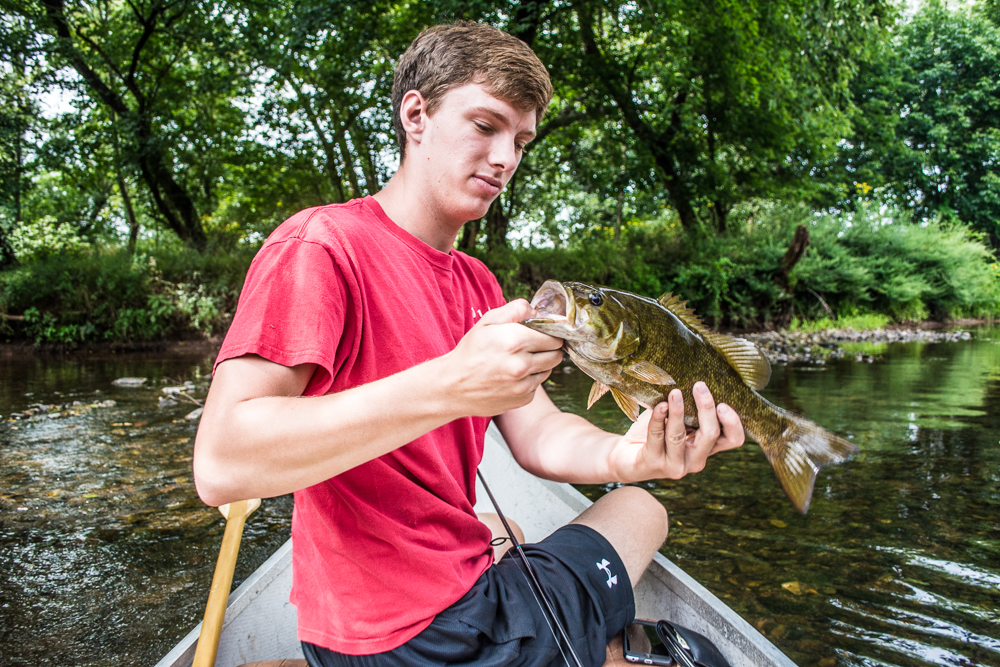
          Senko-style worms long ago eclipsed the popularity of traditional and twister-tail plastic worms for shallows and middle depths, especially when rigged Wacky, hook in the middle. Typically, the hook is attached by an O-ring, which prevents the worm from breaking free. A tool specifically designed for placing them on these worms is easily available. Most anglers intend Senko-style worms for largemouths, but in my own experience over the last decade, I’ve settled on catching most of my largemouths on traditional-style worms, while most of my smallmouths come on Senko-style worms. They sink faster, provoking the quicker responses of smallies. By comparison, largemouths are slow fish. An aggressive smallmouth will charge a worm plummeting towards bottom, which a largemouth might refuse.

          Lake, reservoir, pond, stream, river—during summer you may enjoy catching smallmouths from all five types of water. None excludes the Senko. While so much gets written about smallies 20 to 25 feet deep on lake drop-offs, plenty get caught in close to shore anywhere from three to 15 feet deep, so long as rocks provide habitat. Summer smallies ambush prey eagerly compared to largemouths. From comfortable lairs of concave formations, and from between and underneath rocks. They explode outward like artillery fire to snatch meals. Smallies can seem as active during summer as largemouths during fall, but much of the time—not always—I will let them pounce on a Senko, rather than provoke any to chase down a crankbait or whomp a spinnerbait. Bronzebacks strike a wide range of lures during summer doldrums, and I’m interested in increasing my knowledge of uses, but often I feel most comfortable with the simplest approach.

          There’s irony about that claim. Fishing a Senko, no weight added, just a size 2 plain shank hook under the O-ring, involves wider awareness than using other lures limited to various retrieve actions. I wouldn’t say turn-handle retrieves are mechanical, but they do narrow focus relative to the line reeled back to the spool. During patient intervals while letting a Senko sink, repeatedly pausing after you take up line by moving the rod—more so than turning the reel handle—the mind can open up to what might happen, and this added awareness can put you more in touch with the fishing to gain practical results.

          Even topwater plugs fished slowly might not have the subtle appeal of letting a Senko sink as deep as 15 feet or more among rocks. All the while you wonder if a bass will transmit a tick before that plastic reaches bottom. If nothing happens, you can visualize how much the Senko flutters when you barely twitch it. Maybe if you then give it a jerk to make the ends pull back quickly like spreading crayfish claws--that will do the trick. Or instead, by just lifting it off bottom, easily, this might seem as if forage is trying to sneak by. The possibilities are as open as the given situation and imagination allows, and imagination is more important for seeing what goes on under the surface than the visual feedback electronics provide. Looking at a screen is a lot easier than developing a habit of immediately visualizing how your worm might behave, relative to a bass’s possible inclination to take. Fooling around with a worm in plain view to observe how it reacts to your rod tip can help cement this ability to your neurons.  

          Just as varied a cadence can be created retrieving a Senko as working a topwater plug. A bass won’t crash in view, but it’s thrilling when you anticipate a take you can’t physically see. I don’t buy the new presumption that claims maybe, after millennia of human denial about the issue, fish do think, but I don’t underestimated their acute perceptual sensitivity, which determines what fish will do. Every individual bass is different. Radio telemetry studies prove this point, so the better you get at creating possibilities teasing hits, the more and bigger you catch.

          A five-inch Senko is heavy enough for some bait-casting outfits, but I’ve always preferred spinning. Reel position is easy on the wrist manipulating the rod, but a bait caster may find his outfit fitting to his own style. A five-and-a-half-foot rod allows better accuracy than longer, although longer rods cast farther. Shorter also means the wrist is closer to the tip, so you have better control while working the worm. It’s not sticks and brush fishing, or not for the most part, nor heavy weeds, so six-pound test monofilament suffices.

          Six-pound test works in a stream as it does in any of New Jersey’s reservoirs. The average stream bass is nine or 10 inches long, but they aggressively take fat five-inch Senkos. One of the advantages of fishing Senkos in streams is the long cast. Smallmouths often inhabit shallow stretches a couple of feet deep during summer afternoons, and if you get too close, they spook in that clear water. Catapult a Senko, and a bass may rush from five or more yards distant. Catching bass this way can seem too easy, but when it happens, enjoy the excitement, because New Jersey streams see a lot of pressure. Bass usually don’t react as eagerly to get on your hook as—once and awhile—they might. Any of our freestone streams offer opportunity, but especially to catch big smallmouths, you have to spend time and endeavor seriously.

          Reservoirs, on the other hand, offer tough summer smallmouth fishing, pressure intense, but I’ve heard stories of fast action on the Newark Watershed Reservoirs, which have boat restrictions and involve a yearly fee. Fred Matero and I have done fairly well at sunset on Round Valley Reservoir, but nearly all of the bass are stream-size. Fred’s done better on Merrill Creek Reservoir.

         Lake Hopatcong, however, shines in the memories of me and my son, where on a number of summer occasions we’ve caught and released multiple smallmouths of nearly three pounds and larger. Dow’s Boat Rentals offers anyone with a New Jersey Boating Safety Certificate the opportunity to get on the lake.

           I’ve caught smallmouths in 12-acre Saffin Pond, but the Delaware River always feels as if its resource is inexhaustible. That’s not true, but anyone with any imagination can feel the mystery of its expanse, acres upon acres of bass habitat expressed in myriad variations of the river’s course. Productive float tripping is a foregone conclusion, but wading works out if you read water closely and find spots that hold a few.

          Wherever you fish these worms, it’s the type that matters—the fat heavy-bodied worms you can rig Wacky. A number of brands exist, and I choose Strike King almost exclusively. I’ve tried scented Gulp! but haven’t noticed any increase in catches. Unless you meticulously organize equipment, you might repeatedly forget to place these worms back in the sealed packaging. They shrink. I’ve lost a couple of worm hooks, not to mention worms. It’s all but impossible to separate the hook, once that bait hardens.

          Summer is the stable season. The bite is steady and the days long. There’s lots of opportunity in New Jersey to get out and slow down at catching smallmouths.  


On Down    


Tuesday, April 27, 2021

Jaw Spreader

Used a jaw spreader on a pickerel while fishing with Brian recently. It made removal of a deep-set spinner treble easy, but it looked almost as if the pressure from the coil would split the fish's head in two. 

That was the first time I ever used one. I had my Nikon D7100 hanging from my neck, and when I separated the spreader's prongs, they shot apart from the coil tension, which is very strong. One of the prongs took out a chunk of plastic from my camera, down at a corner by the battery housing. 

I showed the damage to Brian, and said, "Good thing I left my new camera at home." Yeah, that new camera is a $3300.00 value and I certainly wouldn't want a chunk of it ripped out by an eight-buck set of jaw spreaders. 

Applied electrical tape to my old camera. That one a $1500.00 value, no less. 

Works. Not much complaint about it. I'm really more curious if any of you have used spreaders and feel the same I do about possible damage to fish we want to return in good shape.   

Monday, April 26, 2021

Stream Runs Through It


My favorite spot at Peapack Brook was inaccessible. The road leads directly to a park. Blocked. No Parking signs. So I drove a little further to take another road in. No parking allowed on it. And signs indicated parking in the lot nearby was only for that particular business. I could not figure out why access to the park and brook there is denied. No construction underway. Nothing to indicate any reason for dismissal. 

I drove to a spot upstream, catching view of a Fish & Wildlife Trout Stocked Water sign. That's where I got the photo, but the water had no depth and time was limited to go searching. Another spot upstream seemed to allow parking along the road, but to have parked there would have been very awkward with the car halfway on the road across from a residence. Another lot had signs prohibiting parking.

I drove on to find a wide parking space near a municipal park. I had fished the hole under a bridge for wild trout in December once. Boot marks in the sand let me know it had been hit recently. It's been a full month since stocking, so I knew it was possible nothing was going to happen at all. 

I saw a rise at the back of the pool, got my egg back there and got hit. Missed it. I missed a couple more hits, and finished my mediation underneath the bridge by watching four or five rainbow trout in the clear depths, frantic fish that seemed harried by a little too much attention on them.  

Monday, April 19, 2021

Uphill at 60?

Thanks to my brother Rick's interest in the recent big bass, I realized I underestimated myself in that post. This is my fourth consecutive year of bass 20 inches or longer. I probably have caught a number of bass over 19 inches every year of the past 12, too. Caught a 20-incher in 2014, also. That one from shore at Round Valley Reservoir. 

Which makes me wonder. Am I on an uphill curve at age 60?

Better not to hope. But who knows. No hubris here. There are guys in Jersey who do a lot better than me. I just want to go on, that's all.

The One-Pound Test

I had the good sense to leave my camera bag home, though I did wear my GoPro on my head, in a non-waterproof case designed to allow for an external mic. (Talking to nobody there in the woods....hmmm.) But I paid $325.00 for the GoPro almost 10 years ago, which compares little to the 10K or so the bag is worth.

I crossed a current that threatened to drown me; well, which would at least cost me, had I carried that bag...all the more likely my foot would have slipped on those algae-covered rocks. I went underneath a low deadfall over the river. I waded up to my waist at the edge of a deep hole. I climbed a steep and rather unstable bank. 

In general, I joyfully risked my life as I like to do.

I also knew better than to bring Sadie. I would still be back there as it's getting dark now. In protest, Trish took her on a long walk. I'll tell her why, and she'll feel for my safety. Better the dog not get in trouble. 

It's been almost 10 years--October 6, 2011--since I've fished that stretch of river. "And then one day you find...." as Pink Floyd puts it. Shocked to realize it's been that long, I nevertheless saw the river has changed drastically. 

I was a long way downstream of the stocking point and miles upstream of the next. Using my one-pound test and tiny spinning rod & reel, I hooked a trout on my first cast, lost it, figuring "here we go." Turns out there aren't so many there. And others have had the same idea. Boot prints. I caught one, which did not die of lactic acid poisoning. I was recently criticized on a trout forum for using line so light. No, I get the trout in plenty fast. After all, they're just 10- and 12-inch hatchery fish. If you can't handle them on one-pound test, then go ahead. Use heavier as everyone else does.

I doubt anyone else in the entire nation uses one-pound test.


October 6, 2011

Sunday, April 18, 2021

Big Bass and Pickerel Early Season


The past five years on the job have been tough; yesterday was one of the more tough days at meeting customer demand, but before I was on the road for home, unsolicited, I exclaimed to my boss, "All's under control!"

"I wouldn't doubt it for a second."

Gives the backbone some steel to have heard it form him. 

I got home, made some further arrangements with Brian, got sleep, got up at 4:30. I had been hoping, low key, that today I would begin my yearly tally of 18-inch largemouths. Every season, I catch a number of them, usually some 19-inchers, and last year I caught two 20-inchers. The bass in the photo struck an inline Mepp's Aglia as if nothing was going to stop it from going. I measured it at 21 1/2 inches. That's difficult to do in the canoe and the measurement might have been a little off, but not by much.

Brian had said, "Nice one?"

"Big," I said. 

I got it to the net swiftly, Brian not having yet seen it, me feeling as if the connection to the treble hook might be weak. The bass seemed to carry with it an ominous shadow the size of a small hippopotamus, which seemed to be no mere physical attribute, but an intelligent presence--if on the dark side--that told me I better not lose it. And if I had, I take it all of my life hereon would have sunk a little deeper into such shadow. So unnecessarily. As if the necessary thing was to boat the bass, though it had been a gamble from the beginning. 

He lifted, and exclaimed, "It's a six-pounder! Twenty-two, twenty-three inches!"

"It's not 23," I said, experiencing a clear image of how massive my 23 1/4-incher from Merrill Creek Reservoir appeared. But I did think it might be 22. 

I think it was a half inch shorter, but in any event, the bass was bigger than my 20's last year. How much it weighed, we don't know, more concerned with releasing the fish safely. I felt certain it wasn't six, but surely a smidgen over five.

Brian nailed one a minute later on a Chatterbait I thought was 19 inches, though we didn't measure it. Later, he caught one about 18, another about 15, and four pickerel, including one I thought was 24 inches, though skinny. His other pickerel were nice fish, but it's the one he lost--and by the feel he thinks it was a pickerel--I wanted to know about. I saw how the 24-incher put a bend in his rod and fought. And I saw how the bigger fish did the same by a deeper bend. Brian couldn't move it. It went deep and stayed in place, the rod twitching at its thrusts.

There probably are pickerel in this lake slightly over 30 inches.

I ended the day with the single bass, two pickerel, two perch a foot long, and a bluegill almost that long. I also lost a big pickerel, which might have been 26 inches but not nearly 30. The head came out of the water and impressed me as massive. The spinner shook free, and like Brian and his loss, all that remained was a moment of longing as large as the lake. 

It's a privilege to fish that lake, and I thank Brian and Sam. We treat the fish well, trying to release them as if the worst consequence is an improved education. We all know how that can hurt, but maybe it makes us a little wiser.  


Big Bass


Wednesday, April 14, 2021

Did Some Fishing and a Photo Shoot


Showers changed my mind at first. Instead of a Round Valley photo shoot, I would fish Bedminster Pond for a short while, then the North Branch Raritan nearly a mile below the stocking point. I caught nothing at Bedminster Pond, but did have probably a sunfish play with my worm, and something else pick it up, though I never quite felt the weight of a bass. 

I began with a large spinner. I expected either quick result or that nothing would happen, so I began worming close cover. I fished nearly 40 minutes. That place sometimes fishes well in March, and then it seems the water's got to be really warm and you catch a few just before the algae is too thick. 

It's already got free-floating algae. Some.

At Round Valley, spritzers of rain fell, and I finally decided I would subject my lens to no more. The camera itself is pretty rain resistant. (How much, though, is a guess.) I got about 35 shots and deleted more than half, but a handful are interesting. 

Still want to try for trout far from the dump spot. I spoke to one guy at the pond who had been fishing far from the stocking points. He said he's limited out every day since the 10th.