Thursday, February 2, 2017

Water Column Approach Springtime Largemouth Bass Can't Escape


Bottom Grindin’, Middle Movin’, and Top Teasin’


By Bruce Edward Litton


          By early March, lakes and reservoirs of the Northeast region typically ice-out, largemouth bass lethargically responsive to a variety of lure techniques. Two years ago it didn’t happen until days before trout Opening Day in the New Jersey Highlands, early in April. This year, water has remained open most of the winter, but when ice cover helps compose winter as I like it, shallow, stained ponds open long before lakes and reservoirs, especially ponds with a feeder creek that pumps in runoff to break up ice. Late winter/early spring fishing begins at bottom.

          Gravel or hard bottoms of 8-20 feet invite the use of an old standby, the Johnson Beetle Spin, and I could be wrong, but I would almost bet a lot of us have never heard of this spinnerbait with a detaching arm. The Beetle Spin’s insecurity adds special effectiveness for a method I called “tick spinning” during my teens, because the second hand of my watch rotated around the dial almost as slowly as the crank of my reel completed a turn. The cupped Colorado blade just waggles along without spinning. Instead of holding a fixed place, the arm subtly moves about as the jig head crawls over gravel or along hard bottom, not so much imitating a crawfish or any other sort of creature, but creating a very effective presentation that the slow metabolism of a bass responds to regardless of close imitation to anything living down in the cold darkness.

           In a toss-up between much more popular tube jigs and the throwback Beetle Spin, I would put my money on the less popular lure bass see a lot less, because the cricketing metal seems just the ticket to getting the attention of metabolically deficient bass, whether or not the bass’s familiarity with tube jigs has anything at all to do with getting more strikes from the Beetle Spin.

          Another old standby, in-line spinners achieve performance perfection through the mid-column early in the season for a number of reasons. The most obvious, perhaps, involves lack of vegetation to foul treble hooks. A willowleaf spinnerbait will better suit timber, but residual weeds hold baitfish and bass where a spinnerbait isn’t necessary. That logic is a clue. When a simpler approach suits, it may prove more effective than any added nonsense. A Mepp’s Aglia Long upwards of size 3 or a C.P. Swing 6 pulsing over any sparse tendrils of vegetation remaining near bottom is deadly, since the sleek appearance of an in-line spinner plays to the low key of early season music. Never use Colorado or Indiana blades, if you heed this principle of simple logic, because they emit too much vibration in cold water, so the standard Mepp’s or Blue Fox should be refused.

          Perhaps it’s just my personal philosophy. I don’t doubt plenty of bass get caught by use of Colorado and Indiana blades this time of year. And yet, over the course of time, probability proves necessary quantification in relation to applied facts more or less appropriate to actual situations. And even yet, I question my slow approaches further, because I’ve read about largemouths caught on crankbaits burned at top speed with water temperatures in the upper 40’s. One caveat—lots of sunlight is present when this happens, according to the claim. That shook up my presumptions.

         Nevertheless, attraction is not always about how loud and flashy a lure. A bass can feel all sorts of vibrations in the water. If there’s chop on top, bass below are quite aware of what they’re going through. As I understand the early season, environmental changes sensed by bass lateral lines need quiet and subtlety—in most cases—to accord with their slow responses conditioned by low metabolic energy. Slow and subtle presentation attracts bass to check out the source and possibly to strike, when a louder or bigger lure gets ignored. Long spinner blades hum along instead of sending more impact to those lateral line senses, attracting just enough attention with water temperatures in the low to mid 40’s or higher.

          During a warming trend, at least some bass venture towards the shallows, and a slow to moderately retrieved spinner covers water, finds them and provokes strikes. Don’t pound the banks and docks, shoreline brush or stickups; plumb the middle zones between the depths and shallows. Some lakes and reservoirs have submerged ditches or depressions leading off main creek channels with structural breaks where bass hold feeling not quite ready to advance shallower. Rip rap and stone faces get warmed by morning and early afternoon sun, allowing bass short moves to relative shallows from depths close beneath, spinners effective at intercepting them.

          But how is bass fishing complete without surface catches? Shallow water action seems to comprise most of what bass fishing is about, and as a rule, when water temperatures reach and surpass 50, bass invade the shallow flats, docks and other shallow spots. Fifty degrees, however, is no absolute rule. Bass get caught on the surface in water as cold as 47. There’s a specific way to do this, and I bet no bass has ever hit a hula popper chugged along in water this cold.

          Steady sunlight throughout a mild or warm day allows water to warm just as evening approaches, to 47 or so. A northeast pond corner or lake cove with proximity to deeper staging points means sunlight will have warmed the area the most, since sun sets in the southeast. Even if the temperature difference is slight, it’s in your favor. Surface, however, must be dead calm and there’s a reason for this, as you may infer.

          The Rebel Minnow is a floating jerkbait unlike most others, although perhaps some other companies make lures that fish about the same. The plastic 2 ½-inch Minnow is small enough not to serve much of a mouthful, and large enough to attract bass nearby. It sits on the surface at an angle, rear submerged, only head and shoulders breaking surface tension. By twitching only enough to raise that rear, and then allowing that rear to sink back, enough rippling in the water gets sent in all directions. Something like food is there for the taking. No jerking or popping will work. It’s not a matter of trying to send more vibration bass’s way, but as few vibrations as possible short of none. Remember, bass can feel all sorts of motion, including other fish on patrol. With water just warming enough that a few bass poke into the shallows, something seemingly alive—just barely—on the surface can tease interest out of competitive impulses.

            Wait as long as a full minute between twitches, which isn’t easy, but the only way I know to work in water this cold. It’s an exercise in exploring patience you’ve completely forgotten since idle hours and minutes of adolescence, and if a bass comes up and sips as subtly as a trout taking a dry fly, an event has unfolded you may never forget.


http://littonsfishinglines.blogspot.com/2012/05/mounthope-pond-offers-chance-at-lunker.html


Wednesday, February 1, 2017

Hunches, Contrary Hope, and Implied Evidence of Inevitability

When I posted on December 16th about imminent ice fishing, I was right about this for the short term, getting out with Mike Maxwell to ice fish Budd Lake on the 21st, but I just did not have a hunch for the season ahead, as posts going back to 2011 have shown at least correlation between my hunches and what has turned out as fact. The obvious reason for my lack of awareness this year is too much job pressure, and yet, despite the dullness an indoor arrangement may drive against a mind, as if a knife edge is subjected repeatedly to hard rough walls without proper sharpening, I did feel a hunch develop and get confirmed by Laurie Murphy of Dows Boat Rentals at Lake Hopatcong a couple of weeks ago: forget it for the rest of this season. We may be mistaken, but we'll see. My hopes for an enduring arctic air mass dwindle as my daffodil pokes grow higher. I begin now to anticipate March and moderating temperatures, hoping to fly fish nymphs on a coming occasion, although I still harbor an ambition to do just this some future January in the cold and snow.

Those three days of teen temperatures overnight I recently mentioned I think in two posts begin tomorrow, so all the best to anyone who gets out and ice fishes a pond. If you happen to do this and read this post, by all means, leave a comment. I'd love to hear from you.

Laurie Murphy read my open letter to the Boat Commission Chair, and she thereafter told me the lake community is trying to work this out, instead of the Draconian measure of anchoring restrictions getting imposed on us. Please, let's hope this issue gets resolved rationally.

Monday, January 30, 2017

Lucky 13

Around February 2nd, we have three consecutive nights forecast in the teens, no more than mid-30's during the day. This here in Bedminster. Far north Jersey will surely get colder and people who like to ice fish ponds may get out. Twenties in the meantime. Otherwise, more 20's and 30's during the day for the 15-day forecast don't look very promising for a secure ice season and the likes of the Knee Deep Ice Fishing Contests, but mid-February can still change radically for the better with a deep-seated arctic air mass. Climate change means more bipolar shifts of weather.

It's just that my hunch isn't the only one this year that says forget it. Laurie Murphy at Dow's Boat Rentals isn't optimistic for ice fishing this year, either, and she lives on Lake Hopatcong. All the best to anyone who will get out on a pond. I know how satisfying this can be.

So this winter, Lucky 13 is sort of hovering between the possibility of Round Valley Reservoir trout fishing, or wading the South Branch, fly casting nymphs. I might get out on February 8th. 

Thursday, January 26, 2017

Little Ponds Maybe

It's been more than five weeks since I wrote a blurb about the ice situation. Mike and I ice fished on December 21st. Checked the weather and nothing about it looks promising, unless small ponds freeze over three inches thick next week, but I'm not interested in doing that; the likes bring back memories of ice fishing Princeton Day School ponds we had permission to fish in Mercer County, during our teens. The formula was always three nights at 20 degrees. That's give or take, but around that figure, we'd find ice three inches thick. Never really thought of how cold the days had to be.

Here it is almost February.

Wednesday, January 25, 2017

Fortune or Misfortune?


I mediated at length on Aristotle's thought of fortune and misfortune for how many weeks and months, I don't recall. How many years. I read six or seven years ago Anthony Kenny's Aristotle on the Perfect Life, a thorough account of the Nicomachean Ethics, but familiarity with Aristotle goes back to my ninth year. I've owned the McKeon Edition, The Basic Works of Aristotle, from age 21. The thought of fortune and misfortune that seemed to haunt the philosopher, which haunts me, possesses centrality to Aristotle's life and thought.

I don't account for it in a fishing blog as if to pump up the ante in an obviously foolish way. Who cares about philosophy or Aristotle? Isn't it an inappropriate subject to raise in a fishing blog? It's not that anyone else should care, and to hope many would take interest would be rather foolish, but people by and large randomly get jogged into taking interest in this or that account. Any account that happens to lean in their direction. Unless the habit of their scanning intelligence simply rejects any further engagement of the information. Two exceptions to such random reception involve, firstly, the trust my followers place in the value of what I offer. Secondly, the accuracy of search engines in responding to what readers key in. In any event, not many people take it upon themselves to think of fortune and misfortune as if they might have some choice in the matter. And besides, Aristotle leaves us no doubt that we may not be able to help succumbing to misfortune. But if we do, we can measure our losses so we know what we're dealing with, and take stock of what remains in our favor, developing in the process a plan for renewal.  

A lot of us might care about the founding of the American nation, the nation subject to fortune and misfortune as well, but very few seem to ever consider that the philosophical principles involved in the thought of the founders depended not only on the political philosophy of John Locke (17th century England), but Aristotle's this-worldly perspective of nearly 2500 years ago in Athens, Greece. A countermand to Plato's otherworldliness, without Aristotle's affirmation of happiness in this life, thinkers who took up the task of affirming life here on earth from the Renaissance forward wouldn't have had the same leading advantage. They wouldn't have enjoyed the fortune that led to the American experiment in freedom. Aristotle's work served as the central authority of the West, so it's no surprise that living for the hope of the afterlife became supplanted by the pursuit of happiness here on earth. Aristotle's work captivated the Western mind until Francis Bacon's New Organon made immense progress possible, although the scientific revolution of the 17th century resulting from his work certainly took nothing away from life as we live it for our own sakes. 

But the ironic result of the technological conquest of the world stemming from the New Organon is a global temperature rising towards inhospitable levels. A mass extinction of animal species. And, in general, an onslaught upon the environment as no previous ages have seen. These consequences are no argument against seeking fortune. We need it more than ever before.  

Happiness would seem to be what Aristotle is all about, but truth concerned him as first principle of achieving what his mentor Plato never had need to talk him out of. During his teens and young manhood, Aristotle did lead a riotous partying life, selling herbs to get by, so one wonders if the herbs included marijuana. I've read that marijuana was available in ancient Greece. I assume--I'm certain--he knew a good time full well, and though Plato clearly straightened him out, the elder philosopher never robbed him of his heart. Aristotle created his own happiness by writing on just about everything. The concept of the university with its academic departments takes the basic blueprint from the range of subjects Aristotle researched and wrote on, just as the modern academic setting seems to take its partying culture from the habits of his youth. But through everything he accounted for in thought and writing, the passion, the happiness, carries his enormous intelligence forward long after he died at the young age of 61.

I've often thought of him at Round Valley Reservoir. This afternoon I came alone and stayed alone. But I was in the company of millennia. A week ago, I thought I might drive over and enjoy the peculiar solitude that includes presences other than human. I managed to keep and fulfill the goal. I told Mike Maxwell a few nights ago I want to get him on lake trout but that if I were to go this coming week now half done, I would need to be by myself.

And the lakers? I did speak to a fisherman as I packed in. He told me during the coldest weather we've had yet, he caught them consistently. If you've followed the blog recently, you've found me wondering if I could garner any evidence to support a certain assumption. For whatever reason they do seem to behave that way, I believe lakers come in close during severe cold. So there you are. The fishermen I spoke to added a piece of evidence. About 50 degrees today, reservoir water is plenty cold despite recent days in the 40's, but severe cold does affect the environment differently. I have no idea how lake trout respond to whatever measurable differences, but apparently, they do.

I didn't even think of lakers as I departed early this afternoon. I got up not much earlier and didn't want to go. I went outside expecting 60-degree weather to make refusal even more stubborn, but the temperature felt about 48. Nevertheless, something stirred, and though I felt wretched gathering stuff from a disorganized mess due to little time to keep order, I got everything and my black Lab Sadie in the Honda. Then I drove off. I realized I forgot to take my blood pressure medicine and resolved to take it later.

I decided I didn't want to spend the day with depression here, no matter the many things I need to get done that could have weighed on my mind. Bliss on Interstate 78 in a matter of less than 10 minutes took care of that issue. Last night before I hit the road, I read Sven Birkerts' opening essay for issue 84 of Agni, the literary journal of Boston University, my wife's alma mater.  Agni just so happens to be my favorite among many I've read and do read. Birkerts wonders about the accessibility of the primary level with the tremendous digital overlay increasingly demanding the attention of any given individual. With regard to his doubt, I considered that I made a choice today. A choice of a kind much easier for me to make in recent years. The sort of job you have to work might have a lot to do with your fortune or lack of it, and I am certainly not just referring to monetary amount. I see people worse off than me, and degradation of human life affects me in ways I find very difficult to bear, though which would I prefer? To witness and respond, or to scan the reality out of my awareness?

As for the primary level, without it, bless human life on this planet adieu, because what primacy equates to is nature, without which we can't even breathe. Let alone have any reason to manage our carbon emissions so we might prevent global temperatures from rising too high, because without primacy, I believe, none of us can really be sure of living for his own sake. In any case, I don't suffer the same plight as Birkherts. So long as I will continue to make the choice to place my boots on the ground, I will touch the primary level, because my outdoor habits go way back and profoundly deep. When I get outside, I don't remain in a distracted bubble. 

Birkherts I find fascinating. No other voice I've heard has better informed me of the artistic and literary scene today. And by extension, of the society we live in. It's all the more reason for me to find my fortune in the way sunlight scatters a line of brilliance on wind-stirred water. The way sunlight transforms colorless expanse into an inviting blue. 

As for the rest of the world, I might rise to affirmations grand enough to move it, but I am one individual. And the planet is a big rock to push up a hill.


These trollers caught a rainbow trout right out in front of me. A sure sign of better fishing to come.


Sunday, January 22, 2017

Open Letter to NJ Boat Regulation Commission Chair about Proposed Lake Hopatcong Rules


January 22, 2017

Dear Mr. Harrison:

This comment pertains to proposed rules under 13:82-3.11(l), the comment period closing on February 3rd, 2017.

First I want to say I understand that the feelings people have about parties in Byram Cove must be very strong to have come this far. My opposition to the measure proposed is not in disrespect. However, as often has happened down the line of what largely amounts to our unfortunate history going back to the ancient Romans, the measure in response to the complaint creates more suffering than the grievances that led to it, and for people completely innocent of the situation in question, because what amounts to governmental power takes a sweeping approach convenient to its own status quo, not a measured approach specifically addressing the real problem.

I speak for Lake Hopatcong anglers like myself. Far and away, most of us respect property owners’ privacy and don’t crowd anyone’s presence by anchoring close, and besides, many acres of Lake Hopatcong shoreline don’t involve openly visible property concerns such as decks, backyards, and boathouses. Our motives are innocent. We come to Lake Hopatcong as on religious pilgrimage, to escape the stresses of a secular world increasingly hostile to human life. Here on Lake Hopatcong we find this world and planet open to free activity that makes us more who we really are, and so we return to everyday stresses better enabled to make positive differences, rather than to further succumb to what increasingly suggests destructive demise. By and large as we fish, we never run into qualms with property owners. On the contrary, curiosity expressed between property owners and fishermen tends to be friendly, as we expect of a community, but perhaps less and less of institutions under duress of other burdens.

So we oppose the measure to limit anchoring 200 feet or further from shore between May 15th and September 15th of a given calendar year.

The best anglers understand that people from all walks of life, including the most burdensome, are human beings like themselves. And to err is human. A wise observation of Shakespeare that goes to the very root of his tragedies. We, however, are Americans. We recognize that we err, but we do not easily buy into tragedy. Why is this? Because unlike earlier ages that suffered errors they did not recognize and correct, we like to think mistakes needn’t incur guilt, so long as corrected.

Bruce Edward Litton 

Write Mr. Harrison:  LPPMSB@gw.njsp.org   

New Jersey's Knee Deep Club Plans Ice Fishing Contests

Joe Landolfi, long time Knee Deep member and holder of the club's record for rainbow trout, at six pounds. (Photo of the trout below.)

New Jersey's Lake Hopatcong Knee Deep Club, first established in 1947, plans on holding at least a couple of ice fishing contests this winter, and if you feel while reading this as I feel while writing, you might think the story's more about the possibility of ice than any reality. Mild weather is projected for the next two weeks. However, I've seen this situation before. A mild winter persists and people get to feeling that's how it will stay. I never allowed last winter to fool me. When one of my editors told me an article of mine on ice fishing might get withdrawn, I pointed out that very, very few winters--I can't think of any--involve no ice fishing at all in New Jersey north of Interstate 80. I told him the Highlands are not quite the same climate as south of that highway and south of Interstate 78, and that besides, an arctic air mass is a severe weather shift that can last for a week or longer. The middle and latter weeks of February are not immune.

The story ran. And perhaps there'll be an ice fishing contest, even if the dates have to be changed. Knee Deep has slated January 22nd, February 12th, and March 5th. The contests are open to members and non-members alike. $20.00 entry fee for members. $25.00 for non-members. Cash prizes awarded according to categories of heaviest-weighing fish caught reflect the amount of money collected from participants.

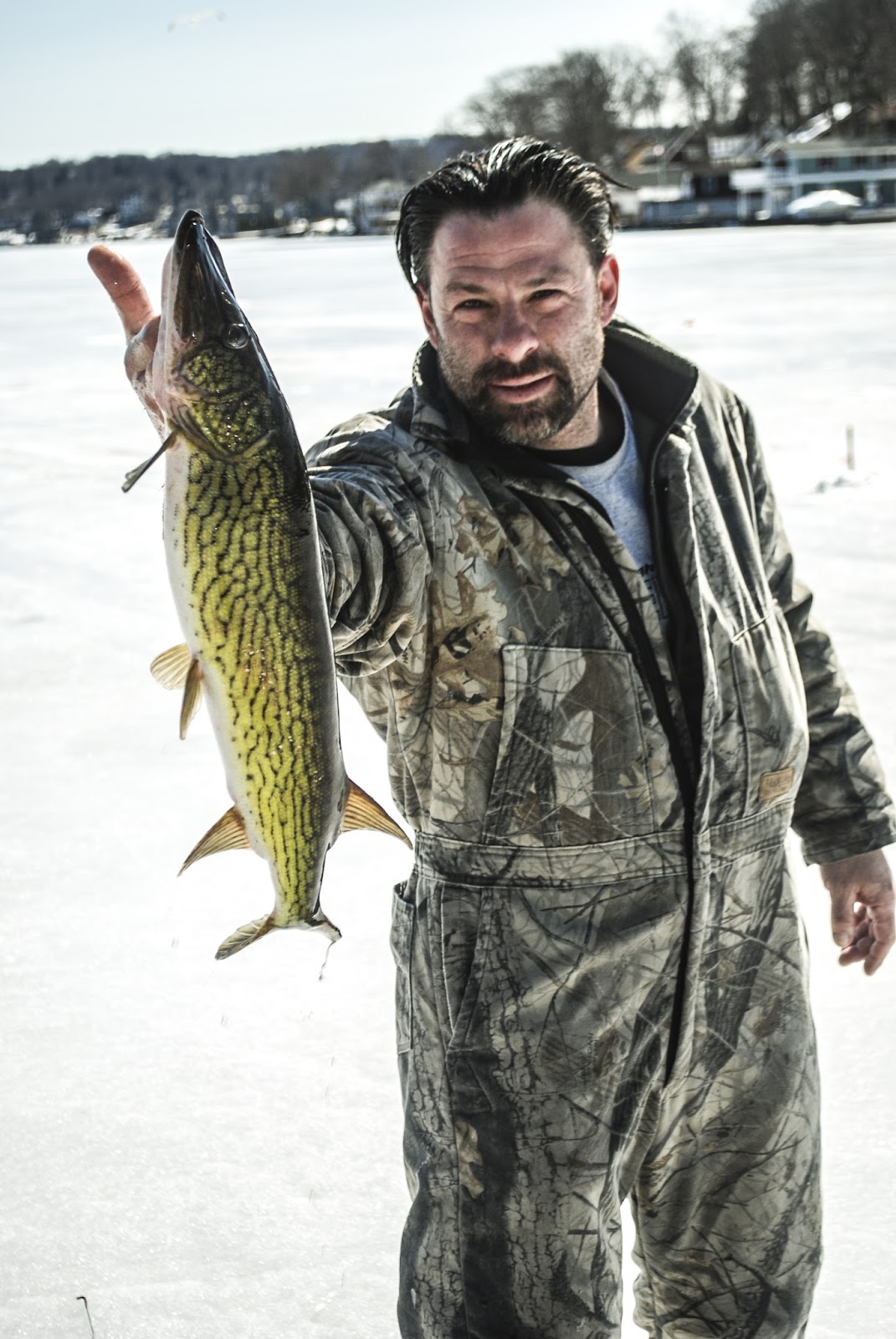
In any event, Lake Hopatcong is regarded New Jersey's premier ice fishing lake and is popular for its big pickerel, a gamefish associated with ice fishing like no other, besides perhaps the yellow perch. Walleye, musky, hybrid striped bass first stocked in Lake Hopatcong--thanks to Knee Deep's initial efforts--during the 1980's and '90's never completely eclipse pickerel's popularity, but the ice fishing contests are open to all species in the lake, besides musky, which cannot be weighed in. Whether or not this is really Knee Deep's implicit reason for the ban, musky catch and release is the prevailing ethic among people who fish the lake regularly, whether through the ice or open water. Few muskies get caught compared to other species, but they are present in the lake in numbers, pursued, and caught regularly.