Saturday, November 12, 2016

Breaking the Bank on a Fishing Rod is no Ticket in


A few afternoon hours can fill out a day, making time off from the job a reconnection with solid assurances at the ground level, instead of presumably urgent matters running away with energies that need replenishment. I felt just a couple of moments when I wondered if I bored my son with such simple pleasures as walking the river, posing him for the photo featured above with Sadie, and fly casting. Shortly before we packed in, I had spoken of us at least encountering some trout, and added that it's important to get out and cast.

"Oh, yeah?" He said, a little too wise, as if my words fell somewhat on the empty side of events.

"If you value fly fishing."

He saw the smile on my face, confident as all the years behind me at this endeavor, since I was 10, and his doubt fled as reassurance came.

Simple pleasures like these I've noted always gratify in me much more than any denigrating caricature of them can deny worth, because the planet is an important value indeed. No one who is sane doubts this fact. The complexity is beyond enormous, but the best part about outdoor recreation is the substantial solidity it grants anyone's character who really participates. With respect to the notion of this gain, simplicity is a unification of many things, not a cop-out in relation to more sophisticated endeavors.

We hiked a half mile upstream from the lower entry of Ken Lockwood Gorge, South Branch Raritan River, in search of a pool to fish, water low, feeling November perfectly present with light breezes carrying temperatures in the 50's, and finally found a small eddying depth with lots of leaves to avoid, catching nothing as expected, and yet I thought of a large stretch easily accessible from the upper entry near Hoffman's Crossing Road, and with enough time to walk back to the Honda and drive over, we did. There I drove on down the roadway with no room for passing and parked very near this stretch I had in mind, where we encountered six other anglers and those trout I've mentioned, which, as expected, wouldn't hit, although a 14-incher did seem to take interest in my pheasant-tail nymph, not actually striking. The rhythm of casting and easy fulfillments of accuracy felt pleasurable, and I often looked askance at my son, who I hoped felt some of the same, though he is so caught up in university applications and his two high-level online math courses--if mostly caught up with his friends--that I think if there's real hope for his taking command of outdoor values I've taught him, it will take hold as he grows older. I'm unusually committed, not so much because I have time to do much of it now--many have more time and money than I do--but because my youth involved an almost daily involvement at the opportunity cost of schooling that would have been more sensible, though schooling never could have imparted nearly as much wisdom. My high school grades suffered, my SAT scores weren't great, but despite my refusal to take AP English--because I wanted to continue fishing more than take the work load--I took the AP English exam and scored a 5, the highest mark. I never forget the girls who laughed at me--me smiling and laughing in turn--when I walked into the exam room, me the only one taking the test who hadn't taken the course. Not all who took that exam scored a 5.

Besides, I read plenty. I didn't need a state-mandated high school to tell me what to read.

As we fished, I overheard conversation among four remaining anglers besides Matt and I, who knew each other. One of these guys had bought a G. Loomis, and I thought of online critiques which, at least regarding seven-weight fly rods, account better for less expensive St. Croix. Eventually, the eldest--early 40's--addressed me. I had already decided he didn't much appeal. First, he tried to tell me all the trout in the pool we fished are big. I pointed out the little 10-incher I had been watching, and spoke of this pool loaded with trout this size last October, holdovers from spring. He never acknowledged the fact, but finally a young lad of about 22 came over and had a look. In the meantime, this elder savvy fly fisherman had confronted me with imperious advice on fishing hopper nymphs, as if, perhaps, my pheasant-tail nymph just wouldn't do. I felt as if our coming President had taken hold of his soul, until I remembered that when I met and worked with Donald Trump--not flinching a flicker while meeting his eyes very directly and shaking his hand--while participating with the Bedminster environmental council concerning issues at his golf course in the township, a session that lasted at least a half hour, no such arrogance as this fly fisher-in-the-know had exhibited came from the President-to-be. But anyway, I gave this younger elder man a pass, thinking after the bristling encounter had finished that he might have been a little enthused, rather than his harboring any lasting need to be top dog.

Five or ten minutes later, another young man of about 22 began speaking, and our conversation ranged over fly fishing salt and fresh, Cape Cod to Pulaski, New York, and Charleston, South Carolina, very pleasant. Matt and I had to go. I have editing work to do tonight, and first my wife and I went out to see a movie in Bernardsville, Dr. Strange, an overdone simplification of the meeting ground between physics and spirituality dramatized pretty badly. The young man expressed hopes that he would see us again, and once again I felt fishing proves to redeem sociability, rather than get lost on "superior" knowledge and G. Loomis as if breaking the bank on a fishing rod might be the ticket in.


Wednesday, November 2, 2016

Moody Shots


Another summer-like day as late fall comes on, or at least a day like late May, into the 70's here in New Jersey, somewhere in the 60's as darkness came on and I advanced casts with my two-weight fly rod after setting up my tripod in the river. When I walked to the edge of the North Branch here at AT&T entry and exit, I spotted a nice trout darting upstream.

Water remains low, of course, but it's good to know there's a few stockers. Maybe I'll try again in December and give the fishing more time. I meant to get out with the sun yet over horizon, but my wife and I had to talk finances. As things went, I was happy to get my waders wet at all, hobbling over rocks with my father on my cell phone before I slipped them on, finished talking, and got in with the tripod extended. Wasn't sure I was going to fish, not at first, but as that conversation proceeded, came to realization I could get the shots I've wanted since September, put the camera and tripod aside, and cast as dusk deepened. Exactly what I did, casting two spots, but I know I need to come back here another time and work further on these low-light possibilities with the Nikon.


Tuesday, October 25, 2016

Strong Lamington River Flow and the Broken Dam about to Go


First encounters will deeply impress memory, if genuine. Early in the year 2000, one of my brothers, Rick, phoned to tell me he fished trout in the Lamington River. At the time, he worked as a banker somewhere within reasonable distance of getting here at the edge of Bedminster, my home town since July 1999. I had fished Hunterdon streams on a warm Opening Day, as I remember, and came home a back way to stop and check this river out. I caught nothing, but Rick's call a week or so later got me back to try again, and for about two weeks, I caught many rainbows drifting salmon eggs along the seam of current that presses around the broken wing dam--broken then, too--to then cut along a deep hole.

Summer that year, I bought the 5 1/2-foot St. Croix I especially use for bass, first casts here in the Lamington above this wing dam, my catching a smallmouth. Since then, my son and I have parked at Cowperthwaite Road's iron bridge to hike and wade on down to fish the North Branch Raritan for bass, confluence with that river a fairly short distance away, but a little trying to ford.

This awkward wing dam. It's always felt a little interesting to see. It won't be here forever. There's talk about its removal for many months now. This is what got me interested in the past week to come and photograph it, before I can't. My 35mm Pentax served interesting shots of my young son exploring it many years ago, but I needed a few for my digital files, arriving here at about 3:30, light getting pretty low, although not creating the sorts of quickly passing opportunities last light often makes very valuable. I'm looking out my window on twilight now, and the sky has cleared after I did notice some interesting light for a moment.

I had taken the opportunity of some breaks in cloud cover. It would be worth trying again around sunset, given time.

North Branch Raritan is stocked with relative few trout this month, water very low. The irony is that Lamington River not stocked is flowing strong, surely due to releases from Round Valley Reservoir into one of Rockaway Creek's branches. I wanted to also get out with my two-weight fly rod for whatever trout may be in the North Branch nearer to home, after the shoot here, planning also to shoot there around sunset, tripod with me this time, but the pressure is on and it's just too much for now with my son's university application process and my demanding job.

In relation to these rivers, I won't let myself down. The drive to achieve can trip over too many lines, those lines that novelist Franz Kafka wrote in his journal are meant to be crossed, but anyone with a salt speck of sanity knows it can be lost. A planted garden needs enough watering, but to pump a reservoir into it would leave no trace. 


Wednesday, October 19, 2016

A Few Moments of Deeper Duration


When I arrived, I felt as if all of life's troubles are worth just coming up here a few times a year and writing first responses in a notebook I keep in my car. A practice that's made occasions of doing this since summer 2014 seem a long time. Arrivals can open up perspective widely and put you directly in touch with life's lastingness. Otherwise, who would disagree that 2014 was a short time ago? A day on the job may seem to last too long, but the weeks and months track by pretty quickly, a state of affairs I don't disagree with, so long as I am able to get away and experience the value of deeper durations.

I finished a couple of pages, set the notebook aside, and confidently jaunted to water's edge, wearing the hiking boots I much prefer for gravel and rocks, to cast a Chartreuse spinnerbait. Air temperature at least 80 degrees, sunlight abundant, water clear as a bell, clearest I've seen here. Not hits came on the first few casts, and I felt convinced by the general ambiance that this wasn't going to be fast fishing.

With that clear water and cloudless sky, I suspect most of the bass moved deep, although sunfish and yellow perch schooled abundantly in some shallow spots. I fished everywhere I could, and caught nothing, although a young man showed up and caught two on a white spinnerbait--about two pounds each--by casting out into deep water, which I did too, though not only that.

I sighted a largemouth of at least four pounds in close, which refused the spinnerbait. I switched to a plastic worm. By the time I pitched, the fish had vanished. At sunset after a few hours, I had pitched and cast that watermelon-colored worm a lot, last of that this year. I also switched to a red tandem willowleaf spinnerbait, which made no difference.

It was a tough one, but I didn't give up. I thought I was on my way out, parking near the exit to cast one last shoreline, when I decided to go back and slowly fish the area where I sighted the big bass with the worm. I caught a little peace. An outing that began so well became one of the most unpleasant I've fished in many years. I can't remember the last I felt my nerves as confused while fishing as today.
 

Thursday, October 13, 2016

Rite of Passage Leaves Open Possibility of Return: Nine Years on Lake Hopatcong


The plan was to fish Lake Hopatcong on Saturday, the 22nd, since that third October weekend, in our experience, is the best of the fall fishing. My job won't allow it, and work comes first, of course. So I struggled with what we had to do--go fishing mid-week on this religious holiday when my son would be out of school, and even this got iffy, since job scheduling remained in question for a day. Whether or not Matt and I will ever fish Hopatcong again in the fall is yet to be seen, since he goes to university next year. We've done this--almost always that third weekend--since 2007. Almost always, either he catches a walleye or I do. Rarely have we caught more than one, but we've caught many more hybrid striped bass.

The five-pound, 13-ounce walleye, 25 3/4 inches, photographed above, is our catch. Strictly speaking, I caught it, but first I said, "There's a fish on that line. You want it?"

"You take it. I caught the catfish."

I guess I should have just given him the rod after I spoke of the life on the line. And as the sure death of the live herring used for bait ensued. After we got home, I told Matt once more I should have let him have that walleye. He insisted no again. So I said, "Well now we have to get back out there in the fall sometime, because the only fitting way for you to end these outings would have been your catching that walleye."

"We'll get back out there in the fall."

We made the catch at about 2:00 p.m. near the end of the outing.

Always, we've arrived at Dow's Boat Rentals about 15 minutes before the shop opens, unloaded our stuff, and with portable running lights--at least since about 2012--got on the water well before sun-up. We used to hang out until enough twilight made boating without running lights quasi-legal. At least once, we had to walk the docks very carefully, the wood coated with thin ice. This morning, temperatures in the 40's felt pleasant by comparison to cold and stiff wind past times. Never seemed to really warm as expected, though.

I wrote a post I named "Forget Chicken Livers, Hybrids Hit Herring," expressing my personal sentiment for the lively fish for bait over slimy innards, but I recently read an article by Lou Martinez about the secret that's kept this lake buzzing with catches for at least several years now, and underwent conversion. So I bought 25 cans of liver cat food and two containers of chicken livers. The cat food for chum, the livers to put on hooks. Along with us, a Tupperware container came to mix water with cat food by use of a spoon to create a soupy mix of embarrassing goo. Why does anyone lower his standards? I guess always it's for more stuff, rather than quality, but I remain convinced this method may have some merit, because I won't argue with that stuff--amounting to phenomenal numbers of hybrid striped bass caught by fishermen who go this way. Years ago--Matt told me this morning he remembers--we fished for channel catfish in the Delaware River with chicken livers, and though we caught no catfish, we did catch little 13-inch striped bass. As I remember that outing, drifting chicken livers in current had a certain delicacy about it, so maybe I just need to catch on, I don't know, but this morning not only did we draw a total blank on hybrids, we watched another boat doing as we did--flinging cat food with a spoon--and I had to laugh, mostly at myself. I then felt very tired and curled very comfortably on the bottom of the boat for a power nap, lines out and waiting, sort of expecting the men in that boat nearby to start hooking up. It never happened. And after an hour or two of waiting on this "best" spot on the lake, we motored off to try others.

We caught fish. Catfish, sunfish, perch, a rock bass earlier on. All on herring and nightcrawlers, besides one bluegill that pecked away on a piece of chicken liver I tried shallow. Later, back at Dow's, I was told very few hybrids, and small, had been caught.

We began the morning on our favorite spot. Not only did none of our herring lines register, very few panfish telegraphed any interest in our nightcrawlers fished on the shallow end. No largemouth or smallmouth bass as we typically catch the third October week. We've caught bass on both nightcrawlers and plastic worms. They'll hit other lures. I just like using live worms on Hopatcong in October. That's how I began with my son years ago and it's stuck. Like this spot we always go to first in October with only one exception I remember.

We returned there about noon, and soon I inferred that oxygen is not re-established in the depths. Water temperature 60-62 degrees, it's too warm. Herring died in the depths, asphyxiated, and I realized that when I had the boat positioned close to shallows for the panfish, our casts didn't get the bait all the way to the bottom line of the drop-off at about 35 feet down. Not until I moved the boat further out, and then herring came up dead. Experience has taught me main lake depths oxygenate sooner than more protected areas, so we motored out to a drop-off a couple of hundred yards from shore. That's where the big walleye struck, in about 28 feet of water, though herring remained alive about 37 feet down.

Lots of fog as we motored across Lake Hopatcong before dawn, just a trace of blue.


Matt's rock bass hit a live herring weighted on bottom about 25 feet down.

Lunker bullhead pulled from 37 feet of water on live herring.

Typical yellow perch.

Monday, October 10, 2016

Fly Fished Round Valley Reservoir for Rainbow Trout

Oliver Round and I fly fished for rainbow trout, the reservoir the lowest we've seen, this my first attempt with streamers and nymphs. Oliver's tried before when he aroused some interest from a palomino in clear view, if I remember rightly his telling me a couple of years ago. Steady wind made casting a little difficult, and after taking the blow sidewise after parking in the main launch area, we bagged it and drove over to Lot 2, finding a point out of the wind, but getting no hits.

Another of my outings before going in to work, I managed to get what I thought would be enough sleep, but I'm used to staying up until 2:00 or 3:00 a.m. and waking late to go in, so it's not simple. I'll do it again. I'd like to fish for the stockers in the North Branch Raritan Friday, but I'll probably wait until next week, after my son and I fish Lake Hopatcong on Wednesday, since he has school off.

Until we got to Lot 2 and stayed put, talking and casting, I felt that sense of being out to sea without a paddle all of us anglers know and feel a little embarrassed about when it happens. We like it when we're on top of our game, and when things make us feel our efforts more futile than promising, it reflects badly on our prowess. I think this feeling goes all the way back to when our species were cave dwellers and getting meals had every bit as much pride involved in sport as it did necessity. I bet it was no more of a big deal to them as it to us.

Parked in lot 2, casting to possible trout began to make sense, because the spot we fished has proven productive multiple times, and for all we knew a pod of rainbows could have cruised along at any time.

I said, "Why wouldn't a trout hit that nymph with a red ass? They love orange Power Bait." I kept winging it out there and letting it drift to bottom. A lot like I fish a plastic worm for bass.

We talked about the possibility of fishing Delaware River striped bass at night next summer. We could get to one of my spots at about 9:30 p.m.--after I drive to PA and back in the morning a day prior buy live eels...it's all about getting sleep right...and fish until 1:30 a.m. I'll be asleep by 3:30 and fresh for work later in the morning. This would be a weekend night, since Oliver has to work early. My son Matt might come along.

I do think about it. What it would be like not to complicate life by taking risks outdoors...with sleep and other things. I now have a sensitive tooth, because I cut 15-pound test fluorocarbon between my teeth a few weeks ago. At first I thought I broke the tooth. I did, a little. And I dread my next dentist appointment...anticipating the one thereafter. It's so easy to forget prior self-recommendations like: Use the clippers, and if you can't find them, as is likely, dig the pliers with the cutting edge out of the bag.

All I know: I respect people who stay within established routines. So long as they respect my right to step outside. The reasons I do are so deep and so many I would probably bore you to death if I attempted any list of them.

Even when soaking bait with three rods, the typical shore-bound Round Valley trout outing, at least in my experience, results in nothing caught. Plenty do get caught, but it takes time. I've watched some other fly anglers try it. I've seen no results, but of course--it's possible.  


Tuesday, October 4, 2016

Ice Fishing for Pickerel: A Complete Guide to this Classic Winter Quest


Classic Ice Quest: Pickerel


The sudden strikes of chain pickerel mark this species as one of the most impulsive freshwater fish, perhaps the chief reason they take scorn from some fishermen. The thick scale mucous is often cited, but some call them jacks, a sure indication that the eagerness is unsettling. On the other hand, many of us admire pickerel and all members of the pike family for the fierce determination and focus. Pickerel often miss the target when they strike, and yet there’s no denying the missile-like intent. Traditionally, pickerel regain seasonal popularity among ice fishermen. They remain a little more active than bass, and last winter, a number got caught in three feet of water beneath 18 inches of ice while it continued to thicken.


Ice Fishing Basics


If you’re unfamiliar with ice, don’t go out on it until it’s established by the community associated with a lake as safe. Early on, any large lake may be safe in certain coves, and yet feature open water at the wind-blown points. Be safe and begin a process of familiarizing yourself with ice conditions too numerous to discuss in this article. Like many fishermen, I got introduced to ice fishing by someone mentored years before by someone else. Guides will teach a fisherman of whatever experience plenty for a worthwhile fee, and books on the subject will too.


A plastic, flat-bottomed sleigh will carry the weight of a power auger and all of your equipment with ease. If you’re young and strong enough, you can cut thick ice with a splitting bar. It’s a workout I used to prefer, until I began to complain about the time it took to set tip-ups.


Tip-ups and jigging rods serve effectively. Secure hooks by impaling dacron tip-up line at the spools, but to avoid getting the hooks stuck, don’t press beyond the barbs. The simple, inexpensive, wood-framed tip-ups are all you need. A propane catalytic heater helps warm hands, as do vermiculite hand and toe warmers. A small hibachi fits on the sleigh and hot dogs and burgers never taste better. If you jig some yellow perch, you may never enjoy them fresher. Keep tackle to a minimum--hooks, split shot, jigging spoons, fluorocarbon, barrel swivels, needlenose pliers. Place a straining ladle in the bucket with shiners to keep hands relatively dry when baiting up. Warm, waterproof gloves are available at many venues this time of year. Folding chairs for each participant make life easy. Don’t forget the coffee!


I’ve heard guys complain about cold feet. A good pair of pac boots will keep them comfortable and completely warm. We’ve ice fished at zero degrees without the slightest chill, and have slogged through water on the ice late in the season. Don’t skimp on gloves, layered clothing with quality thermal underwear against the skin, wool cap, and face protection if the wind is cold enough. Layer clothing with moisture absorbing wool, not cotton. You can always take layers off if you get too warm.


Shallow, Deep, and Always Weedy


Finding pickerel is an engrossing, absorbing pleasure if you really get into it. It’s possible to do a little roaming with the sleigh and quick-cutting power auger. Open water knowledge of a lake or pond isn’t absolutely prerequisite, but helps a lot, as do contour maps. We’ve caught pickerel in three feet of water in the back of a frozen cove on New Jersey's Lake Hopatcong, 12 feet deep among the residual weeds of sloping shorelines, and 15 feet deep on a weedy flat of the same lake’s Great Cove. Years ago, we fished a pond in Princeton Township, tip-up flags popping up constantly throughout the range of the pond’s middle 10-foot depths, the bottom just fuzzy enough with residual weeds to hold pickerel.


As with any other species, you can find sweet spots and score a big catch while others never get the skunk off them. Most of the time, you may have to settle for a fish or two and be happy you connected. No doubt, weeds hold them. But if you know of any spots combining weeds with cover like submerged brush, always fish them. It’s also a good idea to take note during the warm water months of any weedbeds combining plant species--Eurasian milfoil with pads and the like—because any break that stands out in a pattern of homogenous habitat tends to hold more fish.


During the previous decade, before New Jersey's Lake Musconetcong got treated with weed killer to combat water chestnuts, pickerel catches of a dozen fish, many of them over three pounds, commonly accompanied efforts at placing tip-ups just right. The weed mass remained thick, and you could never tell for sure if the shiner would bury and entangle itself. So careful tending of the tip ups allowed corrections, and new holes cut increased the likelihood of getting a shiner in place, where it wriggled and swam about on the hook to entice a strike. Since Lake Musconetcong is about five feet deep everywhere, getting the shiner near the bottom wasn’t necessary. In some situations, we placed the bait halfway down, thus allowing free swimming.


Other lakes have heavy weed cover in the winter, which may characterize the best spots to fish, but carefully. In any event, we tend tip-ups by giving them a lift every so often, both to make sure the shiner isn’t stuck in weeds, and to give the bait a little life.


I’m the guy who involves himself in possibilities out there. The rest of the crew may be content to sit back and tell stories, but while I have my say, the edge of my mind is always ready for any crazy notion butting in that just might lead to a better cut. And besides, jigging with a chrome-finish spoon is a way to cover ground by cutting a lot of holes, letting things quiet down, and fishing the route you’ve created. The one-eighth or quarter-ounce Kastmaster is perfect—compact and fitting for jigging directly down.


A fine line exists between intuition and superstition, but on any lake, there’s a lot of water out there. Even the water featuring weedy habitat is extensive. It’s better to think you might have a sense of where a pickerel might be, than to just stand back passively and feel nothing’s doing. It’s true that some days—especially early and late in the season—pickerel feed more under the ice than on others, and the witching hour of sunset and dusk is typically best. But on any day, a lot goes on down there, and by meditating on your approach and experimenting with sets and jigging, it’s possible to meet a little of that activity halfway, when just setting up and sitting would have yielded relatively few fish or nothing.


Details About Tip-Ups and Jigging


One of us cuts holes and one or more of the others sets. With a power auger, this is quick business. We used to use size 6 plain shank hooks placed near the large shiner’s dorsal fin, but nowadays we're experimenting with size 1/0 circle hooks. (It's possible we'll try smaller size circle hooks, but 1/0 is actually pretty small.) By setting the hook as soon as we got to a flag-sprung tip-up, we rarely gut-wrenched the fish, anyhow. The exception is when we stand so close to a flag when it springs that we need to let the pickerel complete its initial dash, stop, and begin mouthing the shiner. A firm pull on a tightened line usually resulted in fish on, but the circle hooks pretty much set themselves. Needlenose pliers kept in the pocket quickly disgorged any hooks within the cavity of the mouth, the pickerel released in active condition. Circle hooks supposedly always catch in the corner of the mouth, but we'll see, and maybe I'll get back to you about that with an update in a few years. Pickerel strike so that the shiner is immediately mouthed in the middle, although sometimes we do miss a hit, and sometimes have caught a pickerel hooked by a J-hook at the tip of the mouth. Often the pickerel takes the shiner at the middle portion of the belly, not the dorsal area, though a shiner gets worked into the mouth after that first quick run.


Braided dacron should neither be so heavy that you can’t fit much on the tip-up spool, nor so light that you don’t get a good grip on it when playing a fish. Forty-pound test is about right. Tie a small barrel swivel to the dacron and about three feet of 15-pound test fluorocarbon leader to the other end. Tie on a hook and crimp a medium split shot to the leader with the pliers about 18 inches above. Don’t crimp lead with your teeth. We used to do that in our teens, but since any amount of ingested lead affects the brain, it’s not a good idea. Since fluorocarbon resists abrasion, 15-pound test will do for a single catch, but it often does not for two. Always check the leader after each fish on, and retie the hook if any nicks or scrapes present themselves.


The alternative to using fluorocarbon--and we have lost some pickerel that cut through leaders used for the first time--is 20- to 30-pound test wire leader. Especially if you use large shiners, the wire won't negatively affect the bait's liveliness on the hook by much. We started using wire four or five years ago as of January 2025, when I've given you an update, and we've caught a lot of pickerel that neither shied away from the visual presence of that wire, nor cut through, certainly not. 


The shiner's being enabled to swim more and less freely is why, if you do insist on using fluorocarbon, you should use 15-pound test, rather than heavier fluorocarbon or monofilament. We haven't tried size 6 circle hooks as yet, but even 1/0 and the relatively limp line will allow the bait freer motion.


To finish with my description of setting up a tip-up... The line will go loose when the rig reaches the bottom. Tighten the line by wrapping dacron onto the spool as you lower that spool to water level, making sure the split shot is directly on bottom. Wrap seven more turns, so the split shot situates a couple of feet or so off bottom. Make any adjustments needed for heavy weeds or other cover.


The advantage of using a medium split shot for weight, is that you can use a long leader, which you can tie to the swivel of the wire leader, and put that split shot about a foot above that swivel. Another possibility is to shorten the fluorocarbon whether you opt for wire or not. Allow no more that 18 inches to two feet of fluorocarbon below the swivel attached to the Dacron. But before tying off that Dacron, slip a quarter-ounce egg sinker onto it. There's always an advantage to choose with a trade-off, and in the case of using an egg sinker, it makes setting the tip-up easier. That quarter-ounce weight brings the shiner straight down to bottom, and that weight makes the rest of setting a tip-up as I've explained easier, too. Rather than making sure the split shot is directly on bottom before wrapping seven turns, making sure the egg sinker is on bottom is a little easier.


My jigging rods don’t have the sensitive panfish tips. They’re stout, but allow enough play. I attach an ultralight reel loaded with 15-pound test Power Pro braid. A uni to uni knot connects a 15-pound test fluorocarbon leader, to which a small snap is tied, the Kastmaster snapped on. Experiment with jigging by using your imagination as if it’s a perceptual power, rather than frivolous fancy. Some research suggests active imagination helps create possibilities as if from thin air. Possibilities that may actually happen, because the energy of intention is energy just the same as any other form. Pickerel will likely hit a jig that suddenly behaves erratically, but tempt them in by subtly twitching the spoon.

Any guide that claims to be complete is so only within the parameters of a certain logic. A whole world of other possibilities will exist outside it. One thing that's obvious, for example, is that ice fishing develops year to year. I haven't even talked about sonar side scanners, but suddenly it seems as if everyone's using them, not to mention lithium ion augers. Besides, I've only updated the guide during 2025, when I've mentioned the use of circle hooks. I don't mean to disparage my effort to communicate ice fishing for pickerel, only to offer you a friendly reminder that any kind of completeness is mortal, so to speak. 

Never forget that pickerel provide that jolt to make an otherwise frozen environment come to life. Ice fishing is a way to connect with friends and fish alike. 


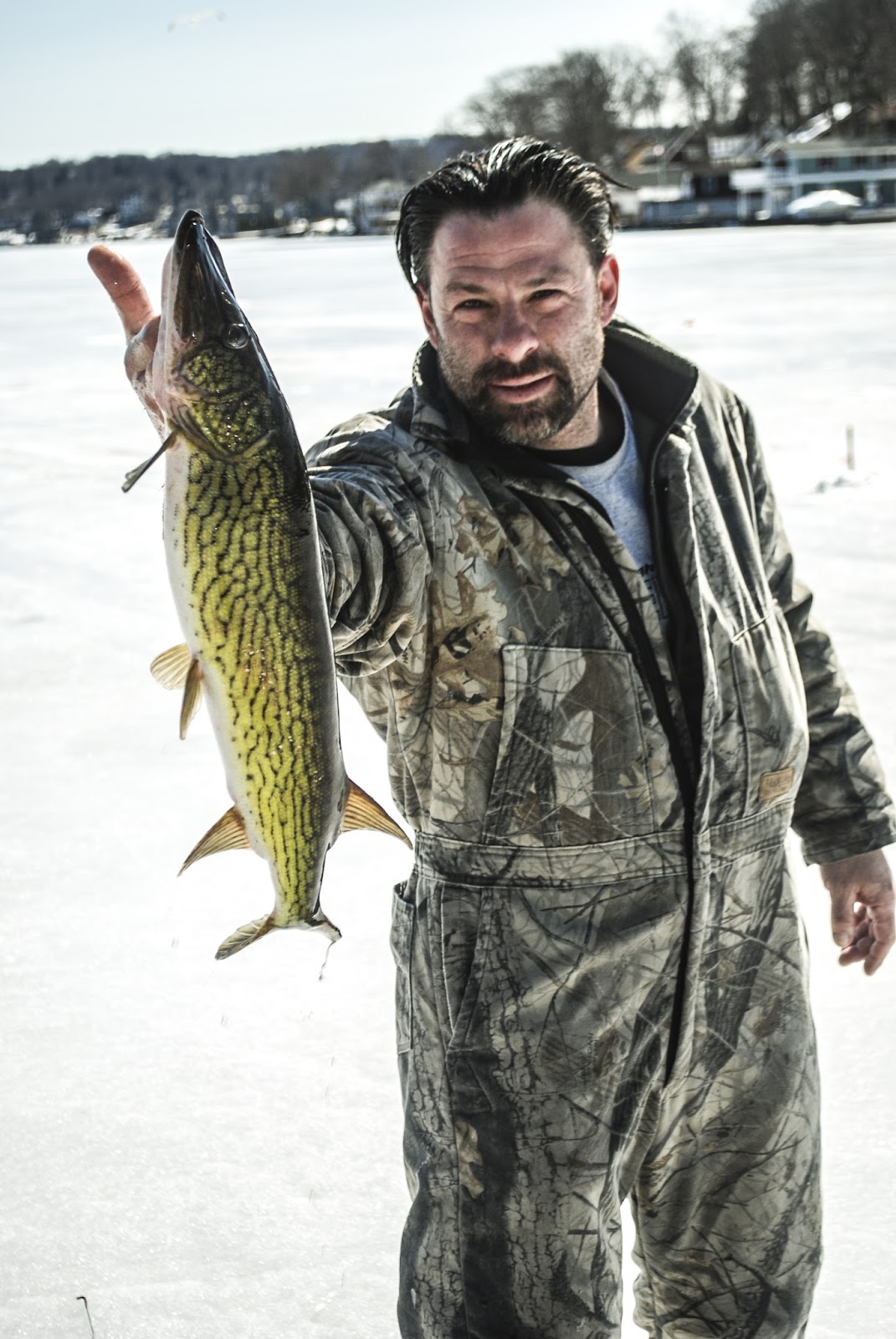
The writer Bruce Litton with a nice pickerel.

Caught before we began using circle hooks, but pliers were at the ready, and the pickerel was released.
Notice the orange ice spikes Brian Cronk looped around his neck. Never ice fish without wearing a pair. Their purpose is to allow you to jam the spike into the ice to give you a grip to pull yourself out, if you go through. Safe ice is a reality, but it's not necessarily absolutely safe. Sometimes underwater springs make thin spots. 
A hand auger is an option for younger ice anglers.

Friends...and family, too. Matt Litton with a nice one.

Ice fishing for pickerel isn't only for the guys.


It's a great way to gather together. Conversation on this occasion photographed will never be forgotten.