Monday, August 31, 2015

Ocracoke Shark Attack Revenge

Our last night on Ocracoke Island, we arrived at the beach at dusk, just as the surf reached high tide. Matt dug the pit where our black Lab, Sadie, began the digging, and we got a cooking fire going as the full moon rose just above the horizon out over the sea.

About two months ago, right here in front of the life guard stand where we cast, a man got attacked by a shark, bitten severely in multiple places. Ocracoke made the news worldwide.

Matt's had a tough time with sharks. At age six, he hooked one right here on this beach just after dark. He barely got hold of his rod before it would have got ripped out to sea, jammed the butt into the sand, and just held on with both arms as the fish raced towards Spain.

"You better take it."

So I took hold and let the fish keep running, no other choice. It stopped with about 10 or 20 yards of 16-pound test left on the spool. I managed to pump the fish back behind the breakers, when it turned and headed up the beach. Twenty minutes and 200 yards distant from my wife, son, our stuff, their flashlight dead, and mine about to completely die, Matt started screaming for me. So I put thumb pressure on the spool and let the line break, ran back. He thought the shark pulled me in, since he could no longer see my flashlight. Big shark.

Two years later, he caught a big bonnethead from a Big Pine Key bridge at night. I estimated 25 pounds and together we broke the fish off, no way to haul it up. I thought nice fish, but surely they get much bigger. First thing Matt did when we got to the cottage, he looked up bonnetheads in his Florida fishing guidebook. What do you know? World record was 23 pounds and some ounces from before 2007.

Ever since these incidents, he's been hot on sharks. Every time on the Banks, we've tried, but have had weather problems.

We had some chunky pinfish for bait. I ripped open the bellies and sliced them up so blood would get in the brine. Then I took 10/0 stainless steel hooks on 86-pound test Toothproof wire, tied off by haywire twists, weighted by five-ounce pyramid sinkers on sliding sleeves, and poked and twisted the sacrifices in tight under the spinal columns. The surf had calmed way down since our debacle at the pier earlier in the day. Full moon shed a lot of light, but the night felt real good. I thought we might catch a shark right where the old man in the news got attacked not long before and create a viral web post. So I imagined with pleasure, anyway.

Well, with two days of an incessant 20-knot northeast blow, that current pushing southward hadn't abated at all, despite the relative relief of the waves. The heavy lead rolled like sandstone down a 70 percent grade, and though we managed to keep bait in the water, it was a little like drifting salmon eggs for trout.

Matt had a great idea. "Dad, why don't you drive back to the house and get those anchor sinkers?" That would have worked. But this was our last night and we hadn't begun packing. We got two hours on the beach, roasting hot dogs and smors. And the three of us laughed at the confrontations between Sadie and ghost crabs as big as rats in the lantern light.

Matt will have a chance yet. And when we head to the Jersey shore for sharks next summer, perhaps, I won't forget the anchor sinkers, just in case.

Sunday, August 30, 2015

Avon Pier with Driven Wind: No Hope for King Mackerel this Time

The alarm failed to go off, so we got to the ferry at 5:00 a.m. with about 30 seconds to spare. Twenty five minutes after we landed in Hatteras from Ocracoke, we arrived at Avon Pier, a menacing cloud bank straight out off the end over the Atlantic. That wasn't our chief concern and rain never materialized. Wind blew out of the east at about 20 knots, making the ocean a brown mess for the entire pier length.

We cast Got-Cha jiggers for about five minutes before giving up, just to make sure no tailor or cocktail blues would hit. Forget Spanish mackerel when the ocean is so thickened by churned-up sand it looks muddy, since the pelagic speedsters feed by sight.

I cast six-ounce anchor sinkers with the two surf rods; the 40-pound test fluorocarbon would serve as trolley lines to send live fish down to no better than sharks in the messy brine. Lots of king mackerel have been caught recently, but not on days like this. The sinkers held, by virtue of the four metal prongs that insert themselves into the bottom so the weight anchors in place.

Before we sent a nine-inch jack my son caught to the angry surface on the trolley line, someone caught a 26-inch red drum (puppy drum) nearer to the beach on cut mullet. Nice fish!

I had bought a Shakespeare six-foot standup rod rated for 50 to 80-pound test line at Dick's Sporting Goods a month ago, when I also checked out an Ande 30 to 50-pound test rated rod. I decided to go ahead and buy the Shakespeare just in case, but see about two heavier Ande rods online. I ordered two 5 1/2-foot heavy power, 50 to 80 pound rated Ande rods, and planned on returning the Shakespeare to Dick's. As events turned out, the Ande rods never got to the outfitter; I phoned several times, and with days left before we would leave for the North Carolina Outer Banks, canceled the backorder eight days overdue.

So I phoned T&W's Tackle in Nag's Head. A few days later, bought a Bill Fisher heavy power 50 to 80-pound rated standup rod, which I like a lot better than the Shakespeare, and it has a thicker tip. For all I really know, a slightly lighter tip will allow better play from a fish anyway, but who knows, when we get down here again in a couple of years or so, I may spring for another Bill Fisher.

Very pleased with our Penn Squall lever drag reels.

But we hardly had the chance to use them this year. Waves broke against the end of the pier and the wind created such a bow in the line from the Squall reel that we couldn't keep the bait quite in the water. Wind was blowing the line with such force that it lifted the jack off the ocean surface where it was supposed to swim frantically and attract jaws.

So we caught some bait stealers, little panfish on our light tackle. It's always a good time at the pier. We stayed out seven hours yesterday well worth it far and away. I always just let time go out there. Never looked at a clock.
Matt's Jack
Big waves got worse as tide lowered, crashing incessantly all the way out on pier's end.

Thursday, August 27, 2015

Potting Killies and Catching a Redfish


Four years ago, we potted killies galore off the end of the boardwalk leading out to the salt creek from our rental house. Many of them large, about three inches long, they led to Matt hooking a flounder of about 20 inches at the Ocracoke Pamlico Sound boat launch. He led it to the ramp, too big to hoist with light tackle, stepped on algae slick as ice coating concrete, and slid on down, flounder taking him in tow before it threw the hook.

Two years ago, no killies at all. Is the population cyclic, or did the hurricanes have to do with it? This year, we caught about a dozen-and-a-half to fish the dock two days ago, no real big killies in the lot. We caught a lot of pinfish, and I did hook something of at least a couple of pounds, but it could have been an eel, for all I really know. The fight felt odd.

Shortly before sunset today, I checked the killie pot and found a nice, big, three-inch killie along with another smaller. Six total to take to the dock, along with shrimp from Tradewinds Tackle. I told Matt to bait up with the big one.

"You sure?"

"Yeah. Keep the bail open and your finger on the line to just let go if something hits hard. But pull it away from any pinfish."

Those pinfish marauder anything put under. I saw a woman two days ago lower an entire chicken neck on a cord for any blueclaw crabs. The pinfish just swarmed upon it and took it entire--down to the bone--like pirahnas.

Soon Matt fought something good-sized, certainly for the dock, and let it up the ramp after a few short runs.

"Nice meal of a croaker," I said. A second later, "It's a red drum." I saw the spot near the tail and it mesmerized me for a moment. "Not sure what keeper size is."

"Doesn't matter. We'll throw it back. Can't believe I caught a red drum." Matt had it in hand.

We had flown to Charleston, SC, last November, the whole family, minus Sadie the black Lab, to pursue and catch red drum, as well as enjoy the city. Redfish are great on the Outer Banks too, the North Carolina state fish.

"I got lucky," Matt said.

"It sets a precedent. If only we could catch a lot of those big killies."

Nevertheless, conditions felt great this evening. Wind bearing down from the northeast, cloudiness, sunset. Good fish move through here on occasion, but mostly its pinfish like the many we caught after Matt's lead. I also caught two other saltwater panfish of another species obviously related closely to grunts.

Potting Killies

Ocracoke Boat Launch Dock

Wednesday, August 26, 2015

Portsmouth Island Pinfish

Two years ago my family took Austin Boat Tours to Portsmouth Island, my wife and son walking the vacant beach and swimming in Ocracoke Inlet while I fished, well prepared with my eight-foot Tica and Penn 440ssg. I had the Tica along today, I just forgot to bring the tackle. But I had two St. Croix 5 1/2-foot medium power rods rigged each with a size 6 plain shank hook and split shot. So I could fish, but just about all my hope for a keeper flounder or two vanished as soon as I realized I had left the tackle tray back at the rental. Or possibly even a cobia. I had hopes for prize game, as crazy as they were, which I came to better realize without any possible means. Cobia do get caught in Wallace Channel during the summer on occasion. I caught a seven-pounder in 2010, though from a boat. That's a small cobia, but 40-pounders have been caught on flounder rigs.

So I removed a split shot from the six-pound test of one of the rods, and cramped it on to the line of the same strength of the other. And then I must have spit a dozen times, because to cramp soft lead with teeth means--for certain--that trace amounts of lead get in your mouth. I have needlenose pliers in my tackle tray. My friends and I were damn fools in our teens, tooth-crimping lead with abandon.

I had a pound of Lund's California squid for bait, and pinfish responded quickly to pieces of it. Wallace Channel cuts right in close to the shoreline, and with tide racing out at very fast pace, it seemed a wonder any fish successfully fought that current. I took a break and tried it myself. No way could I hold my place, swept downstream as I swam as if in a flooding river.

With the Tica and a two-ounce bank sinker, I fished as deep as perhaps 20 feet two years ago. And I caught a lot of flounder, though not one met keeper size. With the split shots, I got about eight feet deep at most. Nevertheless, a bluegill-sized pinfish fights pretty hard on a light rod. These subtly colorful fish get their name from dorsal fins a lot sharper than any sunfish. Like pins. I always try to avoid them, but never seem to avoid getting pierced. They're good to eat, but I tossed the handful I caught today back into the slightly stained, Pamlico brine.

And I caught a snapper bluefish of about nine inches, shortly after something struck hard and took the whole rig--hook, line, and sinker. I resorted to fishing squid weightless and caught a pinfish and the blue. Before I got snagged and lost the second hook, I had it figured out that using the squid heads attracted the most attention and possibly would result in a larger fish. Pinfish nipped and tugged at the tentacles, but the integrity of the mess held together pretty well, as I tugged the bait away. I would have put the rod on the sand and followed the line to a snag to unhook manually, if the line didn't break first, as I tried to shake it loose upstream of the catch. So that ended the fishing.

If you ever fish a shoreline that looks like it's the same up and down, and you're compelled to stay in place, even though you're not getting many takes, take my advice and walk the bank. I went upstream about a hundred yards and found a lot more pinfish. The reason why doesn't matter as much as that they were there, and not where I had left.

A nice late morning and early afternoon I didn't let slip away altogether, just because I had been careless before I got there. Matt took interest in shells, and found another Scotch bonnet like last year, complete and undamaged, but with a couple of barnacles attached. He also found an olive shell, but with part of the top end broken off. When I was young, I used to get up before dawn to scour the beach for shells at the tide line. Now I'm content to watch for differences in clouds overhead.


Tuesday, August 25, 2015

Ocracoke Inlet Bluefish Trolling and Flounder Drifting

Captain Ryan O'Neal of Tarheel Charters told us we might encounter some red drum between 20 and 60 pounds, this news coming just after my son had done a little online research, discovering for himself that citation reds of over 40 inches inhabit shoals out in Pamlico Sound all summer. I knew about the likes, but without a boat, there's no use.

It would take a lot of time, too, though there's nothing else quite enjoyable as is learning new water. So the news from Ryan made it all seem a lot easier, even if we ran into none today. He's been sighting dark patches in the clear water and positioning his 25-foot Carolina Skiff close enough to cast large bucktails to the edges of schools of drum he estimates number between 500 and 1000 fish. They're outside the inlet mouth and today seemed auspicious with barely a breeze and very calm water, though no reds materialized.

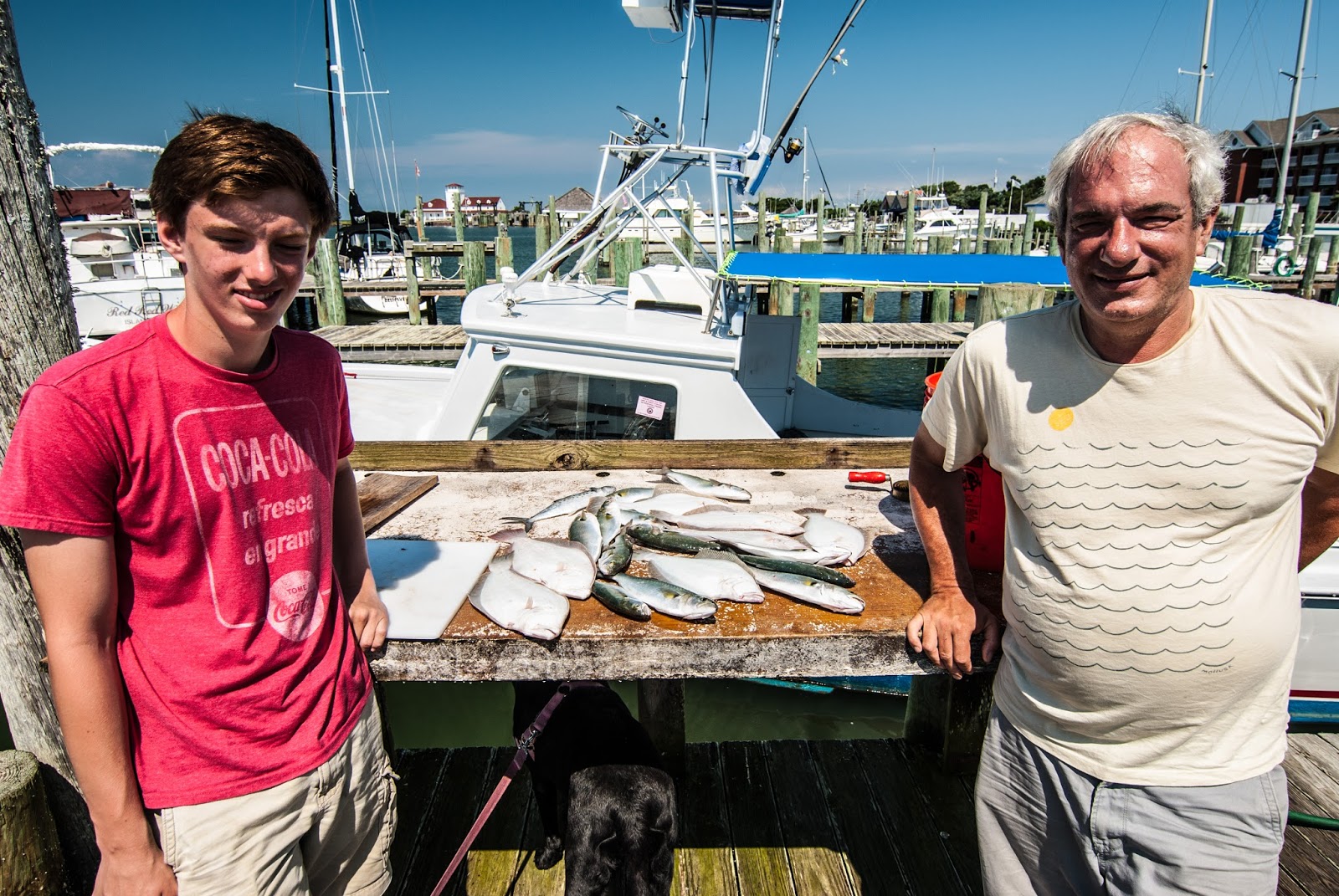
We found a school of bluefish with some Spanish mackerel mixed in, having trolled from inside the inlet and on out. It took awhile. We saw no birds after baitfish anywhere. Once all three rods hooked up at once, and it was pretty easy to circle back and hook up again, although a few times it took us awhile to find that school which must have been pretty small. We caught more than a dozen-and-a-half blues and a small Spanish mackerel on Clark spoons, and then we settled into drifting for flounder.

I liked the depth. We drifted, as tide fell, not far from South Point, and three-ounce dipsey sinkers took forever to touchdown on bottom. Ryan read 32 feet deep on the graph. Flounder carpeted the bottom, but you never know--a cobia is possible even this time of year and deep water holds them. Back in 2010 I caught a seven-pounder in August. That's a very small cobia, and yet a good fish nevertheless. Ryan has guided clients who have hooked up with 40-pounders, and not only until early July when they generally vacate the premises.

We caught flounders steadily, and when we finished our drifts well out to sea, though still drifting past buoys, had some action with blacktip sharks of about 20 inches, sighting one that might have been 28 inches, hoping to get a look at a big one, or for a big one to devour one of the little flounders we reeled in.

The biggest flounder measured 17 1/2 inches, and more than a half dozen others met and exceeded 15-inch keeper size. These are the same species as the fluke of New Jersey, only they don't grow as large here.
Matt's barely legal Spanish mackerel. Notice the gold spots like doubloons. 
Had I hooked up with a cobia, I would have shot straight up, but as the fishing unfolded, felt comfortable reeling in the flounder with ease.
Patricia is almost finished Night Circus by Erin Morganstern
Caught the biggest lizard fish I've ever seen, like a small pickerel.

Lots of keeper flounder and tailor and a few cocktail blues.
Flounder double-header for Matt, which Ryan unhooks.

Wednesday, August 19, 2015

Bass Hitting just as Dark Sets in

My son and I got up to a favorite North Jersey pond yesterday evening, enjoying the southerly breeze, and as proved to be the case, waiting for the cover of dusk to stimulate a little bass action. It's been hot. Bass have some cover under thick algae, which isn't all that extensive, but before darkness gathered, I began to wonder if a lot of the fish hid under it.

I retrieved the worm over the top, which elsewhere has resulted in the mess exploding. Fished hard. Kept casting. First, I had caught a little eight-incher and another about 13 inches I judged too small to photograph, along the opposite shore in shadow. All of the action on the Chompers worm, weightless of course. I can't get enough of fishing this way. It just gets better and better. I think an angler could fish nothing else over the course of an entire lifetime, and still have room to improve.

I did get to thinking, with light vanishing, that a topwater might work. First Matt caught his little bass on a Chompers, and then I pulled my worm to the surface, where it sort of catches that tense film and even floats with the light wire, size 2 hook. I do use 15-pound test Power Pro and 15-pound test fluorocarbon tied directly to the braid by a uni-to-uni splice. With some cover protecting big bass, it's best.

And just when the fishing seemed dead despite so much life in the air, a big bass just slurped the worm right off the surface. Right away I gave the fish slack, then tightened up and set hard--popping the fluorocarbon at the knot. I felt the weight, a really good bass. Enough weight that it didn't budge at all.

I cast to a bush overhanging the shore edge. Nothing. So I continued fishing along this shore...and returned a cast to that same edge of bush five minutes later. I felt the tick, tightened, set..."Here we go, Matt."

Nice bass, not as big as we usually get them.

Some of us will remember the little green red ear turtles sold in pet shops during the 1960's and 70's. Red eared slider. They grow a lot bigger than this Matt plucked from atop a rock, which took some stealthy skill, but this one's a giant compared to those little pets.

Saturday, August 15, 2015

Crappies Hitting at Lake Hopatcong, Nice Walleye, Pickerel


Summer walleye happen at Hopatcong. And look at that blue, sunny sky, when walleye are not supposed to hit at all. All depends on who's supposing.
 
Noel got up to Lake Hopatcong yesterday with a friend and caught 44 fish, his buddy 54. Jigs caught mostly crappie, which is good news, since earlier in the summer, catches numbered nearly the same, but on one occasion, only one crappie figured in. Now schooled, crappie can be like picking cotton from a field that never gets snowed on, whatever that means...have no doubt it means something or other. 
 
A 24-inch pickerel and three pound, two ounce walleye amounted to the top fish in yesterday's heat and sunshine.
 
Or do you admire crappie more? Certainly, a one-pound, 14-ounce crappie is a great fish. Top of the slabs.
 
All this when just yesterday I reminisced about summer Lake Hopatcong outings with my son. Does not feel right we haven't got to the lake this summer.