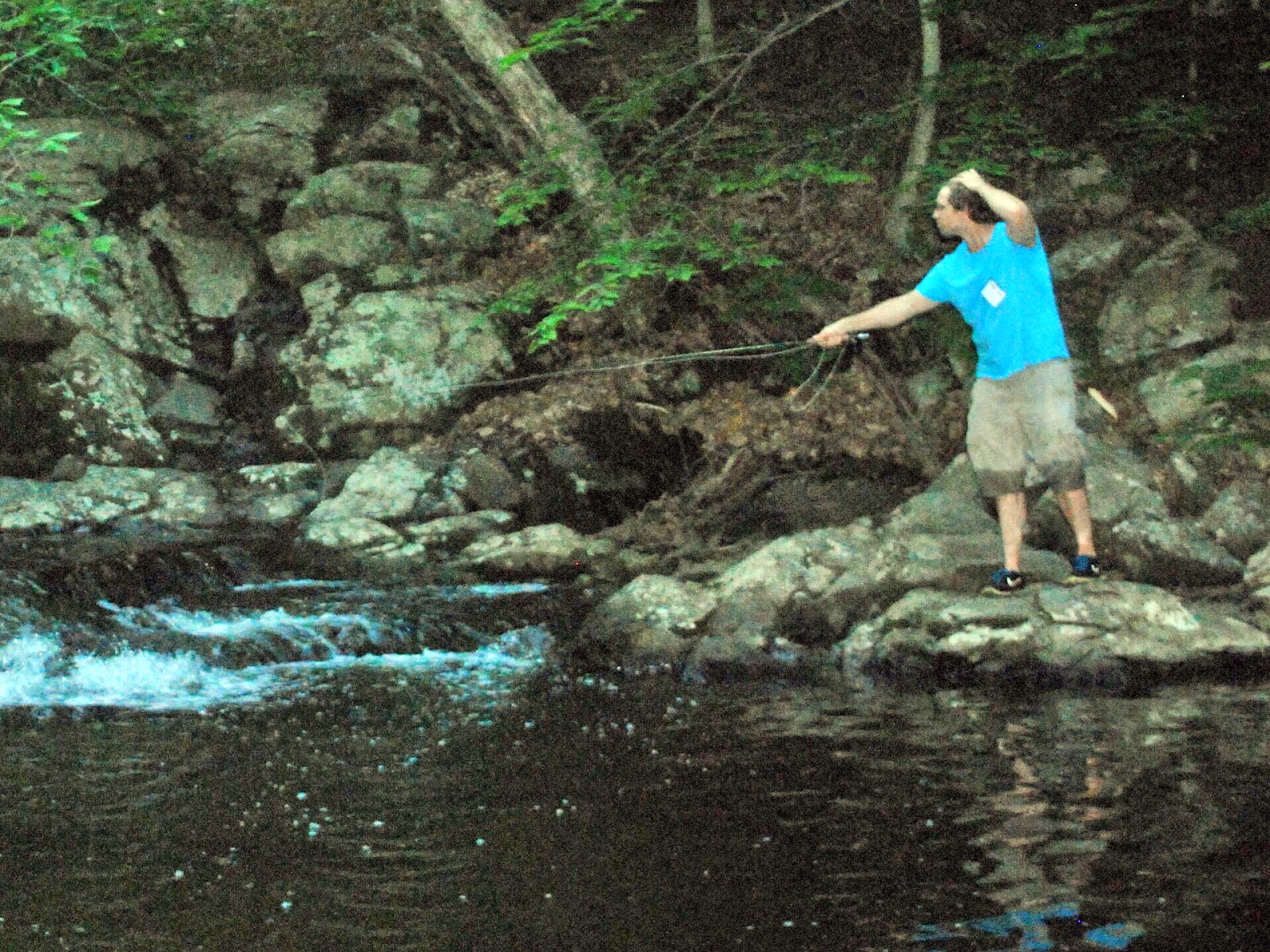
Tuesday, April 28, 2015

Chilly Day Fishing North Jersey


Someone should write a song, "Endless Winter." Here it is almost May and unopened tulip buds remain in New Jersey. Forsythia blooms normally gone by now, peak now with florid yellow. Fred and I fished a North Jersey lake and pond next to it. I wore a fleeced jacket and remained a little uncomfortable. When we left, my hands felt stiff from cold.

I began with a Husky Jerk. A pickerel--probably the pickerel I caught a little while later on a shiner--swiped at it twice, visible in clear water. Fred tossed a plastic worm, fishing slow on bottom. I gave in pretty quick to the dozen large shiners I bought just in case. Last year, we fished here on a much colder day in the middle of April and caught bass after bass out in 15 feet of water on shiners. Curiosity impelled me to see if the likes might happen again, though they did not.

The hike to the pond stirred energies that had flattened with little response from the water to awaken feeling. The single fish had struck about eight feet down, and before it fought with the typical one-line direction of a smallish pickerel, I hoped for a big bass like last year. I managed to catch another small pickerel and a slab crappie in the pond. When the braid line began to produce a little wake on calm surface, sort of slipping away at a snake's pace, I felt a familiar twinge of excitement, grateful for it whatever the mystery having taken the shiner would be. No six-pound bass like Fred caught in this pond last summer, the crappie satisfied enough.

A while later, Fred succumbed to temptation and rigged his rod with a bobber. Soon I suggested we go back to where we started. The water we presently fished rather shallow, any fish for yards around could sense our shiners by their sensory lateral lines, and nothing more happened. The spot felt right, a sort of cove-like curvaceous end-of-a-pond, and if water warmed, it likely would have been better fishing.

Back at my favorite lake spot, Fred angled his bobber here and there a few times. I live-lined my bait, casting deep and setting the rod down as I shot photos before I suggested we go home.

"Why don't you try one more," I said.

Fred had rigged to live-line. It didn't take long before he caught the only bass of the afternoon and evening.

Nice outing. Always good to catch up with a friend.


Thursday, April 23, 2015

Fly Fishing for Highlands Trout Good into June


Fly fishing for Highlands rainbows and browns good into June

X out the browns in NJ, unless you intend to fly fish wild trout. This is a story published a while back in print.

          Despite the short stocking season, which ends May 2nd this year, rainbow trout and some browns will be available through June to fly fishers who apply their time wading a stream. In streams that weren’t stocked at all this year due to furunculosis, more wild browns than rainbows may be caught, but hatchery trout are special in their own right as they become stream acclimated.

          For 39 years now, a brother and I have occasionally fished streams in New Jersey's Hunterdon Hills from just north of Lambertville to Milford—Wicecheeochee Creek, Alexauken Creek, Locatong Creek, Nishisakawick Creek—all of them as beautiful as their Lenape names, names more complicated, perhaps, than Latin entomological terms. However, none of these streams have wild trout, except the Hakihohake Creek further north in Milford, although a very few trout have been known to holdover.

          Trout escaping capture after stocking survive at least into June, and their numbers are significant enough to provide an interesting fishery. In 1978, a friend and I fished the Locatong the way we typically caught hatchery rainbows: 3 ½-foot spinning rods, two-pound test line, and weightless salmon eggs. Nearly June, the streams hadn’t been stocked for a couple of weeks or more, and although no browns swam with what remained, we weren’t doing well. We followed the stream a fair distance from the parked truck and saw a fly fisherman at the pool we intended to fish, where the current meandered into an elbow bend.

          Both of us fixed by a shared fascination, we stood and watched as the man bent to unhook and release a trout. A minute later he was into another. We sat and took a break, watching unrelentingly. The air was quiet and seemed to suspend light like mist. A few insects shifted about erratically, illuminated.

          It became abundantly clear that the rainbows had got away from susceptibility to hatchery pellet look-alikes, such as salmon eggs. All I could think was how dandy fly fishing worked way better than our proven method. It’s an incident I’ll never forget because it improved my respect for these otherwise all too gullible hatchery trout.

          The Locatong among Hunterdon’s very appealing streams, this was a perfect place to see fly selectivity happen, because every time I return to these fair size and smaller creeks flowing to the Delaware River, it seems as if they’re more special than merely being put and take waters. The Locatong has smallmouth bass, but all of these streams have always impressed me more as trout water, and I like to imagine that hidden here and there under currents sometimes plummeting over falls, sometimes slugging through stretches, are a few springs rare holdover trout find in the summer and dwell near. 


          Even Stony Brook in Mercer County has a few cold water springs. I’ve seen August trout congregated in a shallow emission. The same friend who watched the fly fisherman with me has caught such trout—very few!—in the Wickecheoke and Locatong during January. They’ve never been stocked in the fall.

          Given trout stocked in spring surviving into January, the prospects for May and June may seem considerably better. Mayfly, caddis, and drake hatches may occur, but all you may need are Adams in various sizes and some dry ants to provoke response. It’s not a bad idea by any means to observe just what duns are emerging, if any do, or what spinner falls may bring rainbows chasing, and reach for a wide and expensive selection of patterns to try and imitate the bugs, yet more important than pattern is size, especially for rainbows that aren’t quite wild and as selective.

          This year, I bought a six-foot, two-weight, Temple Fork Outfitters fly rod, and balanced it with a Ross Fly Rise 1 reel. I thought I would spend some money in hopes that I find time for years ahead on some very small wild trout waters in the Highlands. I’ll use it on the North Branch Raritan also, but here an eight-foot, five-weight, rod does well, as it would on streams like the South Branch Raritan, Musconetcong, Paulinskill, Rockaway, Ramapo, Pequest, and Pequannock.

          I can just imagine approaching Ken Lockwood Gorge with this set up, tiny sulfur tied to a 7X tippet, and hooking one of the big ones. The trout would race with the plummeting current and strip loose like a kite on a thread.     

Monday, April 20, 2015

Raritan Headwaters Association State of Our Watershed Conference

Recent Raritan Headwaters Association Stream Cleanup, some of the Drake's Brook crew.
 
 
Here's an article I had published in my Recorder Newspapers column earlier this year. Thought it appropriate to post after the recent stream cleanup.
 
Raritan Headwaters Association State of Our Watershed Conference
 
 
          “Without an incredible cadre of volunteers, this program doesn’t work,” said Bill Kibler, Director of Policy and Science, Raritan Headwaters Association. He referred to the Stream Monitoring Program, an ongoing 20-year effort as of 2014. Originally carried out separately by South Branch Watershed Association and Upper Raritan Watershed Association, the two organizations merged in 2011 as Raritan Headwaters Association. The metrics for river health are based on collected macroinvertebrates. This surprised me while attending the State of Our Watershed Conference December 6, 2014 at Gill St. Bernard’s School, Gladstone. Chemical assessment of water samples isn’t the procedure.
          Aquatic insect species are sensitive to pollution. Benthic organisms are bottom dwelling, and macroinvertebrates of this description may include various kinds of worms and crustaceans, but the presence—or lack—of three families of insects determine water quality by a complicated calculation. Ephemeroptera (mayflies), Plecoptera (stoneflies) and Trichoptera (caddisflies) are designated together as EPT, the signifying benthic macroinvertebrates sensitive to pollution. If a variety of EPT larvae are present in a stream sample, water quality is non-impaired.
          Between June 15th and June 30th each year, volunteers use dip nets. Procedures have varied slightly over the years, but each of 56 sites sampled one riffle apiece in 2014. In addition to the North and South branches of the Raritan, tributary and headwaters samples create a vision of the whole watershed. South Branch headwaters and tributaries tested include Ledgewood Brook, Drake’s Brook, Flanders Brook, Mulhockaway Creek, Beaver Brook, Neshanic River, Back Brook, Pleasant Run and Holland Brook. In relation to the North Branch: Burnett Brook, Peapack Brook, Black River, Tanners Brook, Herzog Brook, Cold Brook, Rockaway Creek (confluence with Lamington River and North Branch Raritan in turn) and Chambers Brook. 71.9% of the 56 sites scored non-impaired, 26.3% moderately impaired. No scores indicated severe impairment to sound alarm, although Ledgewood Brook’s moderately impaired status raises particular concern.
          Angela Gorczyca, Water Quality Program Manager, pointed out that with recent activity at Fennimore Landfill upstream of the testing site in Roxbury Township, Ledgewood Brook’s score has fallen. “We did find that in 2007 the DEP collected data. They found that this stream was non-impaired,” she said. “Headwaters streams are usually perfect scores.”
          All testing sites are rated from 0-30. Drake’s Brook Site 1 tested perfect at 30, most other sites above 24. Scores fall off below this number to moderately impaired levels. By contrast to the Drake’s Brook site downstream, the Ledgewood Brook site scored 18.
          Another place of concern was a North Branch Raritan River site behind the ball fields at Miller Lane. “There really was a loss of balance in the invertebrate community. 60% was just scuds,” said Gorczyca. Scuds are small freshwater shrimp resistant to pollution. The site scored an uninspiring 12.
          Gorczyca mentioned the Mine brook tributary just upstream as a possible source of trouble. “We’re going to be monitoring the Mine Brook,” she said. Referring to a computer projected map, she pointed out a “sharp contrast between North and South branches.” Non-impaired sites appeared as blue dots on the map, while moderately impaired appeared in yellow. Only one of five North Branch sites scored unimpaired at 27, site 3 well above Ravine Lake in Bernards and downstream of the little tributary from private Pleasant Valley Lake. Here the highest diversity of caddis and mayfly collected in the net, but fewer stoneflies. A site further upstream, yet below the India Brook confluence, scored 21.
         The South Branch, on the other hand, showed blue dots all the way down into Hillsborough
Township, 17 of 18 sites non-impaired, the only exception a new site in close proximity to Budd Lake.
          Stream monitoring is a precise practice with the intent to identify the source and severity of any impairment, observe water quality trends due to land use changes, see the impacts of development and associated remediation projects as well as gauge any further restoration efforts. Our Upper Raritan watershed gets this attention not only because testing may be an indication for groundwater issues pertaining to drinking water, nor only because some people care about the fishery, but because people care about rivers. To the planet as a whole, they’re like the arteries and veins in our bodies, and without them, the planet could no longer sustain life. Yet deeper value than practical is at stake; if life has any meaning, purpose flows to an end. Rivers make us happy, whether we fish, swim or just sit by them.
          Raritan Headwaters Association needs volunteers. Just access their website and sign on to enjoy an interesting time monitoring a flow in June.  
 http://www.raritanheadwaters.org/


Sunday, April 19, 2015

Turkey Mountain Hike from Pyramid Mountain Morris County Park

In preparation for this coming June at Philmont Scout Reservation, New Mexico, Bernardsville Boy Scout Troop 150 involved the boys hiking with a full pack 7 1/2-mile Turkey Mountain hike this morning. Actually, we ascended some 200-300 feet twice, the vertical ascent from the parking lot about 360 feet or so, not very much at all compared to a peak over 12,000 feet high in New Mexico.

Trails throughout the mountains associated here with Pyramid Mountain Morris County Park are many, well-marked and well-maintained. Easily accessed from Interstate 287 just north of Boonton, they're relatively easy, especially if you're not hauling 50 pounds on your back. Other hikes in New Jersey like Mount Tammany and Rattlesnake Ridge test endurance better, since the vertical ascent from the lot to Tammany's summit, for example, is just over 1200 feet.

I first hiked in this one of many excellent parks of the Morris County system March 20th, 1994, ascending Pyramid Mountain, snapping a photo of Tripod Rock with my Pentax K-1000 35mm camera and hearing a ruffed grouse drumming not far from the trail at one point. So today I was happy to add a new hike to my achievements. An excellent reference guide is The 50 Best Hikes in New Jersey. I checked off many of those listed in 1994-98, often hiking with my wife. Of course, many more than 50 hikes exist in New Jersey and hundreds are good. I can't really imagine any not good. Anywhere you can walk in wild space offers relief from modern tension.

I'm not going to Philmont. My backpacking is over and done, although I will get out and do a hike from time to time that requires some stamina. Weather just right, 60 degrees or so today was better for hiking than temperatures near 80 yesterday. After three or four miles, I started have trouble with the numbness in my left foot. Severe sciatica damaged nerves more than a year ago, and apparently the nerves are never coming back. Today my left leg started to develop nerve trouble also, so I suppose the sciatica weakened nerves in that entire leg. With this sort of trouble generated by herniated disks in my back, it's not wise to try and backpack mountains again, especially given that I just don't have time to undergo the training exercise needed.

I'll let my son climb the Rockies for me.


Saturday, April 18, 2015

Raritan Headwaters Association Stream Cleanup a Success

Raritan Headwaters Association held its 25th Annual Stream Cleanup today. Thirty three sites along the South Branch Raritan River, North Branch Raritan River, Raritan River and tributaries to these three great New Jersey waterways kept volunteers from throughout the region active for three hours this morning.

I volunteered at what was designated as Drake's Brook in Ledgewood, since I had never before visited the creek and wanted to have a look, shoot photos, and spot any wild trout as well as pick up trash. Copious volunteer turnout felt encouraging and hundreds of pounds of trash taken out leaves Canal Park in better condition. The area really appears clean and natural now.

Canal Park hosts remnant ditches once part of the Morris Canal. Back in the woods, I found stone structures which may have been part of the canal system, although Roxbury Township Historical Society hasn't marked them to give any wanderer certainty. Beautiful day to be in the woods and on a stream, the temperature climbed to about 70 before noon.

I did spot three wild trout, very sure rainbows. Each nine or 10 inches long, they scooted about together before dashing from view. Markings and fins distinguished them as trout, but before I could look closer, I couldn't get over feeling nonplussed that they were rainbows instead of browns. I searched other holes, but found no more. Water quality is not what I hoped for. Frankly, I felt surprise--and bliss--upon seeing the trout. The rocks have that ugly brown algae covering them, which indicates water purity that could be improved. Suds on the surface just below riffles indicates phosphorous in the water, I think. I've seen much purer stream water in New Jersey.

I hoped for better, but I was warned. I attended the Association's Stream Monitoring Conference this past December. From what I've gathered, the Canal Park area hosts Ledgewood Brook, which is renamed Drake's Brook just downstream. Ledgewood Brook currently has moderately impaired water quality and the suspicion centers on the dump in Roxbury Township, which has been a big news item as residents have been ill affected. The Association has plenty of evidence to suggest the stream should have much better water. The good news is that wherever the Association monitoring took place on Drake's Brook, the team provided evidence for a perfect score on water quality. I imagine the flow much further down has filtered out impurities a great deal.

Nevertheless, I can't imagine the water downstream of what I witnessed has the quality of, for example, the Dunnfield Creek in Warren County at the Delaware Water Gap. The Dunnfield is so well spring-fed that the deepest pools have a fresh, aquamarine coloration and perfect clarity. It could be embarrassing to confide the following, but it will really back up what I have to say about the Dunnfield's purity. An older friend told me back in the 1970's the Dunnfield's safe to drink. He demonstrated. I took his lead. By all the evidence, it seemed so. For years, I visited the stream trout fishing, hiking--and drinking from it, no purification tabs or boiling. I never have experienced any ill symptoms whatsoever and it tastes very clean. Then I became associated with professional naturalists and spilled the beans. They urged me never to do so again, but I might, though their concern is the possibility of an amoeba. It's clear the stream isn't safe to drink, though I think it's a wonder that a stream in New Jersey can be liberally imbibed with no ill effects, not that any guarantee against illness exists if I try again.

We once fished the Dunnfield many years ago on a trout Opening Day washout. Every stream in our purview raged muddy, and we sought a place that just might retain clarity, a smart move. Dunnfield Creek ran too high to fish effectively--flooded--yet the water remained clear. No, it hadn't the perfect clarity normally so appealing, yet no one would say it ran stained.

http://www.raritanheadwaters.org/
Further down this gulch are a few stone walls that may have functioned as part of the Morris Canal system.
Stone walls left, right and further back in the upper right, which possibly served the Morris Canal system. The Delaware and Raritan Canal flows into the Raritan River at New Brunswick to this day, and I think it's pretty cool that the lost Morris Canal ran in very close proximity to a South Branch Raritan River tributary. And this tributary Ledgewood or Drake's Brook (the brook is named Ledgewood closer to the source) runs within a fraction of a mile to the Black River headwaters, the Black River renamed the Lamington further below, flowing into the North Branch Raritan River down in Bedminster.


Tuesday, April 14, 2015

Husky Jerk Bass on a Drab Afternoon


Tried my favorite 15-acre Jersey pond north of Route 80. First I fished a black spinnerbait in shallows pretty slow, ending up sitting on the concrete spillway with boots on granite below, retrieving the spinnerbait really slow along bottom eight feet deep. That was the venture's highlight, having a little while to sit, slow down and let thoughts arise.

Then I marched back to my car a long way and switched to a Husky Jerk, intending to go scrabble among the rocks. A couple of other guys pulled in. They never followed me to the back of the pond, which takes some effort climbing rocks and shuffling aside brambles.

I caught this 2 1/2-pounder photographed, which my wide angle lens really did little justice to. Broken rhythm on retrieve. Missed another hit way back near the curve around to the other side.

Drab day, kind of chilly, 59 degrees and not much doing. I fished not quite two hours and it just never got better than one of those oppressive days, which nevertheless blesses you with a little realism about things, just doesn't feel good.


Saturday, April 11, 2015

Knee Deep Club Stocks Lake Hopatcong with 1260 Rainbow and Brown Trout


The Knee Deep Club trout stocking took place today out of Dow's Boat Rentals. 1260 trout total came out of the Musky Fish Hatchery's tanks escorted to five boats, which distributed the rainbows and browns around the lake. 1000 of these fish range from 12 to 15 inches, the additional 260 from three to six pounds, but the big brown photographed above surely is at least seven pounds. From what I gathered, it's about 28 inches long.

That's not a fish photo. The man from the hatchery holds the fish right against the top of his waterproofing, which seems to show well for a company restraining the accentuation of an image and sticking to the facts. Customers have relied successfully on Musky for years. These fish are clean, healthy and now in the lake to provide a real nice fishery at least into June. Last year, summer never heated up enough to kill every or nearly every trout. A few got caught through July and possibly later.

KDC provides for any and everyone who will fish Lake Hopatcong. The possibility is there. Today's event a good time, it's just one example of club functions anyone who fishes can get involved in, whether individually or as a family. Membership includes at least 900 people total, and joining is as easy as Googling the club's name, filling out the form and paying the very modest fee, considering the value of these great fish.

KDC is a highly influential voice for Lake Hopatcong's fishery, with a successful history of negotiating with NJ DEP regarding stockings. In 1985, KDC initiated the stocking of hybrid striped bass in the lake, which has become a fantastic year round fishery. 1996 marks the year the club stocked the first muskies. It's amazing how the lake seems to have transformed overnight into a great musky destination. Join the club and enhance the value of your lake fishing experience. It makes a difference to be an insider, because you have a hand in making this lake what it is. You can come to the annual trout stocking event and carry trout to the stocking boats.


 That's the Big One
And Will it get Caught?