Thursday, December 11, 2014

Good-Size Trout Hooked Round Valley

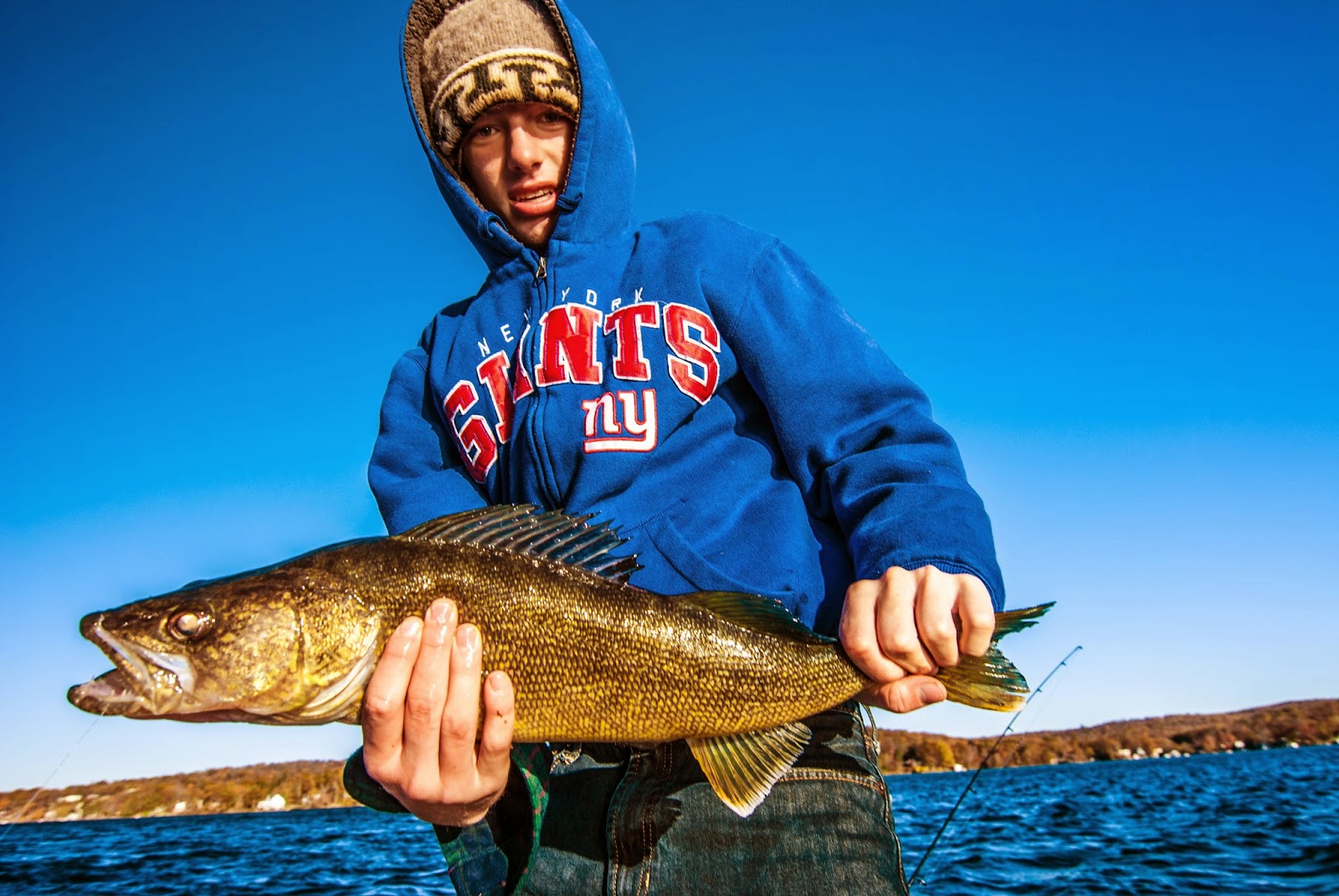
 I happened to be walking by with my camera when he set the hook. "Can I get a shot?" "Sure."
Nothing's happened for me since I caught the big rainbow more than two weeks ago, but I've been out a few times and got the feeling of Round Valley's expanse that always seems to let me breathe easier. I guess that's important for someone who smoked Marlboros. We had some intense snow showers, obviously low pressure moving through, the kind of conditions that make an angler more expectant. This young man I photographed battled a very good-size trout long and hard before it snapped his line. Once these larger trout get close to the bank, they react by powerful runs. I wish I had thought of telling him to loosen his drag a little.
He used a shiner. Now I'm thinking of doing the same, not that this will dramatically improve my catch. Nothing does that in winter. I'd love to catch a laker, and shiners might make this more likely than marshmallows & mealworms.
Has been very quiet in the park. The Valley has a harsh, forbidding wildness in winter. 


Sunday, December 7, 2014

Round Valley Winter Lake Trout Possible to Catch from Shore

Funny how, by mid-January, it still didn't seem Round Valley Reservoir would freeze. By March, 18 inches of ice had accumulated in the main launch area.

Round Valley Lake Trout are a Winter Possibility
          The recent cold snap never froze Round Valley Reservoir. Chances are good for open water fishing the rest of the winter. I’ve been fishing for rainbow and brown trout since October, using the classic mealworm and marshmallow combination. M & M, as it’s called. I’ve meant to try shiners and think I will buy some to use before this article gets to press. Both rainbows and browns hit shiners, but lake trout do also, and I would love to catch one.
          I’ve had lake trout in mind for years. While in Maine six years ago, we rigged a canoe with a portable graph recorder. Our lines with ounce-and-a-half metal spoons got down to the needed 63 feet or so in a jiffy. Big lake trout marked on the graph as I back-paddled the canoe against the breeze. My son jigged a spoon in their midst. None hit. We tried Lake Wawayanda in Passaic County, deep drifting live herring from a rental boat. Nothing there, either.
          But during the late fall, winter, and early spring, some of Round Valley’s many lakers venture close along shore. Last winter, someone landed a 28-incher from a stretch of iron-tinged sand and gravel near the South Lot. This isn’t especially large for a lake trout, but I would be plenty happy with one.
          My son and I, and his Uncle Jim, have together tried live shiners, and I’ve tried them on some occasions solo. We’ve caught bass 25 or 30 feet deep on sharp drop-offs in the dead of winter, but my largest trout so far, a rainbow well over five pounds, went for the humble M & M on a size 1 plain shank hook. Two small marshmallows floated the mealworm three feet off bottom, the leader attached to a small barrel swivel. A three/fourth-ounce steel egg sinker guided the main line running through the middle of it in the South Lot area.
          A mile or so of shoreline to the left of the main boat launch ramp, along the dike, and on around the bend into Ranger Cove and beyond the South Lot area is good fishing. Apparently, trout roam around all of the roughly oval shoreline outlining the reservoir’s 2350 surface acres. Those are many miles to perhaps spread pods of trout apart by wide distances, but if you happen to be in the right place at the right time, you may enjoy a flurry of action.
          I spoke to an angler who caught three rainbows just under the 15-inch minimum size and missed six hits yesterday. Today neither he, nor myself, got any hits. With the rain and fog I thought we might have some fun, but it doesn’t always work out as the conditions seem to augment.
          A couple of years ago, the wind blew from the west 25-40 mph steadily, driving rain like pins into our exposed faces, and this was too much for trout to resist. Four browns came ashore on the hook along with a 20-inch laker between me and another angler in little over an hour. I can’t say for certain whether the weather moved these fish to feed, or whether we were at the right place and right time to meet a pod of trout that could have been elsewhere, but it seemed quite obvious that the trout were feeding actively.
          If you want to catch a laker from shore, you will probably have to spend years fishing. But in any event, live shiners are the bait to use, and bottom fishing may be most effective. Throughout the Ranger Cove area, bottom usually drops off quickly. You can fish from 15 to 30 feet deep or more using the same steel egg sinker for casting range and secure hold. A plain shank, size 6 hook through the back behind the shiner’s dorsal fin suffices. Attach a small piece of Styrofoam to the leader between the hook and the barrel swivel, about eight inches from the hook tie loop, to keep the shiner floating away from obstructions.
          Even at this time of year, Round Valley is a beautiful destination which I find worthy of photography on every outing, in addition to fishing. Since the method is called still or bottom fishing, there’s nothing to prevent you from getting some reading done. Most anglers use a bell device on the rods’ tips to alert them to a hit. In any event, be in close earshot, or check your two or three rods often.


Monday, November 24, 2014

6.9 Pound Rainbow Trout Round Valley Reservoir

The trout broke someone else off. The two yellow orbs of bait weren't mine, and the hook they were connected to wasn't swallowed.


My first trout of the season at Round Valley, third or fourth time out, all of these short stints. I set a mealworm and marshmallow about 20 feet deep, returned to my car, and revisited the rod about eight minutes later. As I approached, I saw the line was tight, straight out. I thought I must have set the rod down before the steel egg sinker hit bottom, so no slack resulted with bail open. And then I saw the spool was empty, and amazed I lifted the rod, reeled some line onto the spool. I'm not sure I tied a proper clinch knot, but I guess so. It's amazing the trout didn't either pull the rod and reel in or break the line off the spool.

It was a long, hard fight. The trout crashed on the surface about 300 feet out. When I got it close to shore, it took off on repeated runs, giving the six-pound test line...a test. Marvelous to see the fish struggling in close. I felt some pity, knowing I was going to take it home. Fish are just like us, in a way. They seek pleasure and flee pain. But we really have no idea just quite what a fish's experience is, although it's not human. Nor would an assumption that they feel pain in any intensity comparable to us have decisive evidence in its favor.

The yellow eyes were fierce, with cobalt blue centers, the teeth spike-sharp. I took it to Behr's Bait and Tackle on the way home to have it weighed. 6.9 pounds, slightly less than 25 inches long.


Tuesday, November 18, 2014

Carolina Low Country Redfish Schooling take the Fly

My family flew to Charleston, South Carolina; my son and I fly fished flats redfish behind Isle of Palms just north and east of the city with Jeremy Mehlhaff of Charleston Shallows. We fished for six and a half hours without a single cloud overhead. A front came through overnight, promising a very tough day. Arrival day had been partly sunny, 80 degrees, and then temperatures never rose beyond the mid-60s. Days like our first when temperatures spike with plenty of sun are the classic chilly season days when reds usually feed, and quite a number may be caught and released.

Wind wasn't too bad on this outing we planned well in advance but brisk enough to hamper my son's casting especially. You need to be able to double haul--not difficult to learn--and cast accurately about 50 feet with nine weight, weight forward line. Polarized sunglasses (amber), may help sight redfish long before they're in range. Sometimes you see nervous water first--not even wakes but subtle riffling--and then the fish come into view. You always want to cast ahead so you can make the fly seem to want to escape.

We began downwind not far from Isle of Palms Marina, water browned by wave action, casting very difficult, and we soon roared away, traveling for miles and to the west to get out of wind. I got a very bad impression from that stained water. I was afraid we'd get skunked. As Jeremy expected, we found clarity. I'll never forget the first red I sighted, a small one perhaps four pounds, and though my cast was awkward, this fish was too close to the boat and surely spooked anyway, though it didn't tear off but quickly passed us before I could throw a second cast. Jeremy sighted fish I couldn't see. I had to wait before I could cast as anticipation flourished with life. We found what we came here for. A friend of mine once went on a guided outing to fly fish redfish in Louisiana, I believe it was, and both he and his father got skunked. That was my secret little dread.

"9 o'clock! Get it out there." I double hauled as I false cast three times, three big reds approaching in front of many behind them. "Drop it." My 50 foot cast perfect, the Seducer fell behind the line of approach. "Strip, strip..." One of the three, a big one of at least 10 pounds, magnificent fish, caught sight of the "escaping" fly, lurching into direct view. The fish, which looked about three feet long and at least 15 pounds to me, darted without hesitation and in the next instant was hooked. Amazed with myself, this was the largest fish I've had on a fly rod. It fought for a full five minutes before the hook pulled. The experience was enough. 

Never drop the fly directly into the path of an oncoming fish unless it comes straight on, in which case you want to strip the fly away from the fish as if food is escaping, usually pulling the fly at an angle. And you want to strip the fly into the fish's view but avoid a cast that results in stripping directly towards the fish. When the fish strikes just keep stripping and the hook will set. Don't use the rod to set the hook. If you're strip-setting for the first time, you may find the habit of setting the hook with the rod irresistible, as I did, but if you just strip into the fish instead, you might boat the first red you have on. Keep the rod tip pointed low towards the water surface for a direct pull.

Sorry about the dearth of fish photos in this blog post--we caught some up to six pounds--but I have to save photos for use elsewhere. We had a great day. From mid-October the reds begin schooling. We sighted a school of close to a hundred fish, which may have offered us more productive fishing had these fish not spooked. That would have been asking too much, given our skills. Through the winter, there's lots of huge schools in these bays hanging out near sod banks, but not scouting right up against them as individual fish or small pods do during summer. If the fish are settled a few feet deep, fly fishing is useless. Through the winter months plenty or most will be in about a foot of water and vulnerable to people who can fly cast. We saw a lot of bottlenose dolphins and that's one of the reasons reds stay shallow--to avoid getting eaten. Reds feed especially on shrimp, plenty available to them. We noticed a lot of finger mullet they eat too.

If you see large, silvery fish, often schooling, you may be sighting adult mullet, not redfish. Mullet of three or four pounds are frequent. Reds are darker in coloration and thick bodied, although not always shading in the classic deep reddish tone, as the photos I've provided for this story show redfish in peachy and silvery colors. Jeremy says they're happiest when shading deep red.

Reds are spooky and that's part of what it's all about. Even the grind of the push pole against oyster shells can send them scurrying. So can the slap of chop against a skiff's bow. And when it's calm, a bad cast slapping the surface can send wakes in every direction.


Oyster bar (no drinks available)

Monday, November 3, 2014

Fly Fished a Somerset County, NJ, Trout Stream

The hike to the pool was about three fourths of a mile. I had time to fish one other using my TFO 2wt. My inexperienced hope was that brown trout would run upstream to spawn and stack in this largest of the stream's pools, complete with some blockage, but when I looked closely, it was evident browns could move on upstream. I don't really know if they run upstream to spawn. They drive out of reservoirs into streams by that urge, but this little Highlands stream has no such connection. I ended up catching the little wild rainbow photographed. A bead head nymph did the trick.

Spotted a pileated woodpecker on the way out, that was nice.


Sunday, November 2, 2014

Pickerel Cold Water Fishing


Pickerel are Active through Winter


          “What are you doing?” I said. Having parked my Ford Fairlane station wagon along the gravel roadway, I leisurely strolled to the edge of the Delaware and Raritan Canal where a familiar fisherman managed something in the water on a cord.

          “Trying to catch some damnable bait!” He said, lifting the square drop net. Four thin, rounded steel supports bended behind a loop in the middle of them for the tied cord. I knew the sand bar he had tossed the net upon attracted a lot of shiners. Silvery reflections wriggled. The bridge of Quaker Bridge Road was busy just beyond where the fisherman stood, plucking fish from the netting and into a bucket half full of water.

          This was October, 1978, and the bait chiefly used for pickerel. The canal has never been the same since it was dredged in the 1980’s, but pickerel can be caught in many lakes and ponds in our region fall and winter, open water or not, chiefly on shiners.

          When my son, Matt, was still a young boy, he wanted very much to catch a pickerel. Describe something interesting to a child, and then offer him the chance to not only see it, but catch it first hand, and he won’t let you be until he succeeds. I took him to the two Burnham Park Ponds in Morristown on a 68-degree January day and he caught several, one of them over 20 inches long.

          But many other opportunities exist, including Ryker Lake and Ramapo Lake from shore, and Lake Musconetcong, Lake Hopatcong, and Greenwood Lake from a boat, if perhaps on a mild day. All of these waters have residual vegetation where pickerel spend the late fall and winter from three to 15 feet deep. Areas like shallow River Styx and the State Park flats of Lake Hopatcong are full of pickerel. By boat, live shiners rigged on size 6 hooks and a 15-pound test fluorocarbon leader, attached to a snap tied onto low diameter 15-pound test braid, can simply be drifted over the stringy tops of vegetation under a light breeze. You don’t have to use braid, but it could mean boating a big one that dives for thick weeds. You do have to use a fluorocarbon leader to prevent pickerel’s rows of razor-sharp teeth cutting line.

          Pickerel are of course members of the pike family. Although they inhabit Florida, and survive quite well in waters that warm well over 85 degrees in summer, they typically feed more in cold water than bass. Along with yellow perch, they are the most popular pursuit for ice fishermen. They are also known popularly as a fish to catch during fall.

          Since not many anglers get out and fish open winter waters, pickerel don’t have the image of open water winter fish like trout, but mild days may offer anglers a chance to get outside. If you’re not resolved to keeping rods and reels packed away until spring, you could catch some fish. Pickerel can be caught even on cold days, but after a few days of sunshine in the 60’s, pickerel become especially active in smaller, shallow waters that warm significantly. Nevertheless, Lake Hopatcong’s River Styx and State Park flats will warm significantly more than the main lake points when such a weather system lingers. (Safe ice can cover the shallows when the main lake remains open—the reverse of this situation.)

          Part of what fishing can be all about is a variety of different sorts of outings. Home methods and approaches, like home waters, preoccupy fishermen, but a new lake or pond, approach or method, piques interest. I admit that I haven’t fished winter pickerel—besides ice fishing—since the Burnham Park Pond days. We went a number of times and always did well. But I have good memories ranging from the New Jersey Pinelands, to the canal in Mercer County, to Morris and Sussex counties, catching winter pickerel since my teenage years when I was keenly attracted to gaining experience of the wilds. I still am, and fished at Round Valley throughout last winter. When I used shiners hoping to hook a big lake trout, I thought of pickerel. 


           Pickerel exist in both the reservoir and the Round Valley Pond, although not nearly in such numbers as trout do in the reservoir, and probably don’t range as deep as a half-ounce sinker can be set from shore, either. But at any rate, if you haven’t caught winter pickerel and want to try a different approach to fishing, the whole of winter months lay ahead to try.  

Sunday, October 26, 2014

Walleye and Hybrid Striped Bass Hit at Drop-Off Bottom Edge


At least I thought I heard the temperature was supposed to rise well into the 60's today, chance of some sprinkles in the morning. Some of the Highlands region did get a little rain well before sunrise, and then a cold front pressed down on New Jersey. When we motored across Hopatcong, powered by a 9.9-horsepower Susuki--one of Dow's Boat Rental's--the wind already kicked up enough for me to get drenched back in the stern. Overhead, the stars almost had wilderness quality, very bright and numerous. I kept at full throttle despite getting wet.

I felt surprised when I opened the photo (below) of me with the first walleye. I caught it before sunrise, but it seemed as if we had fished a long while, yet the light reveals an early moment. Matt had caught a bullhead on a live herring; herring, by the way, are available only in small two-and-a-half to three-inch sizes. I don't know if that's why we caught two more bullheads and apparently lost another. Jimmy at Dows told me not to expect any large herring for the rest of the season. We certainly have no complaints; we caught some nice fish.

After Matt caught his walleye and I had caught both of my hybrids, the anchor began to drag, and I averted the boat and motor crashing into rocks. We had been taking turns with our herring rods, one fish, and then the next.

I don't reflect on issues like this well when I'm on the water, but now I see that it's appropriate next time that bullheads don't count. Matt got a smallmouth, a nice crappie, and his walleye was bigger than mine, but I got two hybrids in addition to the walleye I caught. We caught yellow perch and sunnies on nightcrawlers besides. It's a different way to fish, the setting of herring on bottom, more like ice fishing when you take turns with tip-ups collectively. We used to designate our own two herring rods and go with that, more like the individualistic tradition of every angler for himself, even in good company. On an outing in October 2011, my son & I tallied up nine hybrids for me, eight for him, which is pretty much an equal cut, except that my son should have the privilege of catching more than Dad. We did it the individualistic way by dividing our own rods apart. Now I like putting all four in use, taking turns, and next time not counting bullheads, or crappies for that matter. Even though a crappie is a gamefish, it's not on par with walleye or hybrids in our opinion.

At least when we began fishing Lake Hopatcong in the summer of  2007, Matt caught a five-pound walleye, and I just caught a few bass. He caught some bass too. And he caught our first keeper hybrid, along with others, and walleye on other occasions. He has no complaints. For all I really know, I was right to start him out by minding his own rods rather than pooling them all together. That's how we began ice fishing when he was eight, pooling them, but tip-ups are more and less identical. A rod and reel is specially your own, and more than "teach" Matt to value his own things, I provided things for him, and I pointed to opportunities for his acquisitiveness. He bought his own Nikon D-60 when he was eight. It cost him more than $600.00; a significant amount of that money he earned by getting photos he took published along with articles I wrote for fishing magazines. Before he owned his own camera, he was using mine.

Before we arrived (and learned that it was supposed to really blow, and that fishing has been very slow), I expected to fish Binsky and Cicada bladebaits for the most part. We did fish these for an hour-and-a-half at the end of the morning and just after noon, but got nothing on them. We hadn't seen but a couple of other boats. Now that we fished out of the wind, boats appeared plenty.

I wonder how they did. We had let wind rip right through us for hours. In the fall, I find windy conditions better, so I'm less likely to fish where we would feel more comfortable and take care of things easier. But fishing a bladebait among whitecaps would have been ridiculous, at least I think so. Otherwise, anchored in the wind, line remained just at the edge of being all over the place, I mean, you would think the tangles would be constant with four out and two more fishing crawlers, but we've done this before a number of times and it works out. We soaked bait and fish found it.


 Matt did his sleeping early in the morning. He told me he was very comfortable.