Sunday, October 26, 2014

Walleye and Hybrid Striped Bass Hit at Drop-Off Bottom Edge


At least I thought I heard the temperature was supposed to rise well into the 60's today, chance of some sprinkles in the morning. Some of the Highlands region did get a little rain well before sunrise, and then a cold front pressed down on New Jersey. When we motored across Hopatcong, powered by a 9.9-horsepower Susuki--one of Dow's Boat Rental's--the wind already kicked up enough for me to get drenched back in the stern. Overhead, the stars almost had wilderness quality, very bright and numerous. I kept at full throttle despite getting wet.

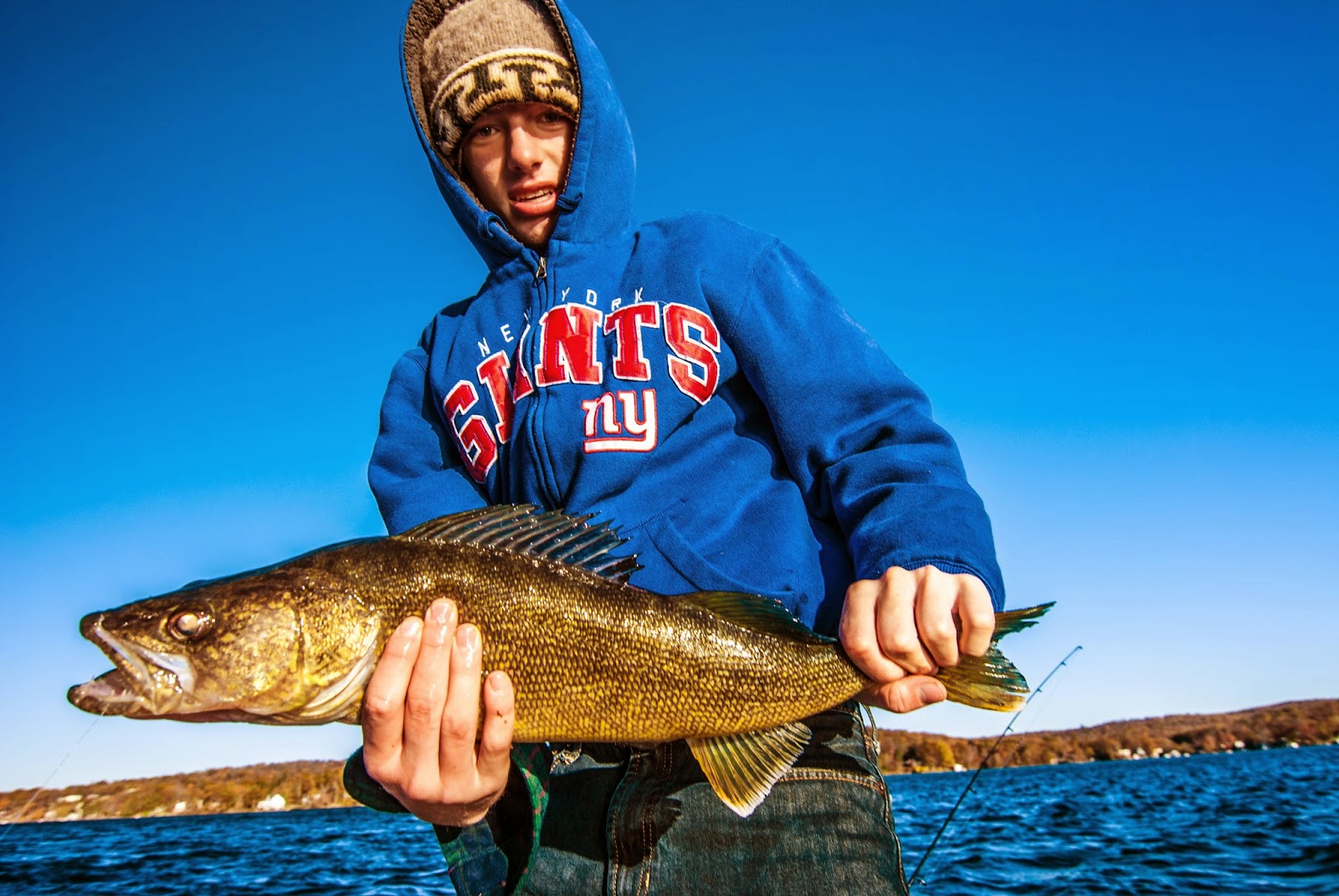
I felt surprised when I opened the photo (below) of me with the first walleye. I caught it before sunrise, but it seemed as if we had fished a long while, yet the light reveals an early moment. Matt had caught a bullhead on a live herring; herring, by the way, are available only in small two-and-a-half to three-inch sizes. I don't know if that's why we caught two more bullheads and apparently lost another. Jimmy at Dows told me not to expect any large herring for the rest of the season. We certainly have no complaints; we caught some nice fish.

After Matt caught his walleye and I had caught both of my hybrids, the anchor began to drag, and I averted the boat and motor crashing into rocks. We had been taking turns with our herring rods, one fish, and then the next.

I don't reflect on issues like this well when I'm on the water, but now I see that it's appropriate next time that bullheads don't count. Matt got a smallmouth, a nice crappie, and his walleye was bigger than mine, but I got two hybrids in addition to the walleye I caught. We caught yellow perch and sunnies on nightcrawlers besides. It's a different way to fish, the setting of herring on bottom, more like ice fishing when you take turns with tip-ups collectively. We used to designate our own two herring rods and go with that, more like the individualistic tradition of every angler for himself, even in good company. On an outing in October 2011, my son & I tallied up nine hybrids for me, eight for him, which is pretty much an equal cut, except that my son should have the privilege of catching more than Dad. We did it the individualistic way by dividing our own rods apart. Now I like putting all four in use, taking turns, and next time not counting bullheads, or crappies for that matter. Even though a crappie is a gamefish, it's not on par with walleye or hybrids in our opinion.

At least when we began fishing Lake Hopatcong in the summer of  2007, Matt caught a five-pound walleye, and I just caught a few bass. He caught some bass too. And he caught our first keeper hybrid, along with others, and walleye on other occasions. He has no complaints. For all I really know, I was right to start him out by minding his own rods rather than pooling them all together. That's how we began ice fishing when he was eight, pooling them, but tip-ups are more and less identical. A rod and reel is specially your own, and more than "teach" Matt to value his own things, I provided things for him, and I pointed to opportunities for his acquisitiveness. He bought his own Nikon D-60 when he was eight. It cost him more than $600.00; a significant amount of that money he earned by getting photos he took published along with articles I wrote for fishing magazines. Before he owned his own camera, he was using mine.

Before we arrived (and learned that it was supposed to really blow, and that fishing has been very slow), I expected to fish Binsky and Cicada bladebaits for the most part. We did fish these for an hour-and-a-half at the end of the morning and just after noon, but got nothing on them. We hadn't seen but a couple of other boats. Now that we fished out of the wind, boats appeared plenty.

I wonder how they did. We had let wind rip right through us for hours. In the fall, I find windy conditions better, so I'm less likely to fish where we would feel more comfortable and take care of things easier. But fishing a bladebait among whitecaps would have been ridiculous, at least I think so. Otherwise, anchored in the wind, line remained just at the edge of being all over the place, I mean, you would think the tangles would be constant with four out and two more fishing crawlers, but we've done this before a number of times and it works out. We soaked bait and fish found it.


 Matt did his sleeping early in the morning. He told me he was very comfortable.


Friday, October 24, 2014

Where the Small Bass, I Wonder


This skinny bass with a bad eye but a big mouth struck on my first cast. With wind, it was chilly, 54 degrees, although temperature warmed to 69 in the afternoon. If enough cloud cover justified using a black spinnerbait, enough sunlight struck water to prompt switching to a white-headed spinnerbait with a green and yellow soft plastic frog for a trailer and large Colorado blade. This lure tracked very slowly with the wind action, too slow, although it didn't take long to feel a jab and miss the short hit, yet two seconds later get slammed. I had the bass on, maybe a three-pounder, but lost it after a couple of throbbing seconds.

This pond makes me wonder what all the small bass inhabit. I've caught one nine-incher, a 13 1/2, a 14 and some, and all the rest have been two pounds to more than three-and-a-half. Doesn't it make sense that the number of smaller bass would exceed the larger? Lake Musconetcong is similar. Most of the bass have been 15 and 16 inches, if most of them get wiped out with the chemical eradication of weed habitat until the water chestnut problem is solved. If it is ever is solved. The pickerel averaged 20 inches and now prove all but absent.

We fished the lake for years and caught dozens of three-pound-plus pickerel about 23 inches long, thick bodied fish, and yet not one more than three-and-a-half pounds. No bass more than that weight, either, although I've heard of a number of seven-pounders caught in the thickest of summer vegetation. I hope I get a really big bass in this pond, meaning more than five pounds, but I think Round Valley Reservoir, where I landed one that big in May, is the likelier place for fish like this, even though average size there is a little under a foot long.

Guess these afterthoughts foreshadow the end of bass fishing this year, but I may get out a couple or a few more times this fall.


Thursday, October 23, 2014

Round Valley Reservoir Trout: Looking Forward to a Long, Cold Season


Had to choose between coming to Round Valley and trout fishing, or visiting Ken Lockwood Gorge and photographing river scenes. Since rain fell fairly hard, I figured I better not miss out on the chance at catching a trout. Besides, the South Branch ran a little high, not very, and my photo opportunities might have been affected in the negative somewhat, and besides water perhaps running too high in relation to a boulder or two in the foreground, leaves have not yet reached peak color anyhow.

I stopped at Behr's Bait and Tackle in Lebanon and bought mealworms. Mr. Behr reported a four-pound and a six-pound rainbow weighed in from the reservoir at his shop this morning. He said plenty are being caught from shore, and this is the typical scenario this time of year, although when you occupy a spot and other anglers fish nearby, you don't usually see a lot of trout being caught as if it were Opening Day or a stocking day on a stream. You may see one or two, or a few, caught, and they average about 16 inches.

During the really hardcore season of December, January, February, and early March, you witness very few caught, although there are regulars who brave the cold and certainly catch some. They just may have to wait a total of 12 hours or more between fish, but there are guys who fish five, six hours a day, a couple or more times a week.

Round Valley is like deep wilderness in winter with few anglers and birders present. I often come and no one is there at all. That's nearly how it was today. I saw no one fishing in the Lot 2 area, but I did see a few cars drive into the lot above, and a Park Ranger drove by.

I've been blogging about this fishing for several years and nothing changes. No increase in visitors results, and it's really not so much my aim to draw others in, but tell a story that you, the reader, may appreciate. Particular points I make may have universal value, so it's more than a fishing report about the reservoir. And if you want to try for these unlikely trout, most of the anglers I've encountered have no qualm about seeing another or others. In fact, at this time of year, especially deep in winter, greetings and conversation are the norm, unlike spring and summer when you're just another person among many, everyone indifferent to one another, except we secret human beings who notice people because life is very much about being social. Leave the anti-social types to their delusions and avoid them, but that's not really how most people are, although people in a crowd are in fact less likely to approach each other, and Round Valley Recreation Area really does fill up when the weather warms.

Not a hit today. The usual, expected result of a sincere attempt.


It's October 23rd and leaves still haven't reached peak color. A mild summer, warm fall. What will winter be?

Wednesday, October 22, 2014

Bass Hitting Spinnerbaits Under Windy Surface


This place seems to never want to let me down. It's not that I approached the pond feeling I would get skunked. Wind blew like a Halloween banshee out of the north, cold at 56 degrees and never milder all day, certainly very invigorating with the light rain jacket, but I really didn't feel nothing would happen, although I felt a skunker possible with so little day left.

Which way to go? I stood at pond's edge and chose between my right or left: back to the fallen tree again and relative shallows, or down where the wind blew against the bank. No, today didn't seem a day for sun-warmed shallows, obviously not. I sort of went with the assumption that wind carries baitfish and stacks it against the bank the wind pushes water against, not that I actually thought bluegills were getting pushed, but I did spot some baitfish in very thin water I took for killies.

Baitfish or not, bass get active in the fall under wind-churned surface any time of day, at least in my experience. I find that in the spring and summer, windy late mornings and afternoons tend not to produce. This nice bass well over two pounds slammed that black spinnerbait and immediately leapt. Not much later, I fought an even larger bass, lost it. Both were 10 to 15 feet out from the shore edge, only a couple of feet to about four feet deep. I did wonder if the first bass that struck about 10 feet out followed the spinnerbait or lurched from deeper water aside from the pulsing blade. Certainly the powerful vibration the Colorado blade produces is sensed from a distance. In any case, that bass overtook the lure very swiftly.

I may get out for bass one or two more times this fall.


Sunday, October 19, 2014

Pursuing John Insley Blair's Spirit: Blairstown, Hope, and White Township, New Jersey

Today my wife, Patricia, and I followed the Blair Trail as written about very thorougly in New Jersey Skylands Visitor magazine, beginning in Blairstown, following through Hope, passing the White Township Museum on CR 519, ending up near Belvidere, and back tracking to find the museum only open on the second Sundays of each month, among other hours, I think. John Insley Blair, 1802-1899, began his career in boyhood trapping muskrats and selling pelts. At 11, he was a store clerk, and he rose through many mercantile endeavors, achieving wealth and becoming a great NJ railroad magnate, pivotal for the nation's 19th century industrialization. Blairstown originally existed in 1760 as Smith's Mill, named after the hamlet's central feature, a grist mill just downstream of what is now the dam of Blair Lake. When J. I. Blair arrived in his late teens, it was called Butt's Bridge, with four homes and the mill; soon the name changed to Gravel Hill. To make a very long and amazing story short, the town became a thriving trading center largely through Blair's influence, and was named after him 175 years ago in 1889.

Blair Lake is private, by the way, and although you can enjoy the walkway, you have to turn back and not enter the area of private residences. I imagine some bass exist in the rather shallow water of good quality, and thought I sighted a very small largemouth in the creek. I was motivated not to fish today, but familiarize myself more with someone who made an enormous productive and financial achievement, influencing America's history more directly than he is famous for. We've often been to Blairstown. I once had the privilege of spending time in a campus auditorium at Blair Academy for a poetry festival. And we enjoy Mohican Outdoor Center and the Paulinskill River. We've eaten many meals at the Blairstown Inn, and often go to Dale Market. But today was different. The purpose was about as singular as the rails of J. I. Blair railroads were straight steel: get a little first hand familiarity with the spirit Blair left behind, just a little, but enough to feel better connected than reading can do, so long as a fair amount has been read in preparation, and we both read the magazine article with Highlands history in our background. Patricia once complained that it was a Sunday and the farmers market wasn't opened, but I appreciated Blairstown and Hope as just like ghost towns today and with the weather chilly. It left us all alone with this spirit we pursued.   
 Overlooks entrance to Blair Academy, grave yard to the right.

 There is a monument which resembles the Washington Memorial in miniature overlooking John Insley Blair's simple gravestone. The simple stone is symbolic of the simple, frugal life he led, always on target with his projects and not extravagant besides.
 After I paid my respects to John Blair, I photographed Patricia leaving the graveyard. The gate is almost immediately beyond the Blair Memorial.
 First Presbyterian Church (1840) and Dr. John C. Johnson House
 Blair Lake
 Blairstown
 Arches with Waterworks to the right, insdie.
 First Hope Bank, Hope NJ
 Hope NJ
John Blair worked as a clerk in this building in 1813. He was 11. Hope, NJ.


For a more in-depth story, "The Blair Trail," access NJ Skylands Visitor by this link to the article: http://www.njskylands.com/tour-blair-trail


Thursday, October 16, 2014

October Bass Action on Spinnerbaits


Quite a different scene than July when I caught all those nice bass, and, as expected, the water has cleared, algae bloom dying off, although the water still has a pronounced green tint. Didn't have much time, but I managed to catch this little bass of less than 14 inches on a spinnerbait. This time of year I ignore the plastic worms I love to fish on hot summer days, not that bass would necessarily ignore the worms, but that in my experience, they're more willing to smack a spinnerbait. You can cover a lot more water quicker with a spinnerbait. I just fan cast shallows when this bass whacked it.

I came confronted with a fundamental choice as I made my way: would I traverse some difficult rocks and go all the way into the back of the pond, near a downed tree in shallows, or would I go fish along the easily walked banks in the deeper front? My more brainy feeling involved the notion of catching something where walking is easy. But my gut told me to go cast near that tree, and that's where I caught the bass.

I can just imagine what action would have been like in yesterday afternoon's rain. Every fall we seem to get at least one rainy day with temperatures in the 70's. Since water temperature is actually warming slightly during such a storm, the bass have all the more impetus to actively rise--no overstatement--and I've had some incredible action on spinnerbaits.

When I was 16, I fished through close lightening under a tornado watch. Some of the dozens of bass I caught actually leapt two feet in the air to come down on top of my buzzed spinnerbait and get hooked! Truly once-in-a-lifetime. I would never do the likes again--I always avoid lightening--and wouldn't actually suggest anyone else do it either. Graphite rods are like lightning rods, and you would be the ground. Leave it to one manic teenager who survived to tell a story. My wife always says God protects fools and idiots--so don't count on it! Many other warm weather storms during the fall without lightning have been excellent fishing, and all you need for these is good waterproofing.

We have less than a month's time before the bass fishery all but shuts down. I used to love to brave cold late fall, even winter, weather, dousing live-lined shiners in a pond's deepest water. I caught bass this way and on jigs as well, but haven't done the likes in years. On one strange late November afternoon, mild, but not warm, I caught bass right up against browned reeds on a buzzbait. Go figure.


Wednesday, October 15, 2014

Low Rivers, Round Valley Reservoir, getting some Rain


Didn't fish today, but scouted the Neshanic River (soft-clarity photo, above), South Branch Raritan, and Round Valley Reservoir, all at very low levels. Two inches of rain is predicted for tonight, and this will raise stream levels. I've never seen Round Valley Reservoir so low, but I'm sure some trout are being caught along its desert-like shorelines.

Lots of people are hoping for rain, but lets hope we don't get too much during the summers ahead. I read that meteorologists are expecting much wetter summers for New Jersey. My first concern in this respect is my summer smallmouth bass fishing. I like a stream low and clear. Smallmouths aggressive fish: a long cast reaches them unawares tending to result in furious charges from distances that surprise people uninitiated to this fishing. On the other hand, when small rivers run higher than normal and slightly stained, I have a hard time catching bass. 


That storm pipe is carrying more water now than when I photographed it this afternoon.