Sunday, September 28, 2014

How to Play the Trout Game: New Jersey Fall Stockers


Piece I wrote for my newspaper column last year. Because of the furunculosis infection at New Jersey's Pequest Hatchery, the 25,000 rainbow and brown trout to be stocked this fall will range from seven to nine inches, besides 500 broodstock 18-24 inches. But the article is mostly timeless and quite appropriate to be read now.
Local rivers to be stocked with trout in October


          Fall trout stocking by the state is not met with the springtime crowds, and although fewer streams get fewer trout, they’re larger. 20,000 14 to 16-inch rainbow and brook trout, and 1000 18 to 22 inches, will be stocked in 17 streams and 15 ponds and lakes statewide over a two-week period beginning the second week in October. In our region, the North and South Branch Raritan, Raritan, Musconetcong, Pequest, Paulinskill, Black, Wanaque, Ramapo, and Rockaway rivers, and Pohatcong Creek and Big Flat Brook are the scenic flows to be enhanced with fish, which by wintertime will be quite adjusted and wild. According to last year’s NJ Division of Fish & Wildlife Fall 2012 Stocking Schedule, the ponds and lakes to be stocked are from Middlesex County southward. This does include Farrington Lake near New Brunswick. There are no stream closings on stocking days, but plenty of trout escape the relatively few eager fishermen who await the hatchery trucks.

          Fall and winter fly fishing in the Highlands and Ridge is not the popular pursuit that catches the eye of passing motorists in the springtime when parked cars line up near stream access, but those who enjoy it are rewarded with solitude in out of the way places. The Big Flatbrook, for example, flows for 16.5 miles of remote Sussex County with great views of Kittatiny Ridge rising above. The Paulinskill River features remote sections, as does the Black River in Hacklebarney State Park with its gorge, not as dramatic as the South Branch Raritan River’s Ken Lockwood Gorge, but it may offer solitude when the popular Califon destination is packed with anglers.

          Fly fishermen anticipate mild weekend days in January and February to fish Hare’s Ear and stonefly nymphs, zebra and brown midges, and wide panoply of possible bead-head weighted fly patterns. With a winter as mild as the previous two (bad guess!), it may be possible to fish a late afternoon midge hatch with tiny dry flies.

         In any case—even with bait—winter fishing is tough and you need to keep interest alive by fishing with serious persistence. Angling, for all its contemplative value, is a game with a single objective—to catch fish. And like any game, when you score, you’re satisfied and confidence is aroused, but you move on with the next approach and try to involve the whole outing. Every outing is unique, and what I find so cool about fishing is that it’s never like returning to the same field format as with other sports, even when the same river is revisited. After all, it was the philosopher Heraclitus who said you never step into the same river twice, and while you may not step onto the same football field twice either, the field format is the same everywhere.

          So fishing is inexact by comparison, the variables as wild as nature itself, which means evaluations of how good the fishing is are different according to opportunity and season, and the weather and water conditions met with must be considered. In our region, the number of trout stocked is about uniform on the streams mentioned. You don’t have to be fancy and use a fly rod, and October will probably be your best bet to catch a few on live fathead minnows, or even salmon eggs and two-pound test line for an exciting struggle given the size of these fish. I tempted a 16-inch rainbow in November from under the route 202-206 North Branch Raritan bridge using a baby nightcrawler on two-pound test, and once tried nickel-sized sacks of salmon eggs I brought home from salmon and steelhead fishing near Lake Ontario. They did work, but I’m not sure any better than single eggs on size 14 hooks.

          Use no weight besides a snap for salmon eggs on two-pound test leaders unless depth and power of current require split shot to get the bait near bottom. But fish the deep holes and weight fathead minnows as lightly as possible.

          I usually don’t bring fish home since I usually judge them to be more valuable in the water, but I bring memories back every time out. These are not sentimental post card depictions with sweet feelings in the mist, but substance acquired directly from nature in the way experience strengthens sense, the way game choices I make exercise my mind, and the way successes confirm efficacy in specific, subtle ways. Don’t think for a moment fishing is a bore sitting on a bucket. Give it the best.       

         
N

Friday, September 26, 2014

Subtle Approaches: Finesse Mindset


The Mindset of Finesse


Finesse fishing is not just a weightless 4 inch plastic worm on a size 4 hook or even a weightless salmon egg impaled on a size 14 hook, fished on 2 pound test line. It’s a state of mind not limited to freshwater, even though traditionally we think of heavy sinkers and big hooks in the brine.


How equipment is handled, cast placement, retrieve and hook set all involve subtle intricacies that define the word finesse. Among anglers, it has come to be associated with light tackle and light lures, but live lining a weightless blue crab for tarpon, for example, involves using big game tackle, yet it’s all about the light touch: giving line when the crab wants it, carefully retrieving slack. The last thing you want happening is to be caught unawares while picking up slack if a hundred pound tarpon hits.


I don’t think of all the fishing I do as quite being finesse. On occasion, I rip a crankbait to provoke reaction strikes from smallmouth and largemouth bass. I love to fish a Gotcha jigger off a pier for Spanish mackerel, which involves fast, snappy retrieves. And I like to soak bunker or clams in the Jersey surf, weighted by heavy pyramid sinkers. I fish other ways not so subtly. Yet, if you take the classic author Izaak Walton at his word—who was not averse to bait fishing—and agree that fishing is a contemplative recreation, any way we approach it involves finesse as a state of mind.


Why Mood and Attitude are Everything


Before I get into details on how to fish with a light touch, even an extremely light touch, I want to point out that mood and attitude encompasses everything you do on an outing. Mood may change, and if you begin in a bad one, it’s good if you end in high spirits, but preparation, getting psyched, can put you on the spot from the start. I know of no better way to get in the mood than simply organizing gear and tackle before I go and I usually do this immediately before leaving. If I get up at 3:00 a.m., the last thing I do before sleep is prepare. We have our favorite lures and memories attached to rods and reels, etc., and by sorting these things out by hand, awaken the mood before we get on the water.


It’s important because the background of the mind that searches for fish, chooses which lures or bait and what techniques to try, measures casts and retrieves, has a deep role in the efficacy at which the game will be played. A positive mood and attitude are not just about having good time regardless of catch and don’t distract from fishing unless the mood happens to be about something else. Positive mood makes possible ideas about how to go about fishing on a particular outing, ideas that arise more and less spontaneously because you are attuned to what you’re doing.


A lot has been said about confidence being key, and we become confident by having a store of successful results. It’s always hardest for the beginner, although all he needs is determination, quality tackle, and some pointers and he will become confident in due time. Deeper than confidence is this quality of mood associational in character, since it begins with the value you have for lures and other tackle you own, other memories and special success. Ideas about the outing you face already begin to form before you do a lot of the conscious thinking about just how you will fish faced with the conditions. You shouldn’t have to think much about the mood; the mood is about the outing ahead of you and sustains you while you are on the water. But being aware that the background of your mind is in your favor, which is not the same as conscious thinking, can certainly increase the ease of thinking and the odds that you will have a good, successful outing.


Mood is finesse. It is subtler than thought and can at times reveal itself as amazingly intricate as the substrate for ideas that present themselves complete and lead to a catch. More than once I have been certain that casting to the right side of a brushpile, for example, would result in a catch. I made the cast perfectly almost without effort and set the hook. The highest moods are spirited; agency beyond ordinary control guides action.


How to Respond Instead of React


Too often I see anglers either stuck on complicated choices, not really knowing what to do and fretting about it, or rushing ahead of themselves to try to catch what they don’t reflect about first. Fish are marked on the graph under the boat. Trout rise. Bass leap for damselflies. Stripers blitz against a jetty. What do you feel? Is it a gut reaction that clouds the mind, a great urge to make a catch as if you could grab the fish? That’s better than indifference, but using a little finesse will organize an approach rather than defeat the purpose.


The ability to think coolly when confronted by a bonanza of opportunity is difficult and it hurts when you screw up. But most outings are mundane by comparison and many cast with uncertainty, flogging away at a general sense of reward’s lack. If they just enjoy being out, this may suffice. But fishing is about catching fish; if they say, “It’s fishing, not catching,” this describes a blithe salve to lack of success, but everyone who fishes wants to catch, not that any of us do every time.


Simplifying choices of lures and presentation depends on your response to the water you fish, rather than reactions to descriptions of three dozen techniques or 50 lures in a catalogue. If it doesn’t distract you from tending to the water with interest and purpose, all that is fine, and every cast should be meant, not thrown away. That’s difficult sometimes and thinking about what might work instead can draw interest on knowing those dozens of techniques. But try them out patiently. In the end, that’s how they are really learned.


Light Lures and Bait, Light touch, Stance


No lure is subtler than a size 32 dry fly, but a single salmon egg fished on a size 14 snelled hook, with a size 18 snap, no more weight, and casted halfway across North Branch Raritan River on spinning tackle may impress for the effectiveness implied. Weightless plastics and tiny jigs, plugs, and spinners all have uses especially when fishing is slow. I used to catch largemouth bass in 40 degree water just after ice out by retrieving an eighth ounce Johnson Beetle spin on the bottom so slowly that the little Colorado blade barely turned. My preferred method for catching fluke in the surf is with my 5 ½ foot St. Croix medium power spinning, six pound test, and size 6 plain shank hooks tied to 8 pound test fluorocarbon for assurance against those teeth. I use medium split shot, wade, get wet, and fish close with live killies when fluke are there, loving the feel of live bait.


The possibilities for light spinning tackle, as well as fly tackle or even big game, are up to you. Marty Roberts catches oodles of hybrid stripers on Lake Hopatcong by using light spinning, 4 to 6 pound test, a size 6 hook, and a medium to large split shot, even 30 feet down or more. He once caught a musky fishing this way.


Since I don’t use circle hooks unless I’m soaking clams or bunker, part of my game involves setting the hook before a fluke or smallmouth bass swallows the bait. And I miss hits, but like it this way. I’ve used the same light Mustads since 1975. Setting the hook, when you think about it, is an entire angling domain. Different species take bait, soft plastics, and so on differently. The first hit I got from a sheepshead, using a mole crab, was a moment I still remember. I was perplexed: “What do I do?” It was a series of very quick taps as if the fish was chewing off bits of the crustacean’s shell. And sheepshead proved difficult. But by tuning in to the feel, I learned quickly and got results. The moment I felt a distinct jab, I set the hook.


Stance can make a difference. My son, Matt, discovered that by leaning over a pier rail, pointing his rod downward, and using the tip to direct his weighted shrimp bait beside pilings, he got unwilling pompano to take. On another occasion, he had to stand on the gunnel “to feel I’m part of the action,” not advisable if the water is cold.


In general, the more composed your stance, the more willing you are; you’re going after the fish and able to interpret the tell-tale signs that lead to catches.

Thursday, September 25, 2014

Beat Afternoon Bass Odds with Topwaters


One day just after noon in August at Ringwood State Park’s Shepherd Lake, my son and I bass fished an even handed way—weightless Chompers worms 17 feet down along a weedline edge, the breeze light enough for control. We heard a whoop and watched an angler catch a good-size bass back in the weeds. I had been watching the two of them chuck topwater plugs. Another good bass struck. I looked at the sky to notice the sun had dimmed as clouds thickened, and understood, feeling distinctly one-upped by someone else taking an odd approach.


Largemouth and smallmouth bass serve an interesting academic research subject for an obvious reason: anglers want to know. A single fact never entirely explains a complex behavior, such as why bass feed early and late during summer, but sometimes a single cause seems to illuminate just what the fish are doing unexpectedly. The eye structure of both largemouth and smallmouth advantages them over forage fish in changing light. Bass see forage early, late—and with thickening or weakening clouds mid-day—better than forage see them. They have no tapetum lucidum, which gives walleye their namesake and advantages them over prey in very low light or turbulent water, not particularly changing light. But bass and walleye may hug bottom for the same reason. Exceptions exist. Walleye suspend over oxygen depleted depths, and bass sometimes cruise slowly in mid-column or near the surface right out in the open under intense sun. 


Usually then they won’t hit because they are not staging to prey. They don’t seem to notice you just a few yards away because less aware than normal, as if in suspended animation. When feeding, bass usually stage under cover to ambush prey, or else they prowl the bottom—particularly among aquatic vegetation, rocks, or timber—with their eyes directed upward.


Forage fish tend to swim near to the surface in order to evade predators on the bottom, with little choice but to create safety in numbers. Not only do bass see them better than they can see bass given equal light, it’s darker near bottom where bass camouflage. Against light at the surface, forage make distinct silhouettes.  


For relatively shallow water—as deep as 12 feet if clear—nothing beats a surface lure as long as warm water season lasts when light is changing. Bass have the advantage, are looking skyward for a mouthful, and catch sight of commotion above. You can just imagine the trigger response. So many strikes leave no doubt that bass put their all into the sheer thrill—whatever this is for a bass—of demolishing the target. From eye socket to spinal column—it’s a very short fuse and a hot detonation.


The typical opinion states that calm water is best for topwaters. I don’t disagree, but it’s not always true. This past May I arrived at Round Valley Reservoir on a lunch break without my lure bag, but I had a rod and my license. As soon as I parked, I reached into the glove compartment to find a big white buzzbait. The sky was clouding. The wind drove the surface like buffalo herds.


Unlikely? I thought so. But not only did I catch three bass in 45 minutes fishing the shoreline at Lot 2, one was a smallmouth that struck from at least eight feet of water. I knew the breakline adjacent to a shallow flat indicated prime locale, but would a bass really come up with that much wave action above it? Perhaps it was crucial the lure was a big buzzbait.


For chopped surface, try to beat the commotion. You may not be able to do it with a musky plug, but choose larger lures and the type that creates the most commotion like buzzbaits, Crazy Crawlers, Jitterbugs, and the Devil’s Horse.


For a calm, mid-day surface, my preference may be smaller plugs, and I especially like the clear plastic versions of Hedden’s Tiny Torpedo and the smallest Zara Spooks. Whether they make a difference or not, I’m curious about these choices and have caught bass on them.


Summer is the time to think about big bass in the thickest vegetation available. Often lunker bass are not at the outside edge of weeds along the deep open water, but just inside where thickest vegetation begins, and even further back in it as if they intend to hide from you. Try Money Frogs, Boohah Baits, or Phatrats. If you get a strike it will blow weeds wide open. Now that fall is here, the weeds begin to recede as bass tend to come out along the inside edges. Look for changes in light intensity and put a plug up top where a bass can see it.  


Saturday, September 20, 2014

Lake Hopatcong: Too much Summer, not enough Fall


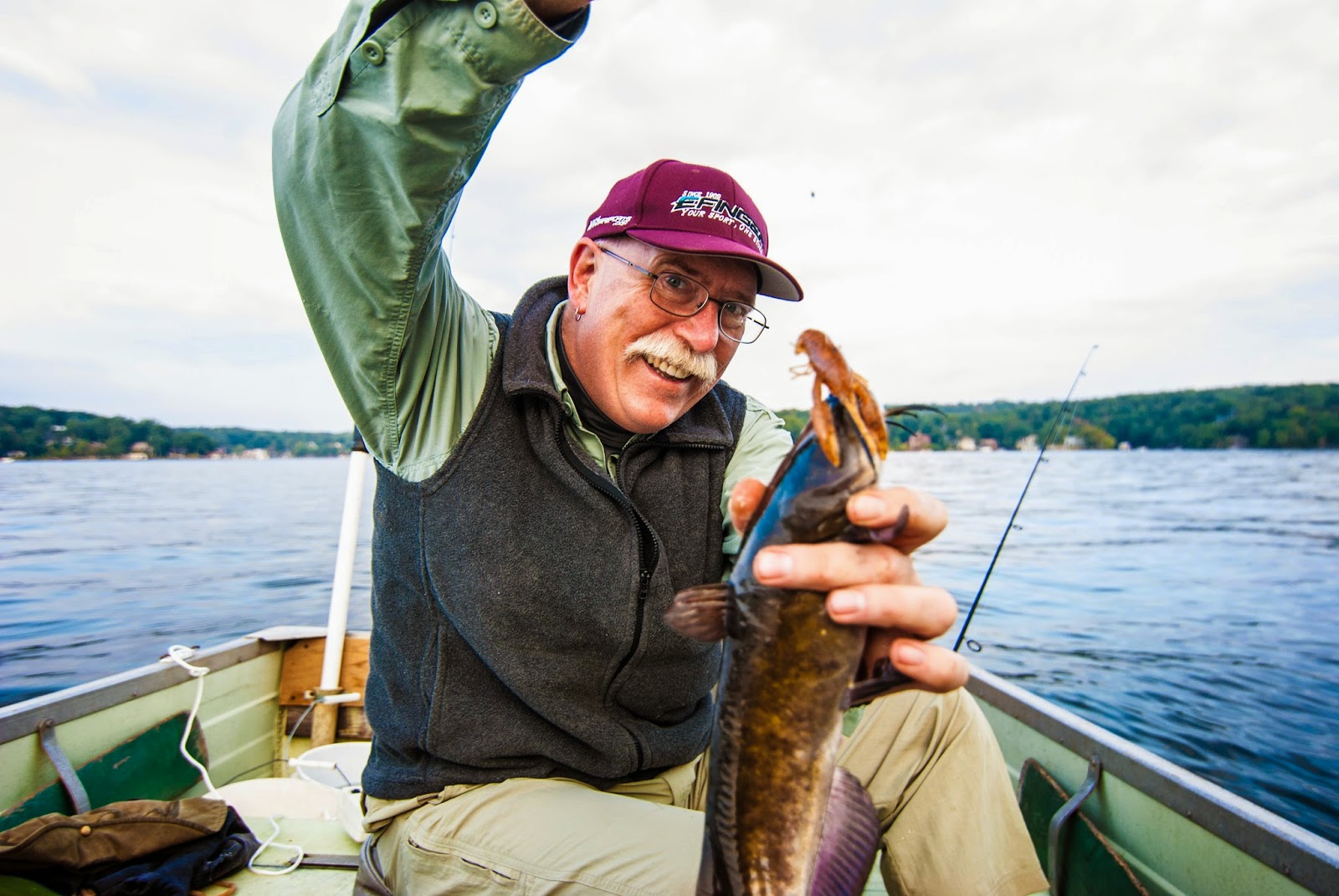
Fall is certainly here with a lot of leaves beginning to change and chilly mornings. And this morning began without much wind, while nothing seemed to vow against the auspices of a good catch. Knee Deep hosted a walleye tournament, and a BASS club had another, but Hopatcong is a big lake and seems to accommodate all. I caught a little largemouth on a Senko in five or six feet of water within minutes of beginning with a Torpedo, and not very long thereafter Fred caught this big brown bullhead (not channel catfish!) on a jig tipped with a plastic crayfish. I thought he would hoist a small walleye; the catfish hit about 25 feet down.

Meanwhile, we had our herring out. We watched one of the Bassmasters catch a couple of small largemouths down the way from us. I had a tugging desire to give up on the bait fishing and pick away at docks. But Fred put it better than I could.

"I can fish bass like that any time I want. We're after other species we don't get much of a chance to catch."

And I've caught both walleye and hybrid stripers jigging, but once I got over my initial anxiety that Fred might be impatient with live lining herring, I touched base with my usual familiarity fishing this way. I only get a few chances each year to do it. And it moves me to a watchfulness of intent--with this, deep relaxation--that only soaking clams or bunker surf fishing, or fishing live shrimp in the Florida Keys approximates. Live lining herring--or weighting them, besides--allows you to fish a Senko or a nightcrawler while you keep watch, or just keep your eyes on the lines in a way that the rhythm of casting, over and over again, breaks the concentration, the meditative focus on something so simple that it can have the effect of opening your senses and mind to a much wider aperture than daily demands allow. I tend to prefer nightcrawlers to plastics because I can fish them in much the same way. All you have to do is attend the lines quite as if something will happen.

And on Hopatcong, something usually does. Besides the nightcrawlers--we caught crappie, a white perch, bluegills, pumpkinseeds, green sunfish--nothing touched the herring all eight hours. This was a first for me. It's as if it's still too much summer, not enough fall. My son and I have always done much better in July. And we've caught crappie on herring. Fred found them 25 feet deep today. We caught four all told, and just about big enough to swallow a herring. We ended up weighting herring on bottom with slip-egg sinkers, and this didn't kill them 25 feet down. Oxygen is getting deep now.


Friday, September 19, 2014

Rainbow Trout are About to Show up in Shore Catches


Greeting incoming rainbows, possibly browns. Once the surface temperature of Round Valley Reservoir dips to 70, they move in close to shore. I suppose that's about where the temperature has fallen over the past week-and-a-half. You would think browns would come in before rainbows, since they're warmer water fish, but I've never seen browns until October. Some of the rainbows, moved by frustrated spawning urges--they don't spawn here, nor browns, though lake trout do--cruise in pods right against shore when wave action stirs sediment and likely offers some tidbits to feed on.

I walked onto the ramp dock and cast a marshmallow & mealworm on three feet of leader, tied off by a small barrel swivel, enough to weight the line a little at a 3/4th-ounce steel egg sinker. The marshmallow floats the hook and the mealworm. Then I kept the bail open and stripped line to set the rod on a stone. Nothing happened. A typical fall, winter, or early spring Round Valley trout stint. Once and awhile something does happen, and I've caught rainbows as large as about 5 1/2 pounds.

I kept watch over the rod--easy to have the line stripped to the spool and rod lost--as I enjoyed photographing scenes and reading otherwise. Most of us fish three lines, and pretty soon I'll be fishing two. I don't like to get more involved than this.

That's all for smallmouths on the South Branch Raritan this year for me, I think. I didn't fish the river much this summer, disappointed in high water levels, for one thing. The Neshanic River flowing into the large river is reduced to a trickle and has been this way awhile, but a lot of water has been let loose from Spruce Run Reservoir over the weeks. I didn't see the South Branch today, but every time I saw it, it flowed fast.

Beautiful day at the reservoir. A couple of people were out paddleboarding, but that's about the last of this anyone will see for a long while.


Saturday, September 13, 2014

Millstone River for Smallmouth Bass, Northern Pike


Millstone River for smallmouth bass, northern pike


          The Millstone River originates in western Monmouth County, flows through a section of Middlesex County into Mercer County and Princeton, and enters Carnegie Lake near the mid-point. The water spilling over the lake’s dam and flowing north and east is the Millstone River, although Stony Brook is a sizeable small river where it enters the lake’s head. The Millstone begins and ends as a Piedmont Plain, mostly mud bottomed river, but Stony Brook is the state’s southernmost predominantly freestone stream. Three miles further south, the Shipietaukin Creek runs over gravelly slates and broken rock for a mile or two of its longer length, yet most of Stony Brook flows through the hilly region of Mercer, and the swift water flowing over rocks at least used to hold excellent smallmouth bass populations.

          Virtually none of these bass make their way into Carnegie Lake (good for largemouths). But the Millstone has smallmouths despite lack of many rocks and gravel. The bass both run upstream from the Raritan River and make their way from Beden’s Brook—another Mercer County freestone stream—which flows into the Millstone at Rocky Hill. From what I understand years after I posted this article, northern pike are no longer stocked by the state, but pickerel may seem more common than smallmouths, largemouths too, but one spot in particular used to hold a number of smallmouths willing to hit on a given afternoon.

          This is the first time I’ve divulged a very specific location in more than three years’ column writing. I hope I didn't burn anyone else’s favorite spot and don’t believe I did, since I passed over the Wilhousky Street Bridge every other day for almost six years. In all that time, I never saw anyone fishing the Weston Causeway Dam race in clear view as I passed over. Since those years of working as a courier, the Weston Causeway Dam was removed.

          My son, Matt, was seven when we parked near the Manville bridge in Somerset County to fish the area of the dam. That was August 2006, and for a couple of months Matt had been excited about fishing this piece of the Millstone for muskies. I had read and discussed with him a peculiar article I liked in The Fisherman magazine which recommends this spot for just that species, and while it isn’t impossible—muskies are stocked in the Delaware and Raritan Canal and find their way into the Raritan River and then into the Millstone—northern pike are much more likely caught, since thousands have been stocked in the Millstone by the state over the years. Oddly though, I've heard of no one actually catching pike in the Millstone. By comparison, Passaic River pike thrive, but I don't know why a discrepancy has existed. I have heard of a pike caught in the Raritan River, obviously having washed down, and a pike caught in the canal, possibly because of a floodwater transfer from the Millstone. One other unlikely catch is walleye. The same article featured a photograph of a walleye apparently caught in the Millstone at Wilhousky. They’re not stocked in the canal or the river. They make their way into the Raritan from the Delaware, by way of the canal. State Department of Environmental Protection Division of Fish and Game personnel reportedly tallied electroshock recovery samples from the Millstone last year, and these included one large walleye.

          Of course, Matt and I caught no muskies or walleyes. We caught no northern pike or largemouth bass either, but I was pleasantly surprised to experience catching three smallmouth bass, which slammed our small spinnerbaits as the blades pulsed through the fast water below the dam. Two bass were very good size, weighing more than a pound-and-a-half. Obviously, a little fast water combined with rock-like concrete is a smallmouth bass magnet. I suppose any walleye in the area would frequent the fast water also. Walleye have been caught on occasion in the canal for decades—always at any one of the nine locks in fast water. You may have to fish all nine locks at least nine times each to hook a walleye, but these are the places where they take residence. Smallmouths at Wilhousky are an easier catch.

          They won’t be for long, since the Weston Causeway Dam is slated for removal soon, probably next summer. This is why I can tell you about this spot in good conscience. It deserves some honor.

          Dams are removed for good reason, since rivers liberated improve ecologically and fisheries increase. Once the two Millstone dams go, shad and herring may swim as far upstream as Carnegie Lake dam. More smallmouth bass will rise from the Raritan too, since at present the Weston Causeway Dam stops bass from swimming further, although some fishermen surely release bass on the upstream side.

          I guess an interesting project for the Millstone would be the introduction of tons of rock and gravel on the stream bed, but I’m only dreaming. Besides, it’s got current sluices, eddies, and especially downed trees and brush making excellent pike, pickerel, and largemouth habitat. It’s a river for kayakers and canoers, and will be safer without temptation to go over a dam and get submerged in the circular current below.  


I'm writing The Microlight Quest: Trout, Adventure, Renewal, a memoir I intend to get published.


Wednesday, September 10, 2014

More Bass Action at the Local Pond


Out walking the dog on Sunday evening, I watched a man fishing the pond for bass, struck up some conversation about fewer bass seeming present than recent years, a view he never assented to. He fan cast a floater/diver plug through open water, hadn't had a hit, and I saw him leave with no action behind him.

I kept targeting the sparse algae edges in close this evening with a Senko-type worm. You can see some in the photo. Since this pond is very shallow, it would make better sense to use a slow-sinking traditional worm, but I prefer the five inch Senko-type's casting range, and have always done well for the past five or six years I've been fishing this type of worm. Often I hook-up on the flutter-retrieve, worm rigged Wacky with hook in the middle. An inset hook is pretty pointless. The only aquatic vegetation here is algae and that attaches to weedless rigs also.

I walked beyond the edge of the culvert after fishing about 10 minutes and spooked a bass that was in close to the bank, under an algae clump. What a rush to have encountered some serious life. A snapping turtle had left a trail of bubbles, but encountering a fair-size bass, judging by the wake, felt like purpose could have a real end to it.

I started touching my casts down beside and in between algae clumps as perfectly as I could guide them. Nothing was happening after almost five minutes of eliminating possibilities, but finally I got a tick, thought it could be a sunfish. I tightened and the line lurched forward with a great deal of weight on the other end. I gave slack, hoping the bass wouldn't drop, tightened up prepared this time, and set the hook.

Two-pounder. Average bass here. I set up my Gorillapod for a remote controlled photo. Since I'm new to taking this sort of shot, it didn't surprise me I encountered complications, even though I had practiced before I went out. Instead of risking the bass's life, I released it without getting a photo. Then I discovered the problem had been that I aimed the remote in the wrong direction.