Friday, November 15, 2013

Fly Fishing the Claremont South Branch Raritan River


Fly fishing the Claremont, South Branch Raritan River

By Bruce Litton
This is another of my Recorder Newspaper column pieces, published recently in September or early October.


          Perhaps no length of river for fly fishing in New Jersey is as mysterious as the Claremont section of the South Branch Raritan. Last stocked in 1995, wild brown and rainbow trout, and native brook trout, flourish in a 1.1 mile section of river from the fence dividing off a private fishing club upstream, and Electric Brook in Long Valley downstream. An abandoned rail line is converted into a pathway that runs straight parallel to the river, but the river itself is out of sight in dense woodland well off the path. Climbing over downfalls and through brambles to wade it may be difficult, and many fishing situations allow roll casting at best. But the heart of the mystery is the size of some brown trout that may be there. They’ve been caught as large as eight pounds apparently.

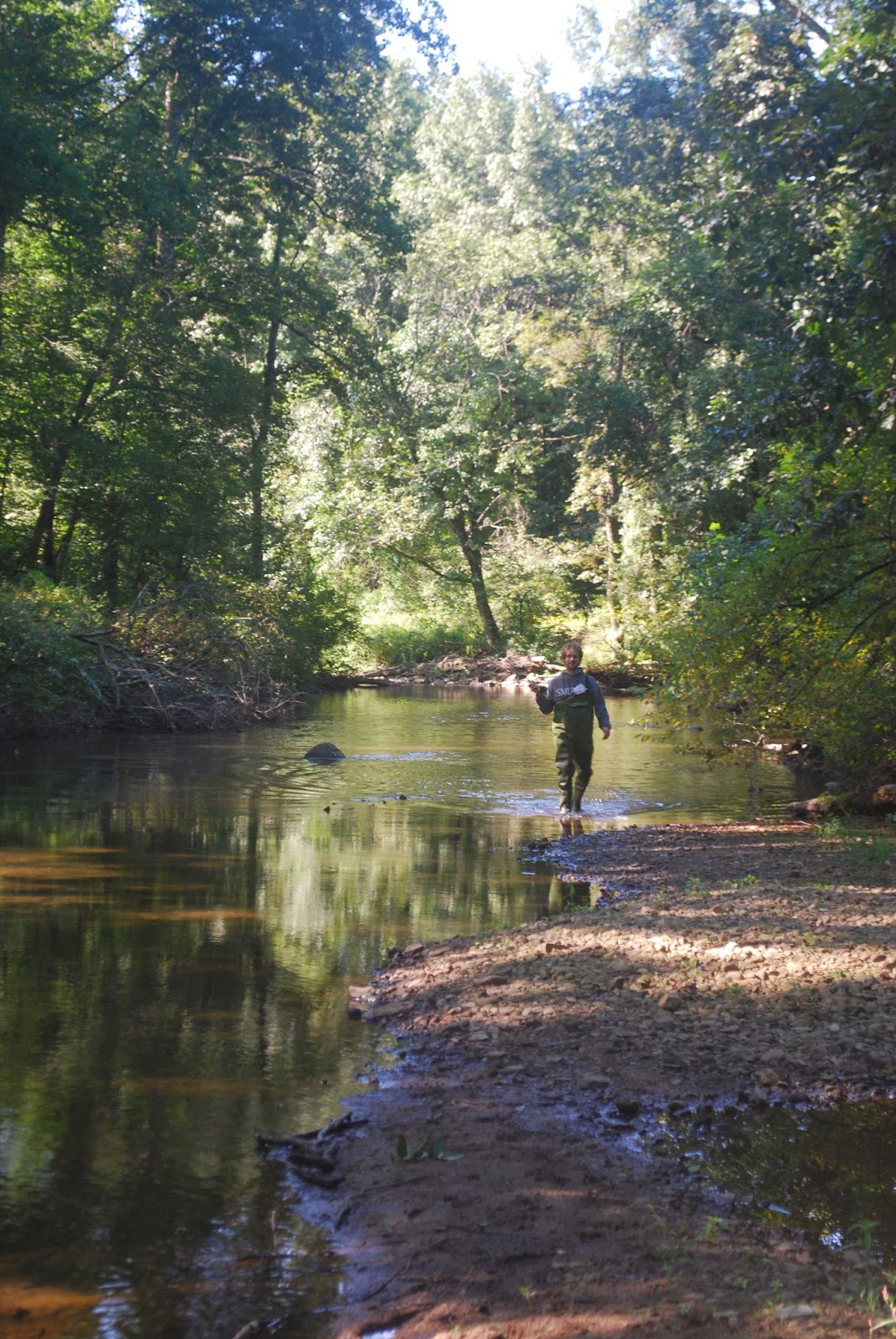
          Fly casting the river recently with Oliver Round, I wondered just where such a fish could possibly be. The hole just below the bridge where Patriots Path crosses is very deep, but not really very large. Wading upstream, I found that the river averages about 20 feet wide and two and a half feet deep, not exactly territory for any browns to be expected over 17 inches or so. No doubt, a real large brown is a rarity. Even a 17-incher is a seldom encounter, and nothing has convinced me that the eight-pounder I heard about was a wild fish. Perhaps it made its way down from stockings by the private trout club above. More mystery yet to add to the picture; if the thought of a huge but stocked trout is disappointing, at least we consider realism.

          This was one of the first of this fall’s chilly mornings when Oliver and I fished—about 42 degrees. However, Oliver has actually waded this section in January—downed trees, brambles, briar patches and all—and happened to catch eight browns that cold day on flies which imitate trout eggs. After all, these trout reproduce and feed on one another’s spawn, as odd as the behavior may seem. This September morning, we spotted a lot of trout but caught only one on a size 14 stonefly nymph. The water was clear, the trout skittish, and time in fairly short supply. A few rose in the hole below the bridge where we first arrived, but I was disappointed that none would take my size 18 parachute ant, size 20 blue winged olive, or size 20 Adams. I tried a fly that resembles a small worm, then switched to a white-bodied streamer with a golden flair of hackle rising over its back and walked over the bridge the way we came, to crawl between bush boughs and begin roll casting to the spot where I had seen a trout rise three times. I got a strike and believe it was that fish, but missed it. Meanwhile, Oliver had three hits from the same rainbow trout on a streamer just upstream of the bridge.

          We waded upstream and the day got more interesting as my hands warmed, and we had the sense of a wild place isolated from the byways, homes, and businesses that fill New Jersey. Once it was the other way around. Villages, towns, homes, even cities, scattered about isolated in the general wilderness. I checked my phone for the time, and of course it had service too. Oliver took out his phone and showed me a video he had filmed of a spring in the woods somewhere nearby between the path and the river. It is immense, wherever it is exactly. Oliver spoke of bringing a GPS and trying to find it again. It didn’t bubble; it welled up like a fire hydrant flow from the ground.

          On the high end of Schooley’s Mountain, Budd Lake—a shallow warm-water lake—is the origin of the South Branch Raritan River not many miles from where we fished. During summer, the water flowing out of the sluggish, weed-choked lagoon at the end of the lake is very warm. But all the way down the mountain the river is spring fed. I had no idea springs like the one Oliver showed me on video exist in New Jersey. But I have read that the river is so rich in springs keeping the water cool that native brook trout exist within a quarter mile of the lake. In any case, there are wild and native trout in the South Branch Raritan’s upper reaches, and exploration may reveal surprises unexpected.

Monday, November 11, 2013

Prepare for Winter: Enjoy the Ice


Black Ice is Best and We May Have Some Soon
 
Every year in November, I look forward to ice fishing, so I thought it appropriate to post. In the meantime, I may be fishing Round Valley next week.
I made a prediction about the winter ahead being a mild one, and I was pretty much right, although we had at least a week of more and less safe ice. I have no hunch about this winter, so just maybe it will be colder than the last two.


Another mild week after skim ice formed on ponds two consecutive cold mornings recently. Even that didn’t move my conviction that this is a mild winter. Typically we get about two months of ice thickening to at least a foot, sometimes twice this or more in northern, high elevations of the New Jersey. In 2008 we had no more than two weeks of marginally safe ice; to get no safe ice over winter’s course is very rare.

For any first timers at ice fishing, paying heed to safety is a life requirement. I never recommend any newcomer go out on ice fewer than five inches thick—clear, hard ice, not refrozen. No one really wants to go out on a deep lake for the first time, poking ahead of himself nervously with a splitting bar, with no adequate knowledge about whether or not the ice he stands on will give way to water that would kill him in 10 minutes. Get a guide to show you how for as long as it takes until you feel comfortable and are knowledgable out there. It’s probably a foregone conclusion of your own that if you want to try this, you should find someone reliable to introduce you to it. Joining the Knee Deep Club of Lake Hopatcong may suffice.

The larger lakes freeze unevenly. Well inside a cove—where pickerel and perch especially are caught—the ice may be quite safe. But walk towards the mouth of that cove, where winds have kept water open until it froze an inch the night before, and you’ll go through. Always, no matter how safe the ice, wear a pair of ice spikes available at many sporting goods shops. If you do go through, as unlikely as this is, the points can be jammed into ice so you can pull yourself out, then belly squirm away from the thin area.

In my experience, there’s really no other outdoor pursuit like ice fishing. I've done it for years, have never fallen through, have never seen anyone fall through. I have also, many times, broken the thin ice of Barnegat Bay as I ploughed in bodily, wearing layered wetsuits for commercial clamming. Once I worked in the bay for five hours beginning at dawn with 10 degrees Fahrenheit and snow, ending at 17 degrees, 45 mph winds, and the wind chill 26 below. Clamming paid well during the 1980’s, and was more of an adventure than ice fishing, but ice fishing is serene, easier, yet plenty adventuresome. It allows you to get in touch with nature in quiet, leisurely ways, so long as not too many snowmobiles, quads, and power augers are nearby. Plenty of fish species are available in our Highlands, New Jersey, region—pickerel, largemouth and smallmouth bass, muskies, northern pike, walleyes, trout species, channel catfish, hybrid stripers, and all manner of panfish including roving yellow perch in some waters.

First ice is best ice—so long as it’s safe. The “black ice” we sometimes have before snow blocks sunlight reaching through clear water depths, often safely covering only two to 10 acre ponds that freeze first (and evenly) before that snow falls, is easy to cut with a splitting bar since it’s not thick as a vault door. But sunlight’s the secret to this fishing. Try to get out on a cloudless day, the kind of day that “isn’t good for fishing.” Fish water 10 feet deep or shallower, clear water among residual weeds preferably. Bait tip-ups with live shiners, and try some chrome finished spoons using short jigging rods.

Shiner scales serve shiners' schooling interests, if you can say this line without twisting your tongue. The flashes of reflected light confuse perceptions of predators. But when isolated on a hook beneath a tip-up device (these also available at many sporting goods stores), these light-reflecting shields do just the opposite, attracting gamefish like a beacon to zero in upon directly and hit. Silvery, chrome spoons like small Kastmasters do the same.

I go for largemouth and pickerel when I have first ice opportunity, this ice which hasn’t been corrupted yet by melting and refreezing. These two species prowl relatively shallow water penetrated by needed light. So long as adequate fish holding depths are nearby (if any), and fairly thick residual vegetation is present if the pond or lake has any, the irony is that fish will be skittish, off the feed, and even residing in the thickest of cover, but they will strike by aggressive reaction. I’ve experienced tip-up flags flying high, bass stripping off five or ten yards of line and dropping shiners, refusing to swallow. This happens no other time.


Sunday, November 3, 2013

Hunch Leads to Binsky Jigged Walleye

I phoned Oliver at 5:00 a.m., complaining to his message recorder of severe nerve pain in my left leg, saying I probably had to cancel. He phoned back within five minutes and I said I had done some exercises, it felt better, I would phone him back. Meanwhile, I fixed eggs and coffee. The car was loaded. I phoned and said, "Let's hit the road."

The weather was sort of mild and the lake perfectly calm. Once again, I made a night crossing from Dows, running lights with the useless suction cups in each of our hands. By the time we got to Raccoon Island, it was still pretty dark. The rods were rigged but a little tangled. Soon we put herring on two rods directly under the boat and casted Binsky bladebaits, jigging them off bottom along the drop-off. We were disappointed after an hour or so of persistence but no action and resorted to nightcrawlers for some perch, sunfish, and each of us caught a largemouth near the rocks. My leg gave me no serious trouble; I had forgotten about it and really didn't think about it for the rest of the outing. It had got chillier even after sunrise, and I expected the weather to warm when we arrived at our next spot.

We jigged Elba and Pickerel Points, a very slight breeze allowing us to drift only a bit while I used the electric to help position. It was getting milder, too. The herring yielded nothing nor the Binskies. But I had one of my hunches and immediately suggested we try Chestnut Point. That's where I had planned to try next, but I knew right away it was time to go. The hunch was the only one I had all day, deep and resonant as qualifies such intuition, rather than ordinary guesses as are common.

That's where--with a light breeze that was about perfect to jig vertically while moving parallel along the drop--I jigged the walleye, which made a very slow day a little more interesting. I told Oliver my hunches seem no better than superstition, since I was in no position to offer him anything close to resembling proof. I can't offer you, the reader, proof either. But I feel them distinctly when they happen, and I'm always eager to act upon them at once, because more often than not, perhaps, I get results. I noticed that in addition to catching the walleye, my hunch put us on the best drifts for jigging of the day as well. I had a glimmer of recognition about this before we got to Chestnut, but I think after I felt the possibility of a fish. We drifted the drop three times and headed in at 11:30. One of the herring rods bent under the weight of a fish that dropped the bait shortly after my catch.

When you think about it, what is "fishing" but feeling around in the dark of water for a catch? A great deal of emphasis is put on explicit knowledge in the pursuit, but when you get down to it, every cast is a sort of shot in the dark. So, apart from sighting fish or very obvious cover, if something or other within you informs messing around in the dark, it might be a good idea to follow it.


Wednesday, October 30, 2013

Brown Trout Round Valley Reservoir Shoreline

When I checked on my two lines out with the bails open, one of the reels was almost spooled. I had casted marshmallows and mealworms into about 25 feet of water and let them be. It took forever to reel this 19 1/2 inch brown to the bank, and when it was in view, it became docile as if submitting to capture, something innocent and aware about the eyes on the large head moving me to a kind of compassion, a sense of shared life between us. I began thinking that this trout hadn't been devouring many herring and shiners out in the reservoir, as skinny as it is. I had the natural hope that other trout are. The 24 inch rainbow I caught last December was very full bodied. Perhaps the distinct spots accentuated the life gleam in the dark eyes. Whatever the case, it's a beautiful fish with a tag, which means it hasn't been in Round Valley very long, and I wonder if for some reason it never acclimated to food sources. However, my big rainbow last year had a tag also.

The rainbows arrive along the shorelines first in late September. I really don't when the browns come in, but I guess they're pretty much in close now.

Monday, October 28, 2013

Round Valley Rerservoir Green as November Comes

Heading for Lot 2 put me into an unexpected appreciation of time as I returned for the first time since March or April. I pulled into a space near the kayak, canoe, etc. launch and set a steel egg sinker deep on the drop-off. I began fishing this spot in February, but I had fished further down along the shoreline, parking in the back of the lot, since December 5th when I caught a rainbow over five pounds. The place was vacant once a couple of kayakers paddled out, and as indifferent to me as a desert, but it's what I take in appreciation that enlivens, which is interest rather than feeling put out and a stranger where I don't belong. I make this place a habitation. Why I do it is a whole can of spinach I won't open.

Trees in the background look brown in the photo, but actually most of the trees are still green just days from November. It's as if New Jersey has a Virginian climate.

I've fished at the Round Valley main launch area four times this year & caught nothing so far. Nothing today at the Lot 2 launch. The marshmallow & mealworm combination has worked for some other anglers, but I'll persist at this through the winter, getting my breaths of open air and eyefuls of distant scenes changing with the weather, while I read whatever books interest me. Intend to try live shiners, since lake and brown trout may be more likely to hit them.

The reservoir's an excellent place to find solitude late and early in the year, and in a space wide open for miles around--all that to take in and be amazed, if the thought even bothers to occur, which it hasn't out here for me to my memory, that this is New Jersey. I'm too involved to impose upon Round Valley the kind of busyness happening on the other side of surrounding Cushetunk Mountain.

Wednesday, October 23, 2013

To a Governor's Honor: Lewis Morris County Park, New Jersey


Lewis Morris Park
To a Governor’s Honor
By Bruce Litton
 
Finally decided this piece will never see publication in any magazine. Here it is, originally intended for a local publication, deal fell through three years ago. I had fished Sunrise Lake since 1995 and walked trails, so I simply got curious as to what the name of the park is all about. Besides research I did online about Lewis Morris County Park, I did my research from the only two books I could get through inter-library loan service on the former Governor and those pre-Revolution times of the fledgling state, and apparently that's about all anyone has to work with. Surprising, because Lewis Morris comes through as a very dynamic and important figure. Whether or not archive stacks are somewhere at scholars' disposal if they choose to use them, I don't know. But my relatively short essay should help you to understand the state perhaps most pivotal in the American Revolution and now the most densely populated in America, but especially to understand a man who made himself. At least to catch a glimpse of understanding.  
 
          Lewis Morris County Park in Washington Township covers 1154 acres of forest, meadows, streams, and sites developed for recreational purposes from Route 24 south and west to Tempe Wick Road, bordering upon Morristown National Historical Park. Meticulously maintained trails wind through forest allowing mountain bikers and hikers to loop as many as six miles on a single path. Morris County’s great unifying trail, Patriot’s Path, connects many parks and communities, and links Lewis Morris Park into its eclectic system. Some trails are designated for horseback riding, open spaces are good for cross country skiing and snow shoeing, hills for sledding during winter. Athletic fields, fitness stations, horseshoe pits, playground, dog park, picnic facilities, and a group camping area are also features that make the park a serious recreational attraction. A three acre aquatic impoundment also graces the surroundings near Route 24.
          Sunrise Lake, with clear water of quality drainage, is fed by a tiny brook with a small population of native brook trout, which require pure water to survive. A swimming beach, paddle and row boats, snack bar, locker rooms and showers, and plenty of shore space to fish bass or sunfish are main attractions. The fishing is good, and has been written about for The Fisherman magazine.
          A great deal appears in blogs about the mountain biking as well, and the Jersey Offroad Bicycle Association, JORBA, and the International Mountain Bike Association, IMBA, have member volunteers for the Morris Trails Partnership, which does much of the trail construction. Upkeep is conscientious and thorough, as trails are rerouted into fresh directions, and forest succession renews the old. But not every activity is for the individual alone, or for small groups.
          Reservation permits are available for parties of 25 or more through the Morris County Park Commission. Reserved activities include wedding ceremonies, wedding photography, tented events, and other special programs. While the natural attractions here are photogenic to say the least, for some people the invisible history may be the most interesting aspect. Like many parks in history- rich New Jersey, Lewis Morris County Park has stories about it worth knowing.
          Lewis Morris County Park itself was the first creation of the Morris County Park Commission, established in 1956, with the park dedicated in 1958. Prior to acquiring the original 350 acres, Sunrise Lake and the adjacent land situated the Jockey Hollow Club. A cultural center is housed in a building on park land with Morris County Park Commission offices, Morris County Heritage Commission offices, Park Police, and other Morris County offices, along with small display cases for the public.
          To the south and west of Sunrise Lake, reaching Tempe Wick Road, the park includes Ledell’s Pond, and the history associated with it, some of that history visible as a lime kiln near the pond. The present residents of the Ledell house own the pond edge and mill foundation. Descendants of Dr. William Ledell acquired the property in the 1770’s. Dr. Ledell had come to Mendham in 1667 to pursue medical studies. Nearly a hundred years later, a few Revolutionary War soldiers encamped in the shadows of one of the relatively few houses in the region. Such historical details are significant and interesting, although not much seemed to happen before the Revolutionary War. But the most significant aspect of the park is its namesake, Lewis Morris, whom so few visitors know anything about.
          Morris lived from 1671-1746 and was the Governor of the Royal Province of New Jersey from 1738 to his death, essentially New Jersey’s first governor. Upon his British Royal Appointment, New Jersey separated from New York’s governing rule. In the years preceding Morris’s appointment, the governor had resided in New York and looked after its interests before he did those of New Jersey. After Morris’s predecessor Governor William Cosby died in 1737, the movement for New Jersey to have its own governor had developed strongly.
          Earlier, prior to 1702, New Jersey was not a royal province at all, regardless of any influence of New York. East Jersey and West Jersey were ruled by separate proprietary governments, governance by Aristocrats who owned large acreages of land: the Landed Aristocracy, or Landed Gentry. Deeds of lease and release granted by the Duke of York in 1664 gave territorial but not political rights to the people, which meant that most had comparatively few rights observed. Nonetheless, a handful of land proprietors exercised government in spite of this implied lack of legality, obviously well understood among people since faction and unrest tore at the political integrity of East and West Jersey, contentions raging essentially about the government’s illegitimacy.
          Although both East and West Jersey surrendered to the English Crown in 1702, political struggle between court and country principles had been endemic to all of the American colonies, and lasted through and beyond Morris’s governorship. Court ideology meant the subordination of the colonies to England, respect for royal authority, and subjects’ duties to the Crown—a very alien state of affairs compared to what we enjoy now, and certainly not without suspicion against it at that time in the form of country ideology, which drove people to fight for their rights, drove them to greater colonial self-government which limited royal authority, and finally abolished royal authority altogether. Country ideology was the body of political ideas which gathered together the rebellion that finally broke out and secured our nation.
          But Morris was not entirely on the side of country principles. He could not have been in order to secure New Jersey as its own Royal Province, which was a progressive step in the direction of American independence. This did secure more rights and better stability. But his career was tumultuously contentious as he alternated between these court and country principles. However, alternation was really the norm among colonial politicians before the Revolution. None of them were rebels who consistently advocated for colonial self-government and rights. What distinguished Morris from them was his personal intensity, unusual among politicians, which endorsed his stature as a distinguished leader, not only in New Jersey’s history, but that of the origins of our national history as well.
          Although his changing positions expedited his personal advantage, these inconsistencies never excluded intellectual conviction in relation to political situations he faced. Much more than provisionally informed on the issues, he grappled with them in passionate depths. A learned man who wrote poetry and conversed about the classics and natural science with William Penn and a large number of other cultural luminaries, his personal convictions never shifted arbitrarily; their rationality held true as we will see at the essay’s end, even though his prejudice favoring those like himself with wealth and social standing biased his decisions.
          His ownership included the 6200 acre Tintern tract at what is now Tinton Falls near the Garden State Parkway north of Asbury Park, a property used for smelting bog iron and for agriculture; the 1920 acre Morrisania estate in the section of New York which is now the Bronx; and a 1500 acre tract on Long Island. He absolutely believed that his own wealth and status gave him the right to act as a natural leader of society and pursued this ambition with single minded passion from the age of 20—his positions not handed to him on a platter—through many political stages, beginning as a member of the East Jersey Council. He did not waste time in roles of lesser importance and soon showed that he knew how to move on.
           In 1696, proprietors from both East and West Jersey misinterpreted the Act of Trade to mean Scots could not hold office in the colonies. As a result, Jeremiah Basse replaced East Jersey Governor Andrew Hamilton, rude to say the least. A letter from the East Jersey proprietors to Hamilton informed him that Basse was coming to America with royal approval. After his arrival, however, Hamilton found that Basse had no royal credentials. Morris, thoroughly clued into the situation, dissented from the other council members’ decision to accept Basse as governor. Dismissed from council office, Morris’s steps didn’t trip for a moment. He knew what he was doing.
          He opposed Basse. Both in writing and speech he kept his presence known, all the while becoming convinced through this very process that royal government must replace proprietary government in New Jersey and went to England to persuade the change. In July 1701 he approached the imperial administration with a letter of recommendation from William Penn, his mission to bring about the surrender of both proprietary governments—East and West Jersey—to the Crown, garnering strong support in his own favor during the process. He was still young and already winning his own and New Jersey’s future.
          December 1st, 1702, Morris personally reviewed for the members of the East Jersey Board of Proprietors the terms and conditions of surrender. Dismissal from council to the surrender of East Jersey in less than six years, Morris had never been undone. The board members were overwhelmingly grateful to him, and reduced the quitrent (taxation) on his land to the payment of a pint of spring water a year, and also gave him Tintern. Ten years total into his career, Morris had triumphed.
           Further offices included the salient examples of Morris being President of the New Jersey Council at 36, Representative in the New York Assembly at 39, Chief Justice of the New York Supreme Court at 43, and finally Royal Governor of New Jersey at 66. Morris learned early in his career that English imperial administration played a central role in the colonial political system; good relations with it were decisive to determine local leaders’ gained or lost power in America. What we call connectivity he had to a very keen degree.
            After a second trip to England at the age of 64, he soon received appointment as Royal Governor of New Jersey by the Imperial Administration of King George the Second. New Jersey subjects generally approved since Morris’s popularity had peaked because of his opposition to New York-New Jersey Governor William Cosby. Cosby had become involved in an inappropriate quarrel over salary. Being at the time Chief Justice, Morris boldly defied Cosby, and was suspended. This resulted in this second trip to England, where he took the case of his suspension on appeal. Before he returned, Cosby had died in 1737, and Morris assumed leadership of New Jersey almost to a hero’s welcome.
          But people soon learned his singularity of mind against the views of others erupted in violent oppositions. Particularly his persistent chiding and quarreling with the Assembly weakened his popularity. This enormous presence of a man who had won such confidence in others by challenging unpopular executives with absolute conviction—had himself become one of the most unpopular.
          As Governor of New Jersey, Morris had concluded that expanded powers of colonial assemblies were dangerous to royal authority. England warred with Spain and France. With this distraction overseas, Morris’s calls for radical parliamentary intervention failed. The earlier years of his career produced in him a major role in promoting the silent revolution of expanding provincial assembly powers, opposite proposals near the end of his career mandated in other forms after his death ironically influenced dissolution of the British imperial structure in America that Morris had hoped to save. But was it altogether by indirection that Lewis Morris played a key role in bringing about the American Revolution, provoking colonists with threats of royalist intervention? He died at the ripe age of 75 long before the struggle came to a head, so it seems useless to speculate upon had he lived longer.
           Because he could have only known what he knew from the vantage of his ambition and unique sense of rightness, he saved New Jersey both from a corrupt proprietary form of government, and from a second rate relation to New York. If he truly believed in court principles in the end, it was a belief much more deeply informed than how these principles were outwardly designated as forms of royalist power. He was himself not a submissive man. He was principled in terms of reason rather than obedience to authority and twice triumphed over loss by what amounted to imposing the order of his own genius upon situations which, on the blank face of them among uncomprehending colonists, were completely hopeless.


Monday, October 21, 2013

Lake Hopatcong Walleyes, Hybrid Stripers, Largemouth and Smallmouth Bass, Crappies


The portable running lights' suction cups were useless, so I held the white stern light, Matt the green and red bow light, as we chugged across Lake Hopatcong in one of Dow's 9.9-horsepower, 16-foot boats in the dark. The moon was full or just a sliver off, getting low on the northwestern horizon. Wind raced past our ears--cold--and stung our faces with spray. Matt was grateful I insisted on his jacket.

"It might be cold on the lake," I had said

"It's not cold out," Matt said as we prepared to leave Bedminster.

I bet it was at least 10 degrees colder at that nearly 1000-foot elevation. Bedminster is 81 feet where we live. Matt averted wind and spray by huddling in the bow space.

All rigged before we arrived, I baited six rods with herring in very low light. Matt caught the first fish, a crappie, and as I unhooked it, he said, "Dad, your rod just bent double." My head pivoted towards the stern, port side, as I reached for the rod in the corner with my right hand. I grabbed it, tightened up, set the hook, and was happy the fish was still there. First walleye, 20 1/2 inches.

I had set the herring fairly shallow, maybe 20 feet down. My hands stung by the cold air, the water inside the live well assured minor pain, water warm to the touch, I suppose about 60 degrees, but my hands quickly chilled in the wind. My graph recorder with thermometer is on the blink.

I keep bails open on the rods with herring set by steel egg sinkers, but line must have caught somehow to bend that rod. Soon we were into hybrids, all of these fish hitting in what would have been about 33 feet of water if the lake weren't down four feet. Matt caught four total, two of them close to three pounds and two about two pounds, all of them putting up the struggle they're famous for.

If we were the fish, and the fish fought on the winning end, it would be a struggle a lot harder for us, no matter how the fish judged our prowess. We lost none yesterday, but missed some hits. Some hybrids got the bait, but no fish got free during a fight. You can tell it's a hybrid by the quick speed of line from the spool after the fish takes a herring. If you hook one on a Binsky or Gotcha, you can tell by the jolting runs.

I was into the 26-inch, five-pound, 15-ounce walleye about a half hour after sunrise, line having slowly rolled off the spool. It swam right towards the boat and I told Matt, "Small fish."

Just then it bolted for bottom and I changed my mind. I pumped the fish to surface, and said, "Big walleye!" "Yeah, small fish," Matt said, and netted it.

My largest hybrid was 20 inches. The Berkeley electronic scale indexed 3 pounds, 10 ounces, and I think I had Matt hold it for the photo. At any rate, that hybrid he's holding looks better than three pounds. Another was 18 inches, two close to this length. I nailed largemouth bass, catching a total of eight about the size photographed. The smallmouth was 16 1/2 inches.

Matt usually likes to use nightcrawlers, and I had my eight-foot Tica with 20-pound test Power Pro, a steel leader, and steel Mustad hook to put a yellow perch hooked near the dorsal down under the boat 15 feet or so with drag set light for a possible musky. Hell of a way to catch one, if any hit, but why not. Turned out Matt used no nightcrawlers, but I used nearly all three dozen. All the bass I played on one of our two ultra-light St. Croix rods I built from components such as rod blanks; cork I filed, shaped, and sanded; guides I wrapped and varnished; reel seats. The smallmouth was a dream come true. Not only did it fight super hard on that rod, it was just about within the size class of smallmouths we have caught consistently the past three years including this summer, although some of these other bass have been 18 and 18 1/2 inches.

"Look at that smallmouth!" I was blown away, seeing it in the clear water. I just didn't really expect we'd score another nice one yesterday.

Matt was mostly content to curl up and sleep in the bow and I didn't hold it against him. Who knows how late he was up. I always tell him to go to bed early before Hopatcong. Nevertheless, he enjoyed the trip and I don't mean that ironically. I kept busy fishing the whole eight hours, sometimes taking a break to just breathe fresh air and take in stunning lake views, absorb the distance all around, feel the breeze and wind (variable) that didn't warm a whole lot (I never took off my jacket). The weather felt seasonal enough to change pain and shivering into that pleasant zest of fall.

Before we had left the marina to cross in the dark, I bought a Binsky from Laurie. I wasn't sure it was going to satisfy, but once I began working it--vertically, diagonally--I knew I had found the lure to replace for me the Gotchas and Rapala Ice Jigs. That vibrant motion must really attract fish. At any rate, no walleyes or hybrids today, but I caught two crappies and a pumpkinseed, these fish in about 30 to 35 feet of water at Pickerel Point and off Chestnut Point. I wanted to fish the lure longer, compelled, but after a couple of hours in brilliant sunlight that seemed to turn the walleyes and hybrids off by 8:30, I knew we had to go or I would get behind on things at home.

As it turned out, I got to sleep at 11:00 p.m. after non-stop busyness, and got through today's workday without getting tired.