Tuesday, August 15, 2023

Headed West

Last August at the Finger Lakes, the "Superhost," as online hype has it about Air B&B, gave me a couple of fly rods passed down from his deceased father. One of them is an entry level Orvis. Found that out by calling Orvis, after I found the rod was fractured and imagined a way to graft the break. They told me my idea wouldn't work. I've kept the rod in case some idea might, but in any event, I like the Cortland five-weight matched with an old Medalist that Superhost gave me, also.

In the Sierras next week, I think I'll just use that Medalist. All a fly reel is, basically, is a way to contain the fly line. I would say the drag is essential...if you're fishing steelhead. But by what I've gathered, a 12-inch rainbow where we'll fish is a lunker. 

It's the line I like. I don't know if Superhost's Dad put Cortland five-weight on the reel, but whatever it is casts really nicely on that rod. Don't think I'll bother stripping it off the Medalist and cranking it onto my Fly Rise.  

Sunday, August 13, 2023

Picking Away at the Bass


I had to make a hundred burgers and fill the supermarket specialty case with various other items yesterday, on top of the normal busyness of a Saturday. I felt quite satisfied when my shift finished, and I came home, put the marine battery in the trunk with the help of my wife, loaded the rods, the sonar, and the GoPro, all other equipment loaded the night before, and went to bed. (I'm no longer keeping the 70-pound battery upstairs, and I'm not lifting it altogether, not without 50% help, but I'm still lifting the canoe along with my fishing partner. I'm not giving up.) 

Up at 4:18, I dressed, poured orange juice, ate a banana and peanuts, drove to Dover where I met Oliver Shapiro at 5:13. We packed his gear in my Honda Civic, loaded the canoe on top, and drove to Oxford Furnace Lake. Not a scratch on the car, but I do need to buy rope rather than continue to use the cord that broke on the return ride. (I pulled over and retied.) I use a heavy-duty ratchet to secure that canoe in the middle, but the front end sort of bounces, caught by the wind, unless tied down. 

We got on the water while plenty of shadow remained, throwing topwaters. I caught a little largemouth about six inches long. Oliver switched-out and caught the first sizeable bass on a plastic worm weighted by a slip sinker. The canoe was situated over about 12 or 14 feet of water. None of the weedlines at Furnace seem well-defined. The water isn't off-color, but not very clear. We were more or less at the edge of weeds, though, and as we began making our way down along the east side of the lake, I caught a smallish bass of about 11 inches by working the weeds with a unweighted worm rigged on an inset hook. 

Oliver made a point of the slip sinker getting the worm down through the weeds, and I agreed a slip sinker will do that. I thought especially of tungsten. I like to fish very slow, though. Weightless, a worm will get caught on weeds one with a sinker won't, but you can usually shake an unweighted worm free and let it drop a foot or two further along. Not always. But in any case, using weight or not is just a matter of preference. I threw a little paddletail jig outside the thick of the weeds, too, but nothing happened. Back at Lake Aeroflex in June, the well-defined weedline and clear water meant putting the little jig on bottom 20 feet down at that bottom edge of the weeds worked wonders. Today I was committed to my favorite way of bass fishing.

"You pick away at the bass," I said. I felt five of them a likely way to end the morning. No lie, but I kind of wish I said so, although that might have jinxed the eventuality. 

I lost a nice one by putting a worm in front of a floating clump of weeds. Even though I set the hook quickly, it was down in the thick already, and as I tried to force it free, it got off the hook. Maybe five minutes later, I caught another one from a clump, which I photographed in my hand. Later, I caught another about the same size from another clump. The two-pounder photographed came from an anomalous spot. There the shoreline is barren and kind of deep--no weeds filling out the water--for maybe 20 yards. Everywhere else, the weeds make a mess of things, but by being patient with them, having long practice at worming, and especially by putting a worm right next to clumps, you can fill out a catch.     


Monday, July 31, 2023

Lake Ontario Salmon Aboard the King's Ransom


Scott Tarnoski's boat the King's Ransom consistently decks king salmon, Coho, brown trout, and steelhead on Lake Ontario. Cronk and I rode up to get onboard at Sodus Point in New York, from Mine Hill, New Jersey. We caught kings. 

We were in town long before departure time, so we located a bait and tackle shop, where Brian bought his fishing license, and where we asked about where we might try for smallmouth bass. We ended up at Port Bay, where I quickly placed a Mepp's Aglia along an inside weed edge, hooking and catching a 10 1/2-inch largemouth. A little later, I caught what might be a variant of warmouth. (A sunfish with large mouth and less circular body profile.) I once caught the same species or subspecies ice fishing a pond in Bedminster about eight years ago, and on another occasion while fishing salmon eggs on Wickecheokee Creek in Hunterdon County. I also fished a rocky but mud-stirred shoreline with the spinner, no hits, but further back in the bay, Brian took a heavy strike on a Zara Spook.


We began trolling over 500-foot depths, Tyler, the mate, switching out spoons, adjusting the depth at which downriggers set them, as well as adjusting the depth at which Dipsey Divers presented spoons. At least some of the presentations included large attractor devices about 15 inches long and four inches wide, set two yards or so up the line from the spoons. I asked Tyler what pound test leader. Twenty. And he said the point is to call the fish in from a distance, not finesse them as if they're leader shy. I couldn't imagine fighting a big king on much less.  

At the center of the stern, an electronic device allows Tyler, Scott, and clients to view any arriving fish from several hundred feet down up to the surface. Since the downrigger weights are the size of sizeable fish and must weight about 12 pounds, they show up as little semi-circular illuminations, steadily occupying the screen. My gaze was fixed on that screen for an hour or more. On several occasions, fish appeared on it as little illuminations moving up and across, and a number of times the dot would merge into the dot of a downrigger, meaning the fish was right at the lure. Tyler watched, too, of course, and that's why he switched-out spoons. 

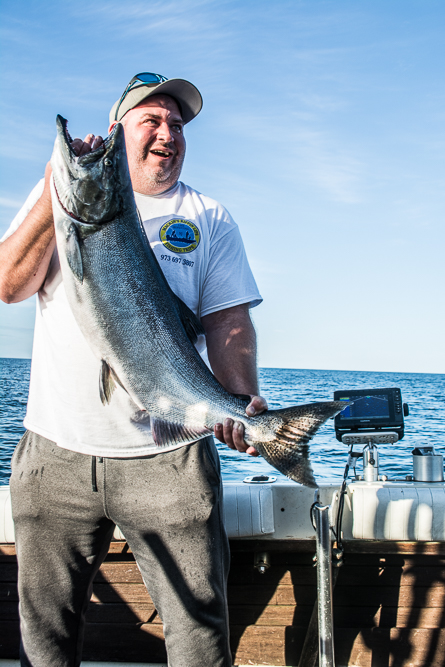
Finally, salmon did hit. Brian, first on deck, caught the one photographed above, about 25 pounds, a really good fish. (I asked Scott what's the biggest he's boated--36.8.) I caught one about 13 pounds and a two-year-old fish about 10 pounds. (I'm not clear on whether the first was also a two-year-old king.) Brian's second fish might have weighed 22. 

The struggle requires a lot of rod-pumping. You never want to allow slack. Both of my salmon used drag, but runs aren't long and smoking. Brian hooked a fifth salmon, and he could not move that fish. I watched. He had got the 25-pounder moving his way in no time, but how big this fifth fish--no one ever quite knew that, because eventually the hook pulled free.

I viewed the dashboard graph and noticed at one point that we fished over 735 feet of water. We did eventually find some baitballs--clouds of forage--and in general the whole experience between the four of us deepened as light began to get low. I felt very much impressed by Scott and Tyler. Tyler's knowledge of fishing is inexhaustible. He guides on the Salmon River, too, and if I'm not mistaken, leads clients on ice fishing adventures. The perch fishing is some of the best on the planet, and Tyler also spoke of 15-pound walleye and big northern pike. Scott I had known years ago when we both served on the board of Round Valley Trout Association, but yesterday I knew him in his element. He spoke of having to travel 60 miles in the ocean to reach such depths. He also plays music as the fishing unfolds. He asked me if I'm into music. I told him I am, which is true, though I prefer classical, and sometimes rock just seems overplayed. But once we got into those salmon--it didn't seem overplayed. I think every life is posed a question. It isn't as simple as being home. Or perhaps it's posed many questions. One that confronts me is how do I reconcile my so-called cultural and intellectual values with the gritty down-to-earth quality of my fishing? Well, you read my blog. You know there's a mind behind it. But not only did Scott nail the issue on the nose--from out of the blue somewhere--when he asked me for my opinion about the Doors. His playing music fused fishing with rock culture. 

But about Scott and the Doors. (I forget which song, but one of the Doors' played as we entered the inlet at Sodus Point.) "Jim Morrison was really far out," Scott said. It's a criticism I share to some degree, because Morrison didn't necessarily have his distance under control. (Anyone might laugh at that as an understatement.) Morrison was out of control, but no one else I've read has put it better than Morrison himself did: "If you can't control your mind, someone else will." So it's evident that Morrison himself didn't feel out of control.

We docked in deep dusk. Brian and I reached his truck parked conveniently in the municipal lot. In the dark. We bought ice at the Sunoco nearby, then we hit the road, stopping soon at a McDonalds. Sometimes a Big Mac hits the spot. 
  
Is it a variant of warmouth?

Lake Ontario shoreline
Brian and his truck
Brian's Zara Spook got hit to the right of the culvert. I fished on the other side of the street, but I clearly heard the water heave when whatever it was struck. 

Maybe about 22 pounds.

Scott Tarnoski on the left, Tyler, and Brian
My first was about 13 pounds.


Sun sets on a fluid horizon like the Pacific Ocean.


Tyler cleans salmon.


Scott and Brian


Tuesday, July 25, 2023

Smallmouths Along the Opposite Bank


I worked my job yesterday, and I found constantly being on my feet put enough stress on the back for pain to accumulate. (I was hospitalized recently for spinal stenosis. It caused severe back pain.) I got control of pain and uncertainty near the end of my shift, when confidence grew and eliminated fear; I soon drove home confident that today's fishing would work out.

I met Mark in the lot by the river, moments after I'd got my wading boots on. Seeing him again, it was as if weeks had passed, rather than more than a year. We walked the trail downstream doing our best to catch up on our lives, deciding to start fishing upstream of how far down we went last year. I made my way back upstream at a swift pace, because I wasn't finding holes nor the wide, long slow stretch I fished early July last year, then losing a very big bass on a Rapala #5 floater. There were no spots like that. The water was a series of rapids, and I managed to find three big boulders and associated rocks creating pocket eddies. These spots looked promising for smallmouths, but I pulled a longear sunfish from each of them, using an eighth-ounce jig with a little green paddletail. 

Soon I was back at my car, having found I left the driver's side window open. I called Mark. He was well downstream. No bass. Some sunnies and chubs. I found the wide slower stretch I had missed, where I caught more sunfish, including a bluegill, and a couple of very small bass. Using the Rapala #5.

I slowed down. The temptation is to fish fast and move on, as if any bass present would hit on the first cast. That's not necessarily true. It's also the case that by slowing down, you better absorb surroundings and take notice of things you wouldn't have by a cursory once-over. That will not only clue you into fish; it will qualify your experience, making you feel better and improving your health. My wading became more certain. I had been afraid that uneven rocks might kick my back out again, but once I became sure of my experience, I realized my worries were absurd. When I'm 80 I might be challenged on uneven rocks in a river, but for now my steps remain sure. 

I paid careful attention to the bank across from me. Repeatedly, fish hit my Rapala just after it touched down near the edge, and I wasn't so sure they were all sunnies. I would cast there, then cast elsewhere to give the bank a break. Finally, I laid a cast inches from the bank where the Rapala got whalloped. The drag screeched for a moment, and then the bass was gone.

Later, I told Mark it might have been 11 or 12 inches. He showed me the photo of his big one. I felt amazed we had got one that big. Last year we lost two that were even bigger, but to have encountered yet another nice bass in these stretches I guess I hadn't expected. I watched him catch another of about nine inches. I caught more sunfish, a fallfish, and another very small bass. We had worked our way further downstream than we fished last year, by what I could judge. Another rather slow, wide, and long stretch. 

When quitting time approached, I got out of the river and relaxed by sitting on a boulder. Mark got into position relative to the far bank where he hooked his big one. He began pulling some sunfish out and the nice rock bass I photographed.

"There's a hole right there in the middle of the concrete where it's broken-in. The fish are staging in it.," Mark said.

He also told me he was about to go, so I decided I'd offer a last try. A couple of minutes before we slogged out, I stood next to him when I hooked and caught an average stream bass of about nine inches on the Rapala, me just laughing out loud because I had been feeling that I had come up short. No bass even close to average size until the last minutes. 

As we walked the trail back to the cars, clouds overhead had closed out sunlight, and both of us spoke of feeling the difference in atmospheric pressure. Mark mentioned it wasn't humid, and I readily agreed, but each of us felt rain coming. The last moment before each of us slipped into our vehicles, thunder boomed overhead.


Salmon Falls River

Friday, July 21, 2023

Checked Up On a Pond


My neighbor and fishing buddy Mike told me a local boy is catching fish in the neighborhood pond, so I decided to check up on things.

It hasn't come back anywhere near to its former glory, but the water has a very nice deep black "tea" tone, and the edges are finely grown over. I worked and worked a Senko, getting only sunfish taps, when a sizeable bass finally assaulted it. Setting the hook only resulted in the worm flying off the hook and somewhere into the thick. 

Earlier today, I discovered my O-ring tool is missing, and when I ordered a new one, I selected the bargain including a hundred of the rings. My stock is low and I've been using ones that don't quite fit. Thus, the worm flew off the hook. 

I snapped on a Hedden Tiny Torpedo. Soon, I caught a 10 1/2-inch largemouth. I kept plugging away, hoping for a surprise, but for whatever reason, some 25 minutes of fishing proved to me that the pond still refuses to fully come back.

Tuesday, July 18, 2023

Polyethylene Canoe Plastic Weld

Go back to work on Monday the 24th. The back isn't completely healed, but is enough to get around without thinking about it. Did 20 or 30 laps in the pool today. Looking for goggles to use tomorrow. 

Might get up to Cronk's house end of the week to do plastic welding on the squareback. He was out in the middle of the lake last week, when the leak broke open. Gave him a scare. Don't use Flex Seal or any other adhesive on polyethylene. I know a new acrylic by 3M--as of 2019--is supposed to hold on the stuff, but the description says "water resistant." I think I would need something better than "resistant." Besides, the stuff is 50 bucks an ounce, and I would like to have more to work with. 

So I read further and have concluded along with others that plastic welding is better on polyethylene than any adhesive. Now let's see if that judgment holds.

Friday, July 14, 2023

Sedge Island Programs

NJ DEP  A couple of Sedge Island programs available, including kayak fishing. My son stayed on Sedge Island a couple of times, and I always remember his adventures with the others as a highlight of his youth. Among many other activities including ocean kayaking by paddling out through the inlet and fishing for blues in the bay, he treaded clams just like his father used to do for a living. The thought of a real outpost on a sedge island is archetypal for me, because I used to think of rooms and apartments I stayed in--although I lived in some nice houses too--as "stations" away from the American mainstream. From my vantage far, far away on the edge I analyzed not only the culture I had removed myself from, but during my daily work engaged with the given realm of nature.