Friday, October 23, 2015

Bass Bunched Together Striking Spinnerbaits

Wednesday evening, I fished the neighborhood pond and experienced bass short-striking the spinnerbait, which surprised me, since I figured the water would be warmer with temperatures in the mid-70's or better. A smallish bass whalloped the lure, though, and that's when I felt how cold. With calm surface, many bass lay right up on top, and I thought I'd have done better lightly touching down weightless plastic worms--my favorite Chompers--but I had just marched out with camera around my neck and rod in hand, no extra lures, not even my fishing license. The pond's right here. I could have walked back to fetch some worms, but just played out 20 minutes or so, losing another bass and watching many roll right behind the lure, some of them tapping it.

So today, driving from Bedminster at I-78 to north of I-80, I came armed with two stinger hooks. I teased out some ruckous coming out from right against the bank that refused to give chase, quickly snapping on a Chompers and nailing the bass, a little 11-incher. Further along, much the same happened, although this time, a nice wake rose behind the chartreuse willowleaf spinnerbait; I kept retrieve pace steady--never slow down if a bass comes behind--but the bass turned, nor did it take the Chompers the next moment.

And then I worked towards the back of the pond of about 10 or 15 acres, playing with a few bass I sighted bunched together that refused to take the Chompers I snapped back on, a little snap, not much to affect life-like presentation, though I never use snaps when I'm committed to worms. Just convenient.

I snapped on the spinnerbait and found that in the process of unloading and loading it back on, the stinger hook came undone, lost. And instead of burrowing out the other from a black spinnerbait deep in my bag, I took fair warning--the hook might come off in the fight. I need better stingers.

I got further back, cast in close to shore, and watched a big bulge rise behind the lure, kept that pace, and the bass overtook and engulfed the lure with a great, heaving pressure on the rod.

Nice fish. About 17 inches. But not the five-pounder I really want before the year is out, and it looks like I won't get. I duplicated the cast exactly, hooked another and lost the bass. Often they bunch together like this, and instead of a catch spooking the others, they seem all the more ready to strike.

Monday, October 19, 2015

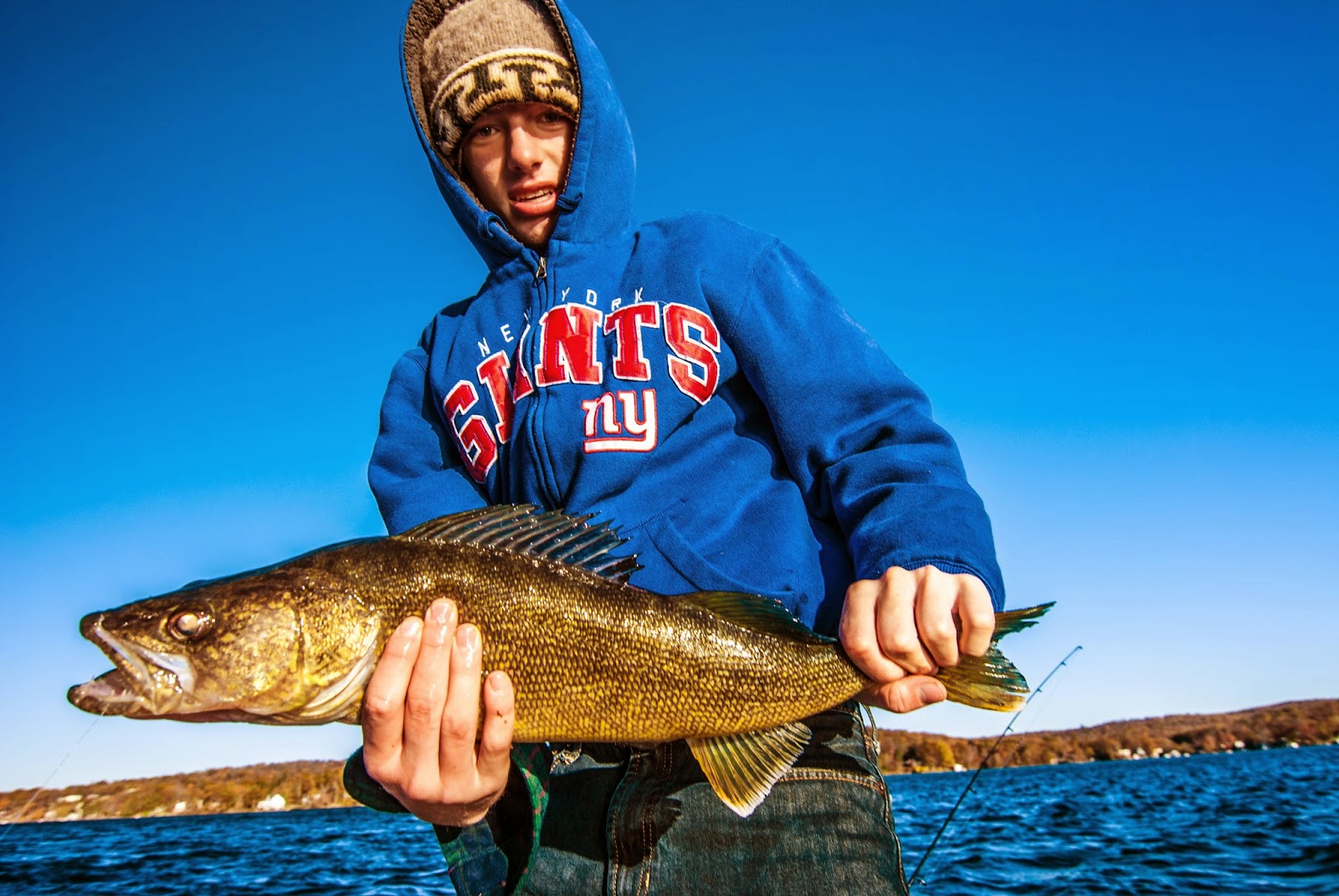
Cold Morning Walleye on Lake Hopatcong

When Steve and I crossed Lake Hopatcong nearly an hour before sunrise, temperatures had fallen somewhere in the 20's, but we felt comfortable with layered clothing. The ride to my favorite drop-off took about 10 minutes with 10 horsepower; we saw no other boats and lakeside houses gave us a feeling of being abandoned, quiet like a place forgotten. I anchored from stern; early on, the lake lay almost calm, and no water splashed over the transom.

By the books, oh, you never anchor from stern, but I always do when I can have better control, quick to pull if the wind comes up. We set herring 20-33 feet deep and began to wait, casting nightcrawlers among shallow boulders. We caught a couple of big yellow perch about a foot long; Steve caught many smaller; I gave up on the nightcrawlers after catching a couple of small largemouths less than a pound apiece.

With no clouds in the sky, I soon began to feel we might get skunked on what we came for. Usually, hits come within five or 10 minutes. Cold temperatures posed no problem as such, and with the lake's depth and expanse, water registered 58 degrees. We waited more than an hour before Steve caught the smallest walleye I've seen at Hopatcong, about a foot long. After 9:00 a.m., he caught a walleye of about 20 inches. 

By 10:30 or so, Steve pulled the anchor set at the bow with increased wind, and we motored off. I gave my spot a silent and solemn farewell, knowing the slow hours we spent there had been full and worthwhile; knowing I might not see it again this year, and certainly not with my son, as we have fished it every third October weekend since 2007.

We anchored on another sharp drop-off, this one with depths of about 45 feet at bottom, rather than 35, finding some refuge from variable wind, a few clouds in the sky. Almost immediately, I caught a small, foot-long walleye. Wind kept whipping around from different directions, and the anchor lifted; we drifted slowly, marking fish on the finder.

"Steve, let the sinker hit bottom, then reel the rig up about 10 feet."

Seconds later, his rod doubled over, and I thought he had a seven or eight-pound fish. The walleye weighed about two-and-a-half, but a nice chunky fish.

We fished intensively. For a good two hours or more I controlled drifts with my electric motor all about this drop-off and sort of pocket of deep water, marking fish on occasion, keeping a herring apiece suspended just off bottom and higher up, while I jigged a Binsky for all I was worth, but just did not connect again.

I had the long drop-off of Chestnut Point in mind, but when we finally turned back to Dow's Boat Rental after seven-and-a-half hours total, we found, as I knew all along, that it was a mess with a prevailing current of head-on wind, rather than an east-west or west-east flow that would carry us along the drop. Clouds had thickened and snow sputtered onto our faces. I wondered how cold the afternoon, and I guess temperatures never rose out of the low 40's.

We passed a boat that had sort of messed around near our second spot, along with several others in the vicinity, no word of any fish caught. Hopatcong has always yielded for me, though once my son and I came in mid-November with water temperature at 45. We jigged hard for five hours, catching nothing, though it's quite possible to catch walleye in water that cold. 

The important thing is to get into it, as we used to say in the 70's. Fish are there, and if you feel out of touch with them, then it's a lot less likely you'll connect.       

Lighting Up
Catching a Few Rays


White perch take the herring deep on occasion, and so do yellow, but we never catch white perch shallow.

Friday, October 16, 2015

Round Valley Trout Association to Stock More Shiners, & Small Brown Trout

Round Valley Reservoir's herring population vanished in the mid-1990's, possibly because all of the vegetation flooded, when the reservoir initially filled, had decomposed entirely, reducing fertility. To remedy the lack of food source for smaller and often thinner trout, Round Valley Trout Association began stocking shiners from Arkansas in the reservoir three years ago. 486,000 have been released.

More shiners come next year, and along with them, $500.00 worth of small brown trout, 11 to 12 inches long, are slated to be tagged and stocked in addition to trophy trout. This may allow RVTA further insight into trout growth rate, given the added forage availability.

If you fish Round Valley, my advice is to join RVTA. Membership dues cost less than a night at the bar and help keep the reservoir fishing productive. Especially, RVTA is a community among anglers.

Catches have come from shore steadily since I last fished on October 2nd. A neighbor of mine caught a 23-inch rainbow. A couple of RVTA people I know of have caught some rainbows; a 3 1/2-pound brown got weighed at Behr's Bait & Tackle, and Jim Stabile emailed me a jpg of four rainbows recently caught, 15-18 inches.

I look forward to getting out, possibly at the end of the month or early November. For certain, I want to fish at least once in January for lakers from shore with my son. 

Thursday, October 15, 2015

Lake Hopatcong Report Knee Deep Walleye Contest

(That's my son with his four-and-a-half pounder.)
 
The Knee Deep Club held the annual fall walleye contest last weekend with 34 entrants, and I would have liked to compete if I could have got out. Not very many walleye made it to the scales, and no big ones, the largest at three-and-a-half pounds, along with a slightly smaller three-and-a-quarter. That's dismaying for fall on the lake, but in my experience, the best walleye fishing begins the third week in October.

Steve Slota and I feel very psyched to get out this coming weekend, and I can't wait to greet subfreezing temperatures Sunday morning before dawn, at least I hope it's that cold. That's what hybrids and walleye seem to want this time of year, all the better if clouds obscure sun with snow flurries suggesting things to come yet, namely ice fishing. With downright cold temperatures, maybe we'll get a big walleye even though it's not the same third weekend my son and I have fished annually for years.

Laurie Murphy at Dow's Boat Rentals also reports a lot of hybrid stripers being caught, these as large as eight pounds, always encouraging and something to look up to, since my biggest as yet is just over five. Perch, crappie, pickerel--these are getting caught also, but as has been the case for many weeks, no mention of largemouth bass, but lots of smallmouths.

A couple of years ago, that third week of October met my intentions with florid largemouth activity, though none of the bass big, and I wouldn't be surprised if Steve and I do catch one or two. While we fish sharp drop-offs for the big fish, we'll fish the shallow side of the anchored boat also.
         

Saturday, October 10, 2015

Prismatic Steelheads: Choose the Color They Want


          The clear plastic float with red top marker vanished in a split second. I reared back, felt weight, and the drag began screeching, my 11 foot noodle rod in a shock-absorbing C-curve almost horizontal to the water. The steelhead approached the stretch’s tailout when it stopped and I began pumping, the rod’s light power with super-slow action absorbing thrusts against the five-pound test leader. The fish within netting range, I kept the rod at full bend low to the water, to my right side. Time and again the fish raced off a number of yards, but tired with each attempt and finally yielded.

          Noodle rodding with plastic beads is a most popular method for steelhead and the battles the best you may ever know. The salmon egg imitations that tempt strikes come in an array of colors, because the fish often show a preference for one over the other. Steelheads will respond to a specific color at a given time because their eye structure is so sensitive they are thought to see ultraviolet and infrared portions of the light spectrum. In other words, make no mistake; these fish are color sensitive. Load a clear plastic tote with beads of all colors and experiment as though you’re a chemist trying to get the right mix.


          A guideline you can follow takes light into account, since color is nothing without illumination and the name of the game more than pattern. Steelhead beads are usually 10 mm, with center holes, and though they resemble salmon eggs steelhead feed on, you’ll never find a green salmon egg in nature any more than you would a unicorn, and yet sometimes steelhead may prefer green. In bright sunlight on clear water, white, orange, apricot, peach, and red are good choices to start with. If the day is dark and water visibility limited, fluorescent red or fluorescent chartreuse may get snatched from the shadows. These hot colors spook steelheads in clear, bright conditions.

          A trick you can pull out of your bead kit is to contrast colors on a single bead. Dab on iridescent nail polish at home. You can’t find color contrasted beads on the market, at least none I know of. Contrast makes it easier for the eye to pick out color. Spawn sacs are typically color contrasted, perhaps not with this reason in mind, but a difference between the color of netting and eggs may mean a strike or not. Placing a single bead of contrasting color in a sac produces an “eye” effect that steelhead seem to like. We don’t expect these fish to think something’s looking to get away, only to see something that might trigger aggressive response.

          A consistent bite is the one relief from uncertainty, but so long as this isn’t happening, which is much of the time, you’re free to play with color. As painstaking as this effort can be, it’s better than standing in a river and feeling you’re there for nothing. Remember that available light and changing water visibility affect the absorption and reflection of light, which literally causes colors to change underwater. You don’t exactly fish what you see in your box, and if clouds ensue after sunshine, the fish don’t see the same color they did before, either.

          Believe it or not, the color of the float you use may make a difference. Those with mostly clear bodies are less obtrusive, color on the top helping you see it disappear, dip, or pause suspiciously. The color contrast against the bead may make the difference sometimes. Steelhead can see in a 300-degree arc, so they see the float and the bead in relationship.

          Make sure to use a float with soft plastic line sleeves at top and bottom; you can instantly adjust the float’s position on the line. Add a series of split shot to the line underneath, heaviest near the float to make it stand upright with just the buoyancy to stay afloat. Pinch smaller split shot in descending order with BB at bottom of the rig near a micro swivel. You’ve created the classic J presentation. The current pulls the lighter shot forward as the bead is swept out ahead. The idea is to hit the steelhead on the nose, so be chary about the depth you set that float.

          Also when rigging up, tying off the bead is critical. Using a toothpick to peg it in place inevitably allows slippage. It’s better to pass five-pound test fluorocarbon leader through the bead, loop back, and pass it through again. Now pass the tag end through the loop created and turn it six times like a clinch knot. Tighten into the bead and it will stay in place. Finish by tying the hook to the tag end with a clinch knot. You end up with 2 ½ inches of leader separating bead and a size 8 to 12 wide-gap, beak-style heavy steel egg hook.

          Look for current breaks where salmon eggs get funneled and then fall into pockets. Good water isn’t very hard to find, and until winter really sets in, is shallower than not. Steelhead fishing is usually a trying effort and may make you think no fish are present where you cast, though plenty fin just out of sight. Hours of effort yielding even just a few of these glorious fish are enough to fill the rest of your life with a desire to get back out and do it again.

Thursday, October 8, 2015

Lake Hopatcong Turning Over & Catches Come

Joe and I were supposed to fish the lake today, but as often happens with Joe, plans change as if by the slightest whim of a breeze, and I'm left with no real idea of why. People who love to fish invest expectations before going out, but when plans get dashed, I just start looking for other options, and otherwise project long range: there's still hope Joe and I will ice fish. In the meantime, Noel has expressed interest in fishing Binsky bladebaits, so if we plan on a time, Joe will have to wait if he really wants to get out there, unless I still have a day very late in the month or early November. My son has so many days planned to take off from work--two of them for steelhead fishing--that our annual October outing won't be a go this year. I told him in May we'll have time after he gets off for about four hours before dark, trolling.

Laurie at Dow's Boat Rentals reports a lot of hybrids, smallmouths, some big pickerel, perch, crappies and a few walleye are getting caught. The lake is turning over and vertical jiggers are getting in the game. She mentioned chicken livers for hybrids, bait that became very popular last year, but although I once caught a striper in the Delaware on chicken liver intended for a channel cat, I will stay with live herring and Binsky bladebaits.

Noel caught 40 fish yesterday, mostly yellow perch, and said the water temperature ranged from 59 to 62. Fifty nine is pretty chilly this early, but we really got switched from summer to fall overnight with very chilly temperatures recently.

"The big perch aren't in yet," Noel says.

I'm happy Noel expressed some interest in Binsky jigging and hope we go. I've connected with a couple of hybrids that might have beaten my personal best at five pounds, one ounce, along with another at just about five, and look forward to boating one of the big ones I constantly get news of being caught. Fishing makes particular things in life--fish--of great value to pursue, and there's a whole lot more to the lake than I can say in a blog post. But I can tell you there really is more, even though I haven't caught a really big hybrid yet. 

Friday, October 2, 2015

Round Valley Reservoir Rainbows Headed to Shore

Today I imagined rainbows would come in, since temperatures never rose more than a degree or two above 50, with some wind and cold rain helping to stir the cooler temperatures into that warm reservoir, warm to the touch, in fact, though I never took the surface temperature with a thermometer. I can't believe it's still warmer than 70, though.

So I drove over after work, stopped at Behr's to find the bait shop closed early, drove into Lot 2, took some photos, and decided thereafter to drive to Flemington for mealworms. And then I came to the main launch area and baited up with small marshmallows to float the mealworms, anchored by 3/4-ounce steel slip sinkers. I fished two rods, instead of fiddling with a third in the rain.

Nothing happened, which proves nothing. I still imagine rainbows are coming in. While I sat in my car, I read an article by Matthew Copeland, "This land was your land Federal transfers rob the American people" in the Outdoor Writer's Association of America magazine Outdoors Unlimited.

51 of U.S. senators have voted for wide-scale divestment of public land, and not one has been voted out of office. Public land is, of course, essential to this country. Imagine having to pay to fish the South Branch Raritan or any other public waterway. It may seem extreme to imagine anything coming to the likes of that in America, but it could be worse; we could be shut out entirely from most of our waters, similarly as access is extremely tight in England. But don't think this is socialism that threatens us. It's the Corporate State and the corporate privatization fomented especially on the right. If you want to fish, protect your self-interest and the heart and soul of America. "This land is your land; this land is my land."

Sign a petition: www.sportsmensaccess.org