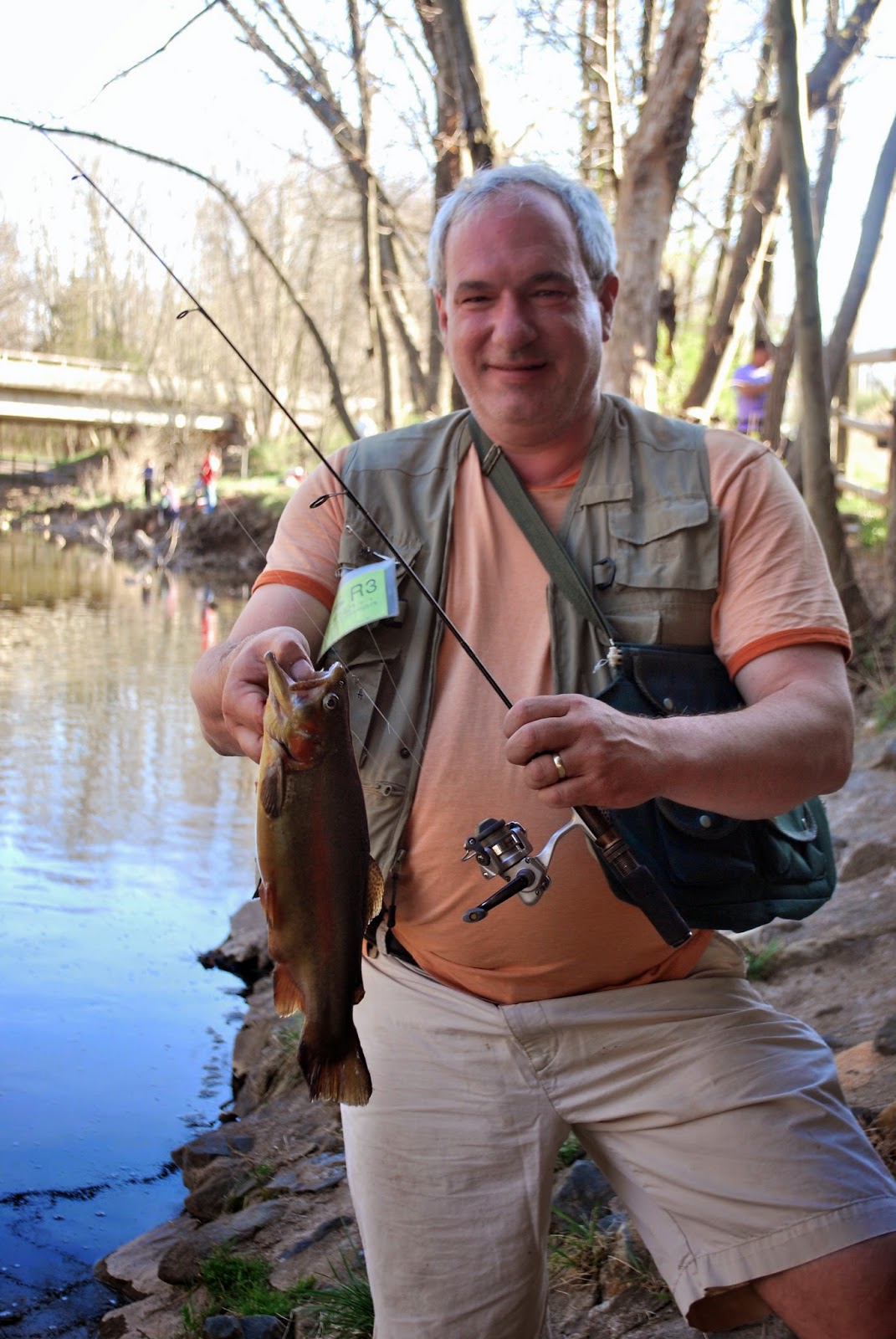
Saturday, March 7, 2015

Little George for Round Valley Reservoir Lake Trout

Ice a foot thick, Round Valley Reservoir crowded with ice fishermen and tourists alike, I placed tip-ups over 60 feet of water, and then cut additional holes away from the set to jig. Instead of the popular Kastmaster (although other lures are used), I tried an old invention of Tom Mann, Bassmaster Classic winner from the 1970's. I used to read about him in Bassmaster magazine and heard him speak at Montclair State College in 1979.

"I'm not your college educated bassman," he began. He cracked a smile to signal the irony.

The Little George weighs an ounce, has a Colorado blade for a tailspinner that sends out good vibrations and is a rounded inch long. It reminds me of the dozen barred sunfish an inch long that fell out of the stomach of  Mike's laker, caught just before ice-over. Jigs great. But I got no hits I know of. Sometimes fish hit and you never feel a tap, cameras testify, but of course I doubt anything happened.

Heard of a number of lakers jigged on a hump that rises to 85 feet from deeper and heard of a couple others, one of them nice sized.

At the end, I felt dismayed at the area I fished, although very nearby guys had two flags. With so much line threaded off the tip-up spools, I counted 12 turns back onto the spools before I set, thinking this enough to keep the shiner off bottom. For two tip-ups, no. Shiners came up with a little mud slime on scales. Could have been from a thin layer on rocks, but the thought of soft bottom really turned me off. So did the shiners' ineffectiveness for the rigs' not having been raised enough.

Right when I had got on the ice hauling my gear, I was informed of two flags right there at the primitive launch. Were they rainbows or browns? Mike told me about a brace of five-pound pickerel caught in the same spot, 2010.


Wednesday, February 25, 2015

Round Valley Reservoir Ice Eight Inches Thick


First time I've ice fished the reservoir, cut eight inches of ice and got skunked, but had a good time as always. I decided to place a tip-up right on my favorite spot shore-bound, and trail a line of the four additional out into deeper water, the deepest I fished about 30 or 35 feet.

I got there the same time another guy walked out with not much more than a jigging rod and a split bar. He came back with a 20-inch laker a half hour before I retrieved my gear.

"45 to 70 feet deep," he said. "I've caught them as deep as a 150 feet." I forgot to clarify his point--under ice or during summer 150 feet deep?

He used a Kastmaster, same lure Matt and I tried on lakers in Maine, and what I'll use next week if I go.

I wanted to sit in my car today, not that it was cold, but for old time's sake open water fishing. I'll try to venture way out there yet.

A lot of lakers get caught. Heard of a six-pound brown. Haven't heard of any bass or pickerel, besides in the pond. That's a curiosity, since a lot of bass are in the reservoir, but everyone goes for trout and mostly further out.


Monday, February 23, 2015

River Dam Removal and Restoration for Improved Fisheries


River dam removal and in-channel restoration enhances fisheries


I wrote this piece for my Recorder Newspapers column last year.


          51 dams were deconstructed in 2013 through a nationwide movement to return rivers to free, flourishing flows. Here in the Highlands, The Musconetcong River Partnership won the 2012 Presidential Coastal America Award for removal of Musconetcong River dams. The Partnership is a team of agencies, organizations, and individuals, including New Jersey Trout Unlimited, the Musconetcong Watershed Association, American Rivers, NJDEP-Division of Fish & Wildlife, US Fish & Wildlife Service, and many others, all honored by the Office of the President of the United States.

          While the Musconetcong is getting the most attention through a process ancillary to dam removal—in-channel restoration—continuing this year, efforts in New Jersey to improve rivers aren’t limited to the Highlands. Somerset County’s Raritan River has had three dams removed, and soon the Millstone River will flow freely from the dam at Carnegie Lake in Princeton to the Raritan. Trout are a concern in the Highlands, but these three rivers share shad and herring in common as a migratory possibility. In fact, shad and herring have been videoed at the Raritan in recent years. Remaining are two Raritan dams: the 1995 Island Farm Weir constructed with fish ladder and video devices just below the Millstone confluence, and the Headgates Dam, located a short way below the South and North Branch Raritan Confluence by Old York Road in the northernmost reach of Duke Island Park. The Millstone River awaits the removal of Blackwell’s Mills Dam well upstream of the town of Millstone possibly this summer. The Weston Causeway Dam at Manville will go sometime soon. Both Millstone River dams are low head varieties, but do obstruct the migration of fish.

          Two of the remaining dams on the Musconetcong River are anything but low head. The Hughesville Dam—expected to be deconstructed in 2015—is 10 feet high, the Warren Glen Dam an enormous 35 ½ feet tall. The latter will be an extremely difficult project, but Trout Unlimited Musconetcong Coordinator, Brian Cowden, is confident that The Musconetcong River Restoration Partnership will pull it off.

          “We’re talking about multiple millions of dollars, and where will that money come from?” Cowden said. More daunting than money, perhaps, is dealing with the sedimentary results of (?) years of the river gorge being dammed—too many tons of mud to guess the number. “Removing the concrete is easy. How do we get that sediment out of there, and where do we put it?”

          I’m sure ways will be found, since the political will behind the project is powerful.    

          “Everyone in the partnership wants that dam gone, including the owners,” Cowden said. “That’s gonna clean up the Musky Gorge for trout fishing. It’s also going to be good for kayakers and canoers. That habitat is phenomenal, and significantly more water will be flowing through than the Ken Lockwood Gorge. Over time, sediment has settled over those beautiful boulders at the river’s bottom behind that dam, and this will renew the gorge as it naturally was.”

          At present, more than four miles of the Musconetcong between Finesville and the Delaware River have been opened and flow without obstruction. Six dams have been taken out, considering that the Partnership’s Riegelsville project involved two solid wood coffer dams and a hand built stone dam. Gruendyke Mill Dam, Seber Dam, and the Finesville Dam are also gone. Removal of the Bloomsbury Dam is under consideration, but Saxton Falls—way upstream above Hackettstown in Stephen’s State Park—is not a concern.

          “That dam is part of the State Park System. We’re not even targeting that. Our focus is downstream,” Cowden said.

          When Bloomsbury Dam goes, shad will have a long, free flowing revitalized river to travel and spawn well upstream. Wild trout will respond with a healthier population to increased oxygen, lower water temperatures, and better insect hatches. And river ecology is also improved by in-channel restoration.

          Trout Unlimited has been overseeing restoration efforts on the Musconetcong. This year, 1/3rd  mile of the Point Mountain Trout Conservation Area, a full mile of the Wattle’s Tract, 1/3rd mile at Asbury, and a section at Beatty Farm, as well as a half mile of tributary West Portal Brook, will be shaped into environmentally sound configurations. Channels are narrowed where they become too shallow and wide, because increased run-off from impervious surfaces like parking lots homogenize the river bed. Pools are dug, boulders added, and point bars shaped, all to keep the river flowing strong, transporting sediment, and producing more trout in these enhanced habitats.

          While the river is spring fed, trout generally reproduce in protected feeder streams, which tend to carry more spring water by volume. Nevertheless, the long term effect of restored habitat is likely to increase trout numbers, because offspring will find fit places to mature.   


Sunday, February 15, 2015

Super Ultra-Light Salmon Egg Spinning for Trout

With trout season approaching, I thought I would post an article on fishing salmon eggs.


Super Ultra-Light Rods for Salmon Egging Rainbow and Brook Trout


          Rod bending all the way to the butt, drag screeching, the line cut zig-zag patterns on North Branch Raritan River’s calm surface. I pumped all three-and-a-half feet working the trout up current, but once again the tiny spinning reel spool slipped. Three minutes later, I lifted a two-pound rainbow grasped behind gills out of cold water.

          I bought the rod I’ve used for the past 15 years at a sporting goods outlet, but more than 35 years ago, a fishing mentor and I built such rods from component parts strictly for use with two-pound test monofilament and salmon eggs. We sawed off the tip sections of flimsy fly rod blanks and created rods like no others, highly effective for this special purpose. Each spring we were lords of the streams we fished, mastering a method no one else quite knew about. We didn’t introduce three-and-a half foot rods, but we beat their appearance on the market by at least a decade or two.

          My brother, Rick, and nephew, Kyle, do well with ultralights just over four feet long, but I would never trade mine because it’s light enough to bend the tip clear back to touch the rod shaft. Every trout I’ve caught has put up a good fight. Low diameter two-pound test allows a single salmon egg on a size 14 snell hook to cast as many as 12 yards without any additional weight but the size 18 snap connecting a leader. Short rods make traversing the brush and brambles of a small stream easy, fine for small rivers, too. A trick for achieving longer casts without sacrificing weightless drift is to attach two leaders of different length to the snap and fish salmon eggs tandem.

          Salmon egg fishing is all about drift. You might think it’s more about setting the hook just right, since rainbow and brook trout are notorious egg stealers. (Browns are less inclined to strike eggs.) Nevertheless, if you can’t present a salmon egg in an appealing way, trout will ignore it. I’ve witnessed anglers using heavy split shots and still fishing an egg on bottom. A trout would not be tempted by the time the egg decomposed. The majority try to drift eggs on four-pound test, over-weighting the line with split shot so the rig gets caught on rocks, interrupting natural drift just off bottom.

          Situations exist—strong, deep currents—when BB or slightly heavier split shot is called for. Strip lead is a better option to break the habit of crimping a split shot hard. The pressure can compress and weaken line, and you would need all of its strength for a good-size trout. The usual weight we use is swivels.

          I don’t buy snaps for trout. I buy snap swivels and use clippers to cut the swivels off the snaps. I collect the swivel pieces, broken at one end, and put them on a few safety pins through the good loops. Attach pins to your vest and you have a handy way to access a swivel or two placed on the snap for just the right amount of weight needed.

          Figuring out that right amount of weight or lack of it is really a subtle aspect of reading water. Only practice can teach it.

          Trout occupy many different sorts of spots. Most fishermen never venture far from bridges or other access points close to where they park. But the best way to learn to read water is to see some. Don a pair of waders and start walking. Obviously, shallow rifts with a slate or two for a trout to hide under require no more than a couple of short casts to tease out a trout, if it’s there. Deep pools require longer stays. But don’t overlook the water in between. If you keep returning to a stream or section of it, you learn where trout lie in holes, become familiar with overhanging banks to count on, riffles that usually hold fish, etc. Home water is a personal possession that can improve fishing over the years.

          Overhanging banks on any stream sometimes situate deeper back underneath and out of sight. I’ve let eggs drift in visible water a foot deep right in among roots and caught several trout before action died. On closer inspection afterwards, it was evident that the depth increased to nearly three feet. The classic pool of five or six feet of water has faster current leading into it. Cast upstream at an angle and let the current bring the egg into deep water. When the line straightens out, retrieve and make another cast. Not all pools are like this. And sometimes the lead current isn’t best to drift. Long slow stretches often have deeper water interspersed that holds trout. Sometimes stretches have a long length of deep water, and you need to fish patiently and thoroughly, casting upstream and retrieving once the egg settles on bottom with slow current. On many occasions, trout bunch together in a pool or hole. If the water is clear enough, you may spot them. Otherwise, finding the zone is achieved by varying cast placement.

           Whether you hop by car from one bridge to another, or wade a section of a stream or small river, getting in the rhythm and flow of knowing how long to stay at a spot and knowing when to move on is something to learn from experience. But as a rule, when action slows significantly—move on. Otherwise, always make sure to fish thoroughly without getting stuck in place. It’s as if many anglers think fishing is all a waiting game, but fishing is just as said in common parlance. To fish around for something is to search.

          Drifting an egg the right way is rarely perfect. Current drags on line. Wind can wreak havoc. Eddies slacken line. But at least with thin diameter monofilament current and wind have less to bow, sag, and run away with. If you can find fluorocarbon two pound test, this line sinks and may be even more manageable without unduly weighting the egg’s drift.

          The chief consideration concerning line bowing, turning in eddies and lifting in wind is how these factors affect drift. Study what happens and try to cast so the egg is presented in as unhindered and natural a way as possible, just off bottom. Any lack of straightness between the line at the rod tip and a trout that has taken an egg makes setting the hook a problem. Pull the line straight and the trout may either slip the egg off the hook or drop it. It may be best to wait a second or two, even more, before snapping the rod back to set the hook. I like to wait until I feel a firm pull. Then I know the line is straight and the trout has the egg fully in its mouth. But not every trout takes an egg firmly. Many will steal an egg before you feel a tug.         

          Many years ago when I was in my teens, my fishing mentor taught me that when trout are fed up—full—they are reluctant to take eggs fully into their mouths. Getting a hook set in this sort of situation is not impossible, but it’s certain you’ll miss hits.

          Hook setting in general when it comes to trout and salmon eggs is trying. Even with years of experience, you will miss many. This is part of the game, testing patience and skill, skill never perfected, yet trout will usually bite another egg on the next or subsequent casts. Fishing dry flies, I find the hook up ratio is greater than with salmon eggs. Nevertheless, missing fish shouldn’t be a frustration or considered a flaw in the method. On the contrary, hooking trout should be a confirmation of the persistence required. It would be too easy if hooking trout this way was as simple as hooking bass, yet the flimsy tip of a super-ultralight is perfect for absorbing the hard tug of an active trout just before you lay back into it.

          The color of eggs can make a difference in how many hits you get. For clear water, I use pale beige eggs almost exclusively, but I’m not averse to trying a red egg if trout are reluctant. Muddy flows are obviously useless for salmon egg fishing, but off color water with a visibility of a foot or so can be challenged by using red, chartreuse, or fluorescent eggs.

         Place eggs on plain, size 14, baitholder snell hooks. Gold salmon hooks are unnecessary, although effective. Learn to snell your own leaders with two pound test fluorocarbon if you can find it, and vary the length of leaders if you plan on using tandem rigs. Monofilament will work fine, but fluorocarbon is less visible, so at least as a matter of form, when fishing very clear water it is preferable. The size 14 hooks are absolutely essential. The smallness fits an egg just right, and trout will ignore your offering if you use a large hook.

          Buy or make your own leader wallet out of thick plastic wrapping, using coat hanger wire to bind sleeves. Tape the sleeves together on the open ends with electrical tape. You also need an egg container with a quick opening lid to attach to your belt or vest. Losing eggs to casts, retrieves, and trout is a constant problem if you have to take a jar out of your vest and unscrew the lid each time. Missing hits is just part of the game, but making a mess of clothing due to spilled salmon egg oil shouldn’t have to be.

          Waders or hip boots are essential for cold water rainbow and brook trout, and take the following tip to mind. Especially when wading small streams, the chances of confronting briars or other neoprene or breathable wader damaging brambles are high. If you get a big rip or tear, there’s little you can do, but usually the penetration is just enough to spring a leak. So take a tube of UV activated wader repair fluid. Even on cloudy days, this stuff works within a minute. If it’s really cold, vermiculite toe and hand warmers are a must. If you want to carry a light pack on your back, streamside coffee from a thermos makes for a real nice break.   

          As a method for spinning gear, no other approach to trout has the subtlety of a single salmon egg on a super ultra-light rod and reel. Tiny jigs work sometimes for some anglers. They don’t likely work as well as salmon eggs. And besides, they take all the challenge of drift and line problems out of the game. They better ensure a hook up when a trout hits, so you don’t get all the play involved in judging when to set the hook. Again, this is not to say that salmon eggs are less effective. In my opinion, salmon eggs are the most effective bait for rainbow and brook trout. Brook trout especially may at times prefer a waxworm over an egg, but most of the time you may do best with salmon eggs once you master this method, and rainbows never seem to get temperamental over them.


Wednesday, February 11, 2015

Round Valley Lake Trout Dominate Catches


Here and Merrill Creek Reservoir remain active for open water fishing, although I've heard no word of anyone fishing or catching trout at the latter. Lake trout are all the news for weeks now, and this goes directly against the grain of what I assumed for a long time, that lakers are few and far between from shore, although apparently they wait until it really gets cold, and then they come in close, at least enough of them to dominate catches recently, not that I'm referring to a whole lot of fish. I had two trout on that got the shiners before I tried to set hooks. Lakers or not, they were surely trout, and while a hit is a lot better than nothing, losing the fish was disappointing.

Mike told me lakers over nine pounds are a rarity with the lack of forage in the reservoir. I've heard of some 10 to 14-pounders last year, though, and an eight-pounder from shore. Mike also told me about the shiners I heard got stocked last year, 800 pounds of them by the state. This just doesn't seem nearly enough to feed the trout populations, yet Mike pointed out the browns this year are fat compared to last year. The lakers are plump, too, compared to what I've seen before.

Mike slit this fish's belly and more than a dozen banded sunfish dropped out. I was amazed to see this species for perhaps the first time, tiny sunfish about an inch long, and they don't grow much larger. In addition, a killiefish, which made me wonder if the laker hadn't been feeding very shallow. None of the state-stocked shiners comprised the fish's recent diet.

 Sadie

They trolled along an ice shelf...

Monday, February 9, 2015

Ice Fishing Great Cove Lake Hopatcong

Maureen and Jeff's first time ice fishing, we had a number of options. State Park lots make the lake very accessible for pickerel fishing on the six foot deep flats. Possibly, we could access River Styx, though parking is dicey there. In any event, we had to visit Laurie's shop for bait first, and I had Great Cove in mind. After Oliver and I were all but skunked in mid-January--Oliver caught a tip-up perch--we got word of a lot of pickerel caught back in the Cove. My son and I once ice fished the mouth of Great Cove in depths as great as 35 feet, hoping for a musky, but since I never had fished back in the relative shallows, I decided to go this way rather than around the bend in front of the Jefferson House, where word had it some nice pickerel were caught recently. I've never ice fished in front of the House per se, but have a few times in that area. I like to try different places.

I found I was short a couple of tip-ups, but after we got, I guess, 13 in place, we settled down to coffee, sandwiches, crab dip and conversation. I've never experienced such fog while ice fishing, and some sleet, rain and snow spattered on a very light breeze. Very mild at 34 degrees or so, I thought the temperature was just right for initiates, although hard core ice fishing challenges have had my son and I active at 0. Tough morning for a nine year old, but the photos I have don't lie. He enjoyed it.

I watched the tip-ups now and then. All was quiet and still. I knew, like on many outings, things can seem unyielding quite as if nothing will happen, until something does. Hanging out was enough, and if we caught nothing, the day would have been fulfilling.

And yet, had that flag never risen--and a second flag after sunset as we packed up, perhaps a missed hit, Jeff wasn't certain if a breeze kicked it--Maureen and Jeff never would have got that taste of childlike innocence in so humble an event as a fish on, certainty no one can deny, no one who has experienced.


Thursday, February 5, 2015

First Lake Trout


Wind raced through in 30-40 mph gusts from the north making 24 degrees or so feel like who knows. Felt good to me, since I like the zest of my native response, but after submerging my right hand in the bucket of shiners, I stuffed it in my right pocket, drying it off while I cupped the shiner hooked through the dorsal in my left so it wouldn't freeze. Snow under boots gave way just enough to grip as I walked half a football length or so to where I could cast, the pocket frozen where the ranger boat is kept during warm weather. I made the round twice, each time jabbing a rod butt into the stiff snow to keep each upright, rather than hauling my bucket to the reservoir's edge.

Then I sat in my car, turned on the ignition, warmed, and wrote in a 4 x 6 notebook I stash between the seats. I checked on the rods a couple of times before Mike showed up, my having discovered I had left my SD card at home, camera useless, a crowd of three species of waterfowl present I desired to photograph--bufflehead ducks, gadwall ducks and common mergansers. They fed at the edge of ice, and I needed additions to my collection of photography, but what the hell, Fifteen years from now I may own a $7000.00 600mm lens. And then I'll really need to get out and use it.

Mike told me he gave up four or five days ago. Hasn't caught a trout since I saw him last week. I told him about the laker caught Friday. He said he's caught two on Power Bait over the years, news to me.

"I saw your rod bounce, is that the wind?"

"That's not wind," I said. I ran like the tumbling breeze, felt like a kid.

...I was into a good fish, Mike cheering me on. It took awhile, hoping it would be a laker, hoping it would weigh five pounds.

Good thing he wore rubber boots. I didn't want to soak my hikers. The snow right at the edge was thick, ice covered, making any maneuver a little difficult. Not a five-pounder, but good size.

Lots of praise for my fish and salutations to a good dinner tonight, I packed the trout and Mike drove off.

For the past 10 years, more than any other fish besides Spanish mackerel until 2010 when I finally caught Spanish after trying since I was 17, I've wanted to catch a laker, a desire shared with my son. We rented a boat on Wawayanda and really tried. Matt hooked something big 60 feet deep and lost it. We tried on Green Lake in Maine, marking lakers 63 feet down--lots of them--Matt jigging a Kastmaster as I backpaddled the canoe against wind to keep in place. None would hit.

I can't wait to go and try again.