Tuesday, October 14, 2014

Steelhead Sight Responses: Noodle Rod Fishing

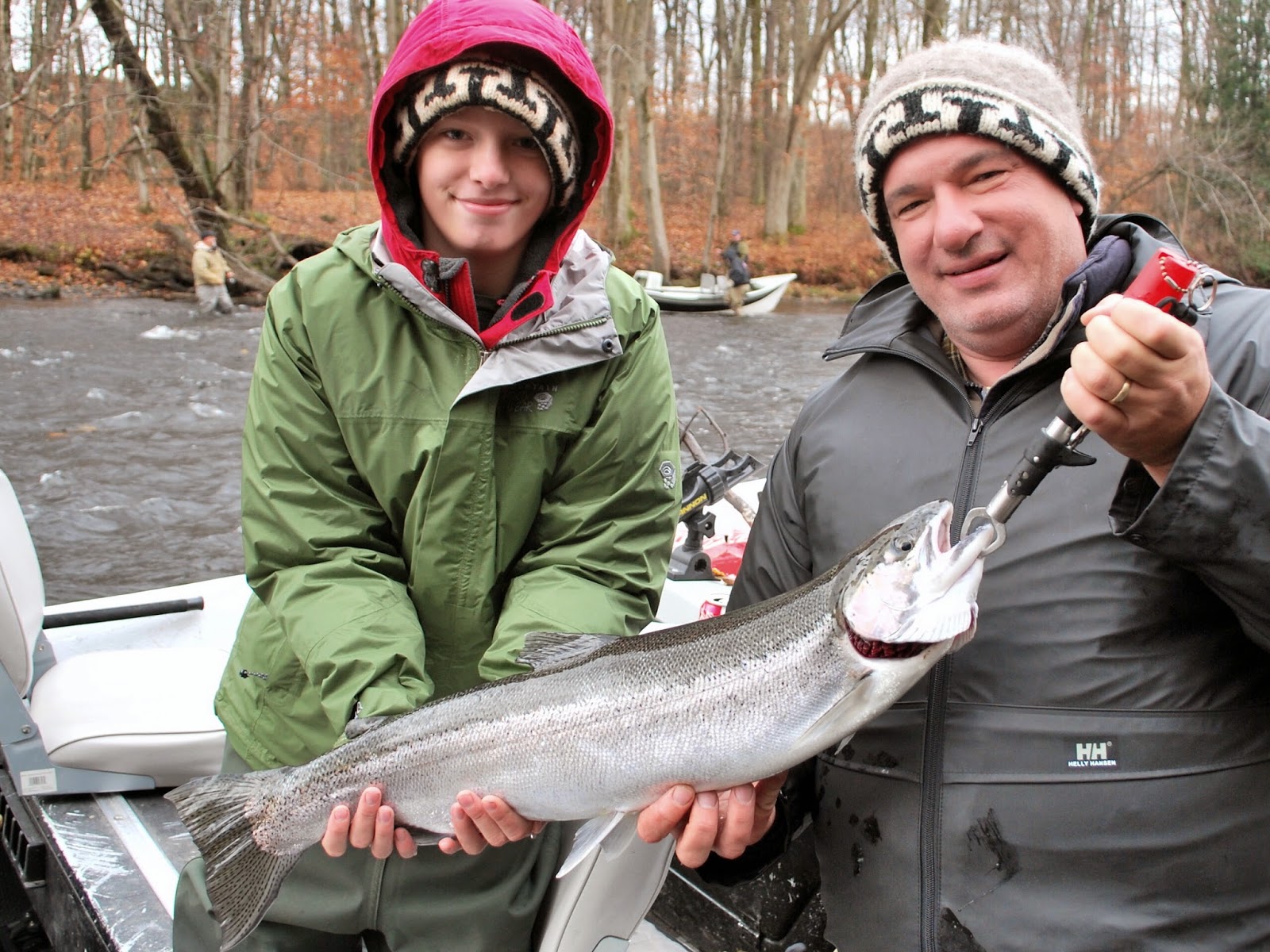
Midwest Outdoors published a similar photo to this one, but the position of the hands, the smiles, and the tilt of my head, among other things, such as that the other photo was taken in a larger frame, distinguish the two. Don't mean to step on anyone's toes! This photo actually was published in Fur-Fish-Game about a year ago, but the six month term of rights is passed.
 
 
Noodle Rodding Steelheads with Beads and Spawn Sacs
By Bruce Edward Litton
 
          Steelhead beads and spawn netting come in multitudes of color hues for good reason. Highly visual and selective, steelheads can choose color preferences that change with the hour. According to scientific research, their eyes sense infrared and ultraviolet light, although ultraviolet is visible only at the water’s surface, which leads anglers to suspect that smolts use it to distinguish floating insects. While ultraviolet light will not be a concern for pursuit of grown steelheads, and we can’t judge the infrared hues they see, the steelhead’s ability to perceive in these two spectrums is an indication of the extreme sensitivity we deal with. We have plenty of concern by experimenting with colors we can see.
          Absorption and reflection of light determines color, so available light and stream conditions can be judged as a starting point in selecting what color bead or netting to use. Depth absorption of light is not quite the only factor. The color a steelhead sees 20 feet away will very likely shift as the object gets closer to the fish, but lateral light absorption is not a major concern because steelheads tend to move little more than a couple of yards to strike a bead or spawn sac. Nevertheless, it’s worth knowing about because in water clear enough, a steelhead may see a bead coming 20 feet away. It’s wise to place casts well ahead of target for a stealthy approach.
          Sometimes steelheads on a particular river will strike one color all season, while steelheads on another stream nearby will strike another, or shift preference by the hour, day, or week. Ultimately, color preferences are a mystery we don’t know about. But we can begin our approach to the unknown by contrasting color with background. For example, if the water is clear, yet slightly tannic brown and weather is sunny, a bead painted over with iridescent nail polish (can’t find these commercially), or white, orange, apricot, peach, red, or bright fluorescent chartreuse stand out against the brownish background and may work. A fluorescent color may stand out too much and spook steelheads. In any case, you should be prepared to experiment. Whether or not steelhead will continue to hit a color drawing consistent strikes through the day is up to more than we may judge. If you’re not getting strikes, weather conditions or the spot you’re fishing may not be the problem; it may be because you haven’t tried the right color, so long as your presentation is otherwise in order.
          I got interested in color after I had fished for hours a run of the Salmon River in New York known to produce. I was using a nail polish colored bead I had previous success with, but failing to experiment with others. Laziness can feel all too comfortable. At the time I knew comparatively little about steelheads’ selectivity, but certainly enough about it to act. Another guy walked up, waded in, and caught two steelheads in 15 minutes’ time.
          So invest in many colors; fill the pockets of your vest. Standard sized beads are 10mm in diameter, some a little smaller, some as large as 14mm. Most are hard plastic with a line passage through the center. The soft plastic beads you can pin on a hook are marginally popular for salmon. I’ve never used them for steelhead because I fear the hook looks too unnatural and won’t hook up as effectively. And although the salmon eggs that steelheads feed on are singular in color, color contrast on individual beads may make a difference. So you can doctor beads with nail polish and/or model paint. With spawn sacs, contrasting netting with eggs is worth trying, as is placing a small bead inside a spawn sac to produce an “eye” effect. We don’t really know why it works, but results are that it does.
          Float rigs by use of noodle rods are effective for placing the bead or spawn sac at steelheads’ eye level. Noodle rods are 10 to 15 foot, light power spinning rods with super-slow action to absorb the thrusts of 10 to 20 pound steelheads. Six pound test monofilament line on the reel spool is standard. Much more than this would easily result in a broken rod if the leader were also heavier test. The famous C formation is achieved by holding the reel upward, the rod in a total bend with butt forward directly under the tip high above, the rod taking shock in that absorbing bend to protect a five pound test leader. Fighting a large steelhead is an arduous exercise—the fish may depart on more than a dozen runs—but with careful determination and practice, you will catch most hooked. When netting a steelhead, let it run if it wants to go. Don’t force the issue. Awkward netting of fish results in some losses after long battles. Lower the net lip to bottom and let the steelhead in.
          Steelhead floats come in many brands. Those that are mostly clear bodied may be less obtrusive, but a color top allows you to notice when it suddenly goes under. Use those that allow you to pass line through soft plastic sleeves at top and bottom, so you can adjust the position of the float on the line. A series of split shots, heaviest near the float to anchor it (medium sized split shot), and a few BB sized near a micro swivel, create a J pattern as the rig moves downstream with current. The heavier split shot up the line lag behind, while the end of the J curve presents the bead out in front.
           Beneath the last BB split shot, the micro swivel is tied to six pound test monofilament and five pound test fluorocarbon fly leader. Fluorocarbon sinks and that’s perfectly fine for fishing a bead along bottom. The knot is simple. Pass the leader through the bead; loop back and pass it through again. Pass the tag end through the loop created, and turn it six times as if you were tying a clinch knot. Tighten into the bead and it will stay in place. You will tie the hook with the tag end so you have two and a half inches between bead and hook. This way, the steelhead takes the egg and it slips free when the hook is set; the hook usually meets the corner of the mouth for a clean release later. Tying off the bead to hold it in place is critical. Using a toothpick inevitably results in slippage on the line.
          A size 8 to 12 wide gap, heavy steel egg (bead) hook is needed. These are not the same as gold salmon egg hooks and more than several brands produce the like. They are clinch knot tied with the tag end of the bead knot.
          A note on split shot. Lead has become unpopular as environmentally friendly alternatives are on the rise. Don’t use shiny tin split shot. They spook steelheads, especially on sunny days. Use a tin/bismuth combination even duller in appearance than lead.    
          Typically the fishing is in water three or four feet deep, especially through current breaks where salmon eggs have funneled and fallen into a pocket. Steelheads clean up some of the mess salmon make. This is the whole point of using beads, even though many colors do not resemble salmon eggs. Imagine a green salmon egg. It would be like something out of Dr. Seuss, but green is a color steelheads will respond to on occasion. Green eggs and slam!
          Cast well ahead of your target zone and hold the rod high to keep a fairly tight line off the water and on the float, not so tight that it affects drift. Trout fishing of all kinds in streams is about drift. More often than not, a little experimentation is required in setting the float and shifting the split shot to get that J presentation coming right at the eye-zone, bead first. This can be more daunting than it is for me to relate it to you in words. But if you are new to steelhead fishing, you have to begin somewhere. And the surest indication that the float is set too high is that it gets hung on bottom or drags at less than current speed.
          A float riding right along can be deceiving. If your bead is riding two or three feet off bottom with steelheads six or seven feet deep, as on occasion there are, none are likely to rise for it. And if you’ve got the float set right, remember that steelheads have 300 degree vision. If water is clear, you can bet they see the color indicator on the float. It’s a good idea to contrast bead and float color, since color against background arouses interest in the fish. A float isn’t much of a background, but the color is very distinct and steelheads see it. So buying more than one color float is a good idea.
          Most of the time, a float set a little more than three feet above the hook is right. With the J effect, the bead is presented close to three feet under the surface. When the float dips under, rear back on the rod immediately. When I first began steelheading, I found it very counterintuitive that most of the fish are in about three feet of water, sometimes two feet. The size of these fish made me feel they would naturally gravitate to holes. If brown trout share the river you fish, you will more likely find them deep and dark. After all, browns are nocturnal. Rainbows leap for the sun; browns dig for bottom. There’s more poetry in the previous sentence than truth, but nevertheless, the two are very different species and browns clearly seem to be more nocturnal. Steelheads like shallows even in the middle of winter to warm their backs the slightest degree on sunny afternoons.
          Nevertheless, the best weather conditions are nasty. Snow in November is a real good sign. Get out and fish in it. Drift boats with three inch drafts float all day on the Salmon River in January, equipped with propane heaters. And if snow is piling up on the banks, it’s usually for the better. If water is clear, remember the list of colors I outlined. If it’s somewhat stained with visibility reduced to a foot and a half, try bright colors like red or fluorescent chartreuse first.
          Particularly while wading a river, persistence is worth a lot more than routine on the job left behind for the outing. True enough, if you finish a drift boat trip, you may feel the duration of it all the way down, and it feels real good. But your guide knows the river like the steelheads do by plying it for years. This advantage is worth money spent, a smart way to get started. But if you beat back the bushes against waders and roll the rocks under wading shoes, remember that experimenting with colors and adjusting the float to get it about right is possibly more important than finding spots with fish in them. Typically, moderate runs of current about three or four feet deep will hold some steelheads.
          You can experiment with both beads and spawn sacks noodle rodding, not so much that you get frantic, but enough that you feel your own effort sort of like coffee water simmering. It’s the sort of involvement that never gets bored and tends to eventually hit it right—score—and allows you to leave happy. Spawn sacks are presented by float or by simply using enough split shot to feel the occasional tick of the stream bottom, but the hook penetrates the sack and rather than size 8 to 12, a size 4 outset hook is appropriate. The first several casts with a spawn sack may be the most valuable because the release of oil and fluid from hook penetration flows along with the sack, dispersing. Sight is not the only sense steelhead have. By analogy, I think of another sight feeder, the bluefish, which have a highly developed sense of smell, although more of smell and far less discrimination by sight. No fish seems to compare to the steelhead for sight. There’s no end to appreciations of the steelhead’s sight abilities because their preferences change in truly uncanny ways. Unless you become an expert at matching color for response, you may feel the suspense of uncertainty more than assurance, except by keeping yourself busy experimenting or catching fish. You don’t want mere fish sense to beat your reasoning mind.
          Don’t forget to layer clothing sufficiently and carry some ultraviolet light wader repair fluid, which hardens by sunlight exposure even on cloudy or rainy days. Most drift boat trips include wading. Vermiculite hand and toe warmers are a must. And a pair of wading cleats can save you from more than wet clothes and pneumonia as a result. On the Salmon River I fish, it’s understood by everyone that cleats are a necessity.
          Steelhead fishing is for hardy anglers who find an attraction not only in the beauty, size, and subtlety of these fish, but the chilly weather conditions and stark environments confronted while going after them. I know people who have drift boat fished at three degrees in the afternoon, taking every advantage of the propane heater, but catching steelheads nevertheless. To be fully functional when weather and environment oppose you—active with a will to succeed, steady as river flow—is something relatively few pursuits offer anyone, and those who experience never forget.


Saturday, October 11, 2014

Ice Fishing New Jersey: Account from Early Last Season

Photo care of Joe Landolfi
A Solid Ice Fishing Season for a Change
          The milder weather in between the arctic air masses threatened to limit this winter’s ice fishing to a short season. Now it seems as if we will have a long opportunity to fish lasting into early March. This used to be typical, although the last few years have seen short stints.
          Laurie Murphy of Dows Boat Rentals at Lake Hopatcong sent an email notice on January 28th. Six to 10 inches of ice was present throughout the lake, and the Knee Deep Club expects to host its ice fishing derby on February 16th
          I like to begin a discussion of ice fishing with safety, and I usually write on the black ice conditions of the season’s onset. Unless Round Valley Reservoir freezes over, and the ice thickens to five inches with no snow falling on it, then black ice conditions will not exist, because everywhere else is presently ice covered with snow on top. Be careful if you go out on the ice when it is melting. If you cut a test hole and find that a chunk has vertical striations throughout, this is weak and rotting ice. Unless at least four or five inches of clear, hard ice remain beneath the striated layer, it’s unsafe. And in any event of early or late season ice fishing, wear a pair of ice spikes around your neck. Countless lives could have been spared over the years if anglers simply grabbed hold of ice spike handles, forcing the metal points into the ice to pull themselves out.
          The Highlands have many lakes, reservoirs, and ponds that feature ice fishing. These include Lake Hopatcong as first and foremost, Lake Musconetcong, Budd Lake, Greenwood Lake, Cranberry Lake, Lake Aeroflex, Wawayanda Lake, Monksville Reservoir, Spruce Run Reservoir, Mount Hope Pond, Steenykill Lake, and many others. Everything from panfish like yellow perch and bluegills to true strain muskellunge get pursued avidly. Pickerel popular in many waters, northern pike are raised onto ice at Budd Lake, Spruce Run Reservoir, and Pompton Lake. Trout come through the ice of lakes Aeroflex and Wawayanda. Largemouth bass are ubiquitous and willing to hit. Walleye get caught from the depths of Hopatcong and Greenwood lakes, and Monksville Reservoir. Hybrid stripers infrequently come through holes at Hopatcong and Spruce Run Reservoir.
          You Tube videos can show you how to set tip-ups—the bait and hook devices—as well as how to deal with other equipment. I can tell you that it’s important to know the lake or pond you venture out upon. Fish species will frequent the same sorts of habitat they relate to in the late fall, and you need to know structures and spots in order to place these tip-up devices where they may be effective. The same with jigging spoons like Kastmasters or Little Cleos, tiny panfish jigs with mousy grubs, or Rapala Ice Jigs: cut your holes where you know it’s possible to catch something.
           In 1979, I drove my Ford Fairlane station wagon to Lake Hopatcong with my two younger brothers. I had no idea where to fish. That we found a public entryway at all is astonishing. This was the first time any of us had seen the lake, and we came from almost two hours away in Mercer County. Thanks to my habit of lifting weights after school, cutting through 18 inches of ice with a splitting bar wasn’t very difficult, though the holes were no use. We stayed out for little over an hour. It felt like all day in 15-degree wind with colder chills.
           We trudged in and I started the wagon’s engine. My brothers waited in the comfortable interior as I approached a Knee Deep Club derby weigh station with pen and notebook. I guess my real design for that outing was to get a story for the Trenton Times, in which I sometimes got published. I knew much better than to fish just anywhere.
          To dare go ice fishing, you might surprise yourself. So long as you don’t fish blind, if you have the prerequisite knowledge about where the fish are, then the experience of an active pursuit is deeply rewarding. This is fishing like no other approach. Slow pace allows you to relax, and especially the freedom to walk in any leisurely direction you please is a release. And there’s nothing like walking on ice. It’s the closest thing on Earth to walking on the moon, besides the Sahara Desert. Deserts are full of life compared to the barren surface of a frozen lake, and to see a tip-up flag rise, indicating a strike from black depths, is a signal of life where it could easily be unexpected.      


Saturday, October 4, 2014

Hopatcong Hybrid Striper and Walleye Love that Binsky

I had a real good feeling about fishing this morning. Yesterday's sun and warmth carried us towards a morning of certain misery if it weren't for raingear and mild temperatures, fishy weather in any case. Walleye weather for certain. Maybe it just wasn't cold enough. Now it's late afternoon, the sun's out, temperatures are very mild. It was the sort of short lived storm with some intensity--not of much wind, though the front eventually blew through--you would think stirs the fish. And maybe it did, as the event unfolded at the end.

Oliver and I weighted herring between 18 and 28 feet, and live-lined on two other rods, just like Joe and I did last Sunday for the action we enjoyed in little time. Nothing happened. Meanwhile, another boat had arrived from Dows and nothing happened with them either. We motored off.

Confidence remained high. I've almost always done well on the drop-off we anchored the boat above. I checked herring after five minutes to make sure they stayed alive. Oxygen is ample in the 33 foot depths where I placed the baitfish anchored with 3/4 ounce slip sinkers. They were frisky. We cast nightcrawlers among shallow rocks where bass typically prey this time of year in shallows. And if no bass, certainly lots of panfish. Our nightcrawlers got ignored for the most part. A few bluegills, a yellow perch, and a 16 inch pickerel for Oliver on a crawler. I noticed a herring rod tip bounce--bail left open--and saw line peeling off the spool. Oliver caught a small hybrid striped bass.

That was the only hit on this drop. I placed the bait in many directions. We moved and anchored further along. Hybrids can school very specifically. I saw this happen in 2012 when Marty Roberts seemed to literally have a school right under his boat. You would think such a school would move along, but Marty had nonstop action for at least three hours in the same place.

Arrival at another drop-off meant use of my electric motor on windless calm surface. I put herring down and we live-lined besides, both of us also casting Binsky bladebaits, working the drop with our legal limit of lines out. Not much later than we had arrived--the guys in Laurie's boat were still there, patient fishermen, they--I hooked up and caught a small walleye on the Binsky. This one striking in about 35 feet of water, I knew exactly how to proceed at catching more walleye and felt that maybe, at last, we would experience at least some telling consistency of action appropriate to the weather we soaked up.

Water got in at our midriffs and clothes leeched it upwards.

This drop-off had more than another hundred yards to go. Since I love fishing that Binsky, banged up from hitting rocks on bottom. I stood with expectation glowing as I almost disdainfully tended herring. I was primed. And then I sat on my prize Penn 430 SS. It was loaded with essential PowerPro Braid. This reel has a graphite casing that used to be whole. The old metal Penn 716 wouldn't have been damaged at all.

"Oliver!" I said. "I know why I write! To buy new reels when I sit on the ones I have."

I asked him if he knows any industrial strength cement; something that will hold up against a big fish. He suggested J.B. Weld and I will try it or other.

I reached into my tackle tote for my Cardinal, also loaded with PowerPro. I find PowerPro essential to feel that bladebait quiver and to notice the tap of a walleye, should it not strike hard. I should have thought of Oliver in the first place and dug that reel out for him to use. Then events would have unfolded differently.

But the reel wasn't in the tote. I thought I had put it there last Sunday and not taken it out. My backup.

OK. So. I would fish on mono. We still had lots of walleye opportunity. I began to prepare when a tremendous wind blew from the opposite direction of the earlier southeast breeze. Before I could get the herring lines in and the motor started, we were almost on the rocks. We faced into small whitecaps and motored across the lake to a point out of the wind.

Some round of assault, assuming it would have at least been different regarding my reel, had I just thought of Oliver needing braid.

It took us awhile after docking to leave Dows. And meanwhile, in came the mysterious crew of three most patient fishermen, who had apparently stayed in one place for almost seven hours, most of that time in heavy rain. The rain had stopped; signs of clearing became evident. They docked and got out.

"How did you do?" You know I hid dread behind that question.

"Real well. Seven hybrids." And the man explained that all were caught in the last hour on chicken livers set 22 feet down on slip bobbers, the largest 20 inches.

"You guys have incredible patience staying in one place," I said.

"We moved about in the general area. They weren't hitting in the morning at all, but then we set 30 feet deep."

So which was it, depth and specific location, or did the bass feed after the front passed through?

Whatever. I would have liked to have fished that whole line of drop-off with my Binsky. And have been prepared to let Oliver do the same properly. But we had a great time and there's more to learn yet. More fish to catch too.


Friday, October 3, 2014

Fly Fishing Trout in a Hunterdon Creek


Brandished my 2wt TFO fly rod against the shrubbery along this trout stream in Hunterdon County, and I didn't lose a fly. In fact, I used only a #16 bead head nymph, though when I first got to the pool in the photo up top, I wished I had tied on a dry fly. I witnessed two splash rises. My approach was too casual to break the nymph off and tie on a little dry, and my time very limited. I flicked the nymph about with very cool, long, side casts, and quickly hooked a chub.

I caught another and two redfinned shiners before I hooked a brown of about seven inches. For wild trout in a stream like this, a good fish. The rod is super light and a little trout gives an account of itself. This one never let me have a close look at him. I saw a few others of about the same size dart through the pool before I gave it up and tried another. No hits there.

I've heard of a 17-inch brown caught in this stream and imagine it's a true story. I saw a sucker about that long. But to catch trout in little cricks is mostly to admit a nine-incher as a good-size fish. You extract the hook as delicately as possible. If you hold the fish in your hand, you wet it first. The trout never really remembers what happened, even if some sort of unconscious memory makes it less likely to hit an artificial again. I noticed these fish were spooky, but the trout that took my fly seemed pretty eager.

Water flowed pretty strong. I saw the Neshanic River today also. It's almost dried up; only a trickle is moving downstream. I don't know what the difference is, but perhaps this other creek is especially well spring fed.


Wednesday, October 1, 2014

Lake Hopatcong in the Fall: Hybrid Stripers, Walleye, Crappie, and Bass


Lake Hopatcong good for walleyes and hybrid stripers yet

By Bruce Litton


          Suction cups proved useless to mount portable running lights on one of Dow’s rental boats. I held the white stern light and my son, Matt, the green and red bow light as we chugged across Lake Hopatcong in the dark, wind rushing against cheeks and smattering our faces with cold spray. The moon was to the slightest degree less than full and neared the northwest horizon, bright and surrounded by stars in the clear sky. The 9.9-horsepower outboard pushed the 16-foot boat fast enough to get across the lake, but by the time I cut back on the throttle with our destination not very distant, blue spilled on the eastern sky as if from a bucket set on Earth’s horizon, paint oozing towards the west.

          Having rigged rods the night before, I weighted herring hooked through the nose by size 8 treble hooks with half-ounce steel sinkers set from 20 to 29 feet deep, leaving bails open and watching each reel for any sign of line motion. The anchored boat swung in the wind, but not enough to be a problem. Still dark, I saw line slowly unravel from Matt’s Shakespeare reel. This could be a walleye. Matt took the rod, tightened the line, set the hook, and promptly reeled in a crappie under a foot long.

          Before the hook was out, he said, “Dad, your rod just bent double.”

          The crappie splashed back into the lake.

          I grabbed the rod at the stern, aware that something must have hindered the line from unwinding freely, tightened up, and felt relieved the fish had not dropped the bait. A walleye over 20 inches long fought doggedly.

          Minutes before sunrise, hybrid striped bass began to hit, and they kept us pretty well occupied for another hour-and-a-half. They were good-sized, but not the great fish over seven pounds reported very frequently from Hopatcong. Our largest weighed less than four pounds, 20 inches long, and all of them fought with the jolting runs they are known for. 


          In the middle of this action, we had another instance of line slowly peeling off the reel, indicating walleye, rather than the very rapid pace of a hybrid. I thought I had another crappie, but the fish proved to have been swimming straight at the boat as I reeled. Once it sensed the boat, it dove for bottom, and I knew I had a good-sized walleye. When I lifted it to view in the clear water, I felt surprised how big. Twenty-six inches and an ounce under six pounds, this lobster of the lake—as walleyes taste—would make a delicious meal after eight hours on the water.

          A cold early morning, we didn't dress for it as we could have. All day, I never took my jacket off, but water warmer than 60 degrees made me consider that it’s a late fall season and largemouth and smallmouth bass action may be good into November. We caught plenty of bass on this October 20th outing, including a very good-size smallmouth, most of them by simply casting nightcrawlers into the shallows of a rocky drop-off with our herring set deep on the other side of the boat. In the past, I’ve caught bass on Senkos this way, and crankbaits might be effective too, since bass feed chiefly on forage fish this time of year.

          Most of Lake Hopatcong’s interest throughout November will be walleyes and hybrids. They can also be caught in December and through ice if any thickens this year. The lake's many points with rocky drop-offs, as well as a couple of mid-lake humps hold fish caught as deep as 50 feet. If you don’t know the lake, it’s a good idea to consult the Lake Survey Maps Guide online or in book form and have a map with you. A fish finder helps narrow down the search once the map has put you on a drop-off.

          Herring may continue to be effective, but in November, jigging Binsky bladebaits, Gotcha jig/plugs, and Rapala Ice Jigs vertically over the boat’s side is most popular. I jigged a Binsky for two hours on our recent outing and caught only crappies and a pumpkinseed about 30 feet deep. I’m headed back out to jig soon with Oliver Round. With fall running this late, trees will blaze with leaves secure on branches rather than piled on the ground.  


Monday, September 29, 2014

Hybrid Striped Bass Hit Herring, Forget the Chicken Livers

"Every day is a fishing day, not a catching day," Joe's brother, Jimmy, said. He's back from seven months on vacation with the chance to do some hybrid and walleye fishing. A nine pound walleye in his freezer from the last he fished Hopatcong, Jimmy wants to get it mounted yet. I wanted to hook a hybrid, but I wasn't really expecting anything. Last week, Fred and I never took any hits at all on our live herring. We fished eight hours.

And they're catching hybrids on chicken livers, chumming the bass with cat food, not particularly how I want to fish. We left Dow's dock yesterday with a bucket of live herring. I also had a Binsky ready to jig. I would nail a bluegill on it.

The four of us fit fine in the 16 foot aluminum, and although this outing would become more of a reunion for the two brothers, we caught fish.

We rigged steel egg sinkers above barrel swivels; 30 inch leaders attaching size eight treble hooks, the snouts of herring served as entry points. Joe fished an ultralight rod with a weightless herring in addition to a weighted rig. With yesterday's weather, live-lining was appropriate, but I stayed with weighting my two herring rigs down in 20 foot depths. Temperatures got pretty close to 90 earlier in the afternoon, but oxygen must be established nearly 30 feet deep by now. We had some very chilly mornings since the day I fished with Fred.

Wind wasn't heavy; our first drift was just right. My line must have angled away from the boat by no more than eight or nine degrees. I wasn't watching when I heard the drag screech. I grabbed the handle and clasped line against it (drag was loosened to allow take), reared back, and felt great weight. I knew instantly I had hooked the largest hybrid striper of my life. That isn't really saying much; I caught one nearly five pounds in 2011. The great fish felt like a buck deer beginning to lope away when the hook pulled.

Then I examined my reel. Line had wrapped around the exterior head base. The striper had taken line extremely fast, then slowed, the spool continuing to spin with the drag set all too light. Line looped off the spool, and when I began to reel--having set the hook--it firmly wrapped around. Hopeless to try and untangle, I cut and retied.

I knew better. But as detailed as my habits of preparation are, I didn't put two and two together or get any intuitive warning from my subconscious about setting the drag too light. I once had the same problem surf fishing, and seven years ago my son nearly lost his first walleye--a five pounder--for the same reason. Miraculously, I got line untangled just as it tightened, and together we set the hook.

It felt real good to have that hybrid on. This bodes very well for outings yet this fall. So did a hit that Jimmy missed. I saw his rod take a bow.

On our third drift pass, the sun had set. We would fish less than two hours total. Suddenly, Joe was on. The drift had nearly stopped altogether and that live-lined, weightless herring did the trick. Who knows where it was in the water column, but we floated in nearly 30 feet of it, 50 foot depths nearby, although these are not habitable yet.

What a difference a fish makes! Joe never uses a net. He lip-landed the bass, a small one of about three and quarter pounds, but big enough for Joe, Diane, and Jimmy to celebrate for dinner. I haven't seen two brothers bond like this since I read the story from Australia.


Sunday, September 28, 2014

How to Play the Trout Game: New Jersey Fall Stockers


Piece I wrote for my newspaper column last year. Because of the furunculosis infection at New Jersey's Pequest Hatchery, the 25,000 rainbow and brown trout to be stocked this fall will range from seven to nine inches, besides 500 broodstock 18-24 inches. But the article is mostly timeless and quite appropriate to be read now.
Local rivers to be stocked with trout in October


          Fall trout stocking by the state is not met with the springtime crowds, and although fewer streams get fewer trout, they’re larger. 20,000 14 to 16-inch rainbow and brook trout, and 1000 18 to 22 inches, will be stocked in 17 streams and 15 ponds and lakes statewide over a two-week period beginning the second week in October. In our region, the North and South Branch Raritan, Raritan, Musconetcong, Pequest, Paulinskill, Black, Wanaque, Ramapo, and Rockaway rivers, and Pohatcong Creek and Big Flat Brook are the scenic flows to be enhanced with fish, which by wintertime will be quite adjusted and wild. According to last year’s NJ Division of Fish & Wildlife Fall 2012 Stocking Schedule, the ponds and lakes to be stocked are from Middlesex County southward. This does include Farrington Lake near New Brunswick. There are no stream closings on stocking days, but plenty of trout escape the relatively few eager fishermen who await the hatchery trucks.

          Fall and winter fly fishing in the Highlands and Ridge is not the popular pursuit that catches the eye of passing motorists in the springtime when parked cars line up near stream access, but those who enjoy it are rewarded with solitude in out of the way places. The Big Flatbrook, for example, flows for 16.5 miles of remote Sussex County with great views of Kittatiny Ridge rising above. The Paulinskill River features remote sections, as does the Black River in Hacklebarney State Park with its gorge, not as dramatic as the South Branch Raritan River’s Ken Lockwood Gorge, but it may offer solitude when the popular Califon destination is packed with anglers.

          Fly fishermen anticipate mild weekend days in January and February to fish Hare’s Ear and stonefly nymphs, zebra and brown midges, and wide panoply of possible bead-head weighted fly patterns. With a winter as mild as the previous two (bad guess!), it may be possible to fish a late afternoon midge hatch with tiny dry flies.

         In any case—even with bait—winter fishing is tough and you need to keep interest alive by fishing with serious persistence. Angling, for all its contemplative value, is a game with a single objective—to catch fish. And like any game, when you score, you’re satisfied and confidence is aroused, but you move on with the next approach and try to involve the whole outing. Every outing is unique, and what I find so cool about fishing is that it’s never like returning to the same field format as with other sports, even when the same river is revisited. After all, it was the philosopher Heraclitus who said you never step into the same river twice, and while you may not step onto the same football field twice either, the field format is the same everywhere.

          So fishing is inexact by comparison, the variables as wild as nature itself, which means evaluations of how good the fishing is are different according to opportunity and season, and the weather and water conditions met with must be considered. In our region, the number of trout stocked is about uniform on the streams mentioned. You don’t have to be fancy and use a fly rod, and October will probably be your best bet to catch a few on live fathead minnows, or even salmon eggs and two-pound test line for an exciting struggle given the size of these fish. I tempted a 16-inch rainbow in November from under the route 202-206 North Branch Raritan bridge using a baby nightcrawler on two-pound test, and once tried nickel-sized sacks of salmon eggs I brought home from salmon and steelhead fishing near Lake Ontario. They did work, but I’m not sure any better than single eggs on size 14 hooks.

          Use no weight besides a snap for salmon eggs on two-pound test leaders unless depth and power of current require split shot to get the bait near bottom. But fish the deep holes and weight fathead minnows as lightly as possible.

          I usually don’t bring fish home since I usually judge them to be more valuable in the water, but I bring memories back every time out. These are not sentimental post card depictions with sweet feelings in the mist, but substance acquired directly from nature in the way experience strengthens sense, the way game choices I make exercise my mind, and the way successes confirm efficacy in specific, subtle ways. Don’t think for a moment fishing is a bore sitting on a bucket. Give it the best.       

         
N