Saturday, March 22, 2014

Greeting Spring at Dingman's Ferry, Delaware River, for Walleye


For many years, reading the Freshwater Report of The Fisherman magazine, I've come upon references to winter walleye caught at Dingman's Ferry, those winters when the river didn't freeze over, or during periods of open water. I've held the desire to try for winter walleye for years, having caught a number of small walleye a couple of times in December at Bull's Island from my 12-foot boat as a teen, with a younger brother. Early spring not excluded, the water is very cold, but walleye happen. The river changes with the seasons and conditions, and I like familiarizing myself with differences.

So when Joshua Bunkers, blogger at www.sussexcountyfisherman.blogspot.com , messaged me yesterday, I was just minutes away from a fast affirmation of the invitation to try Dingman's. The idea of meeting up to fish with someone new on a mild, early spring afternoon felt rejuvenating, and at least when the wind would subside out there, we stood and sat unmistakably on the better side of the season.

The clouds broke up, the sun came out, Sussex County fields and ridges on our return ride glowed with the awakening presence we all expect this time of year. We had fished jigs tipped with shiners, and I also worked a Rat-L-Trap slowly, right at the bottom, 10-25 feet or so deep, finally losing it to a snag, surprised I got as much use from it as I did.


Sunday, March 16, 2014

Catching Pickerel Through the Ice in River Styx, Lake Hopatcong, Knee Deep Derby Day


I don't know how I got the notion in my head that the Knee Deep Ice Fishing Derby on Lake Hopatcong would begin at 8:00 a.m., and registration could be effective any time thereafter before the 4 o'clock close. Joe phoned Dow's to have bait bagged before our arrival, which would be about 9:30, and got the bad news. My feelings sank especially since my son felt somewhat excited about participation. We agreed that next year we will do it. I just have to take the time to read the procedures carefully.

But we had a great morning and early afternoon, fishing until 2:30. River Styx tends to be productive. My pickerel measured 24 inches, Matt having first caught a largemouth about 11 inches, and Joe jigged a perch. All released. We also witnessed a larger pickerel caught, over four pounds. I asked the guy if he registered in the derby, no. Photography a maze of opportunity, it always is with Joe along, who is photogenic and doesn't mind my habit of endless shooting with my Nikon.

The ice had melted to 12 to 15-inches thick. I learned today that it's thick at the edges, where melt tends to be vertical, rather than horizontal. Joe went right to the edge and put his hands in the water, finding the ice five inches thick. I told him to please not do it, feeling nervous. And yet, if he fell through, I had ice spikes on hand. I feel my conscience is absolved by having the device. The car situated a hundred yards away, he would have warmed up after I tossed the spikes to him. Nevertheless, he learned a lot from Bob Neals, holder of the New Jersey state record 42-pound and some ounce musky, who introduced Joe to ice fishing more than 15 years ago.

On Joe's first ice outing, Bob cut a hole and told him, "Put your hands in the water, then hold them out to dry in the wind. You won't be cold the rest the day." The wind then happened to be about 15 degrees, minus wind chill factor.

Today it remained cold, never getting above 30. The breeze felt pretty fierce at times, since we weren't dressed to the utmost protection, expecting temperatures in the mid-40's. But we dressed well enough to bear it and have a good time, layered, although my son could have used his wool pants, even though he did have long johns on.


Thursday, March 13, 2014

Ladder used Ice Fishing to Traverse Edge Melt


A couple of guys were out ice fishing Round Valley Reservoir, catching nothing. I haven't seen anyone on the Pond beyond the dike in a while. A ladder-like device got used to traverse the edge melt. Often, ice fishermen set up logs to traverse an edge at the end of the season. It may be awhile until this ice fishing season is over. It's still plenty thick out there, despite the slushy surface yesterday and melting where the dark ground absorbs heat and melts the ice near it. Laurie Murphy of Dow's Boat Rentals and Bait told me recently that sometimes Lake Hopatcong doesn't completely melt until early April.

Knee Deep Club is hosting an ice fishing derby on Sunday, March 16th on Lake Hopatcong. All are welcome: $25.00 for non-members, $20.00 for members.


Saturday, March 1, 2014

Ways to Catch Early Spring Largemouth Bass in Ponds


I'm jumping the gun to post this piece, but who knows, maybe in two or three weeks ponds in North Jersey will ice out. They will before Lake Hopatcong and other lakes and reservoirs. Knee Deep Club has scheduled another ice derby for March 16th and all indications are that it will be. I remember just a couple of years ago when in March we had sustained temperatures in the 80's and lily pads on the surface.


          Spring is not officially here yet, but for the practical intents and purposes of largemouth bass fishing, it is with open water. The advantage of smaller, shallower waters is that they warm faster than area lakes. They cool off more at night also, but plan to fish late in the afternoon and possibly into dusk on a mild day and you may even enjoy topwater plug action. At the least, to get out and fish now will help set your life in motion for the rest of the year. We all remember how we anticipated spring’s arrival as kids. We felt that events got under way because we were oriented to activities outdoors like various sports and hang outs. That’s still in us as adults, and to step aside from the fast track even for an afternoon can make a difference.

          Topwater plugs, spinnerbaits, in-line spinners, and floater/diver plugs are especially effective bass catchers, and since I’ve mentioned surface action, I’ll first discuss a method that works on calm ponds with water as cold as 47 degrees F. The Rebel Minnow is not a topwater plug per se; it’s a floater/diver plug made of plastic that floats. The way it floats is what gives it a special quality.

          Unlike balsa wood plugs like Rapalas or other floater/divers with types of plastic and/or amount of it that float the plug evenly on the water, the 2 ½ inch Rebel Minnow will float at an angle. The rear is submerged. The plug sits almost at a 45 degree angle to the surface. Use no more than six pound test line on a light spinning outfit. Twitch the plug on the surface very slightly. The nose is pulled forward and the rear lifts then drops back.

         This is subtle lure action and what the cold water calls for. It won’t work if the temperature is 47 degrees and falling. It works late in the afternoon or evening after sun’s been on the water, warming it on a mild day. Bass will take the plug as if they aim at the rear as it drops. You may only see a dimple on the surface as silent as a trout sipping a dry fly.

           If water temperatures are moving through the 50’s, a whole range of small topwater plugs will likely be effective on a calm surface at dusk. You can experiment with retrieves, but slower blooping and popping and such is likely all that will work. If the pond has a northeast corner that has some shallows adjacent to deep water, that’s where you should try your best. With the sun in the southeast, that northeast corner warms most.

          Topwater plugs require the most patience. Spinnerbaits and in-line spinners allow you to cover a pond’s entire range of shallows by fan casting. These lures may be especially effective with sunlight present, which they reflect. But they will work when the sun goes down also. Typically, wind calms at this time. If it doesn’t, don’t bother with surface plug fishing, use a spinner or possibly a floater/diver retrieved, which I’ll discuss in a moment. If water temperatures are moving through the 50’s or higher, a spinnerbait buzzed near the surface, retrieved so that it leaves a wake, may attract bass especially when air is calm.

          Success is not guaranteed. But over years of finding peace of mind by casting lures, I’ve noticed what tends to work and what doesn’t.

          Floater/divers can be retrieved with truly frantic action. I loved these plugs as a teenager. Rebel Minnows work better when water temperature is in the lower 50’s than the more quickly responding balsa plugs that float high. You can impart crazy action to the Minnow by constantly jerking the rod tip. The plug stays a little deeper at slower retrieve than Rapalas and darts side to side, straight, and somewhat up and down. Bass seem to find this irritating and strike even without hunger, perhaps. On a warm afternoon when water temperatures have shot up suddenly, they seem to like to vent some of the excitement of spring fever they have by chasing down a darting plug.

          These are basics enough to follow and have some success on the pond off Route 206 at Bedminster, Heddon Park in Dover, Sunrise Lake in Washington Township, Mount Hope Pond in Rockaway Township, or any other. But never forget to open your perceptions as wide as possible to take in the natural world. The more aware of it you are, the better the game.


Monday, February 24, 2014

Peek at the Round Valley Ice Fishing Scene


I phoned Landolfi over the weekend, hoping we would get out on Hopatcong, but plans fell through. I'm not in shape yet with my bad back to go alone or to rely on my son to do all the work. Today and last week, I stopped and checked out the Round Valley scene. I've heard of some browns as large as 20 inches being caught, and people have been fishing lakers in deep water. Today I spoke to someone coming off the ice who had caught a 21-incher. On the other side of the dike near the launch ramp, the swimming pond has been good for pickerel, nice fish over two pounds being caught.

Much of the reservoir ice is about a foot thick. It's not visible in the photograph, but some of the water out there remains open. I wondered today how long it will be before I can return to my short stints fishing open water trout. Could be sometime well into March, but in any event, most likely before I begin bass fishing.

Incidentally, the Knee Deep Club is planning another ice fishing derby, set for Sunday, March 16th. You don't have to be a member to participate, but there is a small entry fee of $25.00 for non-members. The ice is about 18 inches thick on the lake and isn't going away anytime soon. Lots of fish are being caught.

 Fishing for browns and rainbows in close.
Fishing for pickerel and bass in the 30 acre swimming pond.

Wednesday, February 5, 2014

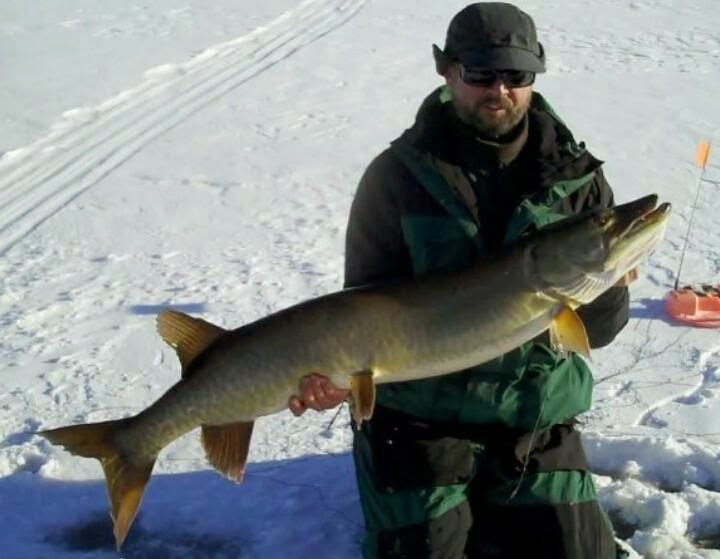
49 1/2 Inch Musky Lake Hopatcong; Ice Fishing Opportunities Now Include Round Valley

 49 1/2-inch true strain musky recently caught on Lake Hopatcong by Bill Archinbald, Knee Deep Club's "Web Guy". Photo care of Joe Landolfi.

Joe got this photo from Dante Dimarco and supposedly the musky is New Jersey's lengthiest so far, besides a 50-incher Dante caught a few years ago. But who knows, really. Muskies get caught, released, and silence kept. But big shiners from Dows Boat Rentals certainly serve the ice season on the lake for big results. Bob Neals' state record 42-plus-pounder was 48 inches, a very fat fish, also caught through the ice, but that of Monksville Reservoir. I'm wondering if any muskies are being caught on Greenwood Lake and also the small Furnace Lake, known for tiger muskies. Mercer Lake is surely fishable through the ice now as well.

My son and I ice fished Furnace Lake in 2009, a nice outing to remember, although we got skunked. For one thing, I probably concentrated too much in the deepest water. I don't know. But I do know Joe Landolfi's big tiger through Lake Hopatcong ice, about 44 inches, came from 20 feet with plenty of water down to 50 feet deep nearby. We fished mostly 25 to 35-feet deep on Furnace, the deepest water.

I get a needle thrust into my spine next week. Whether or not this makes late season ice fishing possible for me this year or not is yet to be seen. Now my reliable trout fishing (not reliable catches) at Round Valley is rendered impossible by ice cover that may remain a while. I recall that during a colder winter, Round Valley remained frozen until late March, 1994.

New Jersey has abundant ice fishing opportunities, and in all of my 38 years of ice fishing, I've hardly begun to fish everywhere. I used to ice fish in Mercer County during my teens and 20's, and we did pretty well on Gropp's Lake, a Delaware and Raritan Canal basin pond of about five or six acres, and especially well on a string of four to six-acre ponds that at the time were owned by Princeton Day School. Since a friend and I took our limits and placed them in a cooler filled with cold water from Colliers Mills one December afternoon and transported the pickerel to PDS, the lower pond became loaded. The largemouth population seemed to remain stable, too. That was illegal activity, but we were 17 in 1977 and not filled in on the prohibition against transplanting fish, at least not enough not to do it. Now I've heard of pickerel being caught in Stony Brook...

We've caught pickerel on Little Swartswood, tried for walleye on Swartswood. Lake Musconetcong has some big perch, and this winter might be a good one for pickerel and largemouths, since last I saw the lake, the weeds were back. Eurasian milfoil apparently does a great job of filtering the water, making it clean, clear, and good for fish. 

Budd Lake was once my favorite. For three or four winters I spent time alone on the ice in the late 90's and early 2000's, catching some pike, but none of them really big. I caught my only channel catfish through the ice there also. Now I'm eager to ice fish Lake Hopatcong more, and over the next few years, the lake may be my only ice destination, since I'm interested in developing a collection of black and white photos associated directly with the lake and depicting any and all forms of recreation I may encounter, as well as scenes. Perhaps sometime I'll try Lake Aeroflex or even Wawayanda. I would ice fish Round Valley Reservoir, perhaps even soon, since my persistent trout fishing has got me interested. I really thought the reservoir wasn't going to freeze over this year, so I was surprised when I drove down into the South Lot yesterday, viewing ice clear across and everywhere. 

Round Valley Reservoir yesterday. 4 1/2 inches of ice near the ramp.
 39-inch northern pike from Budd Lake.
 Joe Landolfi and 25-inch pickerel from Lake Hopatcong.
 Joe Landolfi and hybrid striper from Lake Hopatcong.
Pickerel from Lake Musconetcong.


Saturday, February 1, 2014

Try this Early Season Technique: Largemouth Surface Action at Ice Out


The wrong plug for earliest topwater action, even though it's a favorite.
Since ponds usually open up later this month, I thought I would post an article about surface action after ice-out.
Ice-Out Largemouths on the Surface
          Here in New Jersey, the Delaware and Raritan Canal was built and put into coal barge operation back about the same time Woolrich went into business in the 1830s. Not big barges, mule boats got towed along a path immediately beside the water. Today, the once clean edges of the canal serve as the overgrown haunts of largemouth bass and pickerel. As a teen, I knew of a barge basin alongside the canal near my house in the central region of the state. For more than several years, every late February and early March as soon as the ice had melted, I caught largemouths in this five or six-acre basin pond.
          Where I now live in northern New Jersey, some ponds may be ice-free while ice fishermen still dare to go out on northernmost Greenwood Lake, and possibly Lake Hopatcong. If you prefer to fish open water or especially would like to on a mild day, perhaps after a confining winter, ponds give you the early advantage of being fishable. They easily warm when temperatures climb.
Ponds Warm Earliest and Fastest
          Ponds and lakes with stained water warm fast. But any pond will warm faster than a lake, unless a lake is very shallow. I learned in my teens that largemouths can be caught on the surface as early as late February in New Jersey. But what still amazes me today is that the water temperature at which bass will take a plug from the surface is downright cold.  
          For the only topwater technique I know of that will work at 47 degrees, water of good clarity is best since the method is so subtle. A big popper on a hot summer evening may call up bass from six or seven feet down in turbid water, but the method I will disclose cannot do that, certainly not as a popper can. But leave nothing to doubt: a big popper will not work in 47 degree water unless it’s a freak exception I’ve never heard of once happening. However, there is a way to catch largemouth on the surface consistently at that temperature, although the right conditions—a calm, mild evening after plenty of sun has warmed the shallows quickly—happen only a few times at most, very early in the spring. During the first days of March, 1975, my older mentor showed me how to do it.
How to Fish a Rebel Real Slow
         “Rapalas are useless.” Joe had told me. “Not only do they wiggle too tight and quick if you try to get the bass to hit on a retrieve—as well as begin to rise very fast if you pause for a split second—the main problem with them is subtler.” He dropped a 2 ½-inch Rebel Minnow into the water at our feet.
          He said, “Go ahead, get down near water level and have a look.” The water in the basin was very clear, and I could see that the Rebel floated with most of the body slightly submerged. It sat not so deeply as it would by a 45-degree angle, but only the plastic of the head area broke the surface.
          “I’m going to twitch my rod tip very lightly,” he said. I watched as the rear end of the plug lifted slightly and the head barely dipped. Then Joe lifted the Rebel and cast it long with a whip of the light tip of the rod.
          “That’s all the action you need to get them to hit on the surface now. Wait about 20 seconds, even longer, between each twitch. By comparison, the balsa wood of a Rapala floats the plug high up and evenly on the surface. It’s entirely ineffective.”
          “So by barely twitching the tail up, it takes forever to retrieve a single cast,” I said.
          “Uh huh. But if you can’t stand it, retrieve very slowly with jerks and short pauses every two or three seconds. That sometimes does it, too. Especially gets the occasional pickerel.”
Where to Catch Early Largemouths
          There were two areas of that basin pond where we caught bass on the surface in March, and these structures turned out to have been archetypal for bass fishing this time of year. The northeast corner got the sun late in the afternoon. Situated very close to the pond’s deepest 12 feet of water, we caught bass there in very cold weather and water and through the ice during the winter. On calm evenings, after at least a fairly mild day and lots of sun, we picked off two or three bass or more from this corner with submerged branches. Some of these fish were nice, better than two pounds. They simply took to the nearest, warmest shallows with some cover from a deep retreat.
          The southern end of the pond featured a shallow flat. After several mild days, we took quite a few bass on the Rebel from just about anywhere of about half an acre of one to three feet of water. The bass never arrived there until water temperatures of about 50 degrees and more established in the afternoons and evenings of a couple or a few days.
          This fishing represented a set of two patterns we relied on for four years of fishing the basin together. We spoke eagerly each spring anticipating “the bass moving up on the flat.” Either “back in the corner” or on the flat, we caught bass on the surface with the Rebel.
          And since the 1970s, I’ve repeated the same general pattern fishing other waters. The earliest warming  water, which may be six or seven degrees colder or more the next day with the sort of weather change to expect in March, leads bass to the closest shallows they can access. It’s as though they register that they’ll only be in shallows for a single evening before returning to the depths, so they take to the closest warmed water  to them. They wait at least for the second day of warming water before invading a flat, which is both at a further distance from the depths and an extensive area itself, requiring of the bass more motion and burning of calories.
         We noticed a significant difference between the temperature of the warming water in the basin’s corner when bass were present, and that of the flat when bass moved over it en masse. Three degrees makes a difference. But not all of the bass in a pond move into the ideal structure area on one of these first mild evenings after colder weather. For one thing, that would be an awful lot of bass in one corner of a pond. About 47 degrees is all that’s needed to draw at least some of the bass into very shallow water and likely into more than one spot. Although a northeast corner soaking up that southwestern sun should be the best spot, bass will be elsewhere, too, and likely some in shallows on the feed. So long as the lure cast to them is a floater/diver minnow type plug that allows the rear to be submerged, they may rise and take it with a dimple as subtle as a trout’s taking a fly.
Major Movement into Shallows and Set-Backs
          As soon as the water is going to hold at about 50 degrees or better late in the day, a much larger number of bass move into shallow water. If the pond has a shallow flat, find bass on it. Likewise for lakes once they’ve warmed similarly, although structures, particularly those that lead from deep water into shallow flats, may be more complicated and interesting.
         Impoundments have creek channels. Large impoundments have many channels which lead back individually into shallow coves, while very small impoundments have only one. In some lakes, very subtle channels—ditches—run between shore and the main channel leading back into a cove. Sometimes such ditches can be sighted on the shoreline where they enter the water. Bass use channels and ditches when available to lead them onto flats. It’s a good idea to learn where these structures are, and to fish them closely. Bass will sometimes be reluctant to move out onto to a flat, and remain staged in a channel. Particularly large bass use the edge of a channel or scoop of a ditch as an ambush point. If you can find cover associated with a channel or ditch, that’s better. If the water has good clarity and is six feet deep or fewer, calm and warmed, the surface approach with a low sitting floater/diver may be the best device to coax a lunker to rise and slurp that plug down.
          Lakes and impoundments often have a structure which combines the two archetypes of shallows with immediate deep water access, and an extensive flat: shallow humps, which may be the best spots you can fish, particularly in larger reservoirs where bass winter in water as deep as 40 feet or more well away from shore. If a wintering area is near a hump with a fairly broad shallow area on top of it, excellent fishing may be had.  
          In any case, if the water temperature is falling, the best approach may be live bait—shiners. Getting bass to strike lures is of course not impossible in very cold water with dropping temperature. But we’re in awe of nature in part because of its order, and it’s as certain as any immutable law that no bass will take a plug on the surface in extremely cold water. There’s a world of difference between 40 and 47 degrees. It is true that by evening after a mild day, right about sunset and shortly thereafter, the water temperature may have already begun to slip. But on beautiful days that have quickly brought that surface temperature into the upper 40's without too sharp a dip of the air temperature at sunset, the fact of warmed shallows keeps the bass in them until the effect sharply reverses.
          Fishing lakes and impoundments is, at least in one respect, easier than fishing ponds: on board a nice boat the electronics tell you a lot.  Topographic maps are much easier to find for large waters, too. However, locating the deepest water of a pond isn’t difficult. Tie on a half-ounce jig, cast it, count off its descent. It will drop at about two feet per second. This may result in approximate measures, but you can certainly find the deepest water by the longest count.
          As earlier mentioned, it’s always possible that pond bass will move out of the pond’s deepest water and into two or more adjacent shallow areas on one of these mild evenings. Check a number of areas, even shallows not so likely to produce, so long as you have time. But fish the floater/diver with great patience. It’s not easy. Inevitably some bass are going to be caught on the retrieve. It may just be too tedious to always retrieve the plug by barely moving it all the way back for the next cast. Either way, remember that this is ice-out. Keep it slow.
Ice Out Considered as Pre-Spawn
          We usually do not think of ice-out as the pre-spawn period. Water temperatures are still a long way from the upper 60's of spawning time. Here in North Jersey bass don’t spawn until about early May, if that. Pre-spawn time is thought to be April, but the eggs in females have begun to grow by ice-out, and these bass need energy to grow them to size within a couple months or so. It’s possible that bass, particularly females which account for the lunkers, are particularly motivated to feed as soon as the water reaches into the 40's just after ice-out in order to compensate for the added metabolic demand of their egg mass. There may be a hormonal response in the females that drives them to feed more since eggs require more calories to produce than sperm requires of males.  
          Although bass have a cold-blooded metabolism, metabolism and temperature are not an absolute regulator of activity as such. Hormones may increase feeding activity very early in the spring relative to less feeding activity in the late fall with the same water temperature. Fishery research has established that while bass store energy as fat rather than protein when water temperatures drop in the fall, no evidence exists that this is to protect against the cold of winter. Since bass are cold blooded, that doesn't matter, and neither do they hibernate, nor cease altogether to feed under ice, as ice fishermen know well. Rather, this shift to fat from protein somehow correlates with slowing metabolism; bass do not go on a fall feed in order to fatten up for winter as if they need it in lieu of feeding. Nor have I caught bass on the surface at 47 degrees in the fall, not even on a mild, sunny day with rising water temperature.
          Besides, regarding metabolism as not being the only determinant of feeding activity, it’s obvious that bass feed for other reasons than what the water temperature is. The approach of a low pressure system stimulates feeding activity, for example. Conversely, other conditions put them off the feed. It’s also true that in waters rich with forage, bass grow faster and bigger because they feed opportunistically.
           Whatever the case may really be, ice-out is a significant time of awakening after a stable freeze. The days usually remain cold with little sign of spring becoming visible in early March, but even a single mild, sunny day can critically change the bass environment in the favor of an angler who may otherwise just be glad to get out of the house. Very good catches can be made, and possibly some of the year’s largest. But the Rebel and other plastic floater/divers available on the market may not be the final word on this surface technique.
Plug Modification
          I have never bothered to experiment with modifying plugs to see if I can increase the effectiveness of this cold water angle. The Rebel straight out of the box seems perfect enough, but I don’t really know if a touch up may do one better. It would seem as if the obvious candidate for modification would be the banished Rapala—some weight placed on the rear treble. Surely an angle of the plug’s rear to surface as steep as  45 degrees could be achieved with enough buoyancy remaining in the plug overall. Whether or not the right rear-lift action would remain, I doubt. But for those who love to invest time in tinkering and experiment, I would have to agree that plug modification for ice-out largemouths seems an interesting endeavor.