Saturday, August 31, 2013

Trout to be Stocked in October


Local Rivers to be Stocked with Trout in October

By Bruce Litton


          Fall trout stocking by the state is not met with the springtime crowds, and although fewer streams get fewer trout, they’re larger. Last year, 20,000 14 to 16-inch rainbow and brook trout, and 1000 18 to 22-inches, were stocked in 17 streams and 15 ponds and lakes statewide over a two week period beginning the second week in October. In our region, the North and South Branch Raritan, Raritan, Musconetcong, Pequest, Paulinskill, Black, Wanaque, Ramapo, and Rockaway rivers, and Pohatcong Creek and Big Flat Brook are the scenic flows to be enhanced with fish, which by wintertime will be quite adjusted and wild. According to the NJ Division of Fish & Wildlife Fall 2012 Stocking Schedule, the ponds and lakes to be stocked are from Middlesex County southward. This does include Farrington Lake near New Brunswick. There are no stream closings on stocking days, but plenty of trout escape the relatively few eager fishermen who await the hatchery trucks. It's still August, and as yet I haven't found information for the fall ahead.

          Fall and winter fly fishing in the Highlands and Ridge is not the popular pursuit that catches the eye of passing motorists in the springtime when parked cars line up near stream access, but those who enjoy it may feel rewarded with solitude in out of the way places. The Big Flatbrook, for example, flows for 16.5 miles of remote Sussex County with great views of Kittatiny Ridge rising above. The Paulinskill River features gorges--as does the Black River in Hacklebarney State Park--not as dramatic as the South Branch Raritan River’s Ken Lockwood Gorge, but other gorges may offer solitude when the popular Califon destination is packed with anglers.

          Fly fishermen anticipate mild weekend days in January and February to fish Hare’s Ear and stonefly nymphs, zebra and brown midges, and wide panoply of possible bead-head weighted fly patterns. With a winter as mild as the previous two, it may be possible to fish a late afternoon midge hatch with tiny dry flies.

         In any case—even with bait—winter fishing is tough and you need to keep interest alive by fishing with serious persistence. Angling, for all its contemplative value, is a game with a single objective—to catch fish. And like any game, when you score, you feel satisfaction as confidence is aroused and then the anxiety associated with a desire to win, so you move on with the next approach and try to involve the whole outing. Every outing is unique, and what I find so cool about fishing is that it’s never like returning to the same field format of other sports, even when the same river is revisited. After all, it was the philosopher Heraclitus who said you never step into the same river twice, and while you may not step onto the same football field twice either, the field format is the same everywhere.

          So fishing is inexact by comparison to other sports, the variables as wild as nature itself, which means evaluations of how good the fishing is are different according to opportunity and season, and the weather and water conditions met with must be considered. In our region, the number of trout stocked is about uniform on the streams mentioned. You don’t have to be fancy and use a fly rod, and October will probably be your best bet to catch a few on live fathead minnows, or even salmon eggs and two-pound test line for an exciting struggle given the size of these fish. I tempted a 16-inch rainbow in November from under the route 202-206 North Branch Raritan bridge using a baby nightcrawler on two-pound test, and once tried nickel-sized sacks of salmon eggs I brought home from salmon and steelhead fishing near Lake Ontario. They did work, but I’m not sure any better than single eggs on size 14 hooks.

          Use no weight besides a snap for salmon eggs (on two-pound test leaders) unless depth and power of current require split shot to get the bait near bottom. But fish the deep holes and weight fathead minnows as lightly as possible.

          I usually don’t bring home fish since I usually judge them to be more valuable in the water, but I bring memories back every time out. These are not necessarily sentimental post card depictions with sweet feelings in the mist, but substance acquired directly from nature in the way experience strengthens sense, the way game choices I make exercise my mind, and the way successes confirm efficacy in specific, subtle ways. Don’t think for a moment fishing is a bore sitting on a bucket. Give it the best.       


Thursday, August 29, 2013

Round Valley Reservoir Smallmouth Bass on Jigs and Topwater Plugs


Felt like we had Round Valley Reservoir all to ourselves. The far back cove behind Ranger's looked so good with equal patches of vegetation down to 20 feet or so and sandy bottom with branches and stuff that I felt perplexed at no hits on our plastics. We motored down reservoir to the right a mile or so and began fishing jigs 15 to 23 feet down. At 15-18 feet or so we had some minor problems with vegetation, but the bottom was pretty hard with some stuff on it. I got snagged three times. Another time I came up with the smallmouth photographed. The jigs with synthetic leeches yielded both of us some rock bass and Fred missed hits. Mostly, the outing involved catching up on how life had been since Fred told me back in April he was headed out west. He had an amazing 3700-mile drive full of hiking adventures and fishing the Yellowstone River after landing in Phoenix with his wife. I've always meant to get out west and have a few times in relatively superficial ways. Plenty of time is left ahead for ranging further and deeper. I've been dallying a lot on the East Coast and have a curiosity for comparisons of commercial fishing Maine to Florida, having been in the commercial business for 13 years. But the likes of this can get too bound to seeing things in a certain way, like how I was getting interested in Highlands New Jersey as if it comprises enough of the world--before we left for Ocracoke this summer. I should reach out westward just as I had meant to as a 20-year-old.

The sun slipped behind the western Cushetunk Mountains and all was so peaceful we could hear a pileated woodpecker loudly clear across the water on the eastern side. When real darkness began to fall, I tied on a Hedden Torpedo with just enough light to guide my clinch knot. On the first cast, the plug got blasted right over the vegetation about 12 to 14 feet deep. I reacted to try and set the hook immediately--you have to let a bass take for a split second. The next cast got two hits. Fred tied a popper onto his second rod. No more hits came. Then, when Fred was finished with the jig, he guided the boat very slowly with the electric up the shoreline, popping his plug. This was the right idea. It yielded a smallmouth for me and I lost another over the weeds and, I suppose, rocks. I was in the forward position, so I was advantaged. I noticed that when action stopped. We also came in very close to try right up against the bank as if bass may have moved in to rush baitfish.

It was dark. Clouds we had watched had moved in. Lightning flickered so Fred pulled the starter cord. It always makes me nervous to have deep clouds over me when a thunderstorm is forecast because lightning has to begin somewhere. In the distance, it already had. And a thunderhead can spawn a new beginning as a surprise. But I just figured that if lightning began to strike in our quarter, there wasn't anything we could do but continue to head for the ramp, so I relaxed. I've had some close calls--lightening strikes within feet of me--and so has Fred. When we had the boat trailered, it began to rain very lightly, but we sparked up more conversation having forgotten about the storm that apparently forgot itself--no rain here 20 minutes away--and forgot the tension hooking some fish, all the persistence and hope to catch more. But I think Fred's idea of fishing topwater plugs in among the rocks of the dike near the ramp at night is a good one. It's a good one at least to try.


Friday, August 23, 2013

Pamlico Sound Sea Trout Shallows


Pamlico Sound near the Outer Banks' shores is shallow and wadeable, but beware of crabs and sting rays. A ray more than two feet across nosed right in front of me, and I was ready to brandish my rod against it. I came with only my medium power St. Croix, a Rapala number 9 floater, my camera, and the first hand knowledge that sea trout, relative to the weakfish we catch in New Jersey, frequent the edges on calm sunsets. I witnessed an angler catch one after another feeding on schools of baitfish--not big specks but fine on light tackle--near Rodanthe on a return trip back to New Jersey a few years ago.

I encountered some baitfish but no gamefish. A few small something--or-others swiped at my Rapala at the surface, but I suppose they were lizard fish about six or seven-inches long. Found the hermit crab--photographed his mobile home. Got my left big toe pinched by another crab.

I had found a turn-off from Route 12, Ocracoke Island--most of this island is wild--to a trail that only allows 4 wheel drive by permit. I walked the half mile or more and the bugs weren't bad at all. The solitude felt exquisite. Anyone worth such experience should go for it.

 Pamlico shallows are grassy in large patches.
 Pamlico sunset all to myself. Duck blind on the horizon.
That hermit crab's hide-out.


Outer Banks Pier Fishing for King Mackerel and Otherwise


"There hasn't been a king caught all summer," the proprietor at Avon Pier told me as I paid admission.

And the likelihood of any being caught today reduced by dense water clarity, nor would Spanish mackerel show, but perhaps bluefish. A week ago, a sailfish got caught off the end of the pier. I've never heard of such a thing any summer, although king mackerel used to be frequent.

"Fishing's been slow all year," one of the two other guys trying for kings told us later. Not only for kings, for everything. I've never fished a slower day on the piers, besides once in November, but at least I had witnessed a 16-pound blue. One of the other guys caught a blacktip shark of about 28 inches on the trolley rig, something got one of our live spots set out on the water surface to splash like the goat left out for T-Rex in Jurassic Park.

"Blacktips will just come up and chew the bait off," the guy said. We caught some other spot, a croaker, a small blue, loads of blueclaw crabs, I lost something nice (not a ray), and caught some mullet or what we call kingfish in New Jersey.

Nevertheless, the piers have never let me down. I think Matt got a little bored with it and we left after seven hours, but that's how teens are. I bet I would have got a little bored too in my teens with fishing that slow. As it was for me today, I relished sitting there for hours doing nothing but easily tending my hi/low rig as I watched my baits swim not far in the distance.

However the spot got off, I had it hooked well on the rig and the clip in order, just wasn't watching at the time whatever took.


Wednesday, August 21, 2013

Portsmouth Island Boat Tour Good for Flounder & other Gamefish


Some who take the Portsmouth Island tour boat from Ocracoke bring along fishing rods, and the news I have to share is that flounder and other gamefish species are available in the inlet from shore. The pinfish tore up my shrimp & squid at first. I put on a big piece of cut bait and caught my first flounder by casting a two ounce bank sinker, three-way swivel rig. When the tide shifted, the pinfish vanished, but I still managed to catch a drum of some variety, what we call a kingfish in NJ. Then the tide went out with a strong current through Wallace Channel--it virtually runs right along the shore--and I caught more flounder drifting that two-ounce sinker, baiting up with whole shrimp and squid heads.

We also did some swimming, beach walking, and shell collecting. Matt found a Scotch bonnet in perfect condition and an olive shell also without flaw. Four hours we allowed for plenty fishing and these other family activities besides. It did make me want to spend a lot more time out there. The vastness of the clouds gives you the sensation of almost being among them, as if the shore goes right to them and great distance is connected right where you stand. I could spend days on the beach with just a tent, some water, food, fishing rod, camera, and swim shorts, but from what I've heard, the mosquitos hit the beach at night during the summer months.

Portsmouth Island, Inlet immediately left.
Community Dock, Ocracoke


Brown Pelicans nearly became extinct, early 1970's, due to DDT pesticide.


We came upon this out in the middle of Ocracoke Inlet.

Tuesday, August 20, 2013

Ocracoke Inlet Pompano and Bluefish Blitzes


A good incoming current this morning proved extremely productive, and the fairly high swells didn't matter, just made it all more exciting. We anchored near the mouth of Ocracoke Inlet and caught three pompano to start the outing. This took some patience, the first fish revealed after 45 minutes or so. From about 10 feet of water--some of the fish shallow on top of a shoal in casting reach--these are the largest pompano my son and I have seen, nearly two pounds each. We caught them all on sand fleas hooked on hi/lo rigs.

This is our third Ocracoke Inlet, N.C.,charter with Captain Ryan O'Neal, and each time he's shown us something different. He's never failed to put us on a lot of fish, but if we were to have a bad day, I would certainly forgive him that.

The pompano bite had been slow, but for us the few we caught impressive enough to have made a day. What awaited us I really couldn't have guessed. We headed on out the Inlet, my mood slow as the fishing had been. I really didn't expect anything, but Ryan told us we would cast for Spanish mackerel. For the moment, no evidence of fish reassured the sort of mood that just can't see beyond resignation, no matter how I try and scale the walls closing me off within. Something would simply have to tear them down.

So sure enough, fish broke water chopping silversides to shreds. Immediately, I knew the walls had been no more than a thin veil; however absolute the separation while it lasts, it lifts as easily as a stage curtain.

We hooked up instantly on chartreuse bucktails. Bluefish. And a Spanish mackerel my son lost at boatside. We motored off to more surface commotion and suddenly the sea immediately before us erupted as an exploding dance of thousands of blues and Spanish mackerel leaping through and churning the water. We hooked up instantly until the fish went down. For about two hours it was chase and find with how many schools of predators in the area unknown. The clear water revealed many dozens of blues in eyesight along with some Spanish chasing hooked fish.

This action as fulfilling as any dream of a motherlode for the taking, most of life seems pretty plain by comparison to having all you want at your fingertips.

The water clear blue, electrical pulses shot for bottom, reflecting sunlight like cherry bombs; light-weight rods throttled with drags giving way to these demons, these angels of light in a paradise of life let loose to do as it will. Mostly, we caught double headers with the jigs rigged tandem. There must have been a million bluefish. We took nearly 60, perfect size for the table.


Wednesday, August 14, 2013

Fall Walleyes: Two Approaches


Golden October

Turnover Time Walleyes, Fall Peak

By Bruce Litton


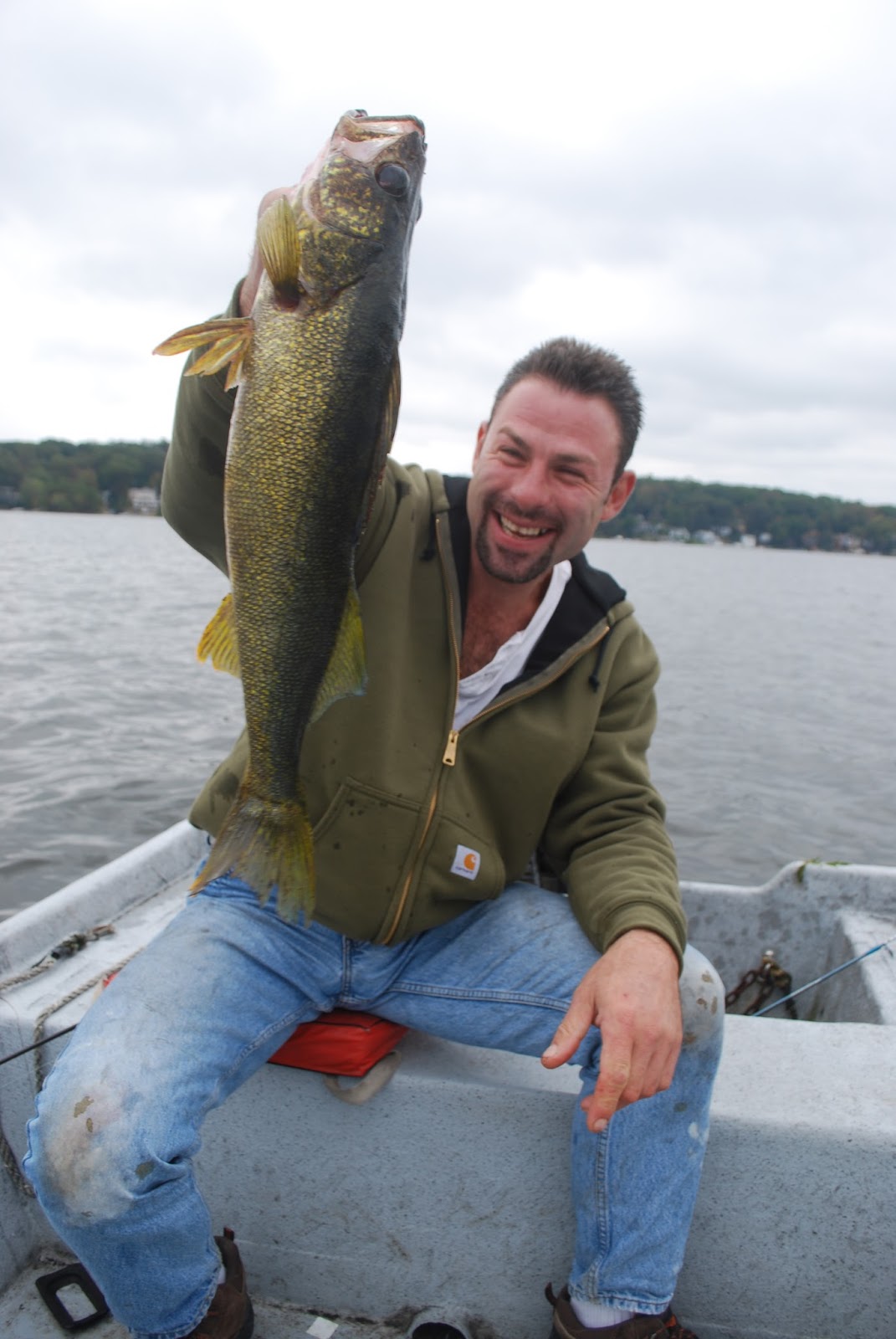
          Timing isn’t perfect between peak leaves and re-establishment of oxygen throughout lake depths-- the fall turnover--but it’s close. And like the color of oaks this time of year, walleyes may give us a deeper experiential tone than do other species more readily caught in shallows and which do, in fact, have lighter body coloration, besides smallmouth bass anyhow. All lake species are available now, but walleyes are especially worth pursuit, since throughout long, hot summer days they may have suspended at 15 feet, but fed almost exclusively at night. It depends on whether or not a lake has oxygen at the bottom during summer or not. Now they may move into deeper water of 25 feet or more suited to the low-light vision afforded them by their namesake, the tapetum lucidum immediately behind their retinas, which reflects light back through so they can see prey better than they see them. Walleyes may now be caught anytime during the day, although fishing hours may be best early and late and under overcast skies and wind driven surface.


Alewives

          Two general approaches to fishing fall walleyes may be appropriate, depending on your preference for one or both, and whether or not the lake or reservoir you have chosen to fish has a population of alewives, choice forage for walleyes. In New York, walleyes thrive on a healthy diet of Omega oil rich alewives in Conesus Lake, Otisco Lake and other Finger Lakes, and Lake Ontario. Lake Hopatcong, Swartswood Lake, Greenwood Lake, and Monksville Reservoir are beautiful bodies of water in New Jersey with populations of large walleyes running with alewife herring. I have caught walleyes on shiners in Lake Hopatcong when alewives were not available for bait, but the value of alewives as forage, not to mention their liveliness on a hook, is superior to shiners.

          Naturally, one of the two approaches I have in mind would be the use of alewives for bait. The second involves the same rocky drop-offs that fall walleyes feeding on alewives typically inhabit, but relies on lure imitations.  Since the time walleyes first reached lunker size in New Jersey lakes and reservoirs—having first been stocked in the early 1990’s—someone struck on the clever idea of using Rapala ice fishing jigs and Gotcha Jiggers (used to catch Spanish mackerel from North Carolina piers) directly under a boat.  Other jigs, 3/8th to ½ ounce, can be used the same way, possibly tipped with an alewife to combine the two approaches. Binsky blade baits have become very popular.

         Perhaps no better time to fish walleyes exists than mid and late October, but the beginning of turnover is the inauguration of a long period for these two related forms of fishing that persists through November, into December, on through the winter, usually until early or mid-March through the ice, and even thereafter. (Alewives, however, are replaced by shiners as bait ice fishing since they are not available in the winter.) Shiners are baited on the terminal end of a tip-up line. Rapala ice jigs, and Gotcha Jiggers are snapped onto the 15 pound test braid of a hefty jig rod and light spinning reel backed with enough low diameter braid to battle a musky, since on occasion muskies approaching 30 pounds hit these lures.

          When ice fishing, walleyes and muskies feel lumped together as a difficult specialty, usually requiring a lot of time spent out in the cold. In October, however, quite a few good walleyes of three, four, on up to 10 pounds can grace any given outing.  It can be the difference between happy abundance and scarcity; the reward for ice fishing is chiefly to have functioned against more difficult odds.


Deep Structure

          Alewives are open water fish that relate to deep drop offs and rocks. They mass together in dense schools, and do not congregate in smaller pods among aquatic vegetation as shiners do. Many reports indicate that on some lakes October is the month to catch walleyes in the shallows. Most likely, those are lakes without alewives. Walleyes will spawn in early spring shallows and strike surface lures at night through the rest of the spring into early June, but their surface presence at night is a function of the alewives’ being there, probably after zooplankton.

          In any case, whether surface fishing in June, or fishing deep by October first, always study a map of the lake if you’re new to it, then find on your graph recorder the presence of alewife masses 25 to 40 feet deep, or deeper, along drop offs. This is where walleyes are likely to be. Main lake, rocky points that ultimately drop off into at least 35 feet of water are, as a rule, excellent. So are other drop offs with rock structure and such depths. But points that contain rock structures along any sort of path from deep water into the shallows may be best because both alewives and walleyes have the full range of available depths. Very early in the morning or during a windy rainstorm, it would be wise to check such rocky shallows as well as the darker depths. However, with wind driven water crashing against a rock face, walleyes would be advantaged. Turbulent shallow water is also good for walleyes’ special vision, since the same eye structure advantages them in rough water as well as dark. But if no alewives are present in these shallows, it’s likely no walleyes will be, either.

         I like to imagine that turnover is an enormous relief for walleyes because they get to be themselves again down near the bottom, ambushing prey from among rocks. But walleyes are not the stalkers pike are; they are not even closely related to pike.  In fact, the pike family shares the same order of classification as the trout, salmon, and char family, Salmoniformes. On first take it may be hard to recognize a pike as anything like a salmon, but a deep intuition will resonate with similarities, such as smaller scales. Walleyes are of the order Perciformes which includes not only the (yellow) perch family, of which walleyes are members, but quite a number of fish families fresh and saltwater including the sunfish, white perch family (along with striped bass and white bass), and many other families.  Nevertheless, walleyes are ambush predators—just not with the same, snake-like attack as pickerel, pike, and muskies. As awkward and lumbering as walleyes may seem—as if with their reflecting eyes they are hindered by light to travel unsteadily—they love to blend their coloration with boulders hiding next to or between them, or to sense prey while on the prowl in pods to then dash yards into a school of alewives and take one between rounded but very sharply pointed teeth. Perhaps they are awkward suspended over their real homes during the summer stratification, but by mid-October reawakened to the dark regions they enjoy best.

          But a very common myth about walleyes must be dispelled. The truth about walleyes’ tapidum lucidum is that it adversely affects vision in bright light no more than cats’ eyesight is affected by the same eye structure—not at all. Walleyes are like any living organism—they seek their advantage and the tapidum lucidum increases vision in dark and/or turbulent water, giving walleyes the distinct advantage over prey in these situations. When lakes with oxygen depletion turn over, walleyes can behave more like themselves by going deeper.


Alewives as Bait

          Bait is never efficient as is a lure; bait is messy and live bait has a will of its own (and needs to be allowed to exercise it). But bait has the potential to bring an angler closest to nature, any kind of bait does to some degree, even manufactured “mulberry” carp bait is more natural than using manufactured plastic. Bait contains a purity that no lure can replace. Natural essence is the purest of elements—everyone seems to believe that fresh air gives us the purest experience we ever feel. Catching walleyes with live alewives allows one to be a direct participant in a huge life and death drama. It’s not cheating; it’s being there.

          You would need medium power spinning outfits, size 6 plain shank hooks tied to three feet  of six pound test Seguar Carbon Ice fluorocarbon leader (abrasion resistant) between that hook and a small barrel swivel tied to six pound test main line, ½ to full ounce (depending on depth) egg sinkers with line running through them above the barrel swivel.

          Don’t worry about the rounded teeth—unless you would have any intention of placing fingers between them. These teeth will not cut light line as razor-like pike teeth will part it at the slightest touch. 

          Prepare two or three medium power spinning outfits per angler—length is fairly arbitrary because neither pin point accuracy nor very long casts are necessary. Still fish with two rods, bails open, and work the rig of the other along or up a drop. Rigs are identical, but hook the still fished alewives behind the dorsal fin, and the retrieved through the nostrils. If you must be fancy, Lindy bait walker rigs with floats may save you a few bucks in the long run, since snags are common. But herring are so active on a hook they don’t need help.

         Retrieve slowly, let sit for 20 to 30 seconds or longer before lifting the rod slowly to noon and back to 9 o’clock. Eye the spool of the soakers as often as you work the retrieved. The alewives on the still rigs will swim very freely near the bottom and any rocks. Larger alewives, three to five inches long, make their presence known to gamefish; walleyes may find them from farther distances. On the other hand, retrieving an alewife, you try to meet a walleye halfway.

          Double anchoring from the bow and stern is a method to keep a boat in stable position. The idea is to position so that the wind blows against port or starboard by setting anchors, each tied to 150 feet of nylon cord, from stern first and to then motor upwind and aside to place the bow anchor. However, I’ve been on Lake Hopatcong in a 14 foot boat with the wind so strong I just anchored from the bow and let the boat bounce and swing—without water coming over the side. Believe it or not we managed to keep lines out, although lines alternately tightened and coiled.   

          If you are as particular as I am, save any alewives that die in the process of fishing, break them up, and chum the water by tossing pieces over the area fished. Yellow perch get most of the chum. But once perch start moving, bigger fish may be aroused by both scent and activity. It’s not always the case that a mass of alewives will be present on a good structure. And walleyes are not always immediately in position to feed on them because alewives are more suited to open water, while walleyes relate more closely to rocky bottoms of drop offs. So bait and walleyes are not a 1:1 relationship; they often go their separate ways, and arousing interest works.


Straight Down

          On Lake Hopatcong especially, vertical jigging has acquired almost cult status in New Jersey. It is very productive. Sometimes it’s as clean as marking a fish on a graph that trips the fish alarm, then lowering an ice jig down in front of its jaws. Most of the time controlled drifting by graph use, as well as electric steering, is an attempt to keep the ice jig or Gotcha as straight down under the boat as possible for control’s sake. A sharp lift of a foot or two, keeping a tight line on the fall works in October, while subtler motions produce as water gets really cold.

          Fishing deep in freshwater may be an interesting diversion from so many relatively shallow pursuits during summer. And walleyes, for that bronze-golden feeling-tone of mystery that they evoke, are a valuable catch. You can purchase Rapala ice jigs with precisely the same color (they work).

          However, while walleyes may chew up some of the younger of their own, as well as small perch (no doubt muskies consume perch), they probably swallow overwhelmingly more alewives than anything else. It’s no myth that this forage is high in Omega fatty oils, which surely answers in part to why 10 pound walleyes swim in these lakes and reservoirs—good, chunky fish. So jigs that imitate alewives make sense and a good choice, I think, is the Gotcha chrome finish. Those depths are dark, but walleyes have night vision.