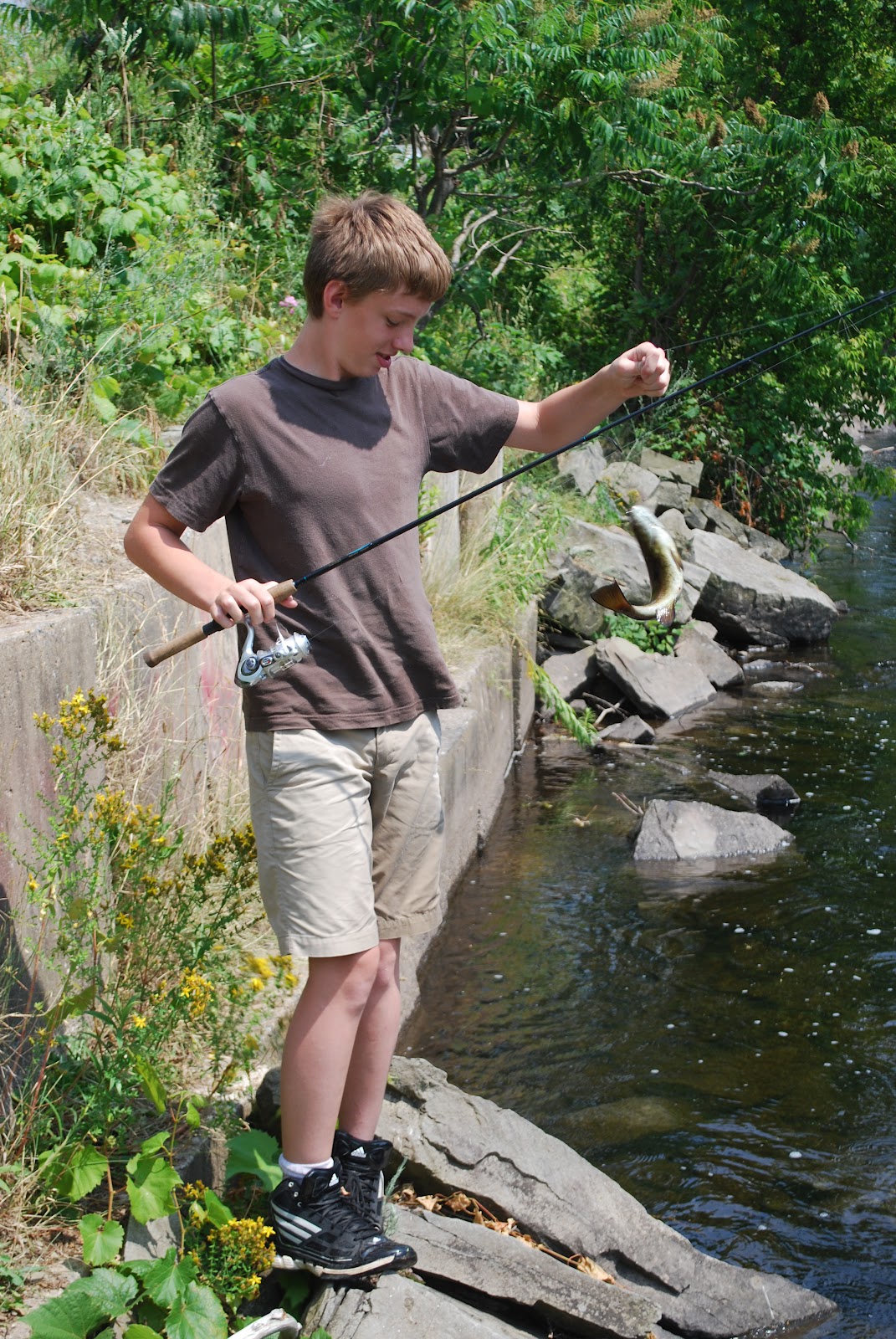
Friday, July 6, 2012

Lunker Smallmouth Bass, Brown Trout or Atlantic Salmon, in View but Off Limits


The Salmon River's flow level is adjusted by hydroelectric dam release. When we arrived yesterday, the river flowed low and invitingly. Late last night the level rose and today remained higher. We began fishing at the Black Hole this morning at about 8:30, 60 feet deep with beautiful shallower currents, ledges, and eddies. Turbidity turned me off, but I did get a few hits from something on a Mepp's #1. I figured maybe the risen water level had stirred up the river to reduce clarity, but felt relieved to later find clearer water upstream.


We made a whole day outside except for lunch at a sub shop. We caught a dozen bass on plugs and shiners, fly fished for hours, Matt catching a couple of rock bass on a big, brown Wooly Bugger, while a couple of fallfish fell for my large stonefly beadhead. Snorkeling at Altmar in the fly fishing section afforded us views of great fish we couldn't attempt since it's closed from May until September 14th  We spotted in this section about half a dozen smallmouth bass around four pounds, one five- pounder, and either a brown trout or Atlantic salmon of about eight pounds. I also noticed a number of rainbow trout six to nine-inches long spawned from thousands of steelhead.

We got around. More than half a dozen spots got our attention. Compared to yesterday, today felt different. With limited time to fish, I felt driven to make every cast count last evening and the two good bass we caught rewarded the effort. Today never fell into sync as strictly a fishing effort. Taking time out to swim and snorkel, to practice fly casting, and to just slow down and enjoy being outside took precedence over trying to score. It made a difference in my life to slow down and just let my physical senses reign for many hours.

Matt sighted a smallmouth of about five pounds with just enough daylight left to see, last evening, and I spotted it today, which explains the shiners. This bass was not at all eager to take the Strike King worm as others had been. We trie for this bass today by scheme, making sure to have half a dozen large shiners for sunset. But it didn't cooperate.

More elusive than five-pound smallmouth bass in the Salmon River this time of year perhaps, Atlantic salmon are a thrilling possibility. I came upon no one targeting them singularly, but what a reward one of these most valued gamefish would be!


Smallmouth Bass Salmon River


We fished by 5:30 p.m., quitting at 9:15. I got word in Pulaski before we got our sneakers wet that smallmouth bass fishing on the Salmon River is relatively slow. The stories I have heard over the past few years amazed me, but I had a feeling we wouldn't have 100 bass-a-day action.

We got two good-size bass and a few others over 12 and 14 inches. I caught eight, Matt three, but he had butterfingers, having taken as many hits as I did.

He caught a bass on his first cast with a Storm Hot 'n Tot crankbait. Plenty of light yet on the water, the silver sides reflected great flashes, and my silver Rat-L-Trap did much the same. I had one hit on the plug, having waded upstream along the stretch a couple hundred yards before I switched to a five-inch Senko-type (Strike King) worm rigged wacky. I chose crayfish brown and stuck to this. I missed a couple of light takes that later I felt sure were rock bass, since I caught a couple of these over the course of the outing.

Matt and I returned to the deeper, slower pool at the bottom length of the stretch, surprised how far shadow had advanced.

"It's amazing how you forget time when fishing," I said.

It amazes me even more now as 1:00 a.m. approaches at the Steelhead Lodge near Pulaski. I had a nice bass on in no time many hours ago now that seems minutes, and for awhile had taken a hit on every cast.

"How are you doing that!?" Matt said.

"When we got here, we saw no bass at all in that sunlit water. They were under rocks and now they're out in the open. Each cast I make to a completely different range--all the way across, then straight up to my right. Bass may dart 15 or 20 feet to grab the worm, so when I get a hit there, the next cast I aim to a different place with the intent to come back around later. The hits are coming within two seconds of the worm hitting water."

Matt walked around and upstream of where I fished and nailed our best bass.

We drove to three more areas, and caught more bass at the last of these. At the Trestle Pool we found a recently dead Atlantic Salmon of about eight pounds. Joe here at Steelhead Lodge informs me that bass fishermen connect with Atlantic Salmon fishing plugs for bass from time to time.

After dinner we went back out to try for big brown trout. We had gone into Pulaski first thing to try to buy Muddler Minnows. Only small ones available, we bought big, bushy streamers with foam heads instead of with bead weights. We soaked them with floatant. The idea involved stripping them right across the surface of our deep hole of choice.

On Matt's third cast--I was still rigging up, but happened to be watching--something gargantuan erupted upon his streamer. It worked. But Matt didn't hook the fish. We fished over an hour savoring the night and the mystery of the strike. Matt caught a fallfish.


I had the notion to abandon ourselves to the night, to fish at least a few more pools for several hours and forget about blogging. At least I did feel this and I hope that Matt does as he grows into his most vital years. It just didn't really grab me, but for the nearly four hours that we fished in daylight, I never took a half-willed step.


Tuesday, July 3, 2012

Lake Hopatcong Smallmouth Bass and Walleye: Beating a Blue Sky


Like last year, our July Lake Hopatcong trip threatened to skunk us for the first couple of hours. Not a cloud in the sky, we had arrived at Dow's Boat Rentals at 5:10 (they opened 5 or 10 minutes before 5:30) in jackets. As if we ventured  within an alternative space amidst this heat wave, it was a little chilly before sunrise with classic cold front conditions, although when we left the lake after noon, cumulus and patchy clouds had arrived and the temperature had moved close to 90.

We began not at the sharp drop-off, but further in where a recent great catch was reported to have come. We stayed maybe 15 minutes and marking nothing on the graph, the drop no better. So on we hustled. Marking no fish, I quickly moved us to where I felt some confidence.

It didn't take long for this 18-inch smallmouth to take a herring in about 20 feet of water, but suspense in the meantime we felt, not wanting to get skunked. I think the bass swam fairly close to bottom, although the herring was not weighted. Oxygen is depleted now somewhere below 22 feet. I tested the depths by putting herring down and reeling them up almost dead (they revived).

Matt worked nightcrawlers from 16 feet (deep weedline edge) down into about 22 feet of water, and I joined him, inflating nightcrawlers with the Worm Blower, weighting them with a chunky tin split shot. I slipped into a nice flow of concentration, enjoying the pursuit even for pumpkinseeds like the one photographed, when I felt a lugging pull and set the hook without even thinking. I then knew I had either a walleye or channel catfish on, giving my ultra-light a fair test. This fish did not want anything to do with the net, streaking away on runs three times before Matt said, "I got it!" Looked beautiful in the water, I thought it would measure 26 inches and think this is because of the hard, weighty stubbornness on the flimsy St. Croix.

It's my first walleye on a nightcrawler, 24 inches, 4 pounds, 9 ounces. Made sense with the mile high sky to float a nightcrawler and tease it along very slowly. This walleye couldn't resist.

We fished a drop-off a long while where Matt caught his bass and a number of bluegills, green sunfish, and pumpkinseeds. He had caught a rock bass back at Pickerel Point. Matt became tired of the sun and heat.

"Mom's going to be angry we brought no sun block," he said.

I sort of wished I had brought some for him, but I never use the stuff unless my bare back is exposed for hours. I managed to enjoin him to drift (virtually no wind, a real good drift speed) the ledge, firing up the outboard a number of times to keep our split shot weighted herring right along the top of the drop in 16-22 feet of water. I hooked and fought another nice walleye only to lose this fish, but a hook-up never counts for nothing.

By Hopatcong standards, it wasn't a day packed with action as they can be on the lake, nor an average day with a fair number of nice fish caught. But we've never been skunked on Hopatcong, and today's fish were good size. Even the bluegills.


Monday, July 2, 2012

Fly Fishing Smallmouth Bass North Branch Raritan River

 Fly fished smallmouth bass for less than an hour on North Branch Raritan at AT&T World Headquarters, catching a couple. Pursuing smallmouth seems to be a fine way to practice, as I'm still a novice fly fisherman. I found getting the stonefly nymph right against an undercut bank very difficult, but made one cast that got the beadhead about two inches from getting caught on the brush, and several other casts or more got it close.

The river's in beautiful shape: clear, cool water that seemed every bit as fine as the Paulinskill Friday, but no trout spotted.

Walking out, I saw a young fly fisherman casting beautifully between the bridges.

If I put music to go with this post, the song would be "Green Eyed Lady," by Sugarloaf. But the eyes look more aquamarine blue than they did while on the stream. Ocean's lady.


Saturday, June 30, 2012

Passaic River Trout and Snakes Scherman Hoffman Sanctuary

Today's outing--snakes at Sherman Hoffman Sanctuary, precisely our intent.

Matt's hope--milk snakes. But I took a patient course, knowing very well how difficult it is to fulfill such expectations. Milk snakes are one of the seven species of 17 New Jersey snake species total that Matt hasn't found to this date. 

Matt discovered two garter snakes today.

What amazed me is that the small garter snake I photographed him holding--perhaps 16 inches long--regurgetated a freshly consumed red salamander, fat bodied and over five inches long. For a moment it seemed as if the salamander remained alive, but my mind snapped immediately back into place the moment I found this surely couldn't be, fresh as killed the moment we arrived on the scene.

I'm reminded of poet Allen Ginsberg, and how he might lavish the find.

Red salamander! You are the world!

And on and on with his ravings to suggest taking the whole world into consciousness. And why not? This salamander very well preserved in my photographs, I know I could pass these photographs off on a lot of people as pictures of a live salamander.

These are Passaic River headwaters running through the sanctuary. Full of wild rainbow and brown trout, the Passaic flows pure. Down below, the river flowing through Newark's Ironbound District is about to be dredged. During the 1970''s the pollution was some of the worst in the world.

Oh, and the Passaic flows through Allen Ginsberg's hometown, Paterson.

Contrary to conventional assumption until fairly recent years, perhaps, the Passaic's pollution didn't intensify beyond hope during the 1970's. A friend of mine caught carp regularly in Passaic River, Paterson, during that decade.


Friday, June 29, 2012

Brown Trout Fly Fishing Paulinskill River and an Afternoon in the Mountains

 Didn't have as much time to fish as had hoped. Heat hung in the air by the time I arrived at the Paulinskill shortly after 10:30 a.m., but water temperature surely hadn't risen over 70. Trout had proven to be plentiful in this stretch. But last year at the end of July we observed more smallmouth bass than trout. Today I saw three smallmouths, one of them about 16 inches, and committed myself to trout with the little time I had.

Still a novice with a fly rod, my casting certainly has improved, but missing three trout strikes shows I am not a straight line to the fish yet. I began with a stonefly nymph and quickly reasoned that the trout, swimming in mid-column, might take a subtle wet fly, but not a bead head. So I tied on a size 18 ant pattern and did manage to catch an average-size brown trout in addition to getting those other visible strikes, the colors of this trout very striking. I quickly released it, rather than taking a photograph, because I feared its getting lactic acid poisoning.

Then I went on my way to Mohican Outdoor Center to retrieve my son, Matt. He opted out of fly fishing in advance, expecting to be tired. But as you can see by the photographs, we had quite an afternoon up in the mountains.

Swimming, by the way, was best. Catfish Lake has 80-foot depths and I felt if I could have swam underwater down into them, I would have. No, it wasn't rapture of the deep, because that is in fact an objective condition in just such a way, but water is salvation. And the Atlantic brine is full of salt, as I recall.


Adventure in the Underground Economy: When We Shelled it Out


From ages 14 through 18, I engaged more than 250 days of outings each year--fishing after school, sometimes before homeroom, weekends. At 19, I began a life of commercial shell fishing. Hardcore outdoor activity, especially considering the wetsuit work in January and February. My teens had been a life of incessant activity and little conflict between interests outdoors, social, and school, little conflict besides the gripes of grouchy Black Dog mornings and the usual sorts of uncertainties teenagers work out in the privacy of their minds. Absolutely no reason existed for why I couldn't succeed professionally. Offered a staff position on the Manahawkin Beacon/Beach Haven Times the same year I began clamming, however, I declined. I chose the bay because I wanted to be a literary writer. I knew the outdoors. I understood it would serve my writing, as my writing would serve it. Getting published on fishing at 16 in various magazines, I finished my last article for The New Jersey Fisherman at 19 and shoved off the mainland for Long Beach Island.

The following is from a piece I wrote for The Sandpaper's Memorial Day edition, 2010. I use the description "Underground Economy" in the post title and think of the spirit of the perennial American economic pursuit beyond the bounds of regular employment, much as 18th and 19th century Rocky Mountain fur trappers are remembered as rugged individualists. It could seem, however, as if I were all over the map. For example, in 1983, I worked for Personality Dynamics in Princeton, before returning to the bay with a friend I persuaded to leave the company. We were valued employees, neither of us dismissed, but not only did we earn better money in the bay, Mark's earnings made graduate work at Rutgers University possible for him. 

And yet with spiritual abandon rather than limitation to basic economic pursuits, I had already joined writers such as Jack Kerouac, Edward Abbey, Jack London and others too numerous to mention who have fulfilled free lives outside convention to emerge in university reading material. I'm not well known in academia, or not yet, but Western Michigan University has archived a couple of my poems. Writers like myself hope to inspire bold possibilities transforming our dark age so light and love may come to us all. Jack London committed suicide, but I do not judge his life a loss. Many would contest the notion that Kerouac fulfilled his life, since he drank himself to death. But no doubt exists in my mind that each of the three I've mentioned lived much fuller lives than conformists afraid to get up and go out. Every clammer I knew held a state license, which made us legit above any illegal underground economy operation, but to have embraced this way of life recalls what one of the band members of The Outlaws said, that each of us has some outlaw in him, and more than one of the clammers I've known loves "Green Grass and High Tides," the Outlaws' signature performance.

One of us parodied philosopher Rene DeCartes. "I clam, therefore I am," which struck me instantly as having nothing to do with DeCartes, but certainly existentialism and the ambition to achieve a genuine life. To have turned our backs and walked out of the formal economy required of us no small measure of daring and apprehension. We all knew that to be an Outsider is to embrace difficulty, and for me the difficulty has indeed been grave; while each of us in any walk of life may have some "outlaw" in him, perhaps virtually no one admits it because it isn't comfortable. Nevertheless, if we are to overcome the shadows, we cannot do it only by old established patterns, but by the brilliance of sunlight itself.


When We Shelled it Out

The temperature, I remember, held at 22 F. Wind drove 20 to 30 knots out of the northwest, and three layers of neoprene wetsuit insulated our bodies. A quarter-inch of neoprene hood wrapped each of our heads; a diver's facemask covered each of our faces; quarter-inch neoprene neoprene Brute boots with heavy nylon treads gave our feet the potential to work. I leapt over the gunwale into a rush of frigid water.

Barry and John were already treading.

"We know the spot's here when the ice melts," Barry said.

"Hope that's not too long," John said.

The bay would soon freeze solid. John had a mortgage to pay. A young family to support. It didn't matter to me how long the bay would stay frozen. I was 23 and family wanted me at college. My freedom mattered more. Good money made that possible. But neither money nor the ubiquitous beach bum image held me to Long Beach Island. I wrote. For someone who loved to pore through books and spend trackless hours exploring ideas by writing in notebook after notebook, clamming seemed the perfect life.

I owned nine boats in total--and some got totaled--over 13 years. I owned all of the equipment needed, license, and sold my catch daily to local seafood wholesalers. We worked low tides, self-employed. Clam treading is the method of jogging backward in water anywhere from knee deep to as deep as the nose, depending on tidal stage and spot. Stepped on, a clam feels like a golf ball. Any of us dipped or dunked, grabbed a clam, and tossed it in a bushel basket. It was in fact an aerobic workout--even though some of us smoked Marlboros. When we smoked, we lifted clams by toes instead of by hand until only the butt remained, although some of us preferred the method in general to dunking. When I paid off necessities, I sometimes worked no more than two hours a day for weeks running, but generally a day's work was four or five hours of low tide. Often I worked with friends; often I worked alone.

Sometimes I felt as if I had the whole bay and island to myself. I never met anyone else who combined treading, beach, going out and so on, with intense study, writing, and exploration of life, ideas, self, nature, and society. My explorations, informed by fertile intuition and chosen by conscious judgment, had advantages college couldn't offer me, and over the course of the 13 years I clammed, I enrolled at three schools for short periods. College is a program more and less imposed upon the student. Following my curiosity instead, I freely developed my mind. At that young age I studied philosophy--Alan Watts, Ayn Rand, Martin Buber, Paul Tillich, Jean Paul Sartre Karl Jaspers, Friedrich Nietzsche, Albert Camus, Plato, Aristotle--taking on the difficulty it presented with great vitality and concentration. When I first began reading Nietzsche at age 20, I was lost on him, but I read Watts with great ease. Nietzsche merely required my persistence, and a couple of years later, I understood him. I read dozens of novels, poetry, and my interest in psychology especially involved Carl G. Jung's work. 

A housemate read classic novels. With a propensity to grand vision and a yearning for freedom, George joined the Navy as a scuba diver, then came to Long Beach Island to clam. Mark, whom I introduced to treading when together we quit a side job, had a serious meditation discipline and studied psychology to finish postgraduate work at Rutgers. By the time I knew George and Mark, I was already along the way of my years at the shore, but before meeting these two men, I spent the summer of 1982 clamming and discussing the Great Books of Western Civilization with a friend, Scott, from St. John's College, Annapolis, MD, where I was enrolled and studied during the spring, 1982, semester. And during the summers of 1983, 1984, and 1985, my brother David and more than half a dozen or so of his friends--all them bright at the least--spent summers on Long Beach Island and clammed.

First introduced to treading in the summer of 1980, I saw that most clammers were college kids. But during the run on the Shelter Island clam beds in fall 1983, I learned that many clammers came from who knows where. Once I stood on the floorboard of my boat and gazed a long time in awe at about 300 other boats. We averaged about 350 clams per hour, and sometimes near 600. I usually worked two tides, spending seven or eight hours a day treading that fall. Paid nine cents a clam, we all did very well for what the economy was in 1983. I paid off my new Toyota pickup truck in six month's time. By January of 1984, 13 1/2 cents a clam kept the hardcore few, me included, working hard in freezing winds and brine, ice floes bumping us on at least one occasion.

Old time rakers also worked through winter. They used a long-handled raking device known as a Shinnecock, named after the Shinnecock Indian Nation on Long Island. Made of heavy aluminum with interchangeable handle parts, together measuring from 20 to 45 feet in length, it's a formidable device that I had the opportunity to try while working in Florida. The head of a Shinnecock is 30 inches wide with four-inch teeth and a basket scoop behind them. Rakers rarely pulled 200 necks or more in one boat drift. Generally, treaders tossed clams into their metal bushel baskets faster than rakers pulled them.

Littlenecks and topnecks are smaller and more marketable clams. Chowders can be five inches wide and tough to eat. But I used to break a chowder open on occasion while busy in the water. That's a fresh clam! I have in my private collection the chowder shell of all chowders, a two-million-year-old fossil Mercenaria mercenaria (hard clam of the bays) that measures 6 1/2 inches tip to shell tip. I bought it at a paleontological and geological market event in 2004 at the Morris Museum near Morristown, New Jersey, just up the road from George Washington's Revolutionary War Headquarters.

Unlike the brave soldiers at Jockey Hollow during the winter of 1777, rakers kept warm in the winter by propane heaters stationed in their garveys. They seemed to well-respect us treaders. A garvey is an open boat made of Pinelands cedar. The boats originated on Barnegat Bay during the 18th century. By contrast, treaders' fashionably colored surfing and diving wetsuits featured that 20th century neoprene I've mentioned. Modern fiberglass varieties served as our boats, which sturdily carried onion bags filled with clams.

During spring 1984, I made a short visit to St. John's College and desires arose afterwards to try another school, Hampshire College, in Amherst, Massachusetts. Hampshire is not a school for the classics as is St. John's, but the school's motto is from the greatest of ancient Greek philosophers, Aristotle: "To know is not enough." Founded in 1970, Hampshire has remained an unconventional school. I seemed to sense 20th century Swiss psychologist Carl G. Jung waiting for me there before I had reviewed any course offerings.

"Hey, Junghog!" My friend Mark, who happened to be a student at Hampshire, introduced the moniker suddenly on a bright afternoon when I might have been headed to the beach. I had borrowed his copy of Jung's memoir for about two months a year or so before I enrolled. At the time, Mark drove an hour to LBI each day from Roosevelt near Hightstown, meeting me at dawn when that coincided with low tide. He was a dedicated clammer who earned more than $10,000.00 the summer before he began his graduate work at Rutgers. My girlfriend of 4 1/2 years lived in Philadelphia, frequently visiting me on the island. Alternatively I went to Philadelphia, and we traveled elsewhere besides. As deeply inward as I traveled--becoming more and more interfused with nature--with her and with friends, we kept culturally connected.

Most people, perhaps, believed that the city, and the whole of the nation, were secure as stone. But even with Reagan in office and the gathering entrepreneurial upswing of the 1980's, I believed that a future crash worse than that of 1929 was possible, although I was confident, more than confident--something absolute that could overcome any difficulty informed me--that relentless persistence will reward us with renewal of the human spirit's greatness.

I had always known that I would return to the mainland. I held my last commercial clamming license in 1993. By then clams had all but vanished. In 1992, a clam bed yielded 450 of them an hour, the very last of such numbers. Clammers by the hundreds and thousands had over the years depleted the clams. Much is said about pollution in the bay and I have got word that most of the eelgrass is gone. Eelgrass is necessary for clams to reproduce, but I know we clammed the bay out. Reproductive inhibition due to lack of eelgrass seems to have coincided with our take. Improving the bay's ecology is possible, because the pollution is a by-product of development near the bay shore.