Saturday, March 24, 2012

Warm Weather Season Arrival

Since I was seven or eight, I've paid close attention to weather. In all those years I've lived in New Jersey at least part of the time, and I've never known anything at all approaching the weather abnormality we've had the past two weeks. We had more than a solid week of May and June temperatures. It never hit 85 or 87 as I expected it would, but it did in Chicago, and we had two days in the low 80's along the bottom edge of the Highlands, many days in the mid and upper 70's. A few scattered days of temperatures in the 70's are normal for March, and I vaguely recall a day when it hit 80 at Hopatcong while fishermen braved melting ice one last day six years ago or so. But for weather like this to be sustained almost for the majority of the month: we have never known this before.

I could have gone out and fished today in weather plenty mild, but it's a slow Saturday for me without the usual eagerness to enjoy the weekend. I may go out and fish a local pond tomorrow, and record results on my Fishing in New Jersey blog to add to the information archived about fishing in this state, which to the contrary of its largely false reputation, is a very interesting tract of land geographically, ecologically, and culturally.

On lunch break yesterday I fished the canal near Weston and the Raritan River behind it. Hoping for a pike in the Raritan, since the Millstone River flowing into it not far upstream is stocked with pike by the state, I cast a large Rebel Minnow, and ran into another angler who related that he caught--in the river--a 28-inch pickerel, the largest he had ever caught, understandably that, using a Redfin minnow plug. I have no doubt many more 28-inch pike swim the river than pickerel that size. My impression was that someone had tossed a few pickerel in from the canal, or Hurricane Floyd left a brood stock.

It was nice being out, but I had no hits or follows trying that Rebel, a smaller Rapala and a spinnerbait. Once again I felt dismay with the canal, but that instance last summer of hooking a really good bass on a Senko-type wacky rigged worm is enough incentive for me to look ahead to perhaps trying again in July or August.


Tuesday, March 20, 2012

Rebel Pop-R Strike, I Imagine Plenty Bass have been Caught on Surface Past Week in New Jersey

Shot's from last year, but certainly bass will strike balsa plugs with this heat. I wonder if some ponds won't have spawning beds by Thursday afternoon. It seems unlikely, given that night temps will dip into the 40's. Water temps will probably reach the mid-60s in some ponds Thursday afternoon with 85 degree air temperatures, perhaps 87--weathermen having been running 5 to 8 degrees under actual afternoon highs--but largemouth need temperatures sustained over a period of afternoons at about 65. So is Saturday out of the question? The earliest I remember bass spawning in New Jersey is April 16th.

Well hit the beach and sunbathe.

If you know of a clean water pond, take a swim.

Happy first day of summer.

I did cast a Rebel Pop-R well after sunset for a ferocious strike, certainly a two pound bass at least. But I was surprised I didn't catch any. Give it a try on Thursday I think.


Saturday, March 17, 2012

Fishing Salmon Eggs For Rainbow Trout, Brook Trout

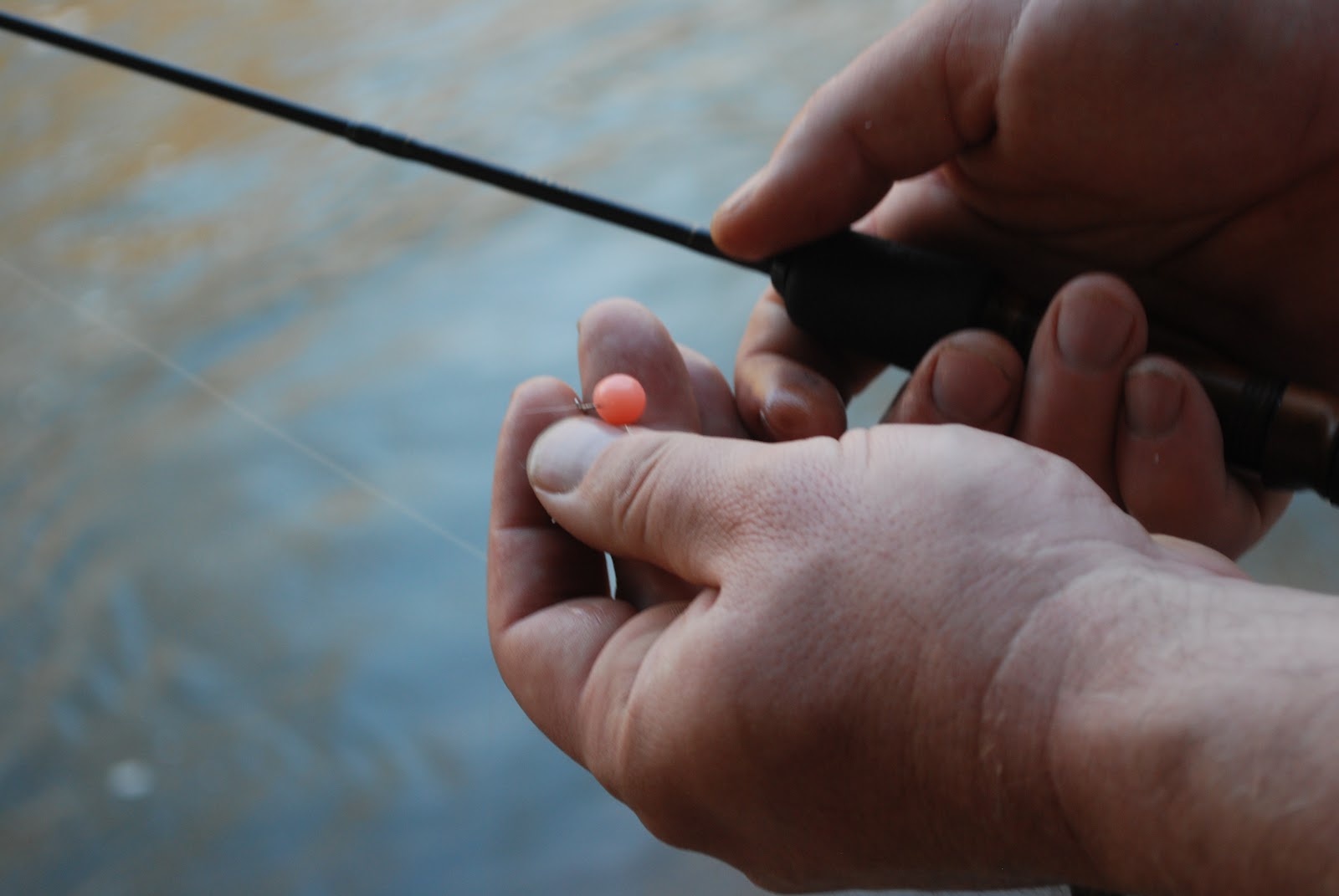
For recently stocked rainbow trout, nothing beats salmon eggs. If trout have been in a stream weeks or months, it's time to fly fish. But for the April weeks rainbows get stocked, fishing salmon eggs properly is a challenging, exciting, and rewarding exercise. Plenty of trout may be caught, but probably many more hits missed. Rainbows and salmon eggs are like sheepshead and sand fleas--both species bait stealers par excellence. But a salmon egg placed on a size 14 snelled hook (doesn't have to be a gold salmon egg hook) on two-pound test leader attached to a small snap tied to two-pound test spooled on the tiniest spinning reel you can find, seated on the shortest. lightest rod you have searched out, is game, no doubt about this; this is fun and something you will never feel you have mastered.

With my three-foot, six-inch ultra, ultra light rod I cast a single salmon egg with only a small snap for additional weight halfway across the North Branch Raritan. Compare the butt thickness to my thumb in the photo above. It is quite thin, thinner than the diameter of a salmon egg. The tip is so light I can bend it to the rod shaft. When I hook up, the fight of a ten-incher is strong and drag-screeching; it takes a while to bring the trout alongside my waders. I once landed an 18 1/2-inch brookie on this rod, foul hooked in the back near the tail. And you know how a fish advantaged like that fights.

Brookies take salmon eggs, but not as unhesitatingly as do rainbows.

For either fish, you need to practice, practice, practice at getting the eggs to drift right. (You will never hook every trout that striikes.) In deep, fast moving water you need to use some split shot or cylindrical weight such as the Boss Tin Stylers or Stix. But most situations call only for a snap; some demand that you add a piece or two of the swivels attached to the snaps, which you cut off from the snaps with nail clippers, only the snap leftover remaining whole. I keep what I cut by running a baby pin through the remaining loop of each swivel, then pin my vest. It's a small detail, but such a subtle difference--which gets a salmon egg in range of trout at the bottom of a faster moving run--can mean a fish or not.

http://littonsfishinglines.blogspot.com/2015/02/super-ultra-light-salmon-egg-spinning.html takes you to a more comprehensive article on the method. 


/


Thursday, March 15, 2012

Pike Fishing Tips Early Season in New Jersey

Notice the big rod. This was my first open water pike caught six years ago at Spruce Run Reservoir, a nice fish, but all that power in an eight-foot rod unnecessary to catch it. Thanks to a little experimentation since then, and Manny Luftglass's persuasions in his Fisherman articles, I now use medium-power spinning tackle with six-pound test monofilament. To catch a pike over 15 pounds in New Jersey is a rare event. I've fished for them late March to May 1st persistently for six years now and haven't caught any over nine pounds. I usually bring guests along with my son, too.

Where

Pike spawn shortly after ice out. They get caught in the shallows of Spruce Run as early as February, led into shallows by spawning urges, though all the information I've gleaned indicates they don't actually succeed at spawning in New Jersey. They do, however, seek out residual vegetation in very shallow water near the mouths of waterways. In Spruce Run, for example, this gives you five options, all of which are accessible by foot, some more easily than others. Even in rivers such as the Passaic, pike will seek the mouth of the little creek in Verona, for example, and even enter that creek to swim upstream. For reasons I don't understand, pike stick around these areas long after they would have spawned until about May 1st, so long as a major heat wave does not drive water temperatures through and out of the 50's.

Method

Pike eagerly hit spinnerbaits, minnow plugs, crankbaits once the water temperature hits 50, and may strike such lures in colder water. The best bet for water colder than the upper 40's, in my opinion, is the Rapala Husky Jerk because it suspends, which means you can retrieve it ultra slow, allow for pauses, and possibly provoke strikes no matter how cold the water. Pike are caught in shallows of four to six feet or so under ice, so cold open water invites the use of this lure. But nothing beats a large shiner for cold water and I like to use them even in 50 degree water for pike at Spruce Run. Large shiners allow longer casts; they also have more presence in the water, more appeal from longer distance.

I use a barrel swivel to separate line from a15-pound test flourocarbon leader. A size 6 plain shank hook is all I need, because I set the hook quickly so a fish doesn't swallow it. The shiner makes its way to bottom poking about on its own while I slowly help it cover the range of a retrieve, this known as live-lining. Often you'll feel the strike only as a tug. Swing the rod in the direction of the pike to allow a quick run. The pike will stop after running about five yards to turn the minnow headfirst into its maw. Don't wait long to set the hook so that healthy release is possible. 

With kids along, setting bobbers may make sense. My son is very proficient with retrieves and lures; he's been fishing since age two. But he prefers to set a bobber for pike. The jetty at Van Syckle Road, for example, is actually a lot of area to cover live-lining. While you do, you can set a bobber for yourself as well, and never get so far from it as to not to be unable to check on occasion.


Monday, March 12, 2012

Early Season Largemouth Bass Fishing Tips

Here in New Jersey largemouth bass can be caught on the surface with 2 1/2-inch Rebel Minnow plugs, which sit at a slight angle on a calm surface, twitched very slightly so the rear rises and lowers in water warmer than 47 degrees that isn't cooling. It may or may not happen, but has happened for me in ponds recently iced out while Lake Hopatcong still hosted ice fishermen, particularly in northeast corners of these waters that warm best. Of course, this year we had almost no ice. And with afternoon temperatures sustained in the 70's, a balsa Rapala would probably work now with its tighter action, straight surface posture, and fast rise to the top when jerked under and paused so it floats.

Spinnerbaits are great now. I like the Strike King Mini King in ponds. The small profile just seems to suit the time of year when bass may be reluctant to react as they will react soon. I've caught plenty of bass over two pounds on these eighth-ounce lures. In-line spinners buzz right by whatever bass are staging towards the shallows; a medium retrieve can draw them to follow and overcome those vibrating blades.

Even with another cold snap bass can be caught. I used to catch bass with water temperatures in the mid-40's or colder by slowly retrieving a Johnson Beetle Spin right on the bottom, the blade barely turning--ticking is the word for it. Largemouths will hit tube jigs dead sticked for up to half a minute before subtly moved forward. Sometimes the slightest twitches set those tentacles to just the right motion to entice a take.

New Jersey early season largemouth always gets underway in ponds first, since they warm first. If Lake Hopatcong is 46 degrees, a pond may be 10 degrees warmer. It's essentially the same wherever chilly springs feature the new season.


Sunday, March 11, 2012

Fly Fishing New Jersey Trout Before the Bell

Today's trip to the Pequest River reminded us both, my son and I, of the Salmon River near Pulaski, New York, because the lot at the Trout Conservation Area just off Route 46 filled.

Temperatures in the 60's made for a great afternoon. Everyone I spoke to appreciated the warmth and some of them caught trout on nymphs, all of these fish released. I did manage to turn a fairly good-size brown, about 13 inches, on a zebra midge, missing the strike. Much larger trout frequent the river and get caught on occasion, and while of course we had such fish in mind, we didn't expect any, since our experience with this river before we stepped in was nil. For a river experienced fly fishermen can depend on for action before closing in anticipation of Opening Day, it's beautifully marked by boulders and deep pockets between, by bank cuts, holes, and stretches that can occupy you for hours if you like.

We spent at least a half hour plumbing a long stretch far downstream of where we parked, along with another angler fishing a Hare's Ear. We got involved in conversation, during which he claimed to have once caught a 10-pound brown right where he stood as evening approached.

After he spoke of this fish, I just savored a long moment, cast and relaxed before we would head back to the car, having to drive nearly an hour back home, reflecting on all the things a day away from more narrow routines inspires.   

I'm a novice fly angler and so is my son. I can catch dozens of stocked trout on salmon eggs, fathead minnows (brown trout), or spinners,  and for the salmon eggs I use a 3 1/2-foot super ultra-light with a tip so light it can seemingly almost be tied in a knot. Two-pound test carries no more than a small barrel swivel for weight. It takes skill. Trout steal salmon eggs like blackfish chop pealer crabs off a hook, or sheepshead remove sand fleas with teeth that look exactly human on a small scale. Whether or not I continue fishing this method I first adopted at age 14 is yet to be seen.


This angler captures a 16-inch brown he released


Zebra midge, I believe size 20
Something hatched a little, don't know what

Saturday, March 3, 2012

Early Season Vertical Jigging Walleyes & Striper Hybrids: Slow Passes Over Drop-Offs, Thought of Mild Winter on Salmon River

So two posts in one day isn't too much after all. Thought I would put a picture of my son with a Lake Hopatcong walleye, actually from October, to grace my word rambling since quite a few are being caught vertical jigged now--hybrids too. But with the wind forecasted for this afternoon, drifts wouldn't be very good, as slow passes over the point drop offs are what you need.

That's why I reluctantly--still reluctant!--have cancelled on the Pequest today. Fly casting in 30-mph wind is annoying at the least. This despite my hunch that these winds won't happen. Maybe 10, 15 mph. But I just don't trust my intuition enough to go ahead and do it against what the weather forecasters are posting. I can't know I'm right. I can't know they are, of course. But some probability exists that ferocious winds will churn through the little Pequest valley, and I don't want to be there in that, not when we can probably go either Saturday or Sunday next weekend.

We better. I've had it in mind to fish the Pequest since December. I'm kicking myself. 

One Saturday back around the first of the year was calm 65 degrees. There I was walking the dog late in the afternoon when I realized what an ass I was for not having gone. I hadn't even recognized the possibility until that late in the day.

This winter was surely a great one for Salmon River steelhead drift boat anglers, fly rodders and noodle rodders alike. Joe at Steelhead Lodge told me they normally have 20 feet of snow by sometime in February. Meanwhile, he has guests throughout the winter, going downriver to fish eight-hour stints at zero degrees. Yes, of course these boats have propane heaters, most of the heat whisked away by breezes. That fishing is so hardcore--it seems easy to ice fish by comparison because hardwater is a stable environment that allows you to manage better in general--that even I balk at ever doing it, even though I used to clam for a living (and most of all adventure), daily, treading in wetsuits brine as cold as 29 degrees with wind chills below zero. 

Anyhow, I wonder how much snow is up there this winter.


P.S. It's almost 2:00 pm and guess what? Yup, the wind is 10 mph, and now forecasted to be 15-20 mph. I bet it never sustains itself over 15 and should I have been a weather forecaster? NO! Because the training in all the models in rooms and routines sealed off from--weather--would have ruined my intuition. And you can't get a job by intuition.